
Participatory
Democracy
Original: /en/e-journal/20040616/index.shtml
| Association for Participatory Democracy | Print version. Published on www.e-democracy.md Original: /en/e-journal/20040616/index.shtml |
Activity of public institutions
1.1. Debates
During the June 3 session, Parliament fiercely debated on the outcomes of the administrative-territorial division in rayons. Senior Deputy Prime Minister Vasile Iovv that reported on the issue mentioned that both economic growth and GDP growth, surge in volume of exported goods, as well as gas supplied to numerous localities were the concrete outcomes of the administrative-territorial reform. Opposition deputies viewed the revision of local public administration system as an anti-reform, they argued that the money spent on its enforcement were unjustly high as the reform failed to bring local government closer to people. In this respect, they cited many problems related to limiting the number of local officials, financial dependence of administrative-territorial units on central government and rayon authorities, politicization of administration structures, lack of material resources, etc.
1.2. Legal acts
Law on Establishing Insolvency Procedure for Financial Institutions provides some exemptions from the Law on Insolvency, thereby insolvency procedures against certain financial institutions started until February 15, 2002 shall be undertaken in compliance with the law in force at the time the procedures were started. The reason for passing the law was the fact that throughout 1996- 2002 National Bank withdrew a number of licenses to financial institutions and appointed ex officio administrators to oversee liquidation procedures. Due to the fact that insolvency procedures continued even after the enforcement of the new Law on Insolvency it was necessary to provide for their settlement under the previous legal provisions.
Noteworthy, on November 14, 2001 Parliament passed the Law on Insolvency, thus abrogating the Law no. 786-XIII of March 26, 1996 on Bankruptcy and the Law on Restructuring Enterprises no. 958-XIII of July 19, 1996.
Law on Deducting the Amounts Wired to the Fund for Guaranteeing Bank Deposits provides that financial institutions that contribute to the Fund for guaranteeing bank deposits, shall be allowed to deduct the obligatory contributions set by the Law on Guaranteeing Natural Entities Bank Deposits in the Banking System.
Via the Law on canceling the penalties and sanctions incurred but not paid by "Fabrica de brinzeturi din Leova" Parliament cancelled the penalties and sanctions due by the Leova Cheese Factory to the state social insurance budget, amounting to 1.2 million Lei. The state had to intervene as the company failed to pay back the credit, due to the fact that the major suppliers of raw material disappeared from the market.
The adoption of the Law on Amending Article 49 of the Fiscal Code, proposed by the President, is seen as an important step towards supporting small businesses. It provides for full exemption from income tax, over three years, of the following economic agents:
The income tax exemption will not apply on economic agents who hold a dominant position in the market; whose social capital has a share of more than 35% shareholders who are not small business agents; producers and importers of goods subject to excises; investment funds; banks, etc.
The right to be exempted from the income tax will be granted upon the conclusion by the economic agent concludes of a special agreement with the State Fiscal Service, and the term for granting the exemption will not depend on the fact whether the agent obtained income subject to taxation or whether the agent suffered losses during the period for which the exemption was obtained.
Via the Law on the Ratification of some International Acts in the Field of Telecommunications the following has been ratified: The Instrument for the Modification of the Convention of the International Telecommunications Union (ITU) and the Instrument for the Modification of the By Laws of the International Telecommunications Union. The amendments operated to these two acts were adopted at the Plenipotentiary Conference of the ITU in 2002, and relate to the following: selection and activity of ITU leadership bodies, access to plenipotentiary conferences, radio telecommunications conferences and assemblies, world conferences on standardisation in telecommunications and conferences on developments in telecommunications, etc.
Also was adopted the Law on the Ratification of the Decision of the Council of Heads of States of the CIS. This law ratified the Decision of the Council of CIS Heads of States adopted in 2003 on changes to the CIS Statute, which included the introduction of the principle of alphabetical rotation for chairing the CIS bodies (Council of Heads of States, Heads of Governments, and Foreign Ministers).
(For further details on Parliament activity see http://www.e-democracy.md/en/comments/legislative/)
2.1. Reshuffles
On June 2, Government appointed Iurie Tabirta as Director of the National Agency for Regulations in Telecommunications and IT, Ilie Boian as Deputy Minister of Environment and Natural Resources, and Valeriu Renita (former press secretary of the Presidency) as General Director of the State Information Agency "Moldpres".
On 9 June, Messrs Mircea Grigorev and Ghenadie Muntean were substituted by Andrei Ivancov and Nicolae Chitoroaga in the positions of deputy directors of the Centre for the Fight of Economic Crimes and Corruption. At the same Government meeting, Eugenia Gonciar was appointed Head of Division on Personnel Policy of the State Chancellery.
2.2. Decisions
At the same time the Cabinet rejected the proposal from the People's Christian Democratic Party to modify the Electoral Code, whereby the voting ballots to be filled in would have a detachable coupon on which the voter would enter his/her name and identity card number. The cabinet also rejected another legislative initiative from the same party which proposed to organise elections for the President of Moldova two months after the expiration of mandate of the president in office. This proposal was intended to avoid the possibility of the head of state being elected twice by the same composition of the legislative body.
3.1. Stability and Security Pact for the Republic of Moldova
On 1 June 2004 President Vladimir Voronin summoned a meeting of foreign ambassadors accredited in Chisinau, to which he proposed a Stability and Security Pact for the Republic of Moldova. At the start of his address, the Head of State enumerated a number of actions taken by the Moldovan authorities with a view to create "an area of stability, transparency and security, an area which is of interest both to Moldova's direct neighbours - Romania and Ukraine, and indirect neighbours - the European Union, the US and the Russian Federation", and called upon the states and organisations in question to support the proposed Pact. President Voronin reiterated Moldova's commitment to the principle of "strategic neutrality" and stressed that Moldova "advances on its road to European integration and at the same time maintains an efficient and functional system of bilateral and multilateral relations within the CIS". In the same context, Voronin stressed that "any attempt to break this natural balance, including to give up the principles of poly-ethnicity and the ones of a federal solution of the Transmission conflict may provoke crises and stagnation".
Expressing his full confidence that "an open and coordinated position of Romania, Ukraine, the European Union, the US and the Russian Federation in a number of major issues related to Moldova may constitute the cornerstone of long term stability in this area", President Voronin called upon the said actors to seek a multilateral compromise on the following issues:
The Moldovan President proposed that this multilateral compromise be reached in the result of a political conference of the heads of foreign affairs departments of the states and organisations concerned and that the Pact has the status of a document of international law. The text of the draft was sent to these states and organisations for consideration. Some of the first reactions to the presidential initiative have denoted a certain degree of confusion (Romania), whereas others have implied that the idea of such a pact is interesting (US, Poland) and even deserves to be supported (Slovenia).
Despite the numerous criticisms to the initiative by the parliamentary opposition, extra parliamentary parties and mass media and civil society representatives - criticisms that invoke the electoral context in which this initiative has been made, as well as its subversive and extravagant character, the will of the current government to undermine the natural course towards European integration of Moldova, and the defiant attitude towards Moldova's main partners - Vladimir Voronin reaffirmed, at last week's meeting with the group of ambassadors accredited at the OSCE on a visit to Chisinau, that the signature of the pact will have positive implications for the development of Moldova.
3.2. Legislative proposals
As a follow up to the presidential decree of 19 March 2004 on the creation of the informational society in the Republic of Moldova, as well as the promises made to the International Conference "BIT +", Vladimir Voronin submitted to Parliament, as a legislative initiative, the draft law on the electronic document and the digital signature. According to the press service of the Presidency, the draft provides for the legal conditions for the utilisation of the electronic document and the digital signature, and establishes the mechanism for guaranteeing, through special cryptographic methods, the security of this type of signature used in the process of electronic circulation of documents.
Another draft law submitted to Parliament for consideration by the Head of State has been the one on micro-finance organisations. The document was developed with a view to implement the State Programme for the support of small businesses in 2002-2005, and is regarded as likely to contribute to the creation of the legal framework necessary for the founding and functioning of micro-finance institutions in Moldova, the development of micro-finance market and the provision of some legal and political guarantees for the foreign investors. According to the Presidential press service, the major objective of this draft is to increase access of small businesses and population to financial resources.
1. 26 OSCE Ambassadors visit Chisinau
A delegation made up of 26 ambassadors accredited at the OSCE in Vienna, including the US, the Russian and the Irish Ambassadors, visited Moldova on 9-12 June. This was a documentation visit, during which the ambassadors wanted to familiarise themselves with the issue of the Transnistrian conflict resolution.
The programme of the visit included meetings with President Vladimir Voronin, the Minister of Foreign Affairs Andrei Stratan and the Minister of Reintegration Vasile Sova, as well as a meeting with representatives of political parties and civil society organisations. The delegation also visited Transnistria where it met with members of the break away administration.
The US Ambassador at the Permanent Council of the OSCE Stephan Minikes told a press conference organised in Chisinau at the end of the visit that, in the opinion of the US Administration, the Russian Federation has plenty of leverages to determine the Transnistrians to unblock the process of withdrawal of Russian weapons from the region. Minikes expressed on behalf of his colleagues from the delegation the OSCE's concerns regarding the halt in this process and reiterated that the commitments taken by Russia at the OSCE summit in Istanbul in 1999, including the one to withdraw its troops from Moldova, may not be dissociated from the adapted Treaty on Conventional Forces in Europe. In this context, Minikes mentioned that the withdrawal of Russian troops and weapons from Transnistria is an essential precondition for the ratification of the treaty by the NATO Member States.
Presenting the conclusions of visit to Moldova of the members of the OSCE Delegation, the head of the delegation, Ivo Petrov, Bulgarian Ambassador at the OSCE, called abnormal the current situation at the eastern border of Moldova. He said that the Bulgarian Chairmanship of the OSCE will intensify its efforts with a view to identify as soon as possible a final solution for the Transnistrian conflict, and underlined that the Bulgarian diplomacy believes that the political plan developed by the mediators under the OSCE aegis last year is a very good basis for this.
2. President Voronin proposes international monitoring at eastern borders
In his address to the International Conference "Building Security Along Frontiers: the Role of the OSCE", held on 10 June in Slovenia, the Moldovan President Vladimir Voronin pleaded for the institution, under the OSCE aegis and with the EU support of an international mission for monitoring the eastern border of the Republic of Moldova. According to a communique by the Presidential Press Service, Voronin said that that such a monitoring mission on the Transnistrian segment of the Moldovan-Ukrainian border would constitute "a good example of applying into practice the experience of European states in the field of border management" as well as "an example of successful cooperation between the EU and the OSCE in this field".
President's Voronin plea comes after almost two years of unsuccessful talks with the Ukrainian authorities to ensure an efficient control at the Eastern border of Moldova. According to some statements made by President Kuchma though, Ukraine is not interested to introduce tight controls over its border with Transnistria because most of the external trade of the latter is being done through the Ukrainian ports of Odessa and Il'ychev, which fact brings Ukraine enormous financial revenues.
3. Political detainee Alexandru Lesco released after serving full sentence
On 2 June the political detainee of the Transnistrian regime Alexandu Lesco was released from the Tiraspol jail after the expiration of his detention term to which he was sentenced in 1992 together with other members of the "Ilascu Group". After the release, Lesco made a brief statement for the press in which he said that he did not recognise his sentence and that he hoped that he and his other mates from the "Ilascu Group" will be rehabilitated by the European Court for Human Rights (ECHR) in Strasbourg. Notably, although the release of Lesco had been announced by the Transnistrian authorities beforehand, no Moldovan official came to meet him and the car in which he was driven from Tiraspol to Chisinau was not escorted by the police.
After the release of Alexandru Lesco and earlier of Ilie Ilascu, in the Tiraspol jail are still detained Tudor Petrov-Popa and Andrei Ivantoc. These, together with lesco and Ilascu started a case at the ECHR against the Republic of Moldova and the Russian Federation which they have accused of flagrant violations of human rights.
1. The Republic of Moldova-EU Action Plan
On 4 June, two months and a half later than initially planned, the third, final round of talks on the Republic of Moldova-EU Action Plan was concluded in Chisinau. According to the Media Division of the Ministry of Foreign Affairs, consultations were held in four working groups: "Political dialogue and regional cooperation", "Economic development", "Infrastructure, education and the environment" and "Justice and home affairs".
According to the same source, "on 15 June 2004, during which period the political aspects of the Plan will continue to be considered in Brussels, the European experts will forward to Chisinau the written agreements reached", so that the document is officially approved at a later stage.
Until now little information has been disclosed regarding the contents of the document. This is due to the relatively poor coverage in the media of the character and contents of talks carried out, which fact speaks for limited transparency on behalf of the Moldovan authorities in this subject and/or the for the fact that the subject of the Moldova-EU Action Plan is not one of particular interest to the local press.
2. Moldovan-Slovene Relations
On 9-10 June, a delegation of Moldovan dignitaries, headed by President Vladimir Voronin, paid an official visit to Slovenia. During the visit, the Moldovan President had meetings with his Slovene counterpart, Janez Drnovsek, the Slovene Prime Minister, Anton Rop, the Speakers of both chambers of the Slovene Parliament, Borut Pahor and Janez Susnik, and the mayor of Ljubljana, Danica Simsic.
Most Slovene officials ensured the Moldovan delegation that Slovenia will support Moldova's efforts at European integration, as well as those channelled towards the resolution of the Transnistrian conflict, all the more so that in 2005 Slovenia will hold for half a year the chairmanship of the OSCE.
The reunion in plenum of the Moldovan and Slovenian delegations was followed by the signature by the two Foreign Ministers of the Agreement on Developing Cooperation between the Moldovan and Slovene Governments.
Employment is the Key Issue
Galina Selari
However, the key question - employment has remained in the shadow.
The problem of labour resources use remains very acute and that why it should be solved urgent.
Economic transformations and changes in ownership structure resulted in changes in labour relations and employment sphere. During the first phase of economic reforms the response of Moldovan labour market to sharp decrease in industrial output appeared as average wage cut but not as release labour. So, as compared with 1990, in 1996 the GDP dropped by 63%, amount of wage - by 80%, but the number of employed population - by 20% only. At the same time the king-size shadow economy was created and the unconcealed shadow employment without any legal background or labour contract was in blossom.
The fact that economic growth occurred in Moldova during the recent years came to 6-% on annual average has had no evident positive influence on labour market. It is a pity, but economic growth can't eliminate all social deformations by itself and to belief that it can make this is no more than illusion. And such illusions should be disappeared.
In fact, the sizable increase of production had not resulted in job growth but even more the number of employed persons slightly decreased and the number of unemployed went up.
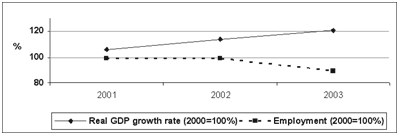
But for all that even an employed person could be considered as semi-employed: in 2003 the average monthly wage size was only 34% above the minimum subsistence or enough to cover nearly 70% of minimal consumer budget.
Within certain limits this could be explained by underemployment: those who worked less than full time or are in unpaid vocation (about 5-6% of total employment) and those who work full time, but both the work and income is shared, i.e. ineffective use of labour force.
The shadow employment still exists either. It simply adjusted to new realities: now we have legal labour contracts, but often they have a formal character and as before based on the principle - "as we will agree".
Such marginal forms of relations at the labour market have become rather stable. And, strictly speaking, there is no reason to believe that they will ever be eliminated in the foreseeable future.
It appears that this is exactly the price our market has paid over the decade of not-so-consequent reforms.
And here is another illusion: everything depends on investments; once funds are invested into economy, we will succeed in everything, the growth will become sustainable and the universal revival will begin, as well as all other kinds of grace.
There is no doubt that we need investments - labour force follows the production capital flow. And Moldova has been a visual proof of this during all last years. Almost every third family has now its "representative" abroad. In 2003, circa 280 thou of our compatriots worked abroad earning their living (Household Budget Survey data). Naturally, a gradual mental re-evaluation takes place: "work to live" rather than "live to work".
And a question arises - whether our labour market is ready for the investments inflow? There is no simple answer, unfortunately. A phenomenon has formed: stable unemployment coexists with the labor force deficit. Say, there is an excess of managers and jurists, while metalworkers and turners are needed. It turns out that workers of specific professions, specific qualification, specific skills are needed, rather than just workers. And the current labour market often falls behind the real needs of the economy.
The demographic forecasts are also distressing. It looks like 2003 was the last year of the population growth and the absolute number of persons able to work will decrease in the future. In 2010 labour resource growth will make up no more than 9 thou persons and in 2015 the negative growth is expected of 20 thou persons at least (the calculations are very approximate as the last population census was conducted in 1989). One could supplement this with the loss of workers from prolonged unemployment: a person loses qualification after about a year of involuntary idleness and unsuccessful search for work (now, the average period of unemployment in the country is 23 months). Moreover, there is an acute lack of persons who know to work in a workmanlike manner. The reason is obvious: neither employers, nor workers are ready for the full-fledged market relations.
A conclusion arises: the labour market is not ready for investments. Moreover, it is - in a certain sense - a hindrance to activization of investment processes. And if the market is not ready for investments, it is possible that they will not happen or will not yield the expected result.
What can and should the state do under such difficult conditions/ firstly, it should elaborate a complex programme of actions in the socio-labour sphere - a labour market concept and measures of its implementation, i.e. create an effective and civilized labour market in Moldova, which would operatively supply employers with the labour force of required qualification and workers - with the work and adequate wage.
So, with solving employment problem we will achieve both most important our goals: sustainable economic growth and poverty reduction.
Mass-media in Moldova
Igor Botan
There is a clear distinction in the Republic of Moldova, at least in the legal framework, between public versus state-run media. Things are quite different in audio-visual and printed media. And this because audiovisual plays a far more important role in informing public opinion than the written press, which has placed it in the center of domestic public opinion's and international organizations' attention.. Therefore, in 1994 Council of Europe recommended the New Independent States to turn radio and television into public broadcasters. Moldovan governors at that time complied with the said recommendations at least in formality. Parliament passed the Law on Audiovisual (no. 603-XIII of 03.10.95) Article 7(1) providing that "Teleradio-Moldova State Company is a public audiovisual institution which may not be privatized".
Article 1 of the Law on Audiovisual defines the notion of "public audio-visual as institution established on state capital or with the state as the major shareholder and other public or private capital, that is independent in its editorial activity and is covering the interests of all social strata" and "private audio-visual institution as institution established solely on private capital or majority private capital, covering the interests of one person or a group of persons". Therefore, one may conclude that in Moldova state-run broadcaster may not exist in principle.
Still, nothing changed with the adoption of the new Law no. 1320-XV on Teleradio-Moldova National Public Institution of Audiovisual on 26.07.2002. Although supposedly both state radio and TV should have become "public broadcasters" back in 1995, in reality, though, with some minor exceptions they served parties in power.
As for the printed media, things are totally different here. International organizations have not wielded heavy pressure on Moldovan governors to turn state-ran newspapers into public ones. This does not mean that the issue is off the agenda. As a rule, parties or personalities in power advocate for the state-run media. They are supported by journalists working in those media outlets. On the other hand, opposition parties plead for shutting down the press services of the public institutions, on the grounds they serve as propaganda instruments in the hands of ruling party and feed on public money.
In this respect it is worth considering the evolution of "Moldova Suverana" (Sovereign Moldova) or "Nezavisimaia Moldova" (Independent Moldova) newspapers founded by Government. Half a year prior to the declaration of independence of the Republic of Moldova, the Law on Publishing and Enforcement of the Laws of the Soviet Socialist Republic of Moldova was passed (no.497 of 15.02.1991) providing that the laws passed by the Supreme Soviet (Parliament) are enforced once published in the "Sfatul Tarii" and "Moldova Suverana" newspapers in Moldovan and Russian. On 2.09.91 Parliament Presidium decided (Resolution no. 699-XII) to found "Nezavisimaia Moldova" published in Russian. Via Resolution no. 739-XII of 09.10.91 on the temporary status of publications, Parliament decided the Editor-in-chief to be appointed by the Parliament, the cost of the publication to be covered from the state budget, while the publication was to: objectively cover on political, economic, social life, events in the country and abroad, Parliament, Presidency and Government activity.
Later on, under Government Resolution no.18 of 17.01.1992 decisions of the Government were to be published in Romanian and Russian in the "Parliament Monitor", "Moldova Suverana" and "Nezavisimaia Moldova". At that time there were enough reasons for keeping state-run newspapers, given that "Supreme Soviet Monitor" was published only once a month, while some legal acts required immediate enforcement.
Further evolution of the state-run media is not less interesting. On 01.04.1994 the Resolution no.31-XIII excluded "Sfatul Tarii" and "Nezavisimaia Moldova" newspapers from the Parliament subordination, while Government was entrusted to outline principle of their activity. Therefore, Government passed two resolutions (no. 305 of 17.05.1994 and no.372 of 1.06.1994) establishing Government press bodies "Moldova Suverana" and "Nezavismaia Moldova" respectively. The regulations were in force until the adoption of the Law on Press (no.234-XIII of 26.10.94), according to which Government passed another two resolutions (no.365 of 5.06.95 and no.390 of 9.06.95) adopting the new Regulations of "Moldova Suverana" and "Nezavisimaia Moldova", which are still in force. Those new Regulations did not oblige the two state newspapers to publish normative acts, as at that time "Monitorul Oficial" took over this function. Therefore the very "reson d'etre" of the state-media has vanished. Nevertheless it is still very much alive.
It is worth shedding some light on the 1994 resolution transferring the two newspapers from Parliament into Government subordination. The only explanation to this is the Agrarian Democratic Party landslide victory in the parliamentary elections of February 28, 1994. Moreover, Prime-Minister and Parliament Speaker ran on the Agrarian party list, which was also backed up by the President. They probably figured out that the aforesaid newspapers would serve their interests anyway. Back then they could not even imagine that in a year or two, the three of them would become political foes and would fiercely compete against each other in the 1996 presidential race.
The editorial independence granted by the Law on Press prohibiting any "interference in editorial activity" and guaranteeing "accurate information" amidst "political pluralism", etc wiped off any difference between state-run and public media, except for appointing their leadership. Both state-run and private media have to follow the same principles of accurate, objective and unbiased information of citizens, thereby halting any attempt to turn them into propaganda tools in the hands of authorities, which hand them public money. Sadly enough, this has not been the case of "public" audio-visual, nor of state-run printed media, which is quite obvious during election campaigns.
2. State media in elections
Heavy bias in electoral campaign has brought to light various aspects of state-run media. The most convincing evidences to this effect are the official documents. Since the first multi-party elections in 1994 there have been numerous references to the violations of the regulations on election coverage in favor of the ruling party both in OSCE reports and CEC documents. This holds true both for written press and Teleradio-Moldova.
Yet another evidence is that whenever a conflict arouse between state moguls, as was the case throughout 1995 - 2000, some of the state-run media was taking sides.
a) 1996 presidential election campaign. November Presidential elections were quite illustrative in this sense. Back then state TV and "Nezavisimaia Moldova" was biased in favor of Parliament Chair Petru Lucinschi, who ultimately won the elections; whereas "Moldova Suverana" was biased in favor of Prime-Minister Andrei Sangheli; fact confirmed in the OSCE report. Let us consider some of the details that may shed some light. In 1996 CEC invited editors of state-run media and Director of the National TV to one of its session to draw their attention to violations of the regulations on election coverage and their heavy bias. The funny thing is that "Moldova Suverana" Editor-in-chief was quite annoyed by the fact that party media outlets were allowed to be biased in favor of their candidates, whereas state-run media was denied the right to do so for its candidate, i.e. Prime-Minister. He pretended not to realize that Prime Minister Andrei Sangheli was running as Agrarian party candidate and not as Government candidate.
Not less curious was the case of "Nezavisimaia Moldova". Back then a group of experts from Dusseldorf Media Institute visited Moldova on a monitoring mission and produced a report on the heavy bias of the state-run media, including "Nezavisimaia Moldova" favoring Parliament Chair Petru Lucinschi. In his editorial, Editor-in-chief of the latter refuted all the allegations of bias and blamed international experts of lack of professionalism. However in a couple of days his cynicism triumphed, when in another editorial on December 2, 1996 he was congratulating supporters of the winner and himself personally for contributing to Petru Lucinschi's victory in elections. He cited letters from supporters claiming that the newspaper campaigning accounted for 95% of the victory. Humbly the editor estimated his contribution at a mere 4-5%, precisely what made the difference between the winner and the looser.
Yet another curiosity of the 1996 campaign was the Director of National Radio who was congratulated by all the electoral contestants for the dignity and impartiality showed by his institution, for which he paid dearly by his position. He was probably punished by the winners for not following the example of "Nezavisimaia Moldova".
b) 1998 parliamentary election campaign. After 1996 elections state-run newspapers were propagandizing in favor of Petru Lucinschi who became a President in 1996. As a result both Teleradio-Moldova and state newspapers were mentioned in OSCE report as being biased and favoring "For a Democratic and Prosperous Moldova Bloc", openly supported by President Lucinschi during 1998 parliamentary campaign.
c) 1999 local election campaign. OSCE did not monitor 1999 local elections, however the Congress of Local and Regional Powers of the Council of Europe did. In 1999 "Teleradio-Moldova" was extremely biased favoring Chisinau Mayor, who at that time was supported by President Lucinschi, as well as by Alliance for Democracy and Reforms holding a majority in Parliament. Throughout the campaign Serafim Ureachean was featured in the news practically every night, inaugurating a petrol station or a portion of a road, doing charity, or scolding his employees for their poor performance.
d) 2001 parliamentary election campaign. Curiously, it was for the first time that OSCE report on election monitoring had no objections to state-run TV and Radio, however it did point that written press was biased in favor of "Braghis Alliance", headed by the Prime-Minister at that time. Most importantly, Party of Communists won elections at the time TV and Radio were raising no concerns. Normally, Party of Communists would have wanted to keep or even improve that state of affairs.
e) 2003 local election campaign. On the contrary, once acceding to power Communists took control over audiovisual and printed media, which has drawn the attention of European institutions. The issue was on the PACE agenda that considered in particular the evolution of the public broadcasting in the country. Referring to Moldova, PACE raporteur stated that amendment of the Law on Public Television twice throughout 2003 brought no changes for the better. An evidence to that was the strike committee set at the television, people being unsatisfied with the selection of Observers' Council and company leadership, censorship, investigations against journalists who took part in protest rallies, etc.
Of more relevance is the 2003 OSCE election observation report reading "presentation of distorted data by state-run media, which was heavily biased" throughout the electoral campaign. Moreover, there was a note to the report entitled "Negative trend observed during Moldova's local elections must be reversed", signed by the ODIHR Deputy Director Steven Wagenseil. The OSCE report specifically cited the so-called analytical programs "Argumente" and "Rezonans". Each of the two 45 minutes programs was broadcast weekly throughout the two months of the campaign and was heavily biased in favor of the ruling party and denigrated its political foe, Mayor Urechean received 81% of negative coverage.
According to Article 37(2) of the Law on Audiovisual and electoral law, CEC together with Audiovisual Coordinating Council (ACC) developed the Concept and Regulation on election coverage (CEC resolution no. 2103, respectively no. 2104 of 4.04.2003). Regulation and electoral law provided that public broadcasters should cover elections by observing the principles of objectivity, impartiality and equal chances to electoral contestants. Article 10 of the Regulation specifically stipulated that "Election related programs, regardless of the time of broadcast, shall be differentiated by a signal to separate them from other shows". One of curiosities of the campaign was the CEC resolution no. 2131 of 18.04.2003 a follow-up to an appeal submitted by an electoral contestant regarding the abuses of the state TV, citing an explanatory note by the ACC reading "the author of "Rezonans" show made a presentation of the electoral bloc by using a metaphor. "Rezonans" program is produced by the "Mir" office in the Republic of Moldova and is broadcast by TVM 1 on a contractual basis". First of all, ACC did found that the relevant program was election related, and therefore it should have been broadcast under the "Election" heading in line with Article 7 of the ACC's own Regulation. However, ACC failed to notice that in fact all the "Rezonans" and "Argumente" programs were election related and biased in favor of the ruling party by denigrating its political foes. It was ACC duty to react when it came across the violations of its Regulation and Law on Teleradio-Moldova Company, specifically Article 2 (providing for accurate, comprehensive and impartial coverage of elections by observing the interests of all the parties).
ACC acted as if the provisions of letter g) of Article 4 of the Law on "Teleradio-Moldova" Company (providing company's right to negotiate and sign contracts with other domestic or foreign TV and Radio stations) were an exception from the general rule of impartiality in producing programs. If so, then it is perfect loophole for promoting certain interests. Lets' say that in order to brainwash public opinion those who are in control of Teleradio-Moldova go and sign a contract with any studio that would produce dozens of programs without bothering to be impartial and unbiased as provided by the law. In fact, "Argumente" did the same, albeit it was the product of Teleradio-Moldova. As a result, in the last elections, Communists enjoyed at least 15 hours additional free air-time for propaganda and denigration of its foes. ACC failed also to notice that the leader of the Association for the Consumer Rights' Protection, who was not a candidate, was allowed by the public broadcaster to invite the counter candidate of the Communist representative to the debates. Thus, on the eve of elections a 1.5 hours show denigrating an electoral contestant was broadcast twice and this without "Election" bearing. Even if much of what he did say was true, the way those facts were presented was a pure manipulation. It would have been normal for the debates to be held between the candidates. Thus, in 2003 Serafim Urechean had a chance to see the other side of the medal, different from the abusive support he enjoyed in 1999 elections.
Of special interest is the ACC's adherence to principles once electoral campaign was over, when it suspended the license of municipal TV and Radio, which according to OSCE report also violated electoral laws during 2003 elections, on the grounds of irregularities found in their statutes. Municipal stations' abuses - bias in favor of incumbent Chisinau Mayor Serafim Urechean - had paltry against the aforesaid ones, given the fewer air time and smaller coverage. One may perfectly understand that what they did was a mere response to Teleradio-Moldova's abuse, still it is not an excuse for what they did.
Still, according to OSCE and Council of Europe the disorders found in the two municipal stations' documents after elections, were not enough grounds for suspending their licenses for two months. What is striking is that in this case ACC did follow on the violations found, in contrast to electoral campaign when it did not follow on the violations by Teleradio-Moldova pointed by OSCE, which it had chosen to neglect. Clearly, selective adherence to principles in fact stands for the lack thereof. Otherwise, ACC should have become the main promoter of the document produced by OSCE and Council of Europe  "Benchmarks for the operation of public broadcasters in Moldova", inspired from the experience of similar institutions in Europe and America. But this did not happen yet.
f) expectations for 2005 parliamentary election campaign. All the aforesaid reveals the morale wavers of the state-run media. It also shows that it didn't evolve much throughout the years and paints a less robust picture for 2005 elections.
Moreover, the breaking news of the day is that on June 4 at the meeting with local public administration (rayon) leadership and rayon media the President entrusted the rayon chiefs to tutor the newspapers founded by local government, to help them procure modern equipment, to decrease the rent, etc. President was aware that the move might be a "violation of the free competition". Apparently, the goal now is to also recruit and arm local media for it to serve the interests of the ruling party.
3. Aftermath of state media
If a foreigner was to regularly read Moldovan state-run media, than he would probably conclude that Moldovan governors are unfailing. They enjoy extremely positive media coverage, they are portrayed as brave, ingenious, and as fighters for the public good. No deviation from this scenario is to be found in state media, no criticism or debates on the governors' initiatives, like what happened to the Social Pact, Permanent Round Table, Presidential Decree on settling Transdnistrian conflict, etc - things mentioned by the President in his initiative to establish a Stability and Security Pact for the Republic of Moldova under international guarantees.
If the media coverage is so celebratory, one might rightly wonder: why than Republic of Moldova is the poorest country in Europe? The answer may be found in the same state media - it is the fault of the ruling party's foes. The latter are featured as malevolent and extremist who thwart all the good initiatives of the ruling party. Predecessors of the incumbent party enjoy similar media coverage, although at the times they were in power, state media was hailing and not denigrating them. The reasonable conclusion is that state-media has been lying then or it is lying now. This way or another, it is in its blood to tell untruth and there are no guarantees that it would stop doing it in the future.
In fact governors are to be blamed for the split and polarization of the society. Governors give the orders to personalize politics, i.e. all the good things come from the unfailing leaders who know exactly what is good and what is wrong and who give precious orders on what is to be done. It is a wide-spread phenomena not only in Moldova. It was described in the article "Amputated Democracy" of the famous researcher and Dean of the London School of Economics, Ralf Dahrendorf, republished in "Der Standart" ("Die amputierte Demokratie") (27.10.2002). The aftermath of such a behavior showed by the governors is that non-governmental media is forced to become an opposition one.
For example, if a foreigner was to read Moldovan independent press he would probably conclude that the only thing Moldovan authorities do is make mistakes and abuses, which of course is an exaggeration. When asked what authorities did well, journalists of independent media outlets usually answer that state-run media overly exaggerates the merits of the governors, consequently the only thing left is to exaggerate their shortcomings so as to strike a balance. This is yet another example as to how state-run media triggers counteractions and pushes independent media into opposition, which in the end is accused of bias and favoring opposition parties. And this is the main reason why Moldovan society is split.
One holds no illusions that once state media is turned into a public broadcaster or the legal framework is improved, state media would have no room for manipulating public opinion. Still, we may only hope that one day we would reach the condition another famous researcher Umberto Eco is complaining in his article "Duke's Eye" "El Pais" (26.01.2004) outlining the mechanisms of manipulating public opinion by means of mass media. Eco concludes that if a dictatorship is possible at all nowadays, then it has to be an informational dictatorship. To at least try to prevent this phenomena the most educated citizens have inevitably to be in opposition to the governors, i.e. trying to get society immune to any kind of manipulation. The example cited is the Italian Prime-Minister's media holding, which apparently complies with the requirements on partial coverage, presenting both "for" and "against" arguments, however the position of the boss is always presented in the end and in such a manner that information recipient ends with opinions favorable to the media mogul. We could only dream to reach such subtleness in Moldova. Here public opinion is shamelessly manipulated in the open.
So far, a solution to creating the minimal conditions for informing the citizens in compliance with the law, would be to enforce the principles aforesaid outlined by OSCE and Council of Europe and oversee their enforcement. These principles should apply both to audio-visual and state-run written press, indeed by taking into account its specifics.
|
© 2001-2015 Association for Participatory Democracy "ADEPT" Reproduction of the materials is welcomed provided the source is indicated | e-mail: [email protected] |