
Participatory
Democracy
Original: /en/e-journal/20041020/index.shtml
| Association for Participatory Democracy | Print version. Published on www.e-democracy.md Original: /en/e-journal/20041020/index.shtml |
Activity of public institutions
1.1. Decisions
During the period covered Parliament convened on two sessions.
During the September 30 session a new Chair of the Central Electoral Commission was approved. Eugen Clim was replaced by Petru Railean as Chair of the CEC. The latter previously hold the position of Chair of the Economic Court; served in the CEC during 1995 local elections, and headed the Commission in 1996 during presidential elections. There are many reasons why a more experienced person was elected to head CEC parliamentary majority seeks to avoid any problems in elections, especially since many international organisations and civil society organisations would closely watch it.
During the same session Parliament accepted the resignation of the Vasile Pentelei Chair of the Court of Accounts, who headed the organisation since 2000. Albeit Mr. Pentelei resigned on his own will, many say he was ousted following the publication of a list of Court's officials who had received plots for construction from Chisinau Mayoralty.
Due to the same scandal, deputy Alexandru Ciugureanu was excluded from the communist faction for "inadequate behaviour and deeds inconsistent with the status of elected official". Mr. Ciugureanu was also in the list of those who got a plot from the Chisinau Municipality for a meagre price.
While busy cleaning the party of "unworthy elements", ruling party did not forgot about opposition. It decided to establish a commission to investigate the legality of the assets in possession of Iurie Rosca, leader of the Christian-Democratic Peoples' Party. In response to Mr. Rosca' explanation that his assets were legal and that he paid taxes on them, new accusations were brought to the effect that he was involved in a money laundry scheme, as reported by Ukraine secret service.
A week later, Parliament heard Minister of Energetics, Iacob Timciuc. He assured the legislature that the heating system was ready for the cold season and that once it got cold it would start operating. Nevertheless, the Minister remained tight lipped on the fate of the indebted apartment blocks whether they would be connected to the heating system or not, and on the eventuality of Russia reducing gas supply and the risks such a move might bring given Moldova's dependence on Gazprom.
1.2. Legal acts
Law on Cancelling Penalties to the State Social Security Budget exempts a number of enterprises that do not have arrears on wage payments and social security fund, from the penalties accrued in the past. The amount of penalties cancelled is worth 1.7 million Lei. As was the case in the past, financial and economic considerations were the reasons for writing-off the debts.
Via the Law on Ratification of International Postal Union's Acts Parliament ratified the Universal Postal Convention, General Regulation of the International Postal Union and Agreement on postal payments. Those acts are aimed at perfecting and bolstering international cooperation in postal communication. Republic of Moldova would enjoy technical assistance to promote and implement new postal technologies in various fields.
According to the Law on Recalculating Pensions, as of November 1, 2004 pensions for age limit, disability, and heir shall be recalculated. The first two will be recalculated by changing the formula. The surplus brought by recalculation should be no less than 25% of the established pension.
Under the law, as of November 1 total pension shall not be less than:
It is estimated that the move would require 490 million Lei.
On the eve of National Wine Holiday celebrated the third year now, deputies passed the Law on Wine Sale during Wine Festival. It enables companies taking part in the exhibit organized as part of the Wine Festival to sell en detail their products without any license being needed.
The Law on Ratification of Memorandum of Understanding between Republic of Moldova and Denmark on Cooperation in view of Enforcing the Depolluted Development Mechanism provided for in the Kyoto Protocol to the United Nations Framework Convention on Climate Change. Under the Memorandum, Republic of Moldova would cooperate with Denmark by trading its emission quotas in exchange for technologies and projects reducing greenhouse gas emissions. In particular, the parties examine the possibility of undertaking projects using gas from waste and gas methane from "Apa-Canal" enterprise to produce electricity. Republic of Moldova joined Kyoto protocol on February 13, 2003.
Law on Privatization of Enterprises to the Left of Dniester and Bender Municipality was initiated by the President of the country. It seeks to prevent illegal alienation of state property in favour of Tiraspol secessionist authorities. Under the law, former and current employees of the enterprises would be entitled to take part in the privation of that particular enterprise. All privatization agreements of enterprises concluded by infringing this law as well as other normative acts of the Republic of Moldova shall be declared null and void. Therefore, the state would be able to guarantee property right on enterprises provided privatization was carried out in line with this law.
Via the Law on Liquidation of the Legislative Centre provisions from the Law on Government were excluded as regards Legislative Centre. The latter was entrusted to draft and endorse legal acts of the Government and Presidency. The Centre was established in 2001. Under the law, its responsibilities were delegated to Ministry of Justice that would be responsible in the future for developing draft laws and draft resolutions of the Government as regards judiciary; provide legal expertise and endorse draft laws and other normative acts; perfect legislation; improve the quality of draft laws, etc.
(For further details on Parliament activity see http://www.e-democracy.md/en/comments/legislative/)
Decisions
In the same resolution Government recommends Chisinau Municipal Council to turn Architecture and Urbanism Department into an autonomous service in the subordination of the State Construction Inspection.
Experts say disputes around land allotment and the arrest of three municipality dignitaries seek to intimidate opposition. In a press release issued on September 28, National Coordinating Council of Democratic Moldova Bloc condemned the "abusive" arrest "fabricated at the order of central government". A number of media outlets have similar opinion quoting in this respect an order issued by the President on July 30 to the Prosecutor General, Head of the Centre for Fighting Economic Crime and Corruption, and other state dignitaries obliging them to "punish persons found guilty of irregularities in the Chisinau Municipality finances over 2003".
Conception outlines the following cross-border cooperation opportunities among Moldova-Romania-Ukraine Euro-regions: establishing a joint informational space on economic potential and business opportunities at the border region; establishing joint structures to facilitate economic cooperation, recognition of goods certification procedures; developing infrastructure in the border area that would facilitate auto, railway, river and maritime transportation; developing a joint strategy to boost tourism in border areas; fostering cooperation between educational institutions in the region; coordinating environmental programs; transfer of know-how and information technology, etc.
According to the Conception, the main goals set for 2004-2006 are: coordinating and adjusting instruments for cross-border cooperation; for the relevant state structures of the Republic of Moldova to prepare and co-ordinate together with partners in euro-regions and international organisations concrete projects in education, infrastructure, research, and investment.
Conception's top priorities are taken from such documents as: Madrid European Convention on Transfrontier Co-operation between Territorial Communities or Authorities, Partnership and Co-operation Agreements, European Commission statements of March and July 2003, Republic of Moldova - EU Action Plan, etc.
As for the Action Plan for enforcing the Conception it includes a raft of measures at the central level as well as for each of the Euro-regions in particular: 1) "Upper Prut", 2) "Low Danube" si 3) "Siret-Prut-Dniester".
Fiscal controls of the economic agents should be conducted in line with the provisions of the Government motion on regulating controls. The latter provides that economic and financial activity of a businesses may be controlled at most once in two years; whereas its technical, technological, sanitary, environmental and labour conditions once a year.
The annex approved via Governmental motion includes 4,449 businesses throughout the country due to be controlled by fiscal bodies (the full list was published in Official Monitor, XI, no. 182-185 (1536-1539) October 8, 2004).
3.1. Decree
President Voronin issued a decree recalling H.E. Mihai Popov from his position as Republic of Moldova Ambassador to Belgium, Luxemburg, United Kingdom and Northern Ireland and Republic of Moldova's representative to NATO and European Commission. The reasons for recall were not disclosed.
3.2. Meeting with Bulgarian President
A Bulgarian delegation headed by President Gheorghi Pirvanov was on official two-day visit to Moldova commencing September 30. During their meeting the two Presidents talked about visa regime, Moldovan-Bulgarian bilateral relations, Transdnistrian conflict and Stability Pact for Moldova. Referring to visa regime, Bulgarian President opted for liberalizing visa regime for Moldovan citizens, and indicated he would urge Bulgarian Government to take actions in this respect. As Bulgaria currently holds OSCE chairmanship and given the deadlock reached in the negotiations on Transdnistrian conflict, Vladimir Voronin talked about revising the negotiation format and replacing current peacekeeping deployment with international stability forces. As for the Stability Pact, President Pirvanov agreed with the document provisions.
3.3. Supreme Security Council session
Last week President Vladimir Voronin attended the session of the Supreme Security Council (SSC). Toping the agenda were safeguarding military patrimony, munitions and arms; preventing and fighting crime among military; as well as intensifying measures aimed at ensuring the legality and security o crossing Republic of Moldova air space.
Taking note of the existing deficiencies, President severely criticized Ministry of Defence and Information and Security Service (ISS). He also demanded a concrete action plan to be developed to prevent abuses and violations of the law among Defence Ministry and National Army and to increase control and security over Republic of Moldova air space. At the end of the session, SSC passed a decision to oust Defence Minister, Victor Gaiciuc, and ISS Deputy Director, Simion Rusu.
1. Foreign investments shun Republic of Moldova
Recently United Nations Conference on Trade and Development released its world investment report on 187 countries. The report made use of new indicators to better reflect on various nations ability to attract and "digest" foreign investments. Republic of Moldova ranks 110th following Ecuador, Mozambique, and Guinea, but has a much better position than Ghana, Sri Lanka and Mali. Last year Moldova ranked 109th out of the 140 countries included in the report.
Foreign direct investments (FDI) in Moldova amounted to 790 million USD at the end of 2003. In 2003 FDI dropped by 50% over 2002, i.e. 58 million USD. One of the most important findings of the report is that total global FDI shot down by 50% in 2003. Republic of Moldova ranks 25th on inward FDI performance indicator, as compared to 18th last year. Nevertheless, Moldova has the best rating for this indicator among CIS countries.
Studies conducted by various international agencies paint a less robust picture than UNCTAD report. According to ERBD, business environment together with relations between state and business, push Moldova to the last position among the 26 countries in transition to market economy. As for business environment, in Moldova it is characterized by institutional sub-development and inappropriate legal framework. That is why the FDI inflow in Moldova is very low, worryingly illegal capital outflow is gaining grounds, even if it is quite difficult to assess the total outflow. Independent experts say total FDI in the last decade are much lower than money laundered through Moldova.
2. Foreign currency reserves swell together with foreign debt
As of September National Bank's foreign reserves were estimated at 347 million USD. Increase of reserves was made possible by National Bank's purchase of foreign currency on the interbank market. In the second quarter National Bank purchased 52.1 million USD on the domestic market to fill the foreign currency reserves. Reserves consist of liquidity and deposits - 268.7 million USD, including in other Central Banks - 111.99 million USD and foreign banks - 156.7 million USD. The Bank holds 77.6 million USD in securities. It also holds special drawing rights worth 79.6 thousand USD and reserves worth 7.3 thousand USD.
On August 31, foreign debt (guaranteed by the state, excluding the debt on imported natural gas) amounted 855.5 million USD, it dropped over the month by 1.86 million USD. And that because debt worth 5.82 million USD was reimbursed. On the other hand, 1.25 million USD were spent from the previously contracted foreign credits. While the appreciation of USD against other currencies has further swelled the foreign debt by 2.72 million USD. Total arrears, including those in the previous years, amount to 34 million USD. According to National Bank, private foreign non-guaranteed debt is worth 447 million USD.
3. Transfers from abroad and competitiveness
For some years now the transfers from abroad (money sent by Moldovans working abroad) have been constantly growing. According to some unofficial sources in 2003 they reached 800 million USD, while others say even 1 billion USD. Those money fuel domestic consumption and ensure social stability for many families by keeping them afloat.
Foreign currency market has been over flooded since the beginning of the year, while trade deficit has neared 800 million USD (in the first months of the year, trade deficit registered 440 million USD), i.e. 30% of GDP, while current account deficit is well over last year, i.e. 5.6%. Currently, capital inflow exceeds by far the amount needed to finance current account and capital account, which enables National Bank to fill its foreign currency reserves. Capital inflow includes transfers from abroad, direct foreign investments, and speculative capital lured by high interest rates.
The well-paid jobs Moldovans have abroad are similar to boosting domestic productivity. In the eyes of many experts if Moldovans were to stay home they would wield a heavy pressure on wage payment and would definitely enlarge the number of unemployed. It is possible that some exports have indeed surged, being bolstered by low labour cost, however it is very unlikely that they exceed the millions of dollars transferred by Moldovans working abroad. Noteworthy, money transferred from abroad equal half of the trade deficit.
4. Trade deficit surging
In the eight months of the year, Republic of Moldova's trade deficit reached 447 million USD, a 34.3% increase over 2003, reports Statistics and Sociology Department in its latest study on the evolution of foreign trade over January - August. Albeit, deficit has surged in 2003 at a slower pace than in 2003 (36.2% growth), experts say the gap between imports and exports is still too high. The gap has widened even further in August by yet another 67.2 million USD. In August goods and services worth 140 million USD were imported into the country, a 5.3% drop as compared to July; while exports reached only 72 million USD, a drop by 11.3% over previous month.
According to official statistics, ratio of exports covering imports in the eight months of the year reached 57.5% over 58.5% in the same period 2003. Moldova's trade deficit with EU countries reached 163.5 million USD, CIS - 153.7 million USD, Central and Eastern Europe - 45.4 million USD, and other countries - 83.7 million USD. Moldova has registered the highest trade deficit with Ukraine 222 million USD, largely due to the imports of energy and raw materials.
In January - August 2004, Moldovan foreign trade amounted to 1672.7 million USD. Moldova's export of goods and services reached 613.2 million USD, a 30.5% growth over the same time last year; whereas imports 1059.5 million USD, 32.3% over the same time last year. Government forecasts exports worth 900 million USD this year and imports worth 1,525 million USD, with a 625 million USD deficit. Experts have their own takes on the subject, they predict that imports would grow at a faster pace (26.3%) than exports (22.8%), therefore in the end trade deficit would reach 810 million USD.
On 29 September, the Transnistrian authorities registered the two Moldovan Latin script lyceums from Tiraspol and Ribnita as foreign educational institutions. The lyceums were registered for one year at their old addresses. Because the premises of both schools are not functional - those of Tiraspol lyceum have been devastated when taken by force by the Transnistrian militia in mid July, and those of the lyceum in Ribnita are still under construction - their pupils have been transferred temporarily to other Moldovan schools in Tiraspol and Bender.
In spite of the resolution of the schools problem and a follow up call by the Transnistrian administration to restart negotiations, President Voronin reaffirmed within a press conference on 29 September the refusal of the Moldovan Government to ever negotiate with the Transnistrian administration and reiterated the desire of the official Chisinau to change the five-sided negotiations format, which has proven inefficient. Moreover, President Voronin declared that the idea of solving the Transnistrian issue through federalisation was obsolete. He said there were "other ways and means" of resolving the conflict, but failed to name any.
A few days later, the official Tiraspol announced its intention to organise a referendum to decide whether to continue the dialogue with Chisinau on setting up a federation or concentrate its efforts on the international recognition of Transnistria. According to Olvia-press, the foreign policy committee within the Transnistrian Supreme Soviet is to develop within one month the mechanisms of holding the referendum. Last July, the head of the Transnistrian 'foreign ministry' Valeri Litkai, declared that if negotiations with Chisinau would fail, Transnistria might call a referendum to determine its 'political orientation'.
On 11 and 12 October, upon the initiative of the OSCE CiO, Solomon Passy, a meeting of the mediators in the Transnistrian problem - Russia, Ukraine and the OSCE, took place in Sofia, which discussed the current situation around Transnistria. According to a communique from the Russian Foreign Ministry, the mediators adopted a joint statement in which they expressed their deep concern with the interruption of the negotiations process last summer and called for the resumption of talks that would work out solutions according to the principle of preservation of sovereignty of Moldova and the provision of a special status to the Transnistrian region.
Later in the week, President Voronin met with Steven Mann, Special Negotiator of the US State Department for conflicts in Eurasia, who, according to a release by the presidential press department, reaffirmed US support for the resolution of the Transnistrian problem according to the principle of territorial integrity and sovereignty of Moldova. The release, however, did not mention any specific solutions that the US would support. On the same day, Mann met with the head of the Transnistrian �foreign ministry' Valeri Litcai. According to the official Transnistrian press-agency Olvia-press, Mann declared that the US plead for the preservation of the current negotiations format and for the resolution of the Transnistrian problem on the basis of the federalisation principle.
Meanwhile, in Tiraspol took place a series of manifestations on the occasion of the 80th anniversary of the first statehood in the Transnistrian region - the Autonomous Soviet Socialist Republic of Moldova. The Transnistrian leaders have used the occasion to celebrate the 14th anniversary of statehood of the so-called "transnistrian moldovan republic". During a "historico-scientific" conference on this topic, the Transnistrian leader Igor Smirnov reiterated Transnistria's intention to organise a referendum on the future status of the region. "The official Chisinau has intensified economic and political pressures upon us. Offences against the Transnistrian people and its leaders have multiplied. Under these circumstances, it is obvious that reunification with Moldova is out of question", told Smirnov the conference, quoted by Infotag. Earlier, the Centre for Social and Political Investigations "Perspectiva" published the results of a sociological poll conducted in Transnistria, according to which more than half of the respondents were against reintegration, 35% would accept it under certain circumstances, and only 8% supported reintegration without any conditions. At the same time, 71% pleaded for the independence of Transnistria, 60% agreed to Transnistria becoming a Russian protectorate, and 27% - to a Ukrainian one.
59th session of the UN General Assembly
Foreign Minister Andrei Stratan headed Moldovan delegation to the 59th UN General Assembly. In his speech Moldovan diplomat referred to several key points. Firstly he called on greater UN involvement in bringing the stability and democracy to Iraq. Talking about terrorist attacks in Spain, Turkey, and Russia Minister Stratan pointed that Moldova condemns those actions, which should be viewed as crimes against humanity in all the countries and be treated as such. "Republic of Moldova fully supports UN reformation" and Security Council in particular, that should become more efficient in pursuing its statutory goal. According to Stratan, this might be done by "improving its representation, legality, transparency and responsibility, as well as by making use of the right to veto in cases provided by the UN Charter". Andrei Stratan also talked reforming General Assembly and consolidating the coordination within Social and Economic Council.
Hence, according to Moldovan diplomat UN should maintain its peacekeeping operations. In this respect Moldova pledged to consolidate United Nations Stand-by Arrangement System.
Referring to the risks of international terrorism, Stratan pointed "more and more terrorism mergers with secessionism" and called on Security Council to suppress any manifestation of secessionism and defend sovereignty, territorial integrity and inviolability of the internationally recognized frontiers of the member states. In this respect Moldovan Minister draw the attention to the difficulties Republic of Moldova was facing in fighting secessionism on its soil. Speaking on the lack of control over Moldavian-Ukrainian border (in the part controlled by Transdniestria), Stratan pointed that an international monitoring mission under the auspices of EU and OSCE of the Moldovan-Ukrainian border would address those risks and help find a solution to the Transdnistrian problem. He also invoked the need to revise the structure of peacekeeping deployment by replacing them with a new format under international mandate.
During his official visit to UN General Assembly, Minister Stratan met with UN Under-secretary-general Kieran Prendergast and Jean Marie Guehenno. The latter signed Agreement on Republic of Moldova participation in the United Nations Stand-by Arrangement System.
To friends - everything, to enemies - the law
Igor Botan
Ruling party has launched a number of information wars and it waged them without any scruples. Nor did opposition parties hesitate to denigrate their foes. Hence, the means and possibilities of each side are quite different, to say the least, therefore their impact is also quite different.
a) Previous ruling party's information campaigns against its political foes
Once they got to power in February 2001, Communists did not bothered distinguishing between state-owned and public media outlets that it subdued; or private or party affiliated outlets that it widely used in polishing its image while denigrating political foes. Information wars varied in intensity depending on political opportunity. What is striking is that Communist party media has been much more critical of the party achievements than the state-owned or public media. Currently, Communist party is the only party endowed with financial, administrative, and media resources allowing it to conduct a successful electoral campaign.
Let us consider the main stages of the "multi-vectorial" and "asymmetric" information campaign started by Communist party against its political foes:
1. The first campaign targeted at "people of the former President Lucinski" in the Vasile Tarlev's Government voted by communist parliamentary majority, was launched on October 23, 2001 when President Voronin addressed the Government with the following message: "Not only, transformations that we have started bring no visible results, but they also might push us to the brink of a political crisis. It might end with us loosing the power. Loosing the power is not only the problem of the party itself or President for that matter. The country may not develop without any political stability. If the new power falls, political instability would take over the country for many years ahead, this might lead to the disappearance of the Republic of Moldova, or even worse, corrupt clans would take over the power in the country. Then, in conspiracy with the incumbent power in the Moldovan Dniester Republic they would turn Moldova into a "black hole" of the region governed by corrupted power that would exploit the people to its own advantage".
A number of articles followed President's message targeting Ministers believed to be "people of the former President Lucinski". Initially, Prime-Minister Tarlev himself was among those accused of economic sabotage. Observers said the campaign sought to redistribute control over much-coveted branches of economy and private businesses. The campaign ended with the first massive "cleansing" in Government, followed by many others. Undoubtedly, the campaign was a successful one.
2. About the same time an information war against separatist leader in Transdnistria, Igor Smirnov, was launched so as to prevent his re-election. This time, however the campaign was a failure. Smirnov was re-elected with a landslide victory, while relations between Chisinau and Tiraspol deteriorated and ended in a deadlock.
3. Several months later a new information war was started. This time it was targeted at Christian Democratic Peoples' Party that at the time was staging protest rallies against revision of history curricula in schools and obligatory Russian language courses in primary schools. Meanwhile, on the pretext of fighting corruption, state-owned media targeted concrete individuals, namely: Gagauz-Yeri Governor; Minister of Economy and his Deputy; and more importantly Chisinau Mayor Serafim Urechean.
The latter was the big target. On the eve of early local elections scheduled for April 7, 2002 governmental media and national TV accused Urechean of lack of managerial skills in administering capital city, corruption, and most importantly of heading "the mafia" in the Republic of Moldova.
The results of the campaign remain contradictory. Former Gagauz-Yeri Governor accused by President of frittering money away was ousted, however later on he was appointed as Republic of Moldova Ambassador to WTO in Geneva. As for Minister of Economy, Andrei Cucu, he was replaced by Stefan Odagiu close to Prime-Minister Tarlev, while his Deputy Marian Lupu accused by the President of smuggling kept his position, later on he became Minister of Economy and one of the most influential persons in the Cabinet of Ministers due to his high professionalism. Those were the "victims sacrificed" in the war against "people of Lucinski" and "Smirnov supporters".
As regards, the flak against Mayor Serafim Urechean, behind whom stood the very same Lucinski as the press alleged, it was a pre-electoral "false start". The fact is that a ruling of the Constitutional Court made it impossible to hold early local elections.
4. The next information war began with the approach of May 2003 local elections. Serafim Ureachean running for mayoralty and at that time leader of "Moldova Noastra" electoral block was the main target. That was the dirtiest campaign ever. Final OSCE report reads "heavily biased state media providing distorted information to voters". Nevertheless, Communists have lost the battle as they failed to accomplish their main goal - throwing out Urechean from Chisinau Mayoralty.
b) Ruling party's new information campaigns against its political foes
Early this year a new information war started against a possible consolidation of opposition forces on the eve of 2005 parliamentary elections. Communist leader realized the danger of such a consolidation when opposition parties came together on November 24, 2003 under the Committee for Defending Independence and Constitution thus opposing his initiative to sign "Kozak Memorandum". Yet another reason for launching a war against opposition was the declaration issued by Christian Democratic Peoples' Party "On the need to keep opposition united" addressed to opposition leaders members of the Committee. Christian Democrats wanted opposition to go "as a single electoral block" in the parliamentary elections because "that is the only formula able to bring an alternative ruling".
To put an end to the would-be unification drive among opposition parties, ruling party has started the procedure of suspending Christian-Democrats MPs' parliamentary immunity. That in turn enabled a penal investigation against them to be started for staging unauthorised protest rallies and burning Russian Federation state symbols in protest for Russia's failure to comply with undertaken engagements at Istanbul OSCE Summit, i.e. withdrawing its troops from Transdnistria.
Later, in March when the negations on establishing Democratic Moldova Bloc had started, whose leader Serafim Urechean was set to become political foe no.1 of the Communist Party, governmental Moldova Suverana published an anonymous article taken from "Novosti Moldovi" agency reading: "investigations against Mayor Urechean and a number of decision makers in Mayoralty and organisations in its subordination are almost completed �", "Investigation on embezzlement of industrial machinery worth 8 million Lei by Chisinau Mayoralty in the person of Serafim Urechean." As a result of this illegal and unfair deal, "NFJ-Gazgrup" had a huge gain. In addition, investigation of Urechean abuses, in particular signing a guarantee letter to Energoimpexgrup enabling it to take a bank loan, without prior approval of the Municipal Council�"1.
Curiously, when asked to comment on investigations, Serafim Urechean knew nothing about them; he himself had learned from the press about investigations against him, not to speak that the prosecution was ready to go to court.
The aforesaid examples illustrate that ruling party is determined to stick to its propaganda campaigns against political foes by using all the means at hand and public institutions. Most importantly, with the elections coming additional backup measures were taken so as to increase the effect of the informational war. Probably, they resorted to new measures because the previous ones were not successful.
Apparently, the aforesaid allegations made by governmental media needed a legal back-up to gain more credibility. In this respect, on May 24 President signed a Decree on establishing Supreme Security Council (SSC). Its new enlarged membership included Prosecutor General, Head of the Centre for Combating Economic Crime and Corruption (CCECC). In the eyes of opposition leaders the new SSC was a "politburo", "pet government" of the President that was to serve as "electoral headquarters that shall bring the victory to the ruling party in the upcoming parliamentary elections".
One may well understand opposition's fears. Article 12 of the Law on State Security provides that "President approves the number, membership, responsibilities, and action plan of the SSC". And opposition fears have been brought to fruition recently. Media2 has come in possession of a SSC Secretary's letter of 30.07.2004 addressed to the President, asking his consent for CCECC and Prosecution, i.e. newly appointed members of the SSC, to examine within a month "all the cases of abuses and violations" elucidated in the Court of Accounts resolution no. 44 of 2.07.2004 on "Results of control over developing and enforcing Chisinau Municipality budget for year 2003". That letter had President's resolution on it, thereby he consented "Organize the execution".
Article 6 of the Law on State Security outlines basic principles for ensuring state security, among them legality and opportunity. Article 4 of the same law clearly provides that "cases of organized crime and/or corruption undermine state security". That's why, in principle, Court of Accounts' resolution on "Results of control over developing and enforcing Chisinau Municipality budget for year 2003" might serve as grounds for invoking the opportunity of CCECC and Prosecution undertaking control. At the first glance everything seems legal, however at a closer look there are two other principles outlined in Article 6, namely non-partisanship and equality under law. Several issues arise in this respect.
A closer look at the resolutions no. 44 and 45 of the Court of Accounts of July 2004 as regards enforcement of the budgets in Chisinau, Balti and rayons of the country leads us to the conclusion that negative trends mentioned in the SSC letter to the President are common not only to Chisinau Municipality, but also to Balti and the rest of the country's rayons. Irregularities found in Chisinau are not more severe than, lets say, in Balti where the Court of Accounts specifically requested CCECC to interfere. Noteworthy, as a result of local elections almost all 31 rayons and Balti Municipality are controlled by Communists. It is even more interesting that Court of Accounts resolution no. 53 of 23.07.2004 found similar irregularities after controlling Ministry of Transportation and Communications headed by Vasile Zgardan, Communist Party candidate in local elections competing with Serafim Urechean.
SSC din not follow-up on the aforesaid irregularities, while the state media remained tight lipped. In such cases, governors undertake some quite curious measures. Thus via presidential decree no.985-XIII of 13.11.2002 Anatol Cuptov, former Minister of Transportation promoted by the President was ousted. He was publicly accused by the President of embezzlement. The curious thing is that several weeks after being ousted Mr. Cuptov was appointed via Governmental resolution no. 1566 of 6.12.2002 as senior manager of the state enterprise "Giurgiulesti Commercial Port".
Going back to the campaign against Chisinau Mayoralty, it is quite interesting that although on August 31 one month passed since the deadline set by SSC Secretary for control, actions undertaken by authorities in September had little if nothing to do with irregularities found by the Court of Accounts. Practically, all the previous allegations made by state media on the alleged investigations against Urechean were forgotten. On September 24, CCECC arrested three Municipality employees for "misinforming Municipal Council" that allegedly resulted in illegal privatisation by a private company of a 0.42 hectare plot in downtown in view of constructing a hotel. The curious thing is that there is a decision of the Economic College of the Supreme Court of Justice (SCJ)3 confirming the legality of the transaction, however General Prosecutor appealed in SCJ Economic Court decision. Several days later, Prime-Minister Vasile Tarlev, also member of the SSC, issued a resolution no. 1071 "On controlling the legality of allotting plots for construction in Chisinau Municipality". Under the resolution, Department of Constructions and Territory Planning, Ministry of Interior, State Cadastre Agency assisted by the territorial office of the State Chancellery, Ministry of Environment and Natural Resources, and License Chamber had to verify within one month the "information on the irregularities found" while granting 546 plots and "issuing construction authorizations".
In fact, there are many questions as to how Mayoralty allotted the 546 plots to private companies and natural entities, especially as the decision was taken on a weekend in the eve of municipal elections of May 25, 2003. That alone was a reason enough for the state TV and radio to engage with new forces in yet another campaign against political foes of the ruling party. Reports and articles like "Corruption campaign" pop up one after another about "Serafim Urechean, also known as opposition leader..."4 Undoubtedly, allotment of plots would remain the "cherry on the cake" of the campaign against centrist opposition headed by Serafim Urechean. State media already discovered prosecutors, judges, employees of the Ministry of Interior and Court of Accounts, and many other moguls among the beneficiaries of the plots. Those details are probably used to show that all the previous campaigns to fight corruption in Chisinau Municipality have failed. Apparently, this last campaign is intended to be a very successful one for the governors, and at the same time a big blow on centrist opposition.
Christian-Democrats were not neglected either. During one of the recent sessions of the Parliament, at the initiative of Communist deputies, including Chair of the Parliament Commission on State Security, also member of the SSC it was decided to establish an investigation commission that would check how Christian Democrat leader Iurie Rosca came into possession of several real estates, a newspaper and a printing house. Rosca's claims that his property was legal, declared, and all the taxes has been paid attracted a new storm of accusations, this time as regards his alleged involvement in money forgery as reported by Ukraine Special Service. The move was also aimed to denigrate the leader in the eyes of his electorate, but mainly raise discord among the party members. Apparently, it was no longer possible to prosecute Christian-Democrat leaders for burning Russian state symbols in February during unauthorised protest rallies and it was necessary to find fresh target. Indeed, several months ago Moldovan President launched a campaign against Russia for supporting Transdnistrian secessionism.
All the aforesaid examples pose the reasonable question: do authorities and SSC really observe the principles of non-partisanship and equality of all under law, as provided for in the Law on State Security, when they claim to fight corruption? This seems to be a rhetoric question, especially as the President himself answered the question immediately after 2003 local elections in his message of June 11, 2003 addressed to voters - "Mayor Urechean shall learn a lesson"5. He continued "as a President, I have univocally opposed Serafim Urechean's candidature". Rather, during the electoral campaign President endorsed Communist candidate Vasile Zgardan. The thing is that Court of Accounts found similar irregularities in the Ministry of Transportation under the incumbent Vasile Zgardan and his predecessors, Anatol Cuptov and Vasile Iovv who were also affiliated or even members of the Communist Parthy, nevertheless SSC headed by the President chose to investigate only Serafim Urechean. In fact, may the Commander in Chief of the Armed Forces, Chair of the Supreme Security Council be a party member or not? If so, then how can the principles of non-partisanship and equality under law be observed when it comes to fighting corruption that undermines state security? When the President acts as an electoral player, he does so in the name of the people as provided in Article 2 of the Constitution, or in the name and in favour of Communist Party? Until the interested persons find an answer to this question, Republic of Moldova citizens may get the impression that so far, in this country the principle outlined by Franco is triumphing: To friends - everything, to enemies - the law!
Conclusions
Indeed, opposition parties undertake campaigns or even wide scale information wars of their own targeted against ruling party. The latter should be considered separately. The major distinction, however, is that ruling party resorts to state-owned media when waging information wars against its political foes. The negative side of both ruling and opposition' campaigns is that electorate is left with the impression that all the political elite is corrupt in Moldova. Only that ruling party may protect "its own corrupt ones", by directing political flak at opposition. So far, no judgement was issued by a Moldovan court against high-rank moguls or party leaders accused of corruption. However, it is this issue that is widely exploited during information wars.
The situation might radically change on the eve of 2005 parliamentary elections by applying the aforesaid formula. And this of course unless the targets back off and accept much-coveted positions of ambassadors, managers of important institutions, etc. Again, this might not be the case, as it is too late and things have gone too far already, to the extend that "execution" has become inevitable.
New inequality
Anatolii Gudym
Do we switch to reforms of a new type?
Meanwhile, it was in parliament where a new initiative was stated: i.e. a transition to new type reforms. First this was said by the President V.Voronin at the close of summer session (on 28.07.2004) and then supported by speaker E.Ostapciuc at the opening of an autumn parliament session on 23.09.2004: "We are to initiate reforms of new types that would facilitate a more sustainable development".
The essence and methods of realization of the reforms of a new type yet to be interpreted. Still, it is encouraging that the President has acknowledged that the reforms should continue since the very fact of "both social stabilization and economic growth does not mean anything in a poor country". And this is true. GDP growth has resumed in Moldova since 2000 (its increase came to about 34% in 2000-2004) and this happened while the employment reduced (!) by 10%. Only about 40% of the growth was brought out by industry and agriculture; its growth was mainly caused by service sector, a rise in consumption and taxes levied on goods and import. Besides it was influenced by remittances transferred by our fellow citizens working abroad. It is clear that this pattern of growth guarantees the country neither sustainable development nor high rate of growth of GDP nor social rehabilitation of the population.
From equality to inequality
The assertion of Moldova being the poorest country of Europe became a stereotype. Here it should be added that such drastic social inequality between the new rich and the new poor has not evolved in any of the other 14 post socialistic countries of the Central-East Europe as it has happened in Moldova. After 1990 income inequality in terms of Gini coefficient applied by UNO has doubled and reached 40-44.
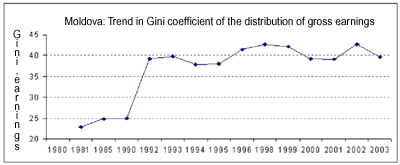
Thus, in the mid of 2004 only 6.2% of total household income volume fell to the share of 20% less secured families and 44.2% - to the share of 20% the most well-to-do families. Recent years revival of the dynamics has reduced a poverty zone in Moldova but it has not removed contrasts of inequality.
Nevertheless the majority of citizens of the RM still remember realia of a "developed socialism", when the state secured relative equality of incomes that basically depended on a salary (except nomenclature' privileges and "blat" - profitable connections).
Inequality began to increase rapidly during the transition period. At first it was caused by the fact that many people lost jobs and their money saving, and then - by process of privatization of enterprises, land and dwelling. Salaries paid in certain sectors became sharply different. Moreover, entrepreneurs have derived an income from shadow economy and employees of public offices - from corruption.
In Moldova in 1997-2003 real salaries grew annually by 7.7% starting from the mid 90s and after 1999 they have risen on average by 14.7% per year. On the other hand, at the same time the contrasts became even sharper. If in 1996 salaries in agriculture made up 2/3 of average salaries of national economy, then in 2003 they already came to ½. The same tendency took place in education and public health sectors. In 2003 salaries that exceeded an average level were paid in construction, transportation, industrial and financial sectors and public administration.
It is strange, but remittances sent from abroad also spurred the inequality. As the most initiative and educated part of the population went abroad for earning, 70 % of remittances get to well-to-do households. These remittances are spent mainly for consumption and also for "family investments" - for children education, purchase of apartments, land and investment into small business. Additionally, state social programmes do not facilitate much to elimination of inequality. Rendering of assistance in the programmes is based on a principle when citizens are assigned categories but it is not based on their real needs.
As a result, according to the Ministry of economy estimates (2003) only 6.6% of social transfers (without pensions) fell to the share of 20% less secured families and 46.0% to the most well-to-do families - recipients of such assistance.
Images of inequality
Inequality is many-sided. The tenseness of the situation also consists in that the inequality becomes apparent not only through contrasts in incomes or availability of property (which is an obvious sign for today), but through unequal conditions of access to the future - access to education and health care.
According to the sociologists data (2003) the number of days spent by the poor and the well-to-do in hospital are in the ratio of 1:11. The number of matriculated persons from the poor is tree times less than the number of matriculated persons from the well-to-do. Only every tenth is matriculated from the village youth that apply for admission to institutions of higher learning, while from the town-dwellers - every second.
It should be mentioned that the inequality in job opportunities available in Chisinau municipality (small business, construction, service and security sectors) and persistent stagnation for the rest of the territory, except 3-5 other towns (Edinet, Balti, Ungheni and Cahul).
Thus, many of the rights of citizens declared by our new democratic Constitution (1994) are difficult to realize. Thereby life of many people, especially young generation, is dominated by sense of vulnerability, impossibility to plan their future.
What is to be done?
One should not assert that the government does not see the inequality as a dangerous reason of social and political tension. Thus, in EG-PRSP for 2004-2006 "elimination of inequality and increase in participation of the poor in economic development" are mentioned as the priority. Basic approaches for this are well-known and approved in countries that undergo active reforms in transition:
At present the draft budget for 2005 is considered in Parliament. Again, the Government mentions that the state budget is "real and socially oriented". But to whom is it directed toward? Confucius said: "in a well-governed state they are ashamed of poverty, in a poorly ruled state they are afraid of wealth". Inequality is a real danger for a young, weak state. Or we are neither ashamed nor afraid?
The following contributed to this issue:
|
© 2001-2015 Association for Participatory Democracy "ADEPT" Reproduction of the materials is welcomed provided the source is indicated | e-mail: [email protected] |