
Participatory
Democracy
Original: /en/e-journal/20041201/index.shtml
| Association for Participatory Democracy | Print version. Published on www.e-democracy.md Original: /en/e-journal/20041201/index.shtml |
Activity of public institutions
Resolution on Council of Europe expertise of draft laws triggered strident criticism and lengthy debates. The draft was developed by the Government and outlines the procedure of submitting draft laws for expertise of and enforcing Council of Europe recommendations. The need to regulate this stems from the inefficiency of the existing mechanisms, when many draft laws are passed without Council of Europe expertise, while others albeit receiving endorsement await adoption.
Under the draft, Ministry of Justice was to become the institution in charge, fact that garnered rich criticism from the opposition. They argued that a specialised institution of the executive branch would be given powers to coordinate and control the activity of the state institutions - Parliament, Government and Presidency. Deputies had many other objections as regards the draft law, but after a break they adopted a Resolution in this respect that provides for:
So far Council of Europe provided expertise on several much-disputed drafts, namely Law on Local Government, Law on Administrative-Territorial Division of Moldova, Law on "Teleradio-Moldova" Public Broadcaster, Penal and Civil Code.
Another important act passed by the Parliament was the Law on Raising the Minimal Quota of Payments in Cash. As it stands now, businesses may make payments in cash up to 15,000 Lei only, otherwise the Centre for Fighting Economic Crime and Corruption sets a fine equal to 10% of the amount. These sanctions do not apply if payments are made to individuals, farms, licence holders, and several other cases. The Parliament now raised the quota to 100,000 Lei. The move is supposed to eliminate one of the barriers the business is struggling with. Noteworthy, previously the Parliament refused several times to raise the amount on the grounds it would channel liquidity to shadow economy.
During the final reading of the Law on Reorganisation of the State Chancellery into Government Apparatus, Parliament excluded provisions on obligatory command of Moldovan and Russian languages by public officers, as well as prohibiting members of political organisations and public associations to serve in Government Apparatus.
(For further details on Parliament activity see http://www.e-democracy.md/en/comments/legislative/)
2.1. Decisions
1. National Bank's foreign currency reserves
Early November National Banks' foreign currency reserves were estimated at 390.9 million USD with no significant change since last month when they hit the record high 391.6 million USD. Reserves mainly consist of liquidity and long-term deposits - 297.09 million USD, including in other central banks - 108.63 million USD and in other foreign banks - 188.46 million USD. Bank holds securities worth 93.80 million USD. It also holds special drawing rights worth 81.74 thousand USD and a reserve at IMF worth 7.47 thousand USD.
In October National Bank purchased 2.5 million USD on the inter-bank market. The growth registered in reserve assets this year outstripped forecasts made by independent experts who predicted they would reach 350 million USD. National Bank managed to reach the level of 1998, when the reserves dropped 2.5 times from 365.7 million USD to 143 million USD.
2. Future exchange rate developments
Many officials in the financial and banking sector claim the 12.7 Lei per 1 USD exchange rate that was used in drawing next year state budget, seems to be "real". This would depend on both internal and external factors that would determine Leu/ Dollar rate.
Among the foreign factors that might wield some pressure on exchange market, experts point firstly remittances from abroad that are expected to continue to grow and would likely lead to appreciation of Leu. National currency's appreciation would swell the trade balance and current account deficit. However, in a small economy open to and dependent on the foreign markets as Moldova is, it is useless to keep a fixed exchange rate. At the same time, a fixed exchange rate (that National Bank was promoting) protected domestic exchange market from various negative developments on the international financial markets. In addition, depreciation of the US Dollar against other currencies especially Euro would likely influence Leu/ Dollar ratio.
Also, analysts cite other factors that would diminish the aforesaid. Among those factors electoral campaign is cited that usually brings "calmness" to the exchange market. Having said, experts predict that in the next 3-4 months Leu/ Dollar exchange rate might fluctuate between 12.30 and 12.60 Lei per Dollar.
3. Moldovan investment position
Last week Chisinau hosted an international investment forum under the auspices of the Moldovan President. The message of the forum was "Moldova - open to international business". One hundred twenty foreign companies and 300 public officers, ambassadors and local businessmen attended the event.
At the forum President Voronin outlined the investment strategy of the Republic of Moldova that had been developed by the Government, in particular its main goal to boost economic development of the country by raising foreign direct investments. According to President Voronin, in 2005 Moldova hopes for a 10% surge in FDI.
According to latest statistics, EU accounts for 40% of the total investments in Moldova, CIS for 24%, Central and South-eastern Europe 4%, while other countries 32%. The most attractive sectors for foreign investments are energy, gas and water supply accounting for 35% of the total FDI, processing industry - 27%, wholesale and retail - 16%, transportation and communications - 12%, and constructions - 2%.
Recently United Nations Conference on Trade and Development released its World Investment Report covering 187 countries. Republic of Moldova ranks 110th on its potential to attract investments. One of the most important findings of the report is that total global FDI shot down by 50% in 2003. Last year Moldova ranked 109th out of 140 states.
Foreign direct investments (FDI) in Moldova amounted to 790 million USD at the end of 2003. In 2003 FDI dropped by 50% over 2002, i.e. 58 million USD. Republic of Moldova ranks 25th on inward FDI performance indicator, as compared to 18th last year. Nevertheless, Moldova has the best rating for this indicator among CIS countries.
Moldovan foreign debt exceeds 1.3-billion USD and reimbursing such a debt is not an easy task, especially as foreign capital flows bypass the country. Given the lack of foreign investments and worsening relations with international monetary organisations, Moldova would find it quite difficult to fund its foreign deficit in the upcoming year. For instance, average annualized FDI in Romania is 1.5-billion USD, whereas in Moldova FDI reached in the last 10 years of transition a bare 800 million USD.
Infrastructure is obsolete, laws are purely decorative, whereas FDI account for only 4% of the GDP - insignificant if compared to 30% in Poland, Czech Republic or Hungary. Undoubtedly, a small and a poor country like Moldova, having a complex, unstable and ambiguous legal framework does not seem attractive at all to foreign capital while few investors dare to invest in its economy.
Ratio of cumulative FDI inflows to GDP in Central and Eastern Europe
Country                 FDI
               Investments 1991-2002 (%GDP)
Bulgaria                18.5
Czech Republic          29.4
Estonia                 33.2
Hungary                 37.5
Latvia                  35.2
Lithuania               19.6
Republic of Moldova      2.9
Poland                  22.8
Romania                 15.9
Slovakia                10.2
Slovenia                16.3
Source: ECE (2002), Economic Survey of Europe, United Nations, Economic Commission for Europe, Geneva.
The Russian Federation will not sign the Declaration of Stability and Security for the Republic of Moldova at the OSCE Summit in Sofia in early December, the new Russian Ambassador to Moldova, Nicolai Reabov, told a press-conference on 24 November in Chisinau.
According to Moldavskie vedomosti, the Russian Federation has not rejected or ignored President Voronin's initiative regarding the signature of a Pact of Stability and Security for the Republic of Moldova1, and has proposed that such a document serves as the final accord and an integral part of the package of international agreements that are to be signed as part of the Transnistrian settlement. Thus, the signatories will not be just guarantors of the territorial integrity and neutrality of the Republic of Moldova, but also of the democratic principles of edifying a multiethnic society within a common state with Transnistria.
According to Ambassador Reabov, the Republic of Moldova has ignored Moscow's proposals, Instead, it has submitted to Russia for consideration a draft Declaration proposed by the US and supported by the EU. "Russia does not accept such a development of events. Therefore we will not examine such documents", Reabov was quoted as saying by the same source. On the other hand, asked to comment on the aforesaid statement Victor Stepaniuc said "Russian diplomat is not fully aware of the Russian Government" intentions and that "negotiations with Moscow continue including at the level of document signers". Ian Boag, Chief of the European Commission to Moldova and John F. Tefft, Deputy Assistant Secretary, Bureau of European and Eurasian Affairs of the US State Department, also confirmed that negotiations on the document are still continuing with Kremlin.
In another context, Reabov expressed his bewilderment at the fact that the Moldovan leaders have declared that the recent mediators' round of consultations in Varna has been a failure, as well as at fact that the Moldovan side refuses to return to the negotiations table. At the same time Reabov denied any disagreements between the mediators, invoking the final document signed in Varna, whereby the mediators express their support for a politically negotiated solution to the Transnistrian conflict, on the basis of mediators' proposals and previously signed agreements.
Furthermore, Reabov reaffirmed Russia's support for the Kozak Memorandum, 80% of which, he reminded, were drafted by the Moldova side; rejected the idea to replace the current peacekeeping forces, in which Russia holds the largest share, with multination ones on grounds that these forces have proven their efficiency; and said that although Russia regards Transnistria as part of Moldova, it will continue the dialogue with the de facto existing authorities and institutions in Transnistria.
Ambassador Reabov's statements have provoked a wave of reactions both on behalf of authorities and the public opinion. The Moldovan Foreign Ministry issued on 25 November a statement, in which it accused the Russian Federation of having breached the norms of diplomatic behaviour, whereas the Government newspaper Moldova suverana accused Russia of applying 'totalitarian tactics' in its bilateral and international relations. The Head of the Communist faction of deputies, Victor Stepaniuc, said in an interview with Radio Free Europe that both Russia and Ukraine, as guarantor states, are 'obliged' to sign the proposed Declaration, and that if Russia fails to do so its status of guarantor in the Transnistrian problem will lose all meaning. Vlad Cubreacov, leader of the People's Christian Democratic Party faction in Parliament, qualified Reabov's statements as "aggressive and provoking" and a proof of the formal status of Russia as guarantor in the Transnistrian problem.
Many political analysts in Chisinau have commented on the statements of the Russian diplomat in Chisinau in light of the ongoing electoral crisis in Ukraine, where Russia's overt and massive support for the pro-Russian presidential candidate has shown how far Russia would go in order to protect its hegemonic position in the so-called 'near neighbourhood', and wondered whether the same scenario will be applied in Moldova next spring.
On the other hand, observers have drawn parallels between Reabov's statements and last year's Kozak Memorandum events on the eve of the OSCE Summit in Istanbul. Thus, it seems that Russia has made a habit out of tensioning the situation around Transnistria on the eve of OSCE Summits so that, when asked about its failure to withdraw weapons and troops from Transnistria, it can invoke 'unfavourable political circumstances' that deter it from complying with its international commitments.
1. EU, USA, and Romania support the Declaration on the Stability and Security for the Republic of Moldova
The period covered was very prolific with three official visits to Chisinau, namely EU Troika; John F. Tefft, Deputy Assistant Secretary, Bureau of European and Eurasian Affairs of the US State Department; and Romanian delegation headed by Anca Ilinoi, Director General for Political Affairs. What all the three delegations have in common is their support towards signing a Declaration on the Stability and Security of the Republic of Moldova at the OSCE Ministerial Council in Sofia in December this year.
Given the latest developments in Ukraine its position regarding the initiative to sign such a document remains unclear. On the contrary, Russia has made clear its position, that is totally different from that of EU, USA, and Romania. It was delivered by the Russian Ambassador to Moldova, Nikolai Reabov.
Besides Stability and Security Pact for Moldova, the Troika met President Vladimir Voronin and Moldovan Minister of Foreign Affairs, Andrei Stratan and talked Republic of Moldova - EU relationships within the framework of the neighbourhood policy and Republic of Moldova - EU Action Plan. In this respect Moldovan side reiterated its commitment to implement the Action Plan and developed a National program in this respect. Other topics considered during the meeting were relations with international financial institutions and upcoming elections. As for the latter, President Voronin stated that it was in the best interest of the authorities to conduct free and fair elections, which was a mater of "prestige". The very same issue of ensuring free and fair elections in Moldova was considered during a meeting of the Troika and John F. Tefft with civil society organisations.
2. Eighth Reunion of the Regional Table of the Stability Pact for South-Eastern Europe
On November 19 Moldovan Minister of Foreign Affairs Andrei Stratan flew to Skopje for the Eighth Regional Table of the Stability Pact for South-Eastern Europe (SPSEE).
According to the Ministry of Foreign Affairs press service, the reunion was preceded by two days of theme-focused Working Table meetings where issues of Democratisation and Human Rights (Working Table I), Economic Reconstruction, Development and Cooperation (Working Table II) and Security (Working Table III) were discussed by participating countries and organizations. During the first Working Table at issue was improved cooperation on parliamentary dimension of the SPSEE. The second table examined the draft Treaty on developing an Energy Community in South Eastern Europe legalizing engagements assumed by countries participants to "Antena I" and "Antena II", where Republic of Moldova is an observer. As for the third Working Table, Republic of Moldova expressed its interest to be granted an observer status as part of the MARRI Regional Forum and Ohrid border management process.
3. Fifth Reunion of the RM - EU Cooperation Committee
On November 23 RM-EU Cooperative Committee convened in Brussels. Moldovan delegation included Minister of Economy, Marian Lupu and Minister of Justice Victoria Iftodi. Reviewing the progress made in implementing Partnership and Cooperation Agreement Marian Lupu referred to trade, customs and border control and investment climate in the Republic of Moldova. Victoria Eftodi referred to adjusting Moldovan laws to European norms and measures envisaged in this respect in the RM-EU Action Plan. Noteworthy, EU delegation shared its own vision as regards the evaluation mechanism of the Plan implementation.
According to the latest official declarations, RM-EU Action Plan should be signed in December, although initially it should have been passed back in May 2004.
Currency Market: New Challenges
Veaceslav Negruta
The Dollar's latest significant "fall" took place on Wednesday and Thursday, on 24 and 25 November, as a result of the declarations of some officials of the Central Bank of Russia about their intentions to increase the share of the Euro in the structure of its currency reserves from 30 to 40 percent in the Dollar's disfavour. The international financial market reacted promptly. China had previously announced its preferences for the Euro, which also troubled the waters on the financial markets.
However, the main reason for the Dollar's "fall" should be looked for in the USA. Probably many actors that play on the currency market have realized that the USA is interested in the Dollar's weakness in order to finance partially its war costs, finance the huge budget deficit and create competitive advantages on the internal and external markets for the American producers. The contradictory statements of the Minister of Finance and the Head of the US Federal Reserves with regard to the Dollar's future amplify these uncertainties. Moreover, the fears related to the high levels of both trade and current account deficits of the United States have generated a decreasing trend of the American currency. Monetary markets fear now that the decline that has been taking place so far gradually and orderly could become chaotic, with unpredictable consequences.
The hardest blow to the US dollar could be caused by the entering into force of the agreement of December 2003 between the German Chancellor Gerhard Schroeder and the Russian President Vladimir Putin regarding the payment in Euro for the import of Russian natural gases. Respectively, there could take place an unprecedented replacement of the US Dollar with Euro in the energy resources import/export transactions, this segment of the international market being traditionally dominated by the Dollar. The decision of the Central Bank of Russia to increase the share of the European currency in the total amount of its currency reserves is an alarming signal for its energy sector.
In case of US Dollar's depreciation, a new wave of price hike on energy resources is not excluded, or a more accelerated substitution of the Euro for the Dollar could become reality. Let us take a look at the Moldovan currency market. Although the Dollar loses its position and value on all international and national markets, the Leu/Dollar correlation remains relatively stable, even with a small depreciation of the Leu. This could be explained by the seasonal factor i.e. that the demand for dollars increased on the eve of winter (we must pay for the import of energy resources). But this explanation is not sufficient. It seems that the target for Leu's appreciation against the Dollar was set by President Vladimir Voronin at the Government meeting of 3 November 2004, when he brought harsh criticism to the National Bank and personally to its Governor Leonid Talmaci.
The Head of the State harshly criticized the activity of those NBM officers that allowed for Leu's appreciation, although the appreciation took place 5-6 months before. Back then, when the exporters and the population dependant on the external money transfers were suffering losses due to the Leu' appreciation, few were those that criticized the situation on the currency market (nobody at all from among the governors). For these reasons, the President's criticism was a little belated. Nevertheless, the criticism had its effects: today the Moldovan currency market does not react in the same way as practically all international and national markets do to the Dollar's evolution.
In the conditions in which the dollars are "thrown out" from international assets in the entire world, the Republic of Moldova becomes the place that absorbs the Dollar. The dollar throwing out phenomenon is obvious especially in Russia. Thus, those dollars could reach Moldova through economic agents, including commercial banks, which could bring about a new wave of pressure on the Leu/Dollar correlation.
It is important to understand the macroeconomic impact of the evolutions on the international currency market on Moldova's balance of payments. In the conditions in which most export contracts have prices fixed in Dollars, and import prices (except energy resources) in Euros (or related to the Euro), we have an increasingly disastrous situation with regard to the trade balance. Its deficit is continuously growing, especially due to the depreciation of the Dollar against the Euro. And the consequences of Leu's appreciation allowed for an increase in the trade deficit, which registered a record amount of USD 515 million in the nine months of this year, as well as an increase in the current account deficit.
At the same time, controlled currency regime (promoted, in fact, by NBM) has protected the internal currency market against the speculative flows and the multitude of negative evolutions on the international financial markets. NBM should change the frequency of its interventions on the currency market and offer an increased flexibility to the exchange rate. It is true that there is the option of using temporary controls, such as minimal obligatory reserves or restrictions in the loan provision policy. Perhaps the market players know them and are aware of what measures the central bank could adopt, should things go wrong at some point.
The Republic of Moldova is approaching more and more to the critical point when it must take a decision regarding the acknowledgement and acceptance of the increasing role of Euro in the world as well as in the Republic of Moldova. The delay in doing this has already degenerated in "missed opportunities". The current political and economic contexts will most likely not interfere with making such a decision.
Barometer of Public Opinion: deja vu or ... change may be?
Viorel Cibotaru
Several factors contribute to the credibility of the research: 1) a group of well-known independent experts supervise elaboration of questionnaires and validate the results; 2) correctness of the opinion polls conducted by the most credible sociological institutions in Moldova are verified by another institution so as to avoid any distortion; 3) each new opinion poll includes 30-40% of general questions that enable a though analysis of developments and trends in the public opinion, similarly new questions that are high on the political, social and economic agenda are included in the poll; 4) every time new techniques, methods and approaches are used so as to enable the use of the opinion poll results in developing public policies.
Once the results were released on November 16, 2004 media and analysts alike turned their attention to the immediate impact of the results, leaving the analysis of tendencies and changes for later. Still, it is exactly those changes that are of great interest given the upcoming parliamentary elections in Moldova, as well as recent developments as regards elections in Ukraine, Romania, but also Russian Federation, Belarus and Georgia.
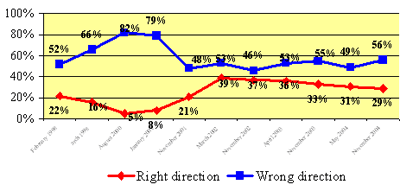
The latest Barometer clearly shows a change in peoples' attitudes as regards country development. Commencing February 1998 opinions on this issue teetered. Throughout 1998-2000 the number of respondents who believed Republic of Moldova stepped on the wrong path surged from 52% to 82% and dropped in 2002 to 46%.
Table 1. Attitudes on the country development (1998-2004)
During the time of major social transformations individual values take the centre stage, which are closely related to the social values. Cultural and spiritual changes, that is shifts in values, stem from changes in public administration, economy, technological or political developments. In this respect, of special interest are the results as regards confidence in public and private institutions. This specifically refers to the support to domestic policies that determine the degree of political stability in the society as well as the level of democracy in the country. The confidence in various state institutions (Government, Parliament, Presidency) as a rule depends on the social-political situation and manipulation of public opinion.
For instance in 1998 the opinion poll conducted in March showed that confidence in the Presidency was 57%, Government 30%, and a low one in Parliament 16%. Things changed in 2001 on the eve of parliamentary elections when confidence in President was only 15%, in Government - 19%, Parliament - 10%. Table 2 illustrates how things evolved since 2001.
Table 2. Confidence in state institutions (2001-2004)
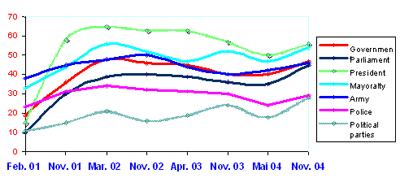
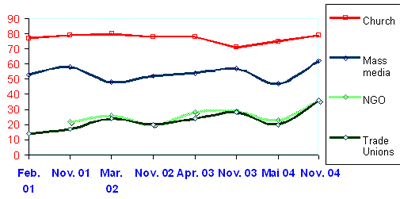
In 2004, out of all public institutions citizens trust the President (56%) and mayoralty (54%) the most, both registering a 6% surge as compared to May 2004. Also surging is the confidence in media with 62% of the respondents having a somewhat or high confidence (15% increase). However, during those years the church has been the most trusted institution. (Table 3).
Table 3. Confidence in civil society institutions (2001-2004).
The latest survey indicates what 52% of the respondents are not happy with the current economic situation in the country. Interestingly, different categories of respondents see different solutions. In general, 38% view that a better enforcement of the laws is the solution, 36% developing industrial enterprises, 35% see the solution in fighting crime. Respondents in rural areas see the solution in supporting farmers - 38%. At the same time, 21% of the young respondents age 18-29 see the solution in changing the country leadership.
In a related note, given the approaching elections the last opinion poll shows an increased interest in politics, i.e. 10% over May 2004. Thus, 28% of the respondents say they are interested or very much interested in politics. Respondents age 45-59 years are the most interested in politics (32% are interested or very much interested), as are those in the urban area - 31%.
As for confidence in political figures, several of them registered an increase over May 2004 and even 2003, namely one of the leaders of "Moldova Democrata" - Dumitru Braghis (21% have a high or very high confidence, as compared to 19% in 2003 and 12% in May 2004); leader of the Democratic Party of Moldova, Dumitru Diacov (11% as compared to 9% in 2003 and 5% in May 2004); one of the leaders of the Social-Democratic Party of Moldova Oazu Nantoi (currently 19%, as compared to 14% in 2003 and 13% in May 2004); Parliament Speaker, Eugenia Ostapciuc (currently 30%, over 26% in 2003 and 23% in May 2004); leader of the Christian Democratic Peoples' Party, Iurie Rosca (currently 17%, over 14% in 2003 and 10% in May 2004); leader of the Social Liberal Party, Oleg Serebrian (currently 14%, over 9% in 2003 and 8% in May 2004). The only one to see a decline in the rating was Prime Minister Vasile Tarlev (33% as compared to 44% in 2003 and 43% in May 2004). Vladimir Voronin enjoys the highest rating with 59%.
If Parliamentary elections had to be held in Moldova next Sunday, 62% of the respondents would vote for the Party of Communists. Those are people over 45 having a low or average income and incomplete secondary education.
The great majority of citizens (86%) believe the President should be elected by all the citizens, while 35% consider that President Voronin has the greatest chances to be elected as the next President after 2005 parliamentary elections.
Noteworthy, the last Barometer takes a closer look at the swing voters as well as factors that influence citizen's choice in elections. Many more respondents decide whom to vote during the electoral campaign or even on the eve of elections. This explains the growing interest towards media that wields a heavy influence on the voter's choice.
Party of Communists and Christian Democrats have the most loyal supporters and potential voters. Still, the two parties have the lowest potential to attract the votes of the swing voters, i.e. about 25%. In contrast, Democratic Moldova might attract up to 50% of the swing votes.
Albeit many analysts interpret electoral options "deterministically", the opinion poll provides a wide berth for forecasts as regards the upcoming parliamentary elections. Firstly, it is clear that electoral context and observance of the "rules of the game" would have a crucial impact. An illustration to this effect is Ukraine where people no longer accept deviations from democratic norms. Secondly, there is a huge gap between voters' expectations and contestants' ability to keep up their promises mode in elections. Thirdly, it is hard to assess at the moment the possible impact of the foreign influence on the election results. Fourthly, "seasonal" differences in the respondents' options and attitudes are too obvious. Opinion poll clearly shows a dependence on migration in and out. That is why the timing of elections would prove crucial in elections.
The following contributed to this issue:
|
© 2001-2015 Association for Participatory Democracy "ADEPT" Reproduction of the materials is welcomed provided the source is indicated | e-mail: [email protected] |