Participatory
Democracy
Original: /en/e-journal/20050118/index.shtml
| Association for Participatory Democracy | Print version. Published on www.e-democracy.md Original: /en/e-journal/20050118/index.shtml |
Activity of public institutions
1.1. Reshuffles
During January 12 session of the Government, ex-Defence Minister, Victor Gaiciuc, was appointed as Republic of Moldova Ambassador to Belgium and representative at NATO. During the same session, Government decided to recall Nicolae Cernomaz as Republic of Moldova Ambassador to Ukraine and concurrently to Azerbaijan and Georgia. He will be replaced by Mihai Laur, who prior to that served as Republic of Moldova Ambassador to Hungary. Valeriu Bobutac was designated to head Moldovan Mission in Hungary. Yet another reshuffle envisaged Eugen Carpov appointed as Republic of Moldova Ambassador to EU, who previously served as Ambassador to Poland.
These are the largest and strangest reshuffles ever among Moldovan diplomatic corps. However the oddest of all is the appointment of Victor Gaiciuc - recently ousted as Defence Minister following disappearance of munitions from the National Army warehouse and major deficiencies within the army discovered by the Supreme Security Council - who despite lacking experience in diplomatic service was entrusted to head one of the most important Moldovan missions abroad. The other reshuffles are hard to explain as well. The reasons for such a move remain unclear, however it is all-too-clear what would be the impact of the reshuffles on the Republic of Moldova's foreign policy.
1.2. Decisions
If the aforesaid actions are inflicted on a pregnant woman or a minor by two or more persons who take advantage of the victim's weakness and use torture devices, or the said actions are undertaken by an official, they shall be punished by 5 to 10 years in prison.
2.1. 2005 parliamentary elections
Given the upcoming parliamentary elections scheduled for March 6, President Voronin addressed a message to OSCE Secretary General Jan Kubis, EU High Representative for Foreign Policy and Security Affairs Javier Solana, and Council of Europe Secretary General Terry Davis, inviting them to encourage a wider monitoring of the electoral process by ensuring "impressive presence of international observers" on e-day.
2.2. Supreme Security Council session
President Vladimir Voronin chaired the latest session of the Supreme Security Council. High on the agenda were abuses committed by employees of the Ministry of Interior. After reviewing the deficiencies in the Ministry, President asked the leadership of the Ministry of Interior and Prosecution to take all the steps to stop such abuses. He also recommended finalizing investigation against employees of the Ministry of Interior who committed abuses or exceeded their functions and applying appropriate sanctions.
Another issue considered during the meeting was child adoptions. In this respect SSC decided to establish a republican commission entrusted to develop until April 1 a draft law on legal framework regulating adoptions, establish a National Committee on Adoptions within the Government and develop and keep a national record of adopted children.
Prices
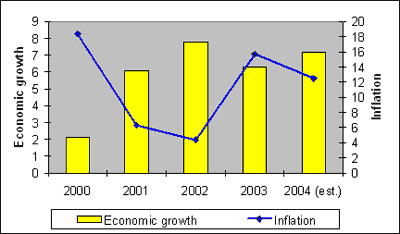
In 2004 cumulative inflation rate in Republic Moldova reached 12.5%, 2.5% above the Government forecasts. In December a 1.6% inflation was registered.
Initially state budget for 2004 provided for a 4.5% inflation, however later once data on the evolution of Moldovan economy in 2003 were released, Ministry of Economy adjusted the figure to 10%.
Over 2004 prices on food rose by 13.1% as compared to December 2003. Prices on non-food goods rose on average by 11.9%.
Consumer price index on services surged by 11.8% over December 2003. Tariffs on telecommunications went up by 29.4%, medical services by 23.9%, and fuel by 23.2%.
In 2003 inflation rate reached 15.7%, as compared to 4.4% in 2002, and 6.3% in 2001. National Bank of Moldova and Government forecast inflation rate below 9% for this year.
Year           1994   1995  1996  1997  1998  1999  2000  2001  2002  2003  2004
Average        104,6  23,8  15,1  11,2  18,1  43,7  18,4  6,3   4,4   15,7  12,5
annualized
inflation
Sourse: www.bnm.org
Public finances
Revenues to the consolidated budget of the Republic of Moldova amounted to 7 billion 521 million Lei in 2004, 1 billion over 2003. 101% revenues were levied to the state budget, while 99.9% expenditures. The 125 million surplus was used for servicing foreign debt. Also in 2004 1 billion 253.8 million Lei, i.e. 103.5 million USD, were spent on foreign debt - 22.7% of the total revenues to the state budget.
Taxes accounted for almost 53% of the budget revenues, while the rest came from customs. Last year State Fiscal Department levied 825 million more taxes than in 2003, while Customs Department 638 million more than in 2003. Income tax levied from businesses surged by 35%, while from natural entities by 28%.
Administrative-territorial units accrued revenues at 108.5%, 226.2 million over what was planned, while expenditures at 97,1%. According to preliminary estimates as of December 31, 2004 territorial units had 323.9 million Lei unspent on their accounts.
Banking and Insurance
In the 11 months of 2004 banking sector showed positive signs, tier 1 capital registered 2 billion 403.8 million Lei, i.e. 18.5% over early that year. Tier 1 capital is formed in order to minimize any eventual banking fluctuations. Currently, National Bank set the minimal quota of the said capital at 40 million Lei for A-licence banks, 80 million for B-license and 120 for C-license respectively.
In the 11 months of the year commercial banks' assets increased by 25%, to 12,849.3 million Lei, while the shareholder's capital by 17.1%, to 2,526.3 million Lei. Banks' liquidity surged by 25.7%, to 688.4 million Lei. Nevertheless the share of foreign investments in the registered capital of the commercial banks dropped to 52.6%. At the end of 2003 the index was 60.2%.
The net revenues of the banks amounted to 407.5 million Lei, while profitability of assets and that of shareholders' capital reached 3.97% and 18.85% respectively. National Bank reported that the banking system liquidity was high, reflecting banks' ability to meet current and long-term obligations.
Deposits that had surged by 30.5%, to 8,959.3 million Lei in 11 months, including growing deposits by natural entities by 36.1%, to 4,578 million Lei, are yet another evidence of the growing confidence in the banking system.
Trade
In the 11 months of the year trade balance deficit was estimated at 690 million USD, outstripping Government forecasts of a 625 million USD deficit for the entire year.
In November the record high deficit during the yea was registered, i.e. 92 million USD, getting close to the highest ever 106.8 million USD deficit registered in December 2003.
Official statistics reports that in the 11 months of the year Republic of Moldova registered a positive trade balance only with Russian Federation amounting to 135 million USD, whereas the highest deficit was registered with Ukraine, i.e. 330.3 million USD. Similarly Moldova registered soaring trade balance deficit with Poland, France, Germany, Romania and Turkey.
In the last two years the trade balance deficit swelled by 30%. Economy watchers say no upturn is to be expected this year. Previously, Minister of Economy Marian Lupu stated that despite the 9% growth of exports expected this year the trade balance deficit was set to soar to 770 million USD?!

Sourse: www.bnm.org
Moldova in the world
Republic of Moldova ranks 77 out of 161 countries in the 2005 Index of Economic Freedom produced by the Heritage Foundation.
The 2005 Index of Economic Freedom measures 161 countries against a list of 50 independent variables divided into 10 broad factors of economic freedom: Trade policy, Fiscal burden of government, Government intervention in the economy, Monetary policy, Capital flows and foreign investment, Banking and finance, Wages and prices, Property rights, Regulation, and Informal market activity.
Moldova scored 2 points for trade policy, 2.6 for monetary policy, 2.0 for Government intervention in the economy, 4.0 on capital flows and foreign investment. The scores range from 1 to 5, the higher the score on a factor, the greater the level of government interference in the economy and the less economic freedom a country enjoys.
Thus, on 3 January the Transnistrian official news agency Olvia-press published a press communique whereby the economic department from Tiraspol had announced the privatisation of the Transnistrian railways on grounds that only a private owner could rehabilitate them. The control of the railways was taken over by the Transnistrian authorities last August after the director of the Tighina station signed the necessary documents. The ownership rights over the consequently created enterprise Transnistrian Railways have not been recognised by the Moldovan authorities.
According to Basa-press, in 2004 the income from the privatisation of enterprises from Transnistria reached 35.1 million USD, of which 29 million USD were obtained from the sale of the electrical Power Plant in Cuciurgan. Observers in Chisinau have indicated that the legislation adopted by the Moldovan Parliament on privatisation in Transnistria will not be possible to apply because the Moldovan authorities do not hold the de facto control of the region.
Earlier the OSCE Mission to Moldova called upon the Transnistrian administration to refrain from pressure on Alexandr Radcenko and declared its concern in relation to the actions of some radical groups and those of the official news agency Olvia-press, which harness public hatred against people that do not share the official views of the Tiraspol administration.
Economic retrospectives & perspectives
Iurie Gotisan
Specifically, economic growth means a positive change of an aggregated economic indicator, such as GDP, in real terms over a certain period of time. In its turn GDP represents the gross amount of goods and services produced in a country in a given year by domestic and foreign businesses. As a rule, the key indicators considered when calculating GDP are:
Consumption. As was the case in 2003, surging consumer spending was the main factor that boosted economic growth. It is expected that the final consumption would surge by 20% over 2003 and would contribute 18% to the GDP growth.
Considerable remittances from abroad and growing salaries in the country have been the major factors that sustained economic growth and boosted the demand domestically. In our opinion remittances from abroad might diminish in the years to come and this because of family reunification abroad.
Still, if remittances are sustainable in the long run, economic growth based on consumption alone, would increase and consolidate structural disproportions. An illustration in this respect are surging imports that deteriorated current account. Massive imports have a negative impact on the current account deficit that has soared to 6.7% of the GDP.
Investments in fixed assets. As for investments, they had a quite modest contribution to GDP. Still, gross investments in fixed assets surged by 15% and had a 2.5% contribution to GDP. After a long while foreign investments show some positive signs. Total FDI in Moldovan economy has reached 100 million USD.
Although from an institutional point of view business environment registered a decline, fiscal conditions improved in 2004. Income tax for businesses dropped by 2% to a record 20%. Moreover, Government announced that in 2005 it would drop it even further. Therefore it is our belief that reducing fiscal burden would have a positive effect on the investment climate.
Exports. Certainly, surging production output of goods intended for exports in 2004 boosted GDP, especially due to growing exports of food and beverages. According to some preliminary data, exports shot up by 25.5% and reached 900 million USD.
Imports. Nevertheless, skyrocketed imports by 29% (1.6 billion USD) have shattered even further the trade balance. Statistics indicates that in the 11 months of the 2004 trade balance deficit reached an alarming 690 million USD, quite likely that for the 12 months of the year it would hit 800 million USD. Accordingly, the negative trade balance would soar by another 30% over 2003.
In 2005 and particularly in 2006 the gap between exports and imports would diminish and this because of those two factors:
Some problems might arise with the exports of agricultural and food products. For instance CEE countries that are importing food from Moldova would join EU's CAP (Common Agricultural Policy) and would have to give priority to the goods manufactured within EU.
Agriculture. We should also acknowledge that a good agricultural output also bolstered the economic growth. For instance, wheat harvest exceeded 830 thousand tones. Nevertheless, agriculture still remains to be extensive and backward. Recession in agriculture gave rise to unemployment. We wouldn't be as lucky this year, as it weren't agricultural policies that determined the success of 2004 but rather good weather. It may well happen that in 2005 prices on wheat would go up due to unfavourable weather conditions and surging demand worldwide.
Foreign investments. Diminishing FDI registered since 2000, points to the flawed economic policies that continue to undermine investors' trust in Moldova. Foreign investments flow is recovering after a long sluggishness. Total FDI in Moldovan economy in 2004 has exceeded 100 million USD.
Privatization. It was stagnating this year. In general, 2001-2004 were marked by numerous failures in privatization of such giants as MoldTelecom (telecommunications), RED Nord and Nord-Vest (energy sector) and many more wineries.
It is our belief that RED Nord and Nord-Vest privatization was thwarted for political rather than economic reasons. It is known for a fact that the price on one kW/hour delivered by RED Nord is much cheaper than the price of the same unit delivered by RED Centre and Sud-Vest. Everything is all-too-clear considering that the ruling party's electorate is at the north of the country.
Moreover, Government initiated re-nationalization of certain privatized companies such as Dacia Hotel, Air Moldova - air career, and Farmaco - pharmaceutical company, while provided no compensation whatsoever to the investors. Furthermore, the heavy-handed cancellation of privatization contracts scared away many investors from investing in Moldova.
Exchange rate. Over 2004 Leu continued to appreciate against USD. There are several reasons for that:
Meanwhile, National Bank of Moldova continued to purchase foreign currency and according to preliminary data by the end of 2004 its reserves have reached 455 million USD.
Inflation. Cumulative inflation rate reached 12.5% in 2004. This figure outstripped Government forecasts by 2.5%, nevertheless it dropped as compared to 15.7% in 2003. Still, price hike on food pushed inflation further upward in certain months of the year.
Better inflation performance in 2004 over 2003 might be also explained by the appreciation in real terms of the Leu against USD. For instance in 2004 average nominal exchange rate was 12.4 MDL/USD as compared to 14.2 MDL/USD in 2003.
Due to parliamentary elections politics would again prevail over economics, therefore we should expect an increased control over price hikes. Electoral campaign is already in full swing, while the election outcomes would be of strategic importance for the fate of Moldovan economic environment.
Dynamics of economic growth and inflation (%)
Source: Statistics and Sociology Department
Withdrawal of Russian Troops in the Context of CFE Adapted Treaty: Perceptions, Interests, and the Changing Nature of European Security
Iulian Fruntasu, PhD in Political Sciences
As follows, we will review the Decisions adopted during the OSCE Summit regarding Moldova, their content and nature, conflicting perceptions of parties involved when it comes to the modalities of implementation, the Russian Federation's view regarding the adapted Treaty and last but not least the perspectives of the Republic of Moldova to use this tool of European security in order to advance its national interests. Due to the lack of space, the particular elements of the adaptation process will be explained only to the extent to which these shed some light on the problems and challenges faced by the Republic of Moldova.
It should be mentioned that during the process of adaptation the Moldovan diplomacy spared considerable effort concerning the strengthening of obligation to secure the consent of host-state for the temporary deployments, looking for solution in the Treaty context to the illegal presence of Russian forces, for solution to the problem of Treaty limited equipment unaccounted for. During many years the national interests regarding CFE were promoted extremely insistent and in particular during 1999 due to the intensification of negotiations. This took place by delivering statements and speeches at the Joint Consultative Group tasked to negotiate the adaptation, by launching initiatives and draft decisions, by means of countless consultations and negotiations both in formal framework and unofficially in Vienna as well as other capitals. Taking all these into account the success of Istanbul came as no surprise to those directly involved into the process of adaptation, though it cannot be rejected a certain positive influence of international circumstances, such as the Western CFE member-States' pressure on the Russian Federation for breaching levels for holdings in the Flank Zone, in particular, in the Northern Caucasus where Russians launched operations using massively conventional armaments. Despite all that, during the last two days in Istanbul a scenario was circulated by which Moldova could had been sidelined because some important states were afraid that a fundamental decision for the European security could be blocked by a regional problem. With some nerve, well-calculated steps, involvement of delegations from Western countries as mediators, Moldovan Delegation succeeded to finalize the negotiations with Russians around 03.00 o'clock in the morning on 19.11.99, after which followed the CFE Conference. The official ceremony of signing the Treaty by Heads of States and Governments took place at eight o'clock in the morning, only a couple of hours away from the conclusion of negotiations.
So, the Final Act, which is part of the package of understandings together with the CFE adapted Treaty1, contains the following references to Moldova: "[Member-States] �Have taken note of the statement by the Republic of Moldova, which is attached to this Final Act, concerning its renunciation of the right to receive a temporary deployment on its territory2 and have welcomed the commitment of the Russian federation to withdraw and/or destroy Russian conventional armaments and equipment limited by the Treaty by the end of 2001, in the context of its commitment referred to in paragraph 19 of the Istanbul summit Declaration."3
Here it is important to make a distinction between the adapted Treaty which by the way contains clauses regarding the consent of host-State4, including the Final Act, that in turn contains very strong political commitments because they had been undertaken in the package with the adapted Treaty, and the Istanbul Summit Declaration that has a political implementation regime as any other OSCE document. On the other hand it could be argued that the cross-references between the Final Act and the Summit Declaration strengthened the mandatory nature of the latter. Istanbul Declaration says the following relevant things about Moldova in the first two paragraphs: "Recalling the decisions of the Budapest and Lisbon Summits and Oslo Ministerial Meeting, we reiterate our expectation of an early, orderly and complete withdrawal of Russian troops from Moldova. In this context, we welcome the recent progress achieved in the removal and destruction of the Russian military equipment stockpiled in the Trans-Dniestrian region of Moldova and the completion of the destruction of non-transportable ammunition. We welcome the commitment by the Russian Federation to complete withdrawal of the Russian forces from the territory of Moldova by the end of 2002. We also welcome the willingness of the Republic of Moldova and of the OSCE to facilitate this process, within their respective abilities (underlined by author to reject the Russian claim of conditionality), by the agreed deadline."5
The web of legal and political documents, as well as the existing relationships amongst them, convey the substance of commitments undertaken with regard to Moldova:
| ||||||||||||||||||||
Now, if we place the adapted Treaty with all its commitments in the context of European security but also in that of Russian-Moldovan relations, we see that Moscow's approaches differ depending on Russian perceptions regarding the threats and challenges it is faced with. For instance, during a high-level Conference in Munich on February 9, 2004, Serghei Ivanov, the Russian Defense Minister, declared that Russia could leave the CFE Treaty due to the fact that Baltic States are joining NATO without signing the Treaty. That obviously allows them to disregard the limits, inspection and information regimes, which in turn offers the possibility to deploy countless Alliance's equipments on the respective territories.6 The Russian Duma made a statement along similar lines, arguing that the integration of Baltic States into NATO creates a gray area thus Russia as a reaction could review its Istanbul commitments regarding its holdings in Kaliningrad and Pskov.7 All this continued until NATO offered assurances that the new member-States, including Baltic States, will follow the provisions of the CFE Treaty and Alliance's commitments in regarding Russia such as the Founding Act of Rrelationship between NATO and Russia, Rome Declaration and 2003 Madrid Declaration. The Russian Duma ratified the adapted Treaty (previously it was ratified by Belorussia, Ukraine and latter by Kazakhstan) on June 25, 20048, and Russian Foreign Minister Lavrov, participating to the Ministerial Council in Sofia at the end on last year, was already appealing in favor of ratification of adapted Treaty.9 This leads us to the conclusion that Russians exercised political pressure that turned to be a successful effort because apparently NATO offered guarantees on non-deployment of troops in new member-States that were quite credible since Moscow moved rapidly from the idea of leaving the Treaty to its ratification. In a wider context it is obvious the fact that the CFE adapted Treaty is a document that is more convenient to Russian Federation than to the Alliance because NATO anyhow was showing some sort of understanding for many years for the violation of limits in the Northern Caucasus and for Moscow's behavior in the so-called near-abroad. Currently, things are changing in the sense that the tolerance regarding the illegal presence of Russian troops is diminishing, though Moscow tries to underline the adapted Treaty provisions that are convenient to it (it was even able to extract additional guarantees from NATO, as we saw) and to downgrade its commitments regarding Moldova and Georgia, claiming either that these are political and without any deadline for implementation, or that these are bilateral with no effect on third parties.10 But if we attempt to imagine a hypothetical situation in which Poland would state that its commitment annexed to the Final Act regarding its limitation of holdings for tanks at 1 577, for armored combat vehicles at 1 789 and for pieces of artillery at 1 370 are not valid any longer because they are political, officials in the Russian Foreign Ministry and Defense would definitely hit the ceilings in their respective offices.
It is not difficult to notice that Russians manipulate the issue of CFE adapted Treaty, with some dexterity, indeed. Moscow knows very well that host-State consent was a fundamental principle during negations and that was dully reflected in the adapted Treaty. It knows it very well because the Russian diplomats and military were the strongest opponents that permanently were against the concept of mandatory host-State consent. Moscow knows, as well, that the Final Act political commitments are included in the package with the adapted Treaty and have a value undoubtedly superior to any other OSCE decision, that from legal point of view no decision can change the substance and terms of the Istanbul CFE Conference but another CFE Conference and that, in the end, NATO's limits of tolerance cannot be tested indefinitely by political-diplomatic challenges as those mentioned above. After all, in comparative terms it is Moscow that needs more the CFE adapted Treaty by which it could monitor the presence and movements of Alliance along its border in the circumstance when the Russian conventional armaments are downgrading and the mobility element and the air component are superior in NATO's case. It is true, indeed, that with an eventual disappearance of the CFE Treaty all sides would lose but Moscow's loses would be greater and its hectic behavior during the last half of year supports the authenticity of this assertion.
It is crucial to mention that the US position made public only one year after Istanbul Summit by Mrs. Albright at the 8th OSCE Ministerial Council in Vienna on November 27-28, 2000, that the signature of CFE adapted Treaty was a historic achievement possible, in part, because of important commitments made by the Russian Federation, is valid today as well, with modification relating to the conditionality of ratification upon the complete implementation of commitments, as stipulated by the State Secretary Colin Powell at the OSCE Ministerial Council in Sofia.11 It might be true that the US and NATO generally could have their own or additional reasons to delay the ratification of adapted Treaty but we leave this subject to Russian experts that are more willing and capable in analyzing the imaginary or real flaws of the North Atlantic Alliance.
When it comes to Moldova and the CFE adapted Treaty it is relevant to keep in mind that from the perspective of many Western chancelleries this Treaty maintains a system of relations that affects the security on the whole continent and that it solves issues much more important that the presence or withdrawal of Russian army from the Moldovan territory. This situation should keep Moldovan diplomacy on the alert and to lead to additional political and diplomatic initiatives in consultations on one hand with Washington, London and Ankara, and negotiations with Moscow on the other hand. It is not the brightest idea of self-gratitude in a reduced capacity, as was shown by the 1996 Flank Agreement, to block the ratification of the adapted Treaty when this is decided by more important member-States of NATO. The following "Defense Monitor's" assertion has a high chance to become reality without serious diplomatic initiatives regarding complete withdrawal of Russian army and that of Russian separatists: "As it was with its predecessor, the adapted treaty regime will likely be plagued by illegal Russian actions in the North Caucasus and the former Soviet Socialist Republics. Moscow views noncompliance as consistent with its security interests and therefore is willing to risk ostracism while the NATO states are deterred from punishing Russia because they are not harmed by the Russian actions"."12
Despite that, at this moment it is clear that the CFE adapted Treaty in Istanbul had a positive impact over the security of Moldova, since Russians withdrew and destroyed, on Western money, by the way, a significant part of armaments. In this context it is meaningful that Moscow keeps the military equipment involved in the so-called peace-keeping mission, hoping that these will be exempted from the CFE if its troops in Transnistria will receive an OSCE mandate. Another problem is the stock-piles of ammunition and armaments that should have been withdrawn by the end of 2002 - though this commitment is stipulated in the Istanbul Summit Declaration, these are also falling under the authority of CFE Treaty, as explained in the scheme drawn above - the distinction was made due to big numbers of armaments and desire to speed up the withdrawal of combat equipment in order to reduce the risk of transfer to the secessionists armed forces. This army, by the way, is another problem because the core of it was established in majority of cases by the deliberate and eager transfers from the 14th Army. When the constitutional authorities do not control the Treaty Limited Equipment they are called unaccounted for (UTLE). On the territory of Moldova there are 18 tanks, 49 armored combat vehicles, 32 pieces of artillery caliber 100 mm.13 There is an urgent needed to launch diplomatic activities both within the CFE framework and using political mechanisms such as NATO-Russia Council, for instance, to ensure the complete withdrawal of Russian army and of UTLE from the occupied area the responsibility for which should be dully attributed to the Russian Federation.
The changing nature of European security requests, in particular from the states which are less important from the military and political perspectives, a foreign policy characterized by perseverance, imagination and dedication in order to advance better the national interests.
The following contributed to this issue:
|
© 2001-2015 Association for Participatory Democracy "ADEPT" Reproduction of the materials is welcomed provided the source is indicated | e-mail: [email protected] |