
Participatory
Democracy
Original: /en/e-journal/20050527/index.shtml
| Association for Participatory Democracy | Print version. Published on www.e-democracy.md Original: /en/e-journal/20050527/index.shtml |
Activity of Public Institutions
1.1. Live TV coverage of the legislative sessions
Parliament sessions held during the aforesaid period were broadcast live by the national TV and radio stations. This fact alone deeply marked the agenda of the day. Previously it took deputies at most half an hour to examine 10-15 draft laws, while now since the media coverage, it took them half an hour to decide on agenda alone, and 3 hours to examine a couple of draft laws.
The mere mention of the cost born by the state for live coverage reasoned many deputies to be brief in their speeches. However, not all the opposition viewed positively the constant reminders on the cost of their long discourses.
1.2. Legislative documents
Via the Law on the Modification of the Law on Education Parliament introduced new provisions regarding:
Via the Law on Canceling Penalties and Dues to "Combustibil Solid" Enterprise the Parliament cancelled dues worth 11.3 thousand USD and fines worth 182.1 thousand USD to "Combustibil-Solid" for the credits it received to purchase coal. Ministry of Finance explained the move by the fact that it failed to reimburse "Combustibil Solid" the coal delivered to social sphere.
Another important piece of legislation approved by the Parliament was the Law on the Ratification of the Credit Agreement of the Council of Europe Development Bank. The Agreement provides for a 6 million Euro credit for implementing the project "Transfusion security in the Republic of Moldova". The credit is provided for a 20 year period, with a five year grace period and a 2.5% interest rate. The total project cost is worth 10 million Euro and it is aimed at improving the quality of medical services in the country by means of improving the collection, storage and provision of blood.
Law on the Modification and Completion of the Law on the Land Normative Price and Sale-Purchase extended to 2007 the deadline for enforcing the reduced ratio on the sale of plots neighboring enterprises. The law also amended the procedure of distributing funds accrued from the sale or purchase of plots (80% to the state budget, 20% treasury).
The Law on Exempting from Income Tax the Sale of Agricultural Plots Intended for the Revaca - Cainari Railroad is intended to speed up the construction of the aforesaid railroad that would bypass Bender, thus avoiding any delays from the Transdnistrian side. The losses to the state budget as a result of the exemptions are estimated at 800,000 MDL, money which would be later recovered by enhancing traffic of goods and people. It is scheduled to complete construction works by the end of the year.
Law on Modification and Completion of the Laws on Social Security of the Unemployed provides:
(For more information on the legislative activity please see "Legal Commentaries" on ADEPT website).
2.1. Reshuffles
Following the Government reform, each Ministry would be entitled to two Deputy Ministers, as compared to three in the previous Government. On May 4, Government appointed Ion Coropcean as Deputy Minister of Defense; Pavel Buceatchi - Deputy Minister of Informational Development and Telecommunications; Victor Postolachi - Deputy Minister for Reintegration; Tatiana Lapicus - Deputy Minister of Culture and Tourism; Nicolae Esanu - Deputy Minister of Justice; Eugenia Chistruga - Deputy Minister of Foreign Affairs and European Integration; Vladimir Botnari and Iurie Cozma - Deputy Minister of Interior; Boris Golovin - Deputy Minister of Healthcare and Social Security; Valentin Dragan - Deputy Minister of Roads and Transportation; Anatol Spivacenco - Deputy Minister of Agriculture and Food Industry; Feodosia Furculita and Mihail Pop Deputy Minister of Finance; Vasile Mamaliga - Deputy Minister of Industry and Infrastructure; Sergiu Sainciuc - Deputy Minister of Economy; Petru Silvestru - Deputy Minister of Environment and Natural Resources; Aurelia Moldovan-Batrinac - Deputy Minister of Education, Youth and Sports. The same day Government appointed Sergiu Puscuta as the Head of Tax Inspectorate.
Later Government completed the list of deputy ministers with Igor Semenovker, Elena Mocanu and Igor Dodon of the Ministry of Industry and Infrastructure, Ministry of Justice and Ministry of Economy and Trade respectively. In addition, Government approved deputy directors of the governmental agencies, namely: Nicolae Gumenii of the Customs Department; Andrei Ivancov of the Center for Fighting Economic Crime and Corruption; Adrian Fetescu of the Licensing Chamber; Stefan Crigan of the Cadastre Agency, and Anatol Gorila of the Border Service.
2.2. Resolutions
According to Iurii Tiscenco, Editor in Chief of Nezavisimaia Moldova, the newspaper would be published two more months, afterwards the newspaper "will seize to be governmental. We are now seeking funds, and we have already found someone willing to pay".
3.1. Decrete
On May 17 the President approved the structure of his apparatus and its regulation. Presidential apparatus consists of:
Apparatus includes the following councilors:
According to the Regulation of the Presidential apparatus, senior consultants or referents are entrusted to provide informational and organization support to councilors.
Law and Public Relations Department consists of Acts Service and Petitions and Hearings Service. The former includes: Promulgation Section and Citizenship, Pardon and State Distinctions Section. As for the General Department, in includes: Section overseeing enforcement of Presidential decrees, Editing-translation Section, Typing and Copying Section; Chancellery and Financial Department.
Apparatus Departments are headed by the Department Chiefs, while services by service chiefs. Noteworthy, the Chief of Supreme Security Council also acts as its secretary, while the Chief of Press Service as a spokesperson.
3.2. End of the "cold war" with the mayoralty
The visit paid by President Voronin to the mayoralty was in the center of public attention. And this because the relations between central and local government have never been colder than in the last 6-7 months, especially since moguls in the mayoralty, including former mayor Serafim Urechean had been under investigations.
Albeit it was publicly stated that the visit sought to identify solutions to the multiple problems the capital city faced, domestic observers made a connection between the visit and upcoming campaign for the mayoralty. The stock of problems identified by President Voronin included: streets lighting, neighborhoods security, roof renovation, improving "Apa Canal" activity, enforcing capital's development plan, perfecting the legal framework in view of clearly stipulating praetors' responsibilities.
1. Prices
Moldova registered a 1.4 percent inflation rate in April. The cumulative rate for the first four months of this year was 5.5 percent, compared with December 2004. The inflation rate this year could exceed the 12.5 percent rate registered in 2004, if the current tendencies do not change.
The food consumption index rose last month by 1.8 percent, the index of manufactured goods rose by 1.3 percent, and tariffs of services provided to population increased by 0.8 percent.
Prices of fresh fruits rose by 17.3 percent, fresh vegetables by 6.2 percent, sugar by 3.5 percent, potatoes by 2.4 percent. Prices of fuels grew by 3.7 percent (including petrol and Diesel oil by 4.5 percent, bottled liquid gas by 3.2 percent) and drugs by 1.6 percent. The public transportation tariffs rose by 7.8 percent.
The higher prices of fuels will unquestionably become a sure source to increase the inflation. The dangers for the planned ten-percent annual inflation rate and evolution of prices in the first four months undermine the efforts to comply with the annual inflationary parameters. The price of fuels represents a serious threat, being reflected in many of consumer prices. A higher price of fuels is not a bad news for the state budget at all costs, since it will bring higher excises.
Growths of oil quotations and imports with increased values have less positive influences on the deficit of current account and trade balance, which became deeper in the first quarter of this year. To combat the effects of a record rise of prices of fuels imported by Moldova, the government should reduce the excises and withdraw the VAT for excises. However, the executive did not work out any draft normative document in this regard.
Let's remember that the inflation rate in April 2004 was 0.9 percent, while the cumulative rate for the first four months of 2004 was 3.9 percent, by 1.6 percentage points less.
2. Banks and insurance
The share of foreign investments in bank capital was 51.6 percent in the first quarter of 2005, and dropped by 0.8 percentage points compared with early this year.
Assets rose by 3.3 percent in the 1st quarter, up to about 13.76 billion lei. The central bank estimates that the growth of this indicator indicates an encouraging tendency and it is mainly financed by new deposits and incomes.
The cash rose by 12.2 percent up to 823.7 million lei, while money owed by banks and the National Bank of Moldova (BNM) grew by 2.5 percent up to 3.29 billion lei, securities increased by 41.6 percent up to 1.37 billion lei, other assets by 3.3 percent up to 1.2 billion lei.
The bank credits were diversified enough, with risks being distributed in all major economic sectors. Credits released to industry and trade held the largest share in the total of credit portfolio in late March - about 47 percent, followed by agriculture and food industry - 27.3 percent, loans for real estate, constructions and development 6.4 percent.
Deposits of individuals rose by 11.7 percent up to about 5.43 billion lei, compared with the first quarter of 2004.
The net income on bank system amounted to 109.4 million lei in late
March. Profitableness of assets and shareholder capital was 3.2 percent and, respectively, 16.6 percent, by 0.6 percentage points and 1.5 percentage points less than early this year. The decline was almost due to transformation of interest generating liquid means into liquid means which do not generate interest, and this eases their allocation for investment projects.
Also, incomes from insurance policies rose by over 35 percent compared with 2003 up to 420 million lei last year, including 135 million lei from individuals. The total revenue of insurance companies in 2004 accounted for about 494 million lei.
3. Foreign trade
Moldova's foreign trade turned over 13.15 billion lei (1.05 billion dollars) in the first four months of this year, that is 922.6 million lei more than in the similar period of 2004.
The imports were valued at 8.44 billion lei in January-April 2005, or 1.95 billion lei more or by 30 percent more than in the first four months of 2004. On the other hand, the exports declined by 18 percent, till 4.71 billion lei.
Overall the 15 customs offices in Moldova recorded more than 33,000 export/import operations in the past four months, and put the customs revenue at 986 million lei, or 30 percent more than during the same period last year.
On the other hand, the trade balance is worsening in continuation, while the trade deficit has almost doubled compared with January-February and rose up to 186.3 million dollars after three months. The trade deficit rose by about 75 percent compared with the first quarter of 2004.
The export growth in January-March this year was 6.8 percent, which is slower than in the first quarter of 2004, while the imports rose by about 29 percent.
Certainly, the growth of trade deficit is influenced by larger imports, generated in turn by rise of internal consumption. In other terms, Moldovans and the state consume more and raise larger debts.
The commercial policy of the government can also offer an explanation in this regard. As for example, the commercial facilities in effect for a range of imports are equivalent with a real appreciation of the national currency, which encourages the imports. The reduction of productivity of industry, which declined the volume of goods supplied to foreign markets, is another important factor which influenced the growth of trade deficit.
| Moldova's foreign trade | 2003 | Q1'04 | Q1-Q2'04 | Q1-Q3'04 | 2004 | Q1'05 |
| Exports, millions USD | 1059,40 | 233,4 | 460,2 | 701,3 | 1317,48 | 249,4 |
| Imports, millions USD | 1728,29 | 338,0 | 773,5 | 1215,5 | 2130,56 | 435,7 |
| Trade balance deficit, millions USD | -668,89 | -105 | -313,3 | -514,2 | -813,08 | -186,3 |
Sourse: NBM, BNS
4. Moldova and the world
Moldova is ranked on the last but one place in the Commonwealth of Independent States (CIS) regarding the industrial growth. The industrial production in Moldova rose by 3.2 percent in the first quarter and it left behind only Kyrgyzstan, which posted a 4.7 percent industrial regress.
On the other hand, Moldova was ranked after Russia, which reported a 3.9 percent industrial growth, Armenia 5.1 percent, Ukraine, and Georgia by 7.1 percent, Kazakhstan 7.4 percent, Tajikistan 8.2 percent, Azerbaijan 10.3 percent. Belarus reported the highest industrial advance in the CIS, respectively 11.6 percent, in the first three months of this year..
The industrial growth in the CIS was five percent on average, by four percent less compared with nine percent in the first quarter of 2004.
The Moldovan industry grew by 3.2 percent in January-March in comparable prices, compared with 16.7 percent in the similar period 2004. According to official data, industrial enterprises, except for businesses based in Transnistria, made production worth about 4.4 billion lei (over 350 million dollars) in comparable prices in the first quarter of this year.
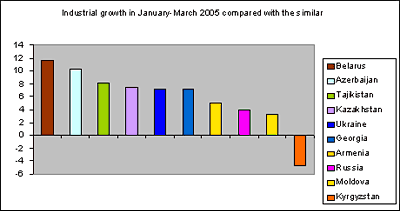
Source: BNS
On 16-17 May in the Ukrainian town of Vinita took place a new round of consultations between the conflict parties and the mediators in the Transnistrian conflict settlement. The key issue discussed at the meeting was Ukraine's plan on the Transnistrian conflict settlement and the seven settlement principles proposed by President Yushcenko at the GUUAM Summit held in Chisinau recently.
In an interview to Radio Free Europe, the Head of the OSCE Mission to Moldova, William Hill, said that the Moldovan side reacted positively to Ukraine's plan, which the OSCE also supports, whereas the Transnistrian side had a number of questions about it. At the same time, Hill said that the Moldovan, Transnistrian, Ukrainian and OSCE representatives decided to invite the EU and US to join the settlement process as observers.
Moldovan and Ukrainian authorities published the plan a few days after the Vinita meeting (see full text in Russian at: www.mfa.gov.ua). The plan reiterates the principles of sovereignty and territorial integrity of the Republic of Moldova, proposes that a special legal status is granted to the Transnistrian region within the Republic of Moldova, provides for Transnistria's right to self determination only in the event that the Republic of Moldova loses its independence and sovereignty and proposes the creation of a common legal, economic, defence, social, customs and humanitarian space. The plan envisages early free and fair elections to the Transnistrian 'supreme soviet' under international monitoring before Moldova recognises this body as the legitimate representative body of the region. The settlement is to take place in threes stages, each stage not exceeding six months in duration. At the first stage, the Moldovan Parliament is to pass a law on the key principles of settling the status of the Transnistrian region, on the basis of which Transnistria adopts a new Constitution. Then, in October-November 2005, free and fair elections to the 'supreme soviet' are organised under OSCE aegis. A parliamentary commission composed of Moldovan and Transnistrian deputies then prepare a draft law on the status of Transnistria, which is to be passed by the Moldovan Parliament. The law enters into force upon the approval by the Moldovan Parliament of an Agreement on Guarantees on the Observation by the Republic of Moldova of the Status of Transnistria, concluded among the future guarantors - Russia, Ukraine and OSCE, possibly assisted by the US and the EU. Lastly, a Conciliation Committee is set up of representatives of the two parties, Ukraine, Russia, OSCE and possibly the US and the EU, which is to settle all disputes arising from the implementation and/or interpretation of the provisions of the Law on Transnistria status.
At a press-conference held soon after the plan was published, Minister of Reintegration Sova said that the Moldovan authorities are generally happy with the plan and are ready to start implementing it.
On the other hand, analysts and political party leaders identified a number of weaknesses of the plan, such as the requirement that the law on the status of Transnistria is developed in accordance with previous documents signed within the Transnistrian settlement process, the provision on granting Transnistria the status of 'republic', and a clause allowing Transnistria to participate in foreign policy decisions affecting it, which literally entitles Transnistria to veto any decision on the withdrawal of Russian army from the region.
Although initially the Transnistrian authorities reacted positively to most of President Yushcenko's seven principles, the tone in Tiraspol has changed now that the entire plan has been disclosed. According to the official news agency Olvia-press, the plan is but a cover under which the Moldovan Government intends to decide the destiny of Transnistria and mobilise international pressure against it. Tiraspol rejects the idea to extend the negotiations format by inviting the US and EU to join it and the democratisation plan which is to result in Moldovan parties and candidates running for the Transnistrian 'supreme soviet'. The Olvia-press commentator has reasons to be worried about the new plan, however the most serious threat being faced now by the break away regime comes from inside rather than outside the regime.
Thus, on 19 May, 34 out of the 37 deputies in the Transnistrian 'supreme soviet' voted for a number of amendments to the 'Transnistrian constitution' intended to scrap the powers of the 'president' and increase the role of the 'supreme soviet' (the legislative body) in the interpretation of the 'Constitution' and its control functions in relation to the administration and use of state property, activity of the Central Bank, the process of denationalisation and privatisation, creation and implementation of 'state budget' and the 'public spending'. The amendments were initiated by a group of deputies headed by Evghenii Sevciuc, Deputy Speaker of the legislative, who is reportedly linked to wealthy business circles unhappy with the Smirnov regime. The deputies intend to take the constitutional reform as far as to transfer most powers from the executive power to the legislative one.
This unprecedented blow to the Smirnov regime is likely to change radically the internal political dynamics of the Transnistrian region. However, one cannot be sure that this will necessarily benefit the conflict resolution process, as Minister Sova hopes it would thus helping the Moldovans put the Ukrainian plan into place. Evghenii Sevciuc is known as a moderate reformer, but his ultimate aim is to consolidate the independence of Transnistria. However, an eventual split in the Transnistrian ruling elite and the removal of Smirnov from power will eventually weaken the regime, and, with an appropriate dose of diplomatic and economic pressure from both Moldova and its neighbours, one day it might simply collapse.
1. Informal CIS Summit
On May 8, on the occasion of 60th anniversary of the Victory Day, ten CIS Head of States gathered in Moscow for an informal CIS Summit, including Moldovan President, Vladimir Voronin. Absent were Azerbaijan's Ilham Aliev and Georgia's Mikhail Saakashvili.
According to the Presidential press service, during the talks on adjusting national laws on social security of the veterans, President Voronin underscored the importance of clear-cut regulation of the pension allocation to veterans. Also President Voronin talked migration within CIS and joining efforts to fight international terrorism, cross-border terrorism, smuggling and trafficking in human beings.
While in Moscow, Voronin met his Armenian counterpart Robert Kocearean to examine the possibility of bilateral cooperation in winery, transportation, IT and culture.
At the end of the summit Vladimir Voronin together with other heads of state signed a Joint Declaration on Humanitarian Cooperation between CIS member states.
2. Bucharest SEECP Summit
On May 11, Bucharest hosted the 8th Summit of South-East European Cooperation Process (SEECP). Albeit Republic of Moldova took part at the event as an observer, Moldovan diplomats strive to become full rights members.
President Voronin heading Moldovan delegation reiterated Moldova's interest to join the structure, praised Romanian chairmanship over the process, and announced Moldova's readiness to support a joint campaign on fighting organized crime and corruption. Voronin also informed that Moldova had already developed an action plan on its participation in the South-East European Cooperation Process.
Given that many regional organizations are complementary and RM took over the chairmanship over two of them, i.e. GUUAM and Organization for Economic Cooperation in the Black Sea region, President Voronin proposed hosting a joint meeting of the different fora: Stability Pact for Southeastern Europe, South-East European Cooperation Process, GUUAM and Organization for Economic Cooperation in the Black Sea region. The agenda of such a forum might include multilateral cooperation in fighting terrorism, trafficking in human beings, organized crime, corruption, energy and infrastructure.
Participants to the Bucharest forum signed a Declaration of the 8th Summit of South-East European Cooperation Process. The document includes 29 points touching upon cooperation in economy, home security, and justice. For Chisinau the third point of the Declaration is the most relevant as it entrusted the Committee of Political Directors to reexamine Republic of Moldova's application to be accepted as a full rights member.
3. Council of Europe Summit
The Third Summit of Heads of State and Government of the Council of Europe grabbed the attention of the international public opinion for two days. The Third Summit was hosted by Warsaw, following similar summits in Vienna 1993 and Strasbourg 1997. This time however, the Summit gathered all the European countries except for Belarus.
President Vladimir Voronin headed the Moldovan delegation which had meetings among others with, Secretary General Terry Davis; Commissioner for External Relations and European Neighborhood Policy Benita Ferrero-Waldne; President of the Congress of Local and Regional Authorities Giovanni Di Stasi; Polish President Alexander Kwasniewski, Latvia's Vaira Vike-Freiberga and Lithuania's Valdas Adamkus; as well as Ukrainian Minister of Foreign Affairs Boris Tarasiuk. High on the agenda of the meetings were resolution of the Transdniestrian conflict, enforcement of the EU-RM Action Plan, local government reform.
Along other Heads of State President Voronin signed three European Conventions: Convention on the prevention of terrorism, Convention on laundering, search, seizure and confiscation of the proceeds from crime and on the financing of terrorism, and Convention on action against trafficking in human beings.
4. Stability Pact's Regional Table
On May 18 Moldovan delegation flew to Sofia for the Stability Pact's Regional Table. Regional Table unites beneficiary and donor states as well as international organizations. The meeting of the Regional Table was preceded by a day (17 May) of theme-focused Working Table meetings where issues of regional ownership, regional infrastructure and energy and defence conversion were debated. During the first table "Democracy and Human Rights" discussion centered around boosting cross-border cooperation on "Education and Youth" dimension.
Ukrainian plan
Igor Botan
The "Plan for resolving Transdnistrian conflict proposed by Ukraine" published on May 20, 2005 together with the comments that followed from Minister of Reintegration, Vasile Sova, shall generate many more debates in the future.
A closer look at the Plan, the context in which it was made public, collateral events, domestic and international reactions to the document both critical and more "balanced" ones, gives the impression of a show with actors playing their parts. Those left aside have been taken by surprise and are the mere spectators of the show.
The way "Ukrainian plan" was developed is reminiscent of Moldovan authorities approach after 2001 when it used to ask mediators to come up with propositions that would be acceptable to Republic of Moldova (RM). The benefit for the mediators was evident - reaping the laurels of regional leaders able to come up with solutions for the entire region.
Up to late 2003 Russian Federation had been RM's strategic partner that is why 2002 Kiev OSCE plan to a large extent reproduced federative model outlined in the Constitution of the Russian Federation. Diplomats hinted that Moldovan authorities requested the release of the document under OSCE auspices. It is known for a fact that when President Voronin decided to introduce the "asymmetric" elements into the federative plan, he asked his Russian counterpart Vladimir Putin to develop a new plan. After refusing to sign the "Kozak Memorandum" in November 2003, President Voronin publicly acknowledged that about 70% of the document had been written in Chisinau, while the rest 30% had been coordinated with Moscow and Tiraspol in view of reaching a comprise.
The same holds true for the Ukrainian plan. It is very unlikely Ukraine to have developed a plan without being asked by Chisinau first. Undoubtedly, prior to being made public the Plan's provisions have been carefully coordinated between Chisinau and Kiev. By doing so, Chisinau attempts to end the stalemate and create a new framework for the resolution of the Transdniestrian conflict. The benefits for Ukraine are numerous, ambition to become a regional leader, but also the need to resolve a conflict at its borders.
Moldovan authorities' stake on the "Ukrainian Plan" is understandable, given that Kiev holds real levers to influence the situation by means of its customs policy at its border with Transdniestria. Still, it is not less important how other strategic actors are dealt with. Under those circumstances Moscow's role morphed from a pro-active to a defensive one, of defending its own interests and the interests of secessionist regime it has been supporting. Having said that, Russia and Transdniestria have practically the same interests - to reject the Plan.
US and EU positions have been taken into account in as far as they are committed to protect their interests in the region. Rejection of the "Kozak Memorandum" in November 2003 has shown that their interests resume to political stability in the region and not allowing proliferation of Russian military presence in the region. As for the rest, it is less relevant for US or EU whether a federative model or any other would be chosen.
2. The gist of "Ukrainian Plan"
The "Ukrainian Plan" gives the impression that what the authors wanted is very difficult to achieve. On the one hand, the main provisions of the plan reiterate the recent statements made by Moldovan authorities, i.e. giving up on federative model and renewing negotiation format.
On the other hand, the document clearly shows that its authors did not give up on previous engagements, ideas and even fears as regards Transdniestrian conflict, however these are worded differently in the "Ukrainian Plan". Indeed, this new approach seeks to avoid antagonizing Russian Federation even further, that already threatened to impose economic sanctions against Moldova.
As it was mentioned, in choosing the partner to propose the plan to resolve Transdniestrian conflict, Chisinau in fact chose the method of resolving the conflict. That was the case of the plans developed by the Russian Federation envisaging federalist models of resolving the conflict, methods which Transdnestrian authorities tended to turn into confederalist ones (similar to agreement between Serbia and Montenegro). Those models implied amending the Constitution of the Republic of Moldova, with all the ensuing consequences.
The same holds true for the Ukrainian Plan that greatly resembles the model applied in Crimean Autonomous Republic. Thus according to the "Ukrainian Plan" Republic of Moldova is a sovereign, independent, and territorially integral state, the single subject of international law. Transdniestria is granted the status of autonomous republic within the framework of the current Constitution of the Republic of Moldova. Under the plan common areas would include: law, economy, defense, social field, customs, humanitarian, etc. Under "Ukrainian Plan" Transdniestrian region is to be "administrative-territorial entity in the form of a republic within the Republic of Moldova" entitled to its own Constitution and symbols along the state ones which is definitely taken from the Crimean model. Certainly, "Ukrainian Plan" contains provisions from other previous documents, from Primakov Memoradum of May 1997 to the most recent Stability and Security Pact for the Republic of Moldova. Of course there is more or less shift in accents.
However, more provisions have been taken from Primakov Memorandum. This specifically refers to pentagonal negotiation format (parts - Republic of Moldova, Transdniestria, and mediators - Russia, Ukraine, and OSCE). The innovation is that the latter are to sign the Plan in the presence of US and EU. Moldovan Minister of Reintegration has called this new formula a "floating format". The document allows for US and EU involvement in the Plan enforcement: a) overseeing elections to Transdniestrian Supreme Soviet; b) assisting the drafting of the law on special legal status of Transdniestrian region; c) taking part in the Counseling Commission entrusted to settle down any disputes in interpreting the law on the special legal status of Transdniestria. Exceptions are "enforcement of international legal measures" in cases when one party or another breaches the plan, right reserved only to mediators - Russia, Ukraine and OSCE. Noteworthy, there is no mention of the type of measures to be applied.
However the most interesting are the terms, stages, and sequence of events provided for in the "Ukrainian Plan". The conflict is to be settled in three stages, six months each:
The guarantees granted by "Ukrainian Plan" to Transdnistria are specific to Moldova, as the very same guarantees were provided to Gagauz-Yeri in 1994. This is yet another evidence to the fact that Moldovan side took part in the elaboration of the Plan. Under the "Ukrainian Plan" Transdnistria would be entitled to "leave RM in case the latter decides to join another state" and/or RM looses its status as a subject of international law. Another Moldovan - style guarantee is the "Treaty on guaranteeing Moldova's observance of Moldova's law on the special status of Transnistria", which is nothing but a different Stability and Security Pact for the Republic of Moldova launched by President Voronin one year ago. "Ukrainian Plan's" provision on Conciliation Committee including representatives of RM, Transdniestria, Russia, Ukraine, OSCE and possibly US and EU, is also a carryover from the Pact. The goal of the Commission would be to settle any disputes between the two parties in case of different interpretation of the Law on Special Status of Transdniestria. One of the major differences between the "Pact and Ukrainian" Plan is the fact that Romania was excluded, while Transdnistria included, whereas US and EU could only assist the drafting of the Treaty.
3. Context and collateral events
The context in which "Ukrainian Plan" was drafted and made public needs a closer examination. Firstly, this is the first document coming after the European Court on Human Rights' judgement on "Ilascu case" clearly indicated that from a military, political, and economic point of view Transdniestrian region had been accountable to Russian Federation. Albeit the latter disapproved of the ECHR's judgment, it still complied. Having said that, for more than a year now there have been premises for a new approach to resolving Transdniestrian conflict. Indeed, "Ukrainian Plan" ensues from this new context, however Moldova refrains from making the necessary adjustments, giving thus Russia a chance to save face and withdraw honorably from the region.
Secondly, the new context has been shaped by the regional tendencies, i.e. NATO and EU enlargement, the way Russian Federation protects its interests in the region. Recent revitalization of GUUAM and revision of its goal brought about the "Ukrainian Plan". Accordingly, US support to GUUAM is extremely important.
Thirdly, tensions arisen between Transdnistria's Supreme Soviet majority and Igor Smirnov's administration on the Constitution modification in view of reducing the latter's powers bear both risks and benefits for the Plan. On the one hand those tensions show the vulnerability of the regime functioning like a "fortress under siege" that ought to hold on regardless the price, including the price of maintaining an authoritarian regime headed by Smirnov clan (Maracutsa, Antiufeev, Litskai etc) that generated the conflict in the first place, then lead the regime and now is interested to perpetrate the status quo, of which they are the only ones to befit both politically and economically. Those tensions also highlight the lack of democracy in Transdniestria, an extremely important factor in the new context of GUUAM declared goals. The "Ukrainian Plan" may serve as a good argument for Smirnov clan in "convincing via specific methods" the "reformatory deputies" from Transdniestria to give up on amending Constitution so as to resist the "foreign danger".
4. Estimations and possible evolutions
The release of the "Ukrainian Plan" may be seen as a positive event, even if the chances of its enforcement are very slim. At least there is a document that may be submitted to mediators, other interested parties, as well as US and EU, Romania. Except for Russia and Transdnistria, the other parties have no apparent reason to reject it, however they may want to come up with questions and ask for specifications. That is exactly what Chisinau wants.
The mere fact that Russia and Transdnistria voiced criticism and lingering concerns with regard to "Ukrainian Plan" did not take Moldovan authorities by surprise. Anyhow the first stage of the plan totally relies on Moldovan side that should adopt the would-be Law on the Basic Principles of the Status of Transdnistrian Region of RM by July 25, 2005. The adoption of such a law is probably intended to channel any initiative coming from foreign partners into the legal framework of the RM, whose sovereignty they respect. There is nothing more RM could do, everything now is up to the foreign powers. And here the benefits end, so let us consider the pitfalls of the "Ukrainian Plan".
Firstly, "Ukrainian Plan" does not provide for any measures "to convince" the Transdnistrian side, in case it chooses to ignore the plan. It is all-to-clear that Tiraspol regime has survived only due to Russia's and Ukraine's support. Still it would be possible to develop and apply mechanisms that would steer the region away from a humanitarian crisis and at the same time would determine Tiraspol to be more receptive to propositions on resolving Transdnistrian conflict. A starting point would be securing the RM - Ukraine border by establishing joint customs control units. By accepting such measures Ukraine would send a clear message as to its interest to settle Transdnistrian conflict. The failure to enforce such measures leaves room for speculations about an alleged competition between different "groups" in Kiev administration, namely Supreme Security Council Secretary Piotr Poroshenko and Minister of Foreign Affairs, Boris Tarasyuk. If indeed such a competition exists then "Ukrainian Plan" is nothing but a compromise between those "groups". And this because the Plan is not feasible in the given time without the aforesaid measures. Further, once the deadlines established for three phases expire Ukraine would most probably loose its interest. Under those circumstances, the primary goal for Transdnistria would be to survive up till the deadline, while later upcoming elections in Ukraine would open them new opportunities.
Secondly, the fears of opposition and many pundits that enforcement of the "Ukrainian Plan" would end with legitimizing Transdnistrian Supreme Soviet are quite real. Their argument is that by recommending monitored elections to the Supreme Soviet, "Ukrainian Plan" does not take into account Smirnov administration, a clan interested in perpetrating the secessionist regime, preserve the military, including Russian troops. The Plan does not take into account the structures that really "guarantee" the existence of the secessionist regime. "Ukrainian Plan" provides guarantees to Transdnistria, but none to Moldova in case Tiraspol ceases cooperating immediately after elections to the Supreme Soviet that would legitimize it as a representative body of the "Transdnistrian people". Technically speaking this could be achieved quite "convincingly". For instance Transdnistrian Supreme Soviet might adopt a "normative act" as provided by the Plan, thereby it would consent to cooperation with Chisinau within the framework of the would-be Law on Basic Principles of the Status of Transdnistrian Region of the RM, and would allow for international monitoring over elections to Supreme Soviet in order to legitimize election results. However, Smirnov may want to make a well-calculated pause and then strike. Under the Constitution Smirnov might appeal to Constitutional Court of Transdnistria that would rule that "Ukrainian Plan" runs counter to Constitution. Therefore, supposedly not only the Supreme Soviet but the entire regime might get a legitimacy following the formula - who has coercive power to enforce judiciary rulings that one is legitimate. Who would stop the Supreme Soviet from acknowledging their own mistake?
Both Transdnistria and Russia would be quite tempted to halt Tiraspol's cooperation with Chisinau after elections to Supreme Soviet are recognized legitimate. The thing is that Russian troops would have to be withdrawn once the conflict is settled. There are a number of evidences to the fact that Russia does not want to withdraw its military from the region, the most eloquent of them - its stance towards obligations assumed at Istanbul OSCE Summit. Half-measures that would only legitimize Supreme Soviet leading to end of cooperation with Chisinau would result in fruitless discussions on the synchronizing withdrawal with final resolution of the conflict. Meanwhile, the effects of "economic sanctions" imposed by Russia on Moldova, coupled with a price hike on energy would serve as quite efficient levers in the hands of Russia when dealing with their Moldovan counterparts. One may conclude that democratization of the Transdnistrian regime via internationally monitored elections, without some demilitarization measures and without creating conditions for the departure of the groups responsible for instigating and benefiting from the conflict (as identified in the ECHR judgment), that is decriminalization, bears considerable risks. In fact "Ukrainian Plan" should be improved considering the provisions of the "Declaration on political partnership in view of accession to EU", unanimously voted by the Moldovan legislators. The document clearly indicates that Transdnistrian conflict should be settled in line with the Constitution of the Republic of Moldova and international law in close cooperation with OSCE, EU, Romania, Russia, US, and Ukraine and according the to the "3D" formula - democratization, demilitarization and decriminalization of the Transdniestrian region.
Out of all these "2D" and Romania felt out. This is quite sad as after Russia imposed economic sanctions on Moldova, Romania has proved to be one of the most useful partners. Nevertheless, "Ukrainian Plan" fails to confer any role whatsoever to Romania in the negotiation process. Moreover, apparently Moldovan authorities are interested in diminishing Romania's role even further. This has produced some curiosities in the "Ukrainian Plan", such as "the right of Transdnistrian inhabitants(!) to self-determination" in case Republic of Moldova looses its sovereignty and independence. Albeit situation has changed, Romania being now a member of NATO and is about to join EU, the same wording was used as in 1994 in the case of Gagauz Autonomy (Law on Special Legal Status of Gagauz-Yeri), which at that time provided guarantees that Moldova would not join Romania.
Several things are to be mentioned. Why it didn't cross the mind of Plan authors that the rights they came up with might be claimed by other communities as well. For instance, how would they like this: "the right of Donbas inhabitants to self-determination" in case they deem Ukrainian central government promotes pro-EU, pro-NATO, and anti-Russian policies? Secondly, asymmetric treatment of the interested parties should be taken into account. On the one hand, Russia recognizing sovereignty, independence and territorial integrity of the RM but de facto controls politically, economically and military 15% of the RM territory; on the top of that adopts laws that would allow other territories (controlled by separatist regimes supported by it) to join Russian Federation, finally it has the status of mediator and guarantor. On the other hand, Romania having a frozen conflict at its borders is totally ignored in the conflict resolution. In this respect, curiously, census data revealing ethnic composition of the RM were made public right before the "Ukrainian Plan", despite international experts' advice not to do so. Supposedly, the low figure of Moldovan citizens who identified themselves as Romanians, only 2.1% determined the authors of "Ukrainian Plan" to ignore Romania. If so then things should be made clear: either the number of Romanians in Moldova is so low that the fears that Moldova would join Romania and therefore granted the "right of the Transdnistrian inhabitants to self-determination" are groundless; or the "right of the Transdnistrian inhabitants to self-determination" is justifiable and the census data are rigged. In both cases things are quite sad. Statistics data are not reliable given that they considerably differ from the number of votes in favor of parties, dubbed by official propaganda as pro-Romanian. If they were indeed reliable, then things are even more gloomier. In that case one would say that Moldovan citizens, tens and hundreds of thousands of them who applied for Romanian citizenship are cynics as they did so for obscure interests. Anyway the credibility of Moldovan authorities and the way citizens view them would have a crucial impact on the model of settling Transdnistrian conflict, its collateral effects, European integration, as well as visa regime negotiations with Romania.
The following contributed to this issue:
|
© 2001-2015 Association for Participatory Democracy "ADEPT" Reproduction of the materials is welcomed provided the source is indicated | e-mail: [email protected] |