
Participatory
Democracy
Original: /en/e-journal/20050609/index.shtml
| Association for Participatory Democracy | Print version. Published on www.e-democracy.md Original: /en/e-journal/20050609/index.shtml |
Activity of Public Institutions
1.1. Legislative documents
During the aforesaid period Parliament passed the Law on the Modification and Completion of the Law on Employment and Social Security of the Unemployed. The goal of the law is to bring national laws in accordance with Labor Code and enhance social security of the unemployed. Under the law, ousted employees who would register with employment agencies would be also entitled to unemployment aid. Furthermore, the law reduces unemployment aid from 50-60% to 30-50% of the previous salary.
Another important law approved by the legislators is the Law on Modification and Completion of the Law on the Status of Refugees. The amendments come in response to recently passed international documents in the field of refugees. The law includes new provisions on several institutions:
In view of preserving "Valea Morilor" park Parliament passed Resolution on granting "Valea Morilor" park in Chisinau the status of monument of architecture. The park was founded in 1951 and currently has 113.9 hectares. By including the park in the list of places under state protection, it would be preserved and become a center culture and recreation, a natural attraction.
Of special interest is the Resolution on abolishing sanctions on prostitution. Parliament resolution that approved the Action-Plan in the field of Human Rights back in 2003 provides for amending the law so as to persecute both the person providing the service and the clients of such services. Since then the criminal law has changed and it does no longer sanction prostitution due to its low social harm. Prostitution continues to be sanctioned as a contravention. In most European countries the client of such services are not sanctioned, that is why Moldovan legislators considered there were no grounds to introduce such sanctions in Moldovan law.
Via the Law on Botanical Gardens, these will have a special legal status - science and innovation public institution under the jurisdiction of the Academy of Science of Moldova or local government. This status would exempt them from state taxes and fees and would allow them to attract foreign investments, including from the private sector. Under the law constructions on the soil of the botanical garden shall be only approved based on a project of the Academy of Science and other urbanism documents. The sale or rent of land on the soil of botanical garden shall be prohibited. The law also entitles botanical gardens to conduct economic activity so as to collect revenues for their maintenance and development.
Law on Granting Facilities to Residents of Transdnistrian Region exempts from VAT electricity, gas, telecommunication services, water and sewage supplied by legal entities located on the soil of the Republic of Moldova and not having fiscal relations with its budgetary system. The said law compensates the difference in tariffs on electricity and gas for the residents of Varnitsa of Anenii-Noi. Those residents did not get compensations as they received electricity and gas from the left of Dniester.
Law on The Modification of the Code on Administrative Offence establishes a "conventional unit" instead of minimal salary when calculating administrative sanctions. As of now sanctions will be calculated in conventional units, one equaling 20 MDL.
Law on Granting Labor Inspection the Right to Impose Administrative Sanctions was largely debated by the legislators. Opposition together with some majority faction deputies objected another institution having the right to impose administrative sanctions. However the supporters replied that those sanctions would stop the numerous violations of the labor law. The initiative was voted from the first attempt, however later, one of the opposition deputies withdrew his vote under the pressure of his colleagues. Therefore Communists had come with an additional vote to secure the approval of the law.
(For more information on the legislative activity please see "Legal Commentaries" on ADEPT website).
2.1. Reshuffles
As part of Government reorganization, Valeriu Lazar Minister of Economy and Commerce, was appointed as Republic of Moldova's representative to CIS Economic Council, thereby replacing Vasile Iovv.
On May 25, Government appointed Igor Semenovcher as Director General of the Agency for Regional Development. Apparently the newly established agency would oversee the implementation of "Moldovan Village" National Plan. Via the same resolution, Mr. Semenovcher was ousted from the previously held position of Deputy Minister of Industry and Infrastructure.
2.2. Resolutions
As for the organizational measures to be undertaken: Chairmanship of GUUAM (currently GUAM); negotiating and signing bilateral cooperative agreements with EU member states in the field of European integration.
Under the motion, Ministries and other local government authorities should submit within one month individual action plans on the plan enforcement to the Ministry of Foreign Affairs and European Integration. Based on those plans the Ministry would develop and submit for Government approval the National Plan.
According to the Senior-Deputy Prime-Minister Andrei Stratan by enforcing the plan Moldovan legislation would be adjusted to European standards, as provided by the EU-Moldova Action Plan and various joint projects would be carried out to consolidate local democracy and support social-vulnerable groups.
3.1. Voronin - Yushcenko meeting
President Vladimir inspected the new equipment to be used in ensuring the security of the Moldovan - Ukrainian border. On this occasion, Vladimir Voronin met his Ukrainian counterpart Viktor Yushenko. Apart from resolving Transdnistrian conflict, which would be considered in greater detail below, the Two signed a bilateral agreement on crossing Moldovan-Ukrainian border that would serve as basis for defining the principles and procedures for the functioning of the joint Moldovan-Ukrainian customs. In addition the Presidents agreed on establishing informational-cultural centers in the two countries and on convening the joint Moldovan-Ukrainian commissions to settle all the patrimony disputes between the two countries. Ukrainian part also pledged to examine the possibility of exporting electricity to Balkans via Moldova.
1. Banks and insurance
The governor of the National Bank of Moldova (BNM), Leonid Talmaci, has reported on activity of BNM in 2004 to the parliament at a recent sitting. Although the bank sector did not post a wonderful evolution, the financial stability was one of its successes in 2004.
The evolutions on the currency market and dynamic of inflation in 2004 threw doubts on the BNM's efforts to respect the monetary targets from the Monetary-Currency Policy for 2004. The supply of currency on domestic market rose under the influence of remittances from abroad (a 70-percent estimated growth) and collections from exports (25 percent). To oppose the excessive appreciation of the Leu, the BNM intensively purchased currency in the second quarter, so that its reserves rose by 55 percent in December up to over 470 million dollars. The annual inflation rate in December 2004 was 12.5 percent, compared with the 8-10 percent inflation forecasted by BNM.
Under such a situation, the BNM had to introduce important changes of key monetary policy tools, and namely it increased the targets for monetary base and unit M2. Raising currency reserves through acquisition of currency from banks was the main monetary growth channel in 2004. However, this tendency seems to be dangerous since it generates new inflationary spirals. The sterilization operations undertaken by BNM were inefficient, while the used tools had low financial maturity terms.
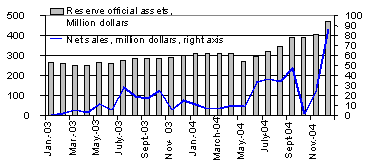
BNM officials have recently said that the National Bank of Moldova could raise this year 600 million dollars in international reserves, though they remained almost unchanged in the first four months of 2005.
BNM purchased 277.1 million dollars on the domestic market in 2004, as a significant supply of currency was available on currency market, particularly generated by remittances of Moldovan nationals who work abroad, while the international reserves rose by 55 percent.
The remittances are on a significant rise this year as well. According to BNM, Moldovans transferred 153 million dollars in the first quarter via bank channels alone, by 53 percent more than in the similar period of 2004.
On the other hand, the remittances in currency represent a massive pressure on the domestic currency market since only ten percent of the money earned abroad represents direct investments, another 60-80 million dollars of annual remittances is deposited in banks, while the rest goes to consumption.
If the remittances grow in continuation the same way, they could amount to more than 600 million dollars this year, and for over one billion dollars, if taking into account the extra-bank inflows, too. We think that the BNM is trying to rebuild a normal stock of currency reserves, so that to enhance Moldova's credibility (and to recover its image) on international capital markets and in front of foreign financiers.
2. Labor market
As usually, the largest salary was paid to bank employees, 4,305 lei, by 204 lei more than in March; in the energy industry, gas, and water supplying business, 2,258 lei; in the transportation and communication, 2,161 lei.
The lowest salary was paid in the agriculture, 607 lei a month on average, by nine lei less than in March; in the education area, 872 lei; and in the healthcare and social assistance, 971 lei.
Statistics show that workers in the agriculture sector represented 37.1 percent of the total of employed people at the end of the 1st quarter, by 4.6 percent more that in the similar period of 2004. Workers in the industry sector count for 12.5 percent, services 37.2 percent, medicine and education 14.3 percent.
The parliament has passed amendments to the law on employment and social protection of job seekers. They call for the enlargement of categories of unemployment assistance beneficiaries and lower joblessness indemnities.
The monthly average unemployment indemnity counts for 507 lei (40.5 dollars) at present, and it will amount for 497 lei (39.7 dollars) after enforcement of the new amendments. The category of beneficiaries of unemployment assistance comprises the
people sacked after the closure or reorganization of enterprises, who will benefit from a joblessness indemnity of 50 percent of the medium salary for the precedent year.
Many lawmakers representing the parliamentary opposition demanded that the unemployment indemnity remain unchanged, saying that the voted version is unacceptable because it has positive and negative sides. Job seekers will receive lower sums from the state, though the number of beneficiaries will grow, they added.
The state-owned enterprises (public property) hold 21.2 million lei or 15.5 percent out of overall arrears, the private sector 88.3 million lei or 64.6 percent, mixed property (public and private) 22.6 million lei or 16.5 percent, and foreign property 4.6 million lei or 3.4 percent.
3. Foreign trade
Russia is the main sale market for Moldovan wines, as it absorbs more than 80 percent of the total of wine production, followed by Ukraine, Belarus, Poland, and Germany. Moldova exports wines to 27 states of the world.
MoldovaVin forecasts a 10-percent growth of wine exports for this year up to about 300 million dollars. Moldova exported alcohol production worth 278 million dollars last year.
According to a study undertaken by the Chamber of Commerce and Industry (CCI) on basis of data of the International Trade Centre (ITC), Moldova was ranked the 11th place in the world top of the biggest wine exporters in 2003, and it held 1.2 percent of the world wine export. Following Moldova in the world top are Argentina and New Zealand, which held less than one percent of the world wine export.
According to the study, France was the world leader of wine exports in 2003, its supplies were valued at 6.6 billion dollars, or 37 percent of the world export. Italy exported wines worth 3 billion dollars in 2003, Spain 1.67 billion dollars, and Australia 1.54 billion dollars. Italy held 17 percent, Spain 9 percent, and Australia 8 percent of the world wine export.
On the other hand, the study shows that the United Kingdom and the United States were the biggest importers of wines, and they held 20 percent and, respectively, 19 percent of the world wine import in 2003. Germany held 11 percent. The world Top-10 biggest wine importers comprises Japan - 5 percent, Belgium 5 percent, Canada 4 percent, Switzerland 4 percent, the Netherlands 4 percent, France 3 percent, and Denmark 2 percent.
Also, exports of wines and strong alcohol drinks represented about 50 percent of the overall supplies in January-April, or 995.6 million dollars. Supplies of fruits and grapes declined from 460,000 dollars in January-April 2004 down to 239,000 dollars in the first four months of 2005. Exports of perfumery and cosmetics rose by over 20 percent
up to 961,000 dollars.
Russia's restrictions for imports of fruits, vegetables, meat and sausages from Moldova did not seriously hit the domestic businesses for the time being, but the losses will be visible the next months, if Moldova fails to resume the exports. Earlier, the Agriculture Ministry had forecasted that the exports of agricultural-food products will grow by about eight percent this year, while imports will remain at the level of 2004-2003.
4. Moldova and the world
The European Bank for Reconstruction and Development (EBRD) forecasts a 5.5-percent economic growth for Moldova in 2005
EBRD experts estimated that Moldova will register a 5.5-percent economic growth in 2005, compared with 7 percent in 2004.
The world economy will provide a less favorable environment for the transition economies in 2005, compared with 2004. The performances of the U.S. economy in 2004, as well as the positive estimates for 2005, suggest that the better results of the developed countries will reduce the capital inflows in the transition regions.
According to EBRD analysts, the economies in East Europe and former Soviet states will post a 5.2-percent average development pace in 2005, compared with 6.5 percent in 2004. The slower growth pace is particularly due to the worsening of economic climate at the world level; the high interest rates in the United States; possible declines of the capital inflows in this region.
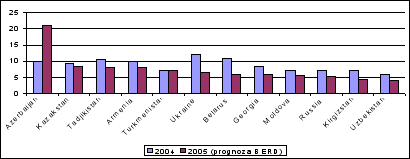
The EBRD forecasts slower growth rates in all the CIS members, except for Azerbaijan. Thus, Russia's economy will grow by 5.2 percent in 2005, compared with 7.1 percent in 2004; Ukraine 6.5 percent, compared with 12.1 percent in 2004; Armenia 8 percent, compared with 10.1 percent in 2004; Georgia and Belarus 6 percent, compared with 8.4 percent and, respectively, 11 percent in 2004; Kazakhstan 8.5 percent (9.4 percent in 2004); Tajikistan 8 percent (10.6 percent); Turkmenistan 7 percent (7.2 percent); Kyrgyzstan 4.5 percent (7.1 percent); Uzbekistan 4 percent (6 percent); and Azerbaijan 21 percent, compared with 10 percent in 2004.
In turn, the International Monetary Fund (IMF) indicates a slower economic growth in the CIS in its latest global economy development report. According to the IMF estimates, Moldova will register a 5-percent economic growth in 2005. The Economist Intelligence Unit launched a similar forecast. On the other hand, the Moldovan government expects a six-percent economic growth in 2005.
Economic growth in the CIS area. Forecasts of the EBRD for 2005 (%)
Source: BNS
Elsewhere, Kurt Geiger, director of the Business Group, the department for financial institutions of the EBRD, told Moldovan President Vladimir Voronin last week that the EBRD will continue to assist Moldova to strengthen and develop the progressive bank sector. EBRD experts appreciate the situation of Moldova's bank sector as positive and stable.
Earlier, the EBRD had expressed readiness to start 10 new projects valued at 21 million euros in Moldova this year, including three worth about 10 million euros in the bank sector.
Under the EBRD Strategy for Moldova approved in July 2003, the Bank will assist the "development of the private bank sector and will provide efficient and adequate financing for private enterprises through local banks, especially for small- and medium-sized businesses and micro-enterprises."
Although the EBRD has opened cheap enough special credit lines in several local commercial banks, such as Victoriabank, Moldindconbank and Mobiasbanca, they increase the interest rate 2-3-fold and make inaccessible the long-term credits, which are absolutely necessary to finance the investment and production spending. Problems such as increased unemployment rate, vulnerability of national producers to foreign stocks, low quality of investment environment, and inefficient promotion of exports are directly connected to accessibility of these credits.
Within a special session on 10 June 2005, the Moldovan Parliament is to adopt a statement on the Transnistrian settlement plan proposed by Ukrainian President Victor Yushcenko. This decision was taken on 6 June at a working meeting of President Voronin with the leadership of the legislative body. According to a communique from the presidential press service, the meeting noted that the Ukrainian plan "reflects the principles of independence, sovereignty and territorial integrity of the Republic of Moldova, is based on the Moldovan Constitution and takes into account the interests of the population from both sides of Nistru River, as well as the aspiration to European integration of Ukraine and Moldova."
This comes a few days after the June 2 meeting between the Moldovan and Ukrainian presidents in Iasiki Odessa, whose key theme was Ukraine's settlement plan and joint measures in support of the plan. The two presidents signed a joint letter to Javier Solana, Secretary General of the EU Council, and Jose Manuel Barroso, President of the European Commission, in which they call for EU assistance in instituting an international customs control on the Moldovan-Ukrainian border and in setting up an efficient mechanism of international monitoring of the border. According to a presidential press service communique, President Voronin told the press at the end of the meeting that he appreciated the Ukrainian settlement plan and that the active involvement of Ukraine and European bodies in the settlement process create the necessary premises for the identification and application of a viable solution to the Transnistrian crisis. President Voronin is undertaking a visit to Brussels and Strasbourg on 7-8 June, where he will meet both with Solana and Barroso, but also with NATO Secretary General, with whom he will discuss primarily the prospects of regional and international cooperation in resolving the Transnistrian dispute.
On the other hand, immediately after the Iasiki meeting, Piotr Poroshenko, Secretary of Ukraine's National Security Council, on an assignment from President Yushcenko visited Tiraspol, where he met with the Transnistrian leader Igor Smirnov behind closed doors to discuss Ukraine's proposals. After the meeting, the Ukrainian dignitary told the press that the Transnistrian leadership had shown understanding of the prospects offered by the settlement process and that a number of compromises had been reached that had opened up new opportunities. He mentioned that a key task now is to resume the negotiations process because a viable solution may be found only at the negotiations table. An official Transnistrian position on the plan has still not been published, while the Transnistrian official press has interpreted the visit of Poroshenko as one reassuring against unilateral moves by the Moldovan Government and guaranteeing that Transnistria is treated on an equal basis with the Moldovan side.
In the meantime, the Ukrainian plan continues to be in the centre of attention of the Moldovan public opinion. The Association for Foreign Policy of Moldova, a Moldovan think-tank, has issued on 31 May a Declaration on the plan, in which it salutes Ukraine's intention to play a more active role in the Transnistrian conflict settlement process, but describes the plan as one unlikely to secure the territorial integrity and sovereignty of Moldova, let alone Moldova's strategic objective of European integration. Thus, the plan fails to mention anything about the withdrawal of the Russian army from Transnistria, the need to demilitarise the region, the liberation of the Moldovan political prisoners held in Transnistria and erroneously proposes that Russia and Ukraine, two states with considerable interests in the region, act as guarantees for the settlement agreements, etc. While most observers in Chisinau have acknowledged these shortcomings, some have noted that this sort of tough and controversial provisions would have upset Russia and Transnistria and were omitted deliberately from the plan, so that it is accepted by all parties as a basis of discussion. At the same time, observers note, after the publication of the plan, the Moldovan and Ukrainian Governments have actually taken a number of measures to make up for these shortcomings. The outcomes of the Iasiki meeting, but also President Voronin's agenda in Brussels and Strasbourg on the eve of the special Moldovan Parliament session on the Transnistrian issue seem to confirm this theory, at least for now.
1. GUAM
1.1. GUUAM ended in GUAM
As it was to be expected after GUUAM Summit held in Chisinau on April 22, Uzbekistan withdrew its membership in that regional structure. Uzbekistan notified of its intentions Moldovan authorities that exercised the Chairmanship of GUUAM via a letter. The grounds for the move, as indicated by President Karimov, were "the geographic location of the country does not allow pursuing economic and security interests of the country within the new projects and initiatives announced by the organization".
On this occasion, GUAM member countries issued a joint statement . It acknowledges Uzbekistan's right to freedom of choosing how to pursue its interests, dictates enlarging GUAM's spheres of activity, and guarantees that Uzbekistan's withdrawal "will not affect the quality nor the level of our friendship relations", expresses intention to boost cooperation with Uzbekistan in bilateral and international format.
Consequently, as of now GUUAM will be named GUAM.
1.2. Reunion of GUAM Parliamentary Assembly
On May 28, Yalta hosted the Second Reunion of the GUAM Parliamentary Assembly. The VIPs present at the forum included Marian Lupu, Moldovan Speaker (who also presided the meeting given that Moldova hold the Chairmanship); Murtuz Aleskerov, Chair of Milli Medjlis of Azerbaijan; Nino Burdjanadze, Speaker of the Georgian Parliament; Vladimir Litvin, Chair of the Ukrainian Rada; Inrida Udre, Chair of the Latvian Saeima; Ceslavas Iursenas, Deputy Chair of the Lithuanian Seimas and Teodor Melescanu, Deputy Chair of the Romanian Senate.
High on the agenda of the reunion were developing parliamentary aspect of GUAM to ensure economic growth, consolidation of democracy, stability in the region and accession to European Union and NATO. The reunion approved the membership of political and legal commissions, trade and economy commission, education, culture and science commission for the years 2005-2006. In addition it endorsed the resolutions adopted at the Chisinau GUUAM Summit, expressed the need to develop the structure, and raise its role in solving conflicts, fighting secessionism, extremism and other threats to international security.
2. Moldovan - Croat relations
On May 30-31, 2005 Croatian President Stjepan Mesic paid an official visit to the Republic of Moldova. As part of the official visit Croatian President met his Moldovan counterpart to talk bilateral economic relations, mutual support on the European and international level, preventing and fighting secessionism, traffic in human beings, arms and drugs. The Two also examined possibility of Croatian investments in Moldovan food industry and telecommunications.
Following the meeting, several documents were signed at the plenary session of the official delegations, namely: Joint Statement of the Presidents, Convention between the Croat and Moldovan Governments on avoiding double taxation, Governmental Agreement on reciprocal customs assistance.
The Joint Statement of the Presidents reaffirms both countries' European aspirations, commitment to democratic values and market economy, pledge to adjust Moldovan and Croat legislation to EU norms on free circulation of goods, services, capital and people. The document also emphasizes the need to boost cooperation in trade, transportation, communications, energy, tourism, science and culture.
Also the document talks of learning from Croat experience in European integration. Another important aspect outlined in the document is boosting cooperation within Stability Pact for South Easter Europe, Central European Initiative, and Process of Cooperation in Southeastern Europe.
What is the future of the Ukrainian plan on resolving Transdnistrian conflict?
Igor Botan
As a follow-up to the provision of the "Ukrainian plan" on the need to secure the support of the Moldovan civil society to the plan, Association for Foreign Policy (AFP) founded by former high-rank officials (including Prime-Minister, Deputy Minister of Foreign Affairs, Chair of the Parliamentary Commission for Foreign Policy, Presidential Councilor), former diplomats and pundits in foreign policy have recently issued a statement on the strong and weak sides of the Plan.
Among the strong points of the Plan, the document cites: a) growing Ukraine's interest to resolve Transdnistrian conflict, especially given the levers it holds to influence the secessionist regime; b) abandoning federative formula and acceptance to resolve the conflict in line with the Constitution of the Republic of Moldova by creating a single rather than joint legal, economic, social, defense, and customs areas; c) emphasis on democratization of the Transdnistrian region in solving the conflict; d) involving US and EU as observers at certain stages of the conflict resolution.
On the other hand, the Association found out a string of ambiguities and contradictions that might seriously undermine the security, stability and sustainability of the reintegrated state, let alone pursuing its strategic goal - accession to EU. Among the flaws, AFP cited: a) no reference to demilitarization of the Transdnestrian region, as well as to securing Transdnistrian frontier in view of fighting illegal trafficking and smuggling; b) preserving the same guarantor countries - Russia and Ukraine - the same "peacekeeping" arrangement; c) proposition to hold "early free elections" to the "Transdnistrian Supreme Soviet" that would only legalize regime's institutions without leading to demilitarization and decriminalization of the region; d) hypothetical granting of the "residents' right to self-determination", all of which raise many eyebrows, etc.
In general AFP endorsed the "Ukrainian plan", however given the numerous aforesaid flaws it recommended Republic of Moldova to ask for the international community's assistance in determining Transdnistrian administration to take steps that would show "minimal political will" to democratize the region: complying with European Court for Human Rights' judgment and releasing political prisoners; eliminating all the obstacles hindering the withdrawal of Russian army and munitions; canceling all restrictions on the free circulation of goods and people to and from Transdnistria; free access of international missions to munitions warehouses.
Noteworthy, there is a certain degree of convergence between the AFP proposals and the actions already undertaken or to be undertaken by the authorities. This apparent convergence may only mean that certain measures have been left out on purpose so as to avoid its rejection right from the beginning by domestic and international stakeholders.
2. Reactions from parliamentary factions
Despite the aforesaid flaws, "Ukrainian plan" has been accepted in principle by the leaders of the parliamentary factions as a document that might lead to the resolution of the Transdnistrian conflict. And this largely due to the fact that "Ukrainian plan" provides for the resolution of the Transdnistrian conflict by granting a special legal status to the localities to the left of Dniester that would fall within the Constitution of the Republic of Moldova. At least this might be inferred from politicians' statements, more so their reactions voiced after the meeting with President Voronin on June 6. At the meeting it was decided to convene a special session of the Parliament on June 10 to consider the provisions of the "Ukrainian plan" and adopt a Declaration regarding Parliament's position on the document. Practically all the leaders of parliamentary factions agreed that the Plan should be accepted as it is, the role of Moldovan authorities and political elite being to avoid the pitfalls and bring it in line with the European practices of conflict resolution. Noteworthy, if the said Declaration really stands a chance to be adopted than it is now, first time since the outbreak of the conflict in 1992.
3. Diplomatic efforts
The debates in Parliament and the would-be adoption by the legislators of a Declaration are aimed at reaching a wide consensus on resolving the conflict. At the same time, diplomatic efforts to secure international support to the "Ukrainian plan" gains grounds, which is of great importance for reaching a consensus domestically. Apparently, diplomatic activity is aimed at polishing the Plan's shortcomings that were pointed by the civil society and Moldovan opposition. Democratization of the region is clearly provided for in the "Ukrainian plan", while demilitarization and decriminalization are not. The latter are viewed by opposition as paramount. It is expected to achieve them with the help of the interested countries, European and Euro Atlantic institutions by resorting to Russia's obligation to withdraw its military from the region, European Court for Human Rights' judgment on "Ilascu case", securing the borders are cited.
President Voronin's trip to Brussels on June 7 - 8 right on the eve of the special hearing in Parliament on the "Ukrainian plan", his talks with the NATO Secretary General Jaap de Hoop Scheffer, and High Representative for the Common Foreign and Security Policy fall within this logic. Noteworthy, both dignitaries played a major role in convincing President Voronin not to sign "Kozak Memorandum" more than one year ago. Last year both of them publicly supported the Declaration on the Stability and Security for the Republic of Moldova during the OSCE summit, which Russia rejected. Accordingly expectations that the two would endorse and correct the "Ukrainian plan" are justifiable.
Such diplomatic efforts would certainly have a positive impact on the Parliament reaching a consensus formula on the "Ukrainian plan". The more so as on June 7 President Voronin addressing North Atlantic Council made a couple of extremely important statements, namely: a) developing an Individual Action Plan Moldova - NATO that would be implemented in parallel with the EU - Moldova Action Plan; b) complete demilitarization of the Transdnistrian region, having civil peacekeepers with the participation of US, OSCE, EU, and Ukraine; c) developing relations with NATO exceeding simple training exercises. "Real problems we are facing - terrorism, aggressive and intransigent secessionism, organized crime, trafficking in human beings, corruption, smuggling - pose a threat to the democratic essence of our country and therefore could only be solved together"; d) "immediate, unconditional and complete withdrawal of Russian Federation's military forces from the soil of the Republic of Moldova would speed up the settlement of the conflict"; e) replacing the current inefficient pentagonal peacekeeping format that would "lead to a sustainable settlement of the conflict. Procrastination of the conflict settlement shields the efforts to strengthen the secessionist regime and promote foreign geopolitical and mafia interests that are far from those of the people residing on both banks of Dniester river". Enlarging the negotiation format to include EU, OSCE, US, Russia, Ukraine and Romania; f) joint Moldovan - Ukrainian border and customs control on the Transdnistrian segment of the border; g) NATO and EU cooperation with Russia in settling Transdnistrian conflict, raising the issue of "human rights in Transdnistrian region, demanding immediate release of the two political detainees of the Ilascu group in conformity with the ECHR' judgment of July 8, 2004".
Having said that, there are premises for the acceptance both domestically and abroad of the "Ukrainian plan" as a basic document for settling Transdnistrian conflict. In this respect, some of the opposition media calls President to "strike while the iron is hot". And this for several reasons, firstly Ukraine needs Moldova's support in joining WTO, secondly international institutions want to get rid of a conflict at the EU and NATO borders. Under those circumstances, Russia has no other choice but to say that it endorses the document, agree to the enlargement of the negotiation format, only if both Moldova and Transdnistria agree to that. It is worth mentioning that those "supportive" statements come from Russia at the time they are closing their market to Moldovan goods and threaten to double the price on natural gas.
4. Reactions of the Transdnistrian authorities
After the first negative comments upon the release of "Ukrainian plan", Transdnistrian authorities have probably decided to ignore the said document. At least official media refrained for a period from any debates or comments. Only after the Two Presidents Voronin and Yushenko met on June 2 in Odessa the Transdniestrian media had to react. At that meeting two important things were decided: a) a joint address of the Two Presidents to the EU Secretary General and Chairman of the European Commission asking for international monitoring and control of the Transdnistrian portion of the Moldovan-Ukrainian border; b) creating joint Moldovan-Ukrainian customs units. The feedback in the Transdmentrian media came within the framework of the closed door meeting Ukrainian Secretary of the Security and Defense Council Piotr Poroshenko had with the separatist leader Igor Smirnov at the request of Viktor Yushenko. According to the official Transdniestrian press agency "Olvia-press" allegedly Poroshenko assured Transdnistrian authorities that the cornerstone of the "Ukrainian plan" was to "mutually reaching a compromise between the two parties involved in the conflict - Moldova and Transdniestria".
In their turn, Transdnistrian leaders declared they accepted only the "seven steps" to conflict resolution outlined by President Yushenko during the GUUAM Summit in Chisinau on April 22, especially the proposition on international monitoring of the elections to Transdnistrian Supreme Soviet as it would pave the way to legitimizing the regime. In fact, the latter is the only interest of the Tiraspol regime, especially as elections would be held pursuant to Transdnistrian legislation, fact allegedly confirmed by Poroshenko himself.
The conciliate reactions of Transdnistrian media to "Ukrainian plan" stem from the presuppositions that Transdnistrian authorities might follow Moldovan authorities' example in the case of the "Kozak Memorandum" that was initially "initialed" and then rejected. That is, Transdnistrian authorities might follow the Plan until Supreme Soviet elections get legitimize, afterwards they might call for "mutually reaching a compromise between the two parties involved in the conflict" as provided by the 1997 Primakov Memorandum. Russia endorses such as scenario and allegedly Poroshenko also does.
Vegetables and fruits might temper swelling inflation
Iurie Gotisan
Falling prices on vegetables, bread and meat hang on to inflation. Food accounts for about 40% of the populations' consumption, accordingly any slight change in the prices affects the rest of economy. NB and NSB rely on statistics when calculating a price hike close to zero in the summer. The farmers overload the markets in towns with fruits and vegetables, thereby sending inflation down for several months. This year is not an exception. Pundits expect it would neutralize the effects of price hike on fuel and other food products, etc.
Apart from statistics and NSB's estimations, the current context sends the prices on agricultural products even further down. Shortly farmers would bring their fruits and vegetables to the market, while the newly harvested wheat would cheapen the bread, especially in rural areas. Sales on the domestic conserved market are very low throughout June 30 - October 1 due to extremely low prices on the market as farmers' supply is plenty.
If the prices on wheat go down in July, bread price might also go down. On the other hand, many experts doubt such an evolution, especially as massive investments in technology would be needed. Noteworthy, bread accounts for 1/5 of the expenses on food, accordingly it might greatly impact inflation in the next months.
There are other forces impinging on the prices as well. Imports are getting cheaper as the Leu is appreciating. Meat and sugar prices would get cheaper and cheaper. This holds true for the diary products, accounting for more than 10% of the population consumption, that are also likely to go down. Seasonal cheapening would send inflation down this summer. It remains to be seen if the problems in agriculture would allow for long-term stability of the prices, or the prices on food would surge again. We'll see�
The following contributed to this issue:
|
© 2001-2015 Association for Participatory Democracy "ADEPT" Reproduction of the materials is welcomed provided the source is indicated | e-mail: [email protected] |