
Participatory
Democracy
Original: /en/e-journal/20060301/index.shtml
| Association for Participatory Democracy | Print version. Published on www.e-democracy.md Original: /en/e-journal/20060301/index.shtml |
Activity of Public Institutions
1.1. Reshuffles
1.2. Legislative documents
1.3. Parliamentary control
Hearings
Lawmakers heard information about control on execution of the June 30, 2000 law # 1100 on making and circulation of ethyl alcohol and alcohol production. According to a report by the parliamentary commission for agriculture and processing industry, the lack of a strict record of making and circulation of ethyl alcohol and alcohol products generates big losses to the state budget. Estimates show that about 200 million lei (15.5 million dollars) could be raised to the budget. The lack of an electronic record register of all businesses working in the area is the main cause of shortcomings, which would contain updated data on production they make or/and sell. Lawmakers proposed harsher sanctions for violation of legislation on this sector and indicated the need to ensure a strict control on use of sugar in wine industry, combat of counterfeiting of alcohol production.
Questions and interpellations
Lawmakers have heard several answers to questions that the Ministry of Economy and Trade has earlier received regarding:
The lawmaker representing the AMN faction, Anatol Onceanu, submitted several interpellations to the Moldovan president on February 17, 2006, asking him to speak out publicly about the "legal coverage of the direct involvement in direction of legislative, executive and juridical powers" and statements of Romanian President Traian Basescu regarding "the request for a route paper of the E.U. for the Republic of Moldova," "boost of the Romania-Moldova bilateral relations, starting from the principle "two states - one nation" which will meet again in the E.U.," "translation of the entire Romanian nation inside of the E.U."
Opposition representatives accused on February 23 and 24 the parliamentary opposition and some of its representatives of abuses and usurpation of some functions improper to a state with a democratic parliamentary regime. The closing of a plenary sitting of the Parliament after an hour of questions and interpellations was the cause of these accusations. The need to modify the Parliament's Regulation was taken back to the foreground on this occasion, with the opposition and parliamentary majority insisting on introduction of some amendments to establish the procedures of parliamentary control clearly.
The most unexpected statement was delivered by the chairman of the parliamentary commission for culture, science, education, youth, sport and mass media, Victor Stepaniuc, former chairman of the PCRM faction. Stepaniuc said that the legislation stipulates the right of lawmakers to questions and interpellations and "it does not exist in Constitution,"1 while the way this right is used at plenary sittings "is inefficient," a situation requiring the revision of legislation and practices in the area.
2.1. Reshuffles
2.2. Decisions
2.3. Sittings. Decisions. Statements
Sitting of the National Commission for European Integration
The sitting evaluated the activities related to the implementation of the Republic of Moldova - European Union Plan within one year and outlined the key directions of activity for the next period. Deputy Premier Andrei Stratan said that 2006 will be a decisive year for the process of implementation of the Action Plan, while the consolidation of democracy and the law based on the rule of law, insurance of economic reforms, start of a dialogue with the E.U. regarding the facilitation of visa regime remain key priorities of 2006. The foreign and European integration minister has highlighted the need to draft a programme for the implementation of the Action Plan, while the prime minister asked coordinating ministries to table sectoral programmes on fulfilment of provisions of the Action Plan, within 20 days.
Vasile Tarlev indicated the importance of some serious progresses in ensuring the efficiency, fairness and independence of justice; guaranteeing of human rights and freedoms; freedom of mass media and modernisation of audiovisual; public administration reform as priority tasks for the implementation of the Action Plan. The prime minister reiterated the importance of introducing a visa simplification mechanism for E.U. residents, in order to demonstrate the "opening of the Republic of Moldova."
Checking of activities of functionaries
Premier Vasile Tarlev considers that many functionaries from the central administration are not disciplined and practice activities of other nature but required by their offices that the legislation does not allow. He asked the Centre for the Struggle Against Economic Crimes and Corruption (CCCEC) to identify all functionaries of the central administration who work in trade structures or earn from different international financial projects at once. CCCEC will have to issue a list of such functionaries, while the Government will decide what to do with them.
It should be noted in the context that the law on public service bans the functionary:
The order of the prime minister does not establish modalities how CCCEC will fulfil this task, mode of checking of foreign organisations which remunerate public functionaries, nor it establishes a clear term when the information must be presented. On the other hand, we should remark that the Moldovan president said in a speech on April 8, 2005, when the acting Government was created, that the personnel of the executive power should be reduced much, but the volume of financing should remain unchanged, so that "to increase the salaries of functionaries up to the equivalent of 400-1500 dollars, to ensure an inflow of high quality specialists from private business and other competitive sectors, with many experts working in different projects of foreign missions to Moldova."
Criticism against Interior Ministry
Vasile Tarlev addressed a sitting of the Interior Ministry College and admitted the contribution of the ministry to combat crime and to ensure the respect for law, but noted that there are many problems besides positive results that should be solved "shortly". He indicated among such problems the combat of organised crime; better record of crimes, penal cases. The prime minister criticised the conduct of measures of reorganisation and optimisation of the structure, staff policy of the Interior Ministry and activity of some distinct subdivisions, mentioned the persistence of corruption, involvement of police in activity of businesses, treatments that harm human rights. The activity of the Interior Ministry against trafficking in human beings and illegal migration is not coordinated enough and it is inefficient.
Rise of gas tariff does not justify higher prices of all products and services
According to the minister of economy and trade, the heating, glass and cement are the main products that should become dearer because of higher natural gas tariffs. The electricity should not be more expensive, while the Government has started recalculating normative compensations for some categories of citizens who are provided increased social protection.
"Free services" for land consolidation
The prime minister has ordered the drafting of a package of documents capable to establish free services provided during the agricultural land consolidation process. Agreements with state notary's offices have been established for this purpose and negotiations are being held with those deprived "to accept the providing of services" for sale, donation or inheritance of land.
Opening of the oil terminal is postponed
Vasile Tarlev said after a visit to the Giurgiulesti oil terminal that it will open in May, not in March, when it should open. A cargo and passenger port, a crude oil processing plant will be built and a network of 50 filling stations will open in Moldova at the second stage of the project, while investments are estimated at 250 million dollars overall. The Azerbaijani company has invested about 18 million dollars in this project until now and paid the old debts of Moldova towards foreign creditors. It should be noted that the Chisinau Municipal Council has recently failed to decide on leasing of 7 fields for filling stations of the Az Petrol Company. Municipal councillors were unsatisfied that the Government decided to locate the filling stations in Chisinau without consulting them beforehand and proposed that the filling stations be built in other localities that do not have them. They also invoked a too high number of filling stations (about 100) in the Chisinau municipality and warned that the intentions of the executive to facilitate the construction of more stations harm the local autonomy and present an ecological danger.
Modernisation of higher education
The prime minister told a meeting with students and professors from the State University Bogdan Petriceicu Hajdeu in the Cahul city that the executive intends to improve and modernise the higher education.
Vasile Tarlev considers that the didactic staffs should be "rejuvenated" because 99 percent of rectors of institutions of higher learning subordinated to the Academy of Sciences were over 74 years in 2005. The executive will propose a draft law allowing the reemployment of persons over 65 in leading posts of institutions of higher learning only on basis of individual contracts and in exceptional cases.
3.1. Decrees
The president has decreed the awarding of the Order of the Republic to economist Vladislav Cutirchin for substantial contribution to the economic development of the country, prodigious organisational and public activity, as he turned 75. Under a recent decision of the Parliament, retirees who hold the Order of the Republic will earn 500 lei (38 dollars) a month. Ion Vasilati, judge of the Constitutional Court, was awarded the Honour Order, while another judge of the Constitutional Court, Dumitru Pulber, has received the Civic Merit medal, both for prodigious activity in jurisprudence, high professionalism, contribution to the judiciary and law reform.
The chief of state recalled Victor Borsevici from the post of Moldovan Ambassador to China.
3.2. Sittings. Statements
Implementation of the National Plan "Moldovan Village"
The president chaired a sitting of the Academy of Sciences on activity of this institution and insurance of scientific support for the implementation of the National Plan "Moldovan Village". It was noted that scientists must focus to boost the priority branches of agri-food sector, to restore the production capacities, to use possibilities of production and regeneration of energy resources. According to a communication on the sitting, "Vladimir Voronin has instructed the Academy of Sciences to establish economic zones for cultivation of agricultural crops, creation of cooperatives for acquisition, processing and sale of agricultural production."
Attitude towards "Kosovo" problem
Vladimir Voronin has told a news conference at the end of a meeting with the Macedonian president that "the Republic of Moldova, as member of the United Nations, cannot do anything but to support a solution to the Kosovo problem and the rapid elimination of this hotbed of tension in the middle of Europe." He noted that the conflicts in Transistria, Kosovo, Abkhazia, South Ossetia are not similar and the modalities of settlement should be different, depending on the concrete situation of the region.
Drafting of the development plan of the capital
The chief of state has convoked a sitting on drafting of the social-economic plan on development of the Chisinau municipality for the next four years. Taking part in the sitting were representatives of the Government, ad-interim mayor of the municipality, responsible functionaries of the Chisinau City Hall, presidential advisers and members of the municipal council. Vladimir Voronin proposed that a special plan on social-economic development of the Chisinau municipality, coordinated with the development programme of the country and general urban plan of the capital, be implemented starting 2007. According to an official communication, the chief of state "called for finalisation of works on this plan by July 1, 2006, so that to foresee financial resources needed to implement the planned actions in the 2007 municipal budget of Chisinau."
3.3. Visits abroad
Albania
Negotiations between official delegations of Moldova and Albania focussed on the European integration and extension of economic-commercial relations. Voronin asked the Albanian authorities to share their experience of readjustment to European standards, a fact that allowed Albania to sign the stabilisation and association agreement with the E.U.
Macedonia
The visit to Macedonia was the first one at the level of chief of state and it gave an impulse to the bilateral relations between countries, especially in the economic area and perspective to approach the E.U., as Macedonia obtained the status of candidate to the E.U. entry in 2005. The Macedonian president expressed readiness to support Moldova on its path to the E.U.
1. Labour market
According to statistics, real salaries rose by 7 percent in 2005, while the medium wage on economy accounted for about 1,350 lei (105 dollars). The salary growth resulted with administrative rises in budgetary sector, because we think that the rise of the real medium salary on economy was much lower than in 2004, when it grew by 7.6 percent. Indeed, salaries rose slower in 2005 than in 2004, though the inflation rate was lower.
...a trend that could continue in 2006, too
On the other hand, some revenues of households rose visibly. We may mention among others the currency means (estimated at over 800 million dollars) as pay for work transferred from abroad. The rise rates of salaries in national economy are expected to remain at the level of 5-7 percent in 2006 (except for budgetary sector, in which wages are expected to grow much more).
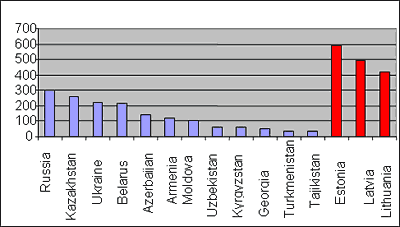
Monthly medium salary in Moldova is 5.6-fold lower than in Estonia...
If we make a regional comparison regarding the monthly medium salary on economy for 2005, the Republic of Moldova ranks the 7th place in the CIS, paying a medium salary of about 105 dollars a month in 2005. The monthly average salary in the Republic of Moldova is 5.6-fold lower than in Estonia, for example, a country which pays the highest medium salary in the former Soviet Union.
Country         Medium salary (in USD)
Russia          302
Kazakhstan      260
Ukraine         220
Belarus         214
Azerbaijan      140
Armenia         115
Moldova         105
Uzbekistan      60
Kyrgyzstan      58
Georgia         50
Turkmenistan    40
Tajikistan      36
Estonia         593
Latvia          493
Lithuania       420
Medium salary in CIS and Baltic Countries (in USD)
2. Business environment
The Moldovan Export Promotion Organisation (MEPO) forecasts foreign direct investments (FDI) in the amount of 300 million dollars for 2006, after FDI reached in 2005 a record level for the past 15 years - 260.3 million dollars, by 7.7 percent more than in 2004. A record number of foreign companies - 721 firms - were registered in Moldova last year or by 65 percent more than in 2004. This rise will influence in 2006 the general evolution of foreign investments in Moldova.
Moldova attracted FDI worth 114.9 million dollars in 2001, 166.8 million dollars in 2002, 102.9 million dollars in 2003, 241.8 million dollars in 2004, and 260.3 million dollars in 2005. According to estimates, FDI will reach 1.5 billion dollars overall in late 2006 for 15 years of independence. This is an annual average of FDI placed in Romania, for example.
The EU is not happy with the results of the Transnistrian settlement process
On 14 February the European Union Council adopted a common position to extend the Schengen visa ban on 17 Transnistrian leaders considered responsible for the lack of progress in the conflict settlement process. According to the text of the position, EU regards the resolution of the Transnistrian conflict as crucial for the stability and prosperity of Moldova and the capitalisation on the full potential of relations with the EU. The travel ban, joined up by the US and Romania, was first introduced in 2003 in response to the obstruction of the settlement process by the self-proclaimed region's leaders.
At a press conference held in Chisinau on 23 February on the occasion of the one year anniversary of the signature of the Moldova-EU Action Plan, Cesare de Montis, the Head of the European Commission Delegation in Chisinau, said that the EU is unhappy with how the settlement process has proceeded in the past year, hence the Union renewed the visa ban for 17 members of the Transnistrian administration. In six months, the EU will consider this matter again, and, subject to the results of the settlement talks, will either toughen or relax the sanctions against the region. At the same time, Moldovan Foreign Affairs and European Integration Minister, Andrei Stratan, expressed hope that 2006 will see progress in the Transnistrian matter due to the assistance from the EU and the OSCE.
On the other hand, Marianne Mikko, the Head of the European Parliament delegation to the EU-Moldova Inter-parliamentary Committee, said the federalisation of Moldova, proposed as a solution to the Transnistrian conflict, runs counter to the Moldovan Constitution, and the presence of Russian troops on Moldovan soil is illegal. According to Moldpress, which makes reference to international media, Marianne Mikko said she had sent a letter to the OSCE CiO, Belgian Foreign Minister, Karel De Gught, whereby she had asked him for explanations for the statements made in early January. "I am a little bit surprised, how can the OSCE chairmanship say that the Russian military presence in Transnistria is a theoretical matter, as long as there exists the 1999 OSCE declaration in Istanbul, which says that the Russian troops had to leave the region in 2002 at most.," Mikko told the press. "Russia has to observe the commitments assumed at the 1999 Summit in Istanbul, and a partial solution in this respect would be unacceptable. Moreover, the peacekeeping troops deployed in Transnistria include only Russian soldiers, not Ukrainian or Romanian. I sincerely hope that the OSCE's Belgian chairmanship will go ahead with the diplomatic efforts in the relations with the Russian Federation, and we would like to see a certain progress in this difficult activity of finding a viable solution to the Transnistrian conflict," Mikko added, quoted by Moldpress.
First findings of the EU Border Assistance Mission
On 16 February in Odessa took place the first meeting of the consultative council of the EU Border Assistance Mission at the Moldovan-Ukrainian border, attended by the Moldovan and Ukrainian Foreign Ministers and heads of customs and border guard services, as well as representatives of the European Commission and the UNDP offices in the two countries. According to press agency "Novosti-Moldova", the meeting heard the findings of the first assessment of the infrastructure and control procedures at the Moldovan-Ukrainian border. The key recommendations were to enhance the institutional procedures and improve the border control procedures. The Moldovan Foreign Minister, Andrei Stratan, said the border monitoring is one of the principal aspects of the Moldovan-Ukrainian relations and thanked the Ukrainian side for its assistance in deploying the mission. On the other hand, Boris Tarasiuk, the Ukrainian Foreign Minister said the mission has already shown its efficiency and expressed hope that it will help facilitate border crossing procedures for ordinary citizens and prevent smuggling and other illegal activities. Tarasiuk also said that by appealing to the UE for border assistance, Ukraine showed its readiness to solve the problems at the Moldovan-Ukrainian border.
In the meantime, Chisinau and Kiev concluded consultations on the technical aspects related to the implementation of the unified border procedures at the Moldovan-Ukrainian border. The Moldovan authorities have accepted Kiev's proposals to review the mechanism of border crossing for Transnistrian goods. Thus, the Moldovan authorities engaged to extend the term of validity of provisional licences for Transnistrian enterprises registered temporarily with the Moldovan Chamber of State Registration. These will be able to export goods to Ukraine under the same terms as the enterprises registered permanently in Moldova on the basis of certificates of origin of type CT-1 for exports to Ukraine in preferential regime. These certificates will be issued on the condition that Moldovan officials will be guaranteed unhindered access to documents, the production process, warehouses and goods destined for exports.
The new regulations will enter into force after being discussed with the participants in the negotiations process and with representatives of the EU Border Assistance Mission. According to an OSCE Mission communique, this issue will also be discussed the next round of talks in the "5+2" format scheduled for 27-28 February. Other items on the agenda of the talks will be the international inspection of the military-industrial complex of Transnistria, the situation in the security zone and the possibility of deploying a needs assessment mission to Transnistria in view of conducting democratic elections in the region.
Transnistrian "parliamentary" delegation on visit to Moscow
A delegation of the new elect "Supreme Soviet" from Tiraspol, headed by Speaker Evgheni Sevciuk, paid a visit to Moscow on 20-22 February. During the visit, the Transnistrian "deputies" met with the heads of factions and committees of the Russian Federal Assembly, the State Duma leadership and the leadership of the Russian Union of Industries and Enterprises. "We came to Russia to establish inter-parliamentary ties, as well as political and economic contacts. In addition, Russia's position is very important for us, and we appeal to Russia as a guarantor state in the Transnistrian conflict settlement to ensure the observation of the provisions of the 1997 Memorandum, which regulates relations between Moldova and Transnistria," Speaker Sevciuk was quoted by Regnum.ru as saying at the wrap up press conference on 22 February.
During the same press conference, Sevciuk stated that in the event that the conflict situation escalates in South Ossethia and Abhasia, Transnistria will exit the negotiations format, in line with agreements signed earlier by Transnistria with the two break-away regions. Also Sevciuk supported Russia's position regarding the universality of the solution that will be identified in the Kosova case, which could also be applied in the case of Transnistria. Sevciuk spoke against the withdrawal of Russian peacekeepers from the region, which he called "guarantor of region's stability and security".
Republic of Moldova - Council of Europe
The special representative of the CoE secretary-general told a news conference on February 22, 2006 that Moldova must reform its justice, audiovisual and ensure the press freedom and free access to information, in order to demonstrate that it respects the criteria of an authentic democratic state.
The European Court of Human Rights (ECHR) has sentenced the Moldovan Government in the case "the Christian Democratic People's Party (PPCD) vs Moldova", obliging it to pay 4,000 euros in trial-related spending. PPCD has sought only trial-related spending because it is "aware of how grave will be the consequences on the Chisinau executive, if it should pay large amounts for moral and material damages." In 2002, PPCD organised protests that were not authorised in line with Moldova's legislation. As a result, the Justice Ministry has decided to suspend the activity of the party for one month. The national courts awarded victory to the Justice Ministry and the PPCD has appealed to the ECHR. The ECHR ruled that the Moldovan authorities have violated Article 11 of the European Convention on Human Rights regarding the freedom of meeting and association. It should be noted in the context that the Parliament has recently passed in the first reading a draft law that introduces the material responsibility of officials who are to blame for Moldova's sanctioning by ECHR. The former justice minister is the acting secretary of the Supreme Security Council of the Moldovan Presidency.
Republic of Moldova - European Union
The Moldova - E.U. Action Plan turned one on February 22 and the implementation of this document declared as priority of Moldova's foreign policy was summarised and estimated on this occasion.
Representative of the European Commission have expressed satisfaction with accomplishments registered in the process of implementation of the Action Plan, but noted that still much work is to be done for insurance of human rights, combat of corruption, reformation of the judiciary, insurance of mass media and audiovisual. The head of the European Commission to Moldova named the opening of the European Commission Delegation in Chisinau, appointment of the E.U. special representative to Moldova and creation of the E.U. Border Assistance Mission to Moldova and Ukraine, progress of economic reforms, and others, as important accomplishments.
The Foreign and European Integration Ministry appreciates that the authorities have accomplished many priorities indicated in the Action Plan, while 2006 will be a decisive year for the implementation process. The consolidation of democracy and of the state based on the rule of law, insurance of economic reforms, start of a dialogue with the E.U. regarding the facilitation of visa regime are among priorities. The authorities intend to draft a special programme on implementation of provisions of the plan, which would establish distinct areas and tasks by taking into account the included chapters.
Civil society representatives consider that the implementation of the Moldova - E.U. Action Plan has registered some progress, but the accomplishments could be more important. The Association for Participatory Democracy "ADEPT" and the "Expert-Grup" Centre have launched a first  Report on independent monitoring of implementation of the Action Plan with the assistance of DFID. According to preliminary findings, a moderate progress was registered in a series of priority sectors stipulated by Action Plan, mostly due to the political will, social consensus and external factors. The stagnation in certain areas is also due to insufficient administrative capacities, inertia to get adapted to the new conditions created in the process of implementation of the plan and lack of appropriate economic and financial resources. The regress in some fields could be due to some temporary shortcomings or other singular factors of influence, while definitive conclusions should be based on further evolutions and capacities of authorities to correct or to eliminate the shortcomings. "ADEPT" and "Expert-Grup" consider that a programme of concrete actions differentiated on sectors, coordinated and implemented under strict monitoring of authorities and public opinion should be drafted for an ordered and progressive implementation of the Action Plan. Also, the E.U. should get involved more actively in this process, providing a technical, financial assistance and political support for the implementation of the Action Plan.
Cautious attitude towards E.U. enlargement
Several E.U. officials have indicated the need of a pause as regards the enlargement and inclusion of new candidates to the E.U. integration. The European commissioner for foreign policy,
Benita Ferrero-Waldner, has called for a "pause and reflection" regarding the future enlargement of the E.U. She considers that the E.U. population must get through the recent enlargement wave and it needs time for this purpose.
The E.U. commissioner for industry, Gunter Verheugen, has launched categorical forecasts, saying that the countries in the former Soviet Union will not become E.U. members the next 20 years.
The Foreign and European Integration Ministry said that the statements of the Brussels officials regarding Moldova's perspectives to join the E.U. should not discourage the Moldovan authorities to implement the European integration policies and "nobody can show on the political map of Europe what country will join or will not join the E.U." He argued this opinion through the fact that the idea to stop the E.U. enlargement was intensively spread after several countries have turned down the European Constitution, but the E.U. awarded the associate status to Albania and started negotiations with Croatia meanwhile.
Republic of Moldova - Romania
The Romanian minister examined some issues related to the Moldova-Romania relations while on a visit to Chisinau. The sides discussed the determination of the political status of the Moldovan-Romanian relations by the end of this year, with Romania proposing the signing of a partnership agreement for Europe. Victor Stepaniuc, representative of the ruling Communist Party, considers however that Moldova needs a basic treaty, a document that the Chisinau authorities are trying to sign for a long time. In reply, the Romanian foreign minister said that his country looks in future and "any document that will be signed between the two states that involves the executives of the two countries and the will of the political classes of Romania and Moldova aims to plan the future, not to return to the past insistently and without any result." It should be noted that the Moldovan president did not comment univocally on this topic, while Foreign Minister Andrei Stratan said that Chisinau accepts to discuss the agreement within the bilateral partnership for Europe proposed by the Bucharest authorities, but a "basic document" will be examined to establish the bilateral relations.
The Romanian foreign minister said that a possible presentation of the Transnistrian settlement plan of Romania by Romanian leader was studied during his visit to Chisinau. Traian Basescu could present this plan in front of the Moldovan Parliament.
Ungureanu promised that he will insist on the Bucharest executive to simplify and to speed up the examination of applications of Moldovan citizens for the Romanian citizenship, without modifying substantially the law that regulates the citizenship awarding principles. This statement of the Romanian official has raised the dissatisfaction of some political forces in Bucharest, which feared that the interventions in the citizenship awarding process may lay obstacles on way of Romania's integration in the E.U., but this opinion is not argued enough from political and legal points of view.
Republic of Moldova - Russian Federation
Russian Ambassador in Chisinau Nicolay Ryabov has met with students and professors of the International Relations Institute of Moldova and discussed issues related to the bilateral cooperation and latest political developments. Speaking about Moldovan-Russian relations, Ryabov said that the Russian Federation wants to strengthen these basic relations through mutual safety and benefit, in compliance with the friendship and cooperation treaty between the two sides.
The ambassador noted that the Russian Federation does not oppose the wish of Moldova to join the European area, as every sovereign and independent state makes its choice, though the integration process is complicated enough.
Speaking about the Transnistrian problem, Ryabov said that this is not a "black hole" of economy and the Ukrainian authorities also support this stance. He noted that Russia has never recognised the status of Transnistria as international law subject and the conflict must be settled "between the two participating sides."
Asked to comment on the Pasat case and the statements of Anatoli Chubais in connection with the sentencing of the former defence minister, the Russian ambassador said: "The problem is simple: Pasat is a citizen of Moldova and that's why Russia will not take any actions"; "Chubais is a manager, not a state functionary," and "some official notes would transfer the conflict to an interstate level and this would be a mistake."
Republic of Moldova in the world
Improvement of electoral legislation
Cristian Untila
The newly-elected Parliament has adopted several laws on the modification of the Election Code after the parliamentary elections, which aimed to solve some of the signalled problems, but the 1465 (2005) Resolution and the 1721 (2005) Recommendation on functioning of democratic institutions in Moldova adopted by the Council of Europe (CoE) last autumn avoided to establish that the situation in the area corresponds to all standards and asked that the electoral legislation and practices "take into consideration the recommendations of the Venice Commission and of the OSCE/ODIHR immediately."
The recommendations of international institutions did not leave room for interpretations or procrastination and, therefore, the Parliament adopted on November 11, 2005 a schedule of legislative actions in compliance with the Resolution and Recommendations of the commission on respect for obligations and commitments of CoE member states, pledging to ensure the presentation of draft laws mentioned in the schedule to the Council of Europe for expertise before their adoption. As regards the Electoral Code, the November 11, 2005 Parliament Decision # 284 establishes that the Council of Europe will make the expertise of the draft law in January-March 2005, while the final law must be adopted by August 2006.
The objections and recommendations of CoE - OSCE/ODIHR reveal several key aspects, envisaging both the electoral legislation and practices and related fields, which international institutions have spoken about more than once:
The considerations mentioned above are partly valid in connection with the recommendations to review the legislation on parties, in order to allow the creation of some regional parties. A new law on parties is late, while the modalities that the Parliament intends to apply under conditions of a political consensus (in line with the November 11, 2005 Decision # 284), in order to review the present legislation on parties "accordingly to the European norms," are unknown so far.
Legislators established new regulations on the status of members of the Central Electoral Commission (CEC), but these norms politicised the functions of CEC members, especially because the new orders do not ensure a stability of the post and all guarantees for exclusion of influence of those who appointed the candidates, a situation that requires the modification of some provisions from the Electoral Code (Art.16, 19 and 20) and this is also a recommendation of CoE-OSCE/ODIHR experts.
Some problems may appear in connection with electoral offices of polling stations, as there are cases when a party (electoral bloc) that has most of representatives in the Parliament holds the majority in a local council. Thus, some situations may occur when most of members of an electoral bloc would represent one party (electoral bloc) and the legality of functioning of this electoral body will be conditioned with the competence of members who represent other parties and of observers.
However, we consider that some legislative and administrative measures aimed to ensure the depoliticising of electoral functionaries, training of some persons who will permanently participate in elections at all levels, under independent monitoring, would be needed in perspective.
The ADEPT Association has drafted a package of documents on the Moldovan electoral legislation within the Improvement of Election Code Project, supported by the Eurasia Foundation, which contains:
All the documents contain explanations that argue the included provisions and estimate the effects of their implementation1.
The adoption of recommended amendments to the Election Code and the improvement of some inherent procedures would allow the closure of this chapter from the monitoring package of the Council of Europe and would be an important step forward implementation of the E.U.-Moldova Action Plan, and this is the cause why we think that the drafted initiatives deserve a major attention.
Betting on exchange rate
Iurie Gotisan
Beyond different figures unveiled by bankers, two words are often met in their commentaries on exchange rate that indicate a convergence of opinions.
The first word is "appreciation" and it is related to the leu, which could moderately strengthen in 2006, mainly due to a record share of credits in lei and foreign investments - either direct or speculative, according to bank functionaries. Of course, the millions of euros or dollars that come from Moldovans working abroad (remittances were estimated at about one billion dollars in 2005) are also important.
"Volatility" is the second word that bankers often use while speaking about currency market. Less predictable moves of exchange rate will continue in 2006, too, though no big fluctuations will be registered. Indeed, the direct intervention of the National Bank in the monetary and currency market could amplify the volatility of the market. On the other hand, the commercial inflows (collections from export-import operations) will be more important in evolution of exchange rate.
The volatility, which everyone speaks about - as concerns the evolution of the currency market - is like "reading on water," especially because the domestic currency market was predictable nor in 2005. Considerations related to the currency market are interesting for everybody, but how much the dollar will cost is the question of anybody who reads or listens to currency forecasts and thinks about exchange rates, variations of salary negotiated in foreign currency or deals that one must put across. Will it cost 13 lei? Or 14 lei? But how worthy the euro will be?
A medium exchange rate for the entire year 2006 could be 13.5 lei per dollar. Several factors will shape the currency market the next months, including direct foreign investments, evolution of trade deficit, rise of natural gas prices, capital inflows, and not the last, decisions of the central bank, besides the evolution of economy in general.
The Moldovan leu has depreciated verso main reference currencies this year and we think that the jump of the pair euro-dollar on international markets is a primary cause, since the domestic market depends on the foreign market in a very big measure. On the other hand, we consider that both season factors and some long-term factors have superposed as motives of depreciation.
Indeed, if you try to monitor the evolutions on currency market from interest, you will observe a correction of the exchange rate at the beginning of every year (taking into account that many importers make massive reserves at the beginning of year, buying currency and the National Bank is probably trying to intervene through commercial banks, influencing the rise of inflation this way), that means a season depreciation. Moldova registered in 2005 the largest trade deficit in all these years of transition and this deficit pressures the Moldovan leu in a bigger or smaller measure.
What is happening over the borders is also important, from performances of savings in the region and decisions of the American and European central banks to oil price on world market. Year 2006 will likely mark a re-balance of factors of influence on exchange rate on domestic market. In our opinion, the trade deficit is on one scale of the balance and we think that it will be high in 2006, too, and will act against leu. We mean the record imports last year and unbalance between them and exports, which have generated a trade deficit of over 40 percent of GDP.
Financial factors will be on the other scale of the balance and we think that they will act in favour of the leu. Capital inflows, private foreign credits and foreign direct investments (which are expected to grow up to 300 million dollars in 2006) would increase this year. What would be the result? The cumulated effect will be a real appreciation of the leu or a nominal appreciation.
Shall we expect a sudden depreciation of the leu? Such a possibility seems to be excluded, if we take into account the currency reserves of the central bank - approximately 600 million dollars in early January 2006. Thus, BNM has enough reserves to combat a strong trend of depreciation of leu and to control the prices.
Perhaps it is premature to estimate the influence of some massive depreciations of the leu
(of course, if there will be some) on economy in general, but in particular the depreciation disadvantages those who receive their salaries in Moldovan lei and want to make reserves or savings by purchasing foreign currency and lose while exchanging. Workers who earn salaries in foreign currency or their wages are calculated in foreign currency harvest the benefits, since they gain after the exchange into lei. In addition, exporters profit from depreciation, while importers suffer losses. At the same time, the state is also affected by depreciation, as it buys fuels, as for example natural gas.
Perhaps BNM will practice a directed currency regime in 2006, too, especially to control the inflation. Those who monitor the international currency market forecast a downfall of the dollar in 2006, while the main cause of the "collapse" should be searched in the United States, which has an excessive trade deficit and current account deficit. Performances of American economy and European economy, the oil price, BCE policy and American Federal Reserves will influence the exchange rate at world level.
It is important to understand the macroeconomic impact of evolutions on international currency market on balance of payments of Moldova. As most of export contracts stipulate prices calculated in dollars, while import prices (except for energy resources) are calculated in euros (or in dependence of euro), the situation of trade balance is worsening. We could register a "super-performance" of trade balance in 2006, too.
In addition, the exchange rate will have an impact on all families who have debts in currency. The bank world uses the term effect of wealth and balance. It is simple - when the leu-euro or leu-dollar exchange rate declines (the leu is appreciating), you pay less lei to reimburse the loan, thus you save more money, and vice versa. It should be noted that BNM likes a strong leu because it helps the decline of inflation, but exporters and finally Government do not like it because it affects the external competitiveness of economy.
The financial market is in charge with establishing the exchange rate in the entire world. The story of the Moldovan leu is becoming more fragile, if we look in perspective. In our opinion, the trade deficit is one of reasons that raise concern. It does not matter that it is financed without problems for the time being, similar developments in East European countries (Hungary, the Czech Republic or Poland) show that a monetary crisis occurs sooner or later.
The following contributed to this issue:
|
© 2001-2015 Association for Participatory Democracy "ADEPT" Reproduction of the materials is welcomed provided the source is indicated | e-mail: [email protected] |