
Participatory
Democracy
Original: /en/e-journal/20060314/index.shtml
| Association for Participatory Democracy | Print version. Published on www.e-democracy.md Original: /en/e-journal/20060314/index.shtml |
Activity of Public Institutions
1.1. Cooperation with civil society
The speaker has convoked the task forces of the Parliament at a sitting that examined the procedures of implementation of the concept on cooperation between Parliament and civil society, adopted in late 2005 (DP # 373-XVI of December 29, 2005). The speaker asked the heads of permanent commissions to pay more attention to cooperation with civil society, respecting the procedures established through the February 16, 2006 Decision of the Permanent Bureau, which determines the concrete mechanism of implementation of the concept: publishing of draft legislative acts on the website of the Parliament; reception of contributions of civil society organisations within 15 days; examination of proposals and their reporting.
Later, the Parliament has invited representatives of public associations at a meeting dedicated to the start of the process of cooperation with the Parliament. Marian Lupu said that all premises for the start of cooperation are prepared and the process of collaboration with civil society must focus on two areas:
It should be noted that draft legislative acts are being published on the official website of the Parliament starting late February, but the process is not orderly, it faces technical shortcomings: the arguments and other necessary additional acts are absent, operative information about submission of these documents to the Parliament. Also, the drafts are published selectively, while the Parliament Decision # 373-XVI stipulates that all draft legislative acts "registered in compliance with norms" will be published. Thus, the drafts that have challenged the most controversial and ardent debates within plenary sittings have not been proposed for public talks: draft laws on administrative and fiscal facilities for economic agents based on the left bank of the Dniester river; draft law on importation of granite items used for reconstruction of the Military Glory Memorial in the Chisinau municipality; the new draft law on vine and wine; draft law on online access to official acts; draft law on modification of the law on Governmental Agent; draft decision on findings of the control on execution of the law on making and circulation of ethyl alcohol and alcohol production, etc.
The Moldpres news agency said on March 2 that the permanent bureau of the Parliament has approved the regulation on accreditation of journalists at the works of the Parliament, as well as a list of accredited journalists. It noted that "the Permanent Bureau of the Parliament, at the initiative of the Press and Image Service," will accredit the journalists at plenary sittings, sittings of permanent commissions, news conferences and other political events within legislature. Also, a series of grounds for withdrawal of accreditation was instituted: inappropriate conduct; provocative actions, scandal and other actions that contravene to the "generally recognised norms". The draft regulation was not published, but the requirements for accreditation and issuing of identity papers, as well as the list of accredited journalists will be published soon on the website of the Parliament. It should be noted that lawmakers excluded in 2002 from the Parliament's Regulation the norm allowing the withdrawal of authorisation from a mass media representative who attended the plenary sitting, if he presents "clear misinformation about works of the Parliament" and did not comply to observations of the chairman of the plenary sitting, meeting recommendations of the Council of Europe this way. Starting 2002 to 2005, journalists were accredited in the Parliament without any regulations and special requirements for accreditation.
1.2. Legislative documents
1.3. Parliamentary control. Declarations
Questions and interpellations
Declarations
2.1. Reshuffles
The Government appointed on March 1, 2006 Ion Chicu as deputy finance minister. Ion Chicu has previously been adviser for first Deputy Premier Zinaida Greceanii.
Also on March 1, the Government appointed Maria Cara as rector of the Comrat-based State University.
The Government gave green light on March 7, 2006 to a proposal of the Foreign and European Integration Ministry to appoint Lidia Gutu as Ambassador of the Republic of Moldova to Romania.
Valentin Crudu was appointed on March 7 as deputy minister of education, youth and sport, while Valeriu Turcanu was named deputy minister of culture and tourism.
2.2. Decisions
Decision on the rise of nominative compensations. The Government has decided to increase the nominative compensations paid to some layers of population to compensate the spending related to use of natural gas, starting February 1, 2006, in connection with the rise of natural gas tariffs. The number of beneficiaries is estimated at over 120,000 persons, while the annual cost of the rise is about 7.5 million lei (some 577,000 dollars). The annual cost of the law # 933/2000 on special social protection of some categories of population is estimated at 220 million lei (about 17 million dollars).
Decision on approval of the draft law that exempts goods and services used for construction of the Burlaceni power station from some taxes. The executive proposes the Parliament to exempt goods and services imported for capital investments in construction of the power station near the village of Burlaceni, the Cahul district, from customs duties and VAT. According to the Ministry of Industry and Infrastructure, the awarding of these facilities would speed up the building of the station and would reduce the cost of the objective, a fact that would be also reflected on tariffs of the electricity that plant will supply later. The station is built by Mold Itera Energy Company, which intends to invest about 250 million euros within three years. It should be noted that the Government has earlier proposed such exemptions for the construction in Burlaceni and a similar station in Balti, while the Parliament has adopted this law after long and controversial debates. However, the chief of state did not promulgate the law meanwhile, saying that the business is doubtful and non-transparent, while the parliament accepted his objections and turned down the draft. The problem of security and energy independence has become primary and the authorities resumed the implementation of some drafts that seem to fail, after the conflict related to the Dubasari power plant and rise of the natural gas price.
Decision on the allocation of financial means for a feasibility study on construction of a high tension power line. The Government has allocated 1.5 million lei (about 115,000 dollars) from the reserve fund for finalisation of a feasibility study on construction of the 330-mW high tension line Balti-Novodnestrovsk. Earlier, this construction was mentioned as priority for insurance of energy security of the country, which should ensure the importation of electricity energy from Ukraine and exportation of electricity from Balkans.
Decision on the development programme of the capital. The Government has approved the development priorities of the Chisinau municipality for 2006: the construction of a trolley line leading to the State Agrarian University (by the end of April); finalisation of repairing of the Nasterea Domnului Cathedral; re-dimension and reconstruction of the memorial complex Eternitate; reconstruction of the biological water cleaning station and building of the northern bus station. The reconstruction of the road leading to the Chisinau International Airport was included in the programme at the proposal of the prime minister.
Decision for the approval of the Regulation on order of introduction of digital signatures on electronic documents of public authorities. The regulation establishes the conditions of use of digital signatures in electronic documents of public authorities, order of certification of public keys, obligations and rights of person who applies the digital signature, security insurance requirement, etc. The implementation of this regulation is a condition for functioning of the Electronic Government, so that positive premises for implementation of electronic exchange of service documents are created, the time needed to execute and coordinate the documents is reduces, while the control on execution increases.
Decision on the creation of the national commission to work out initial and periodical reports on implementation of international conventions by the Republic of Moldova. The composition and functioning regulation of the commission is approved and it will fulfil among others the key tasks:
Government Decision on allocation of financial means to the magazine Moldova. As much as 457,700 lei (35,000 dollars) was allocated from the reserve fund of the executive "to partly cover the maintenance spending." The magazine Moldova was founded through the September 17, 2003 Government Decision, while the executive is its only founder with a share of 10.000 lei (770 dollars). According to the statute of the magazine, its work is based on self-administration principles, while the financial sources are created from: financial and material shares of the founder; revenues from sale of the magazine, other polygraph production and goods, as well as from services, advertising, etc.; banking credits, other credits; charity donations; other sources that the legislation in force does not prohibit. It should be noted that the parliamentary opposition has earlier asked the Government to withdraw its quality of founder of two republican newspapers and it met this demand in 2005.
2.3. Sittings. Statements. Declarations
Implementation of the "Moldovan Village" Programme
A cabinet sitting has studied the actions taken in 2005 to implement the national programme Moldovan Village in 2005. According to available estimates, 1.7 billion lei (more than 130 million dollars) was used last year to implement this programme, of which only 370 million (28 million dollars) was contribution from the state budget. The rest of contributions came from local budgets, local and foreign investments, unreimbursable financial assistance. Most of means went to development of telephone network, gasification, creation of plantations, construction and modernisation of drinking water providing systems, etc. The largest sums were spent in the administrative territorial unit of Gagauzia, districts of Orhei, Ialoveni and Hincesti. Investments for 2006 are estimated at more than two billion lei, of which 600 million lei from the state budget.
Larger budget collections
According to data provided by the Finance Ministry, revenues in the amount of over 1.1 billion lei (84.5 million dollars) was raised to the state budget in the first two months of 2006, or by 22.2 percent more than in the first two months of 2005. The budgetary expense rose by over 10 percent and foreign payments worth about 7.5 million dollars were performed in January-February.
First report on EGPRSP
The Ministry of Economy and Trade has tabled the first report on assessment of implementation of the Economic Growth and Poverty Reduction Strategy Paper (EGPRSP) to the Government. The document was not made public but data published by mass media show that foreign direct investments in economy accounted for 260 million dollars in 2005, reaching the highest share in the past ten years. The priorities for the next period include the drafting of a strategy on attraction of investments and promotion of exports, strategy on sustenance of development of small- and medium-sized businesses for 2006-2008, cooperation wit international financial organisations, intensification of coordination with the World Trade Organisation, reduction of deficit of trade balance.
Priority of the employment strategy
The Ministry of Economy and Trade is due to complete the employment strategy for 2006-2020. The ministry will focus this year on the need of crediting for creation of jobs, elaboration of a system of analysis and real forecast of labour market. According to data of the Ministry of Economy and Trade, only 24,600 job seekers (41 percent of those registered) got employed last year.
Commentary on situation in the Transnistrian section of the Moldovan-Ukrainian border
The governmental press service has released a communication of prime minister regarding the situation in the Transnistrian region, saying that:
3.1. Decrees
The Moldovan President signed decrees on appointment of ambassadors on March 3, 2006:
Ten decrees of the chief of state on awarding of official orders were published on March 1-10, 2006.
Dumitru Ursu, former first deputy governor of the National Bank of Moldova, was awarded the Labour Glory order. It should be noted that Ursu, 46, has tendered resignation from this important post that he has run from 1992 from unknown reasons.
3.2. Sittings. Statements. Declarations
Renovation of some monuments and headquarters
The Moldovan president has chaired a working sitting on renovation and arrangement of the museum complex Alexei Mateevici in the village of Zaim, the Causeni district. The paternal home of the poet, church where his father had served and the building of the former primary school where Alexei Mateevici had studied will be renovated. According to mass media, the chief of state has insisted that the objects concerned be completely repaired and restored and these works include the consolidation of basements, walls, restoration of historical aspect of the building, arrangement of territory, repairing of road, construction of heating and water providing systems. Voronin proposed that different sources, including the central and local budgets, Social Investment Fund, financing, etc be used to cover the financial spending for works.
Vladimir Voronin convoked a working sitting on March 2 to discuss the problem of building of a new headquarter for the National College of Choreography. The chief of state said that the new headquarter of the National College of Choreography must be built in compliance with the latest requirements in the area, while its construction should become a priority in agendas of the Ministry of Culture and Tourism, Ministry of Education, Youth and Sport, Agency for Regional Development and Chisinau City Hall. He proposed as temporary solution that the Government find possibilities to finance rhythmically the construction of an addition to the present headquarter of the college.
Order and legality of medical expertise system
The Moldpres agency has reported that the Moldovan president convoked on March 9 a sitting on the mechanism of awarding of validity degrees, with the participation of officials of the Government, Parliament and Presidency, representatives of the Association of the Blind. The head of the Republican Council for Medical Vitality Expertise, Leonid Zaharia, has reported on functioning of the medical expertise system, signalling some grave shortcomings in the area. According to findings of some controls, there were cases of awarding of invalidity degree without necessary documents and 16,000 medical expertise files were absent in the archives. The director of the Centre for the Struggle Against Economic Crimes and Corruption has recently reported that a large number of cases of forged medical files for establishing of invalidity degree was discovered and the fake files represented about 20 percent of the medical expertise files in 2005. The sitting "decided that the Government will examine the opportunity to stop on April 1 the payment of invalidity pensions to the persons whose medical files are absent in archives and refuse a new expertise for reconfirmation of cases."
It should be noted in the context that the press reported in late 2005 the appearance of a serious conflict within the Medical Vitality Expertise Council, with many expert doctors being suspended from offices for some service investigations. In turn, they accused the council head of misuse of authority and corruption, invoking the fraudulent awarding of invalidity degrees to functionaries close to the Presidency, Government and Health Ministry.
Development plan of the capital
The presidential press service said that Vladimir Voronin has convoked a sitting on the implementation of the development plan of the Chisinau municipality in 2006. The proposals tabled in this regard by the city hall administration called for reconstruction of the Nasterea Domnului Cathedral, construction of an elderly asylum, repairing of a centre for minors, reconstruction and redimension of the Memorial Complex, finalisation of construction of the northern bus station, construction of the trolley line leading to the Agrarian University, continuation of arrangement of dwelling districts and implementation of projects on building of attics, etc. The chief of state demanded competent authorities to speed up the designing, identification of optimum solutions aimed to establish spending estimate and administration of means distributed for development of the municipality in 2006.
Statements on Moldova-1
The Moldovan president delivered a series of statements on interior and foreign policies of the country during a programme on the TV channel Moldova-1:
1. Real sector
The Moldovan economy rose by 7.1 percent in 2005, while GDP amounted to 34.2 billion lei (2.7 billion dollars) in comparable prices. At the same time, the rise pace was slower than in 2004, when a 7.3 percent growth was registered.
In particular, the rise of GDP was due both to positive evolutions in commodity and service sectors and to considerable collection of taxes on products and imports. Also, more than 60 percent of GDP collections came from services and trade, while the share of industry and agriculture still remains low enough. As for example, the agriculture registered a one-percent rise compared with 2004 and it contributed with about 25 percent to GDP in 2005.
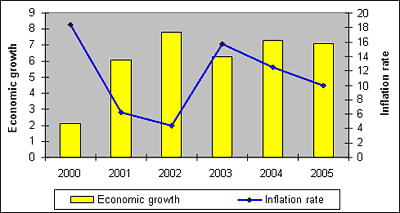
...but rise paces slowed down like in other states in CIS area
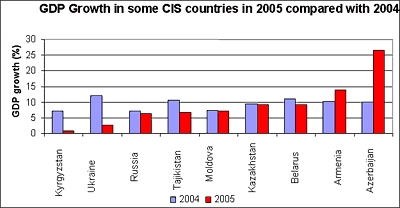
On the other hand, according to data of the CIS Committee for Statistics, Azerbaijan has reported the highest economic growth - 26.4 percent, followed by Armenia - 13.9 percent, Belarus and Kazakhstan - 9.2 percent of GDP. If a GDP growth standing is worked out, Moldova would rank the 4th place in CIS. Indeed, according to a recent report of the United Nations., the transition countries (including in the CIS) registered the highest economic growths in 2000-2005, 6 percent on average, while CIS recorded a 7-percent average. On the other hand, in Armenia and Azerbaijan only the economic growths in 2005 were higher than in 2004, an evolution reflected in the table below.
According to governmental forecasts, GDP will grow by 6.5 percent in 2006, but this could decline moderately down to 5 percent due to higher prices of fuels and lower investments in production process. The large remittances from abroad and the increasing price of imported fuel could generate a higher inflation in 2006.
On the other hand, the Economist Intelligence Unit forecasts a 4.1 percent average rise pace for Central Europe (the Czech Republic, Hungary, Poland, Slovakia and Slovenia), 4.4 percent for the Balkan states (Bulgaria, Croatia, Macedonia, Romania and Serbia-Montenegro), 6.6 percent for the Baltic countries (Estonia, Lithuania, Latvia) and 5.9 percent for the CIS (Azerbaijan, Kazakhstan, Moldova, Russia, Ukraine, Uzbekistan).
2. Prices and inflation
The inflation rate in January 2006 was by 1.9 percent higher than in December 2005, while the consumer price indicator in February was 1.4 percent. The cumulated inflation rate for the first two months of this year was 3.3 percent. In our opinion, this level will be maintained in March as well or it will even grow moderately. The tariffs of services provided to population rose the most - by 3.3 percent (mainly generated by higher prices of natural gas), prices of food products grew by 3.1 percent, while prices of manufactured goods rose by 2.6 percent.
According to BH data (budgets of households), food products will hold 44.5 percent in the CPI (consumer price index) calculation in 2006, compared with 45.77 percent last year, manufactured goods - 30.19 percent, compared with 29.77 percent last year, while services for population will hold 25.36 percent, compared with 24.47 percent in 2005.
...with Moldova ranking the 3rd place in CIS regarding price rise
The Republic of Moldova is ranked the 3rd place in CIS regarding the CPI rise, after Armenia and Russia, which registered 3.6 percent and, respectively, 2.4 percent. Following Moldova is Tajikistan, which reported a 1.5-percent inflation, Azerbaijan, Belarus and Kyrgyzstan, by 1.3 percent each. Ukraine and Georgia have reported the lowest price rises, by 1.2 percent each, while Kazakhstan posted the lowest inflation rate in CIS - 0.9 percent.
The Government and the National Bank have forecasted a 10-percent maximal inflation rate for this year, but we fear that it will be hard to maintain this level because the economy could be affected by higher prices of fuels. We note that the natural gas tariffs rose by about 37 percent in February, and these tariffs will be in effect till April 1, 2006 and they will generate, in turn, a rise of electricity tariffs.
3. Bank sector
The total assets of the Moldovan banking system rose by 147 million lei (11.4 million dollars) in January, fuelling estimates that the rise trends registered in the past two years will be maintained in continuation. The assets were valued at about 18.2 billion lei (some 1.401 billion dollars or 1.175 billion euros) in early February. For comparison, the assets of the Romanian banking system are estimated at over 36 billion euros and these assets are 30-fold higher than of the Moldovan banking system.
...but the volume of forward deposits in Moldovan lei dropped...
At the same time, the volume of forward deposits in Moldovan lei has dropped, mainly due to the decline of deposits of businesses. On the other hand, the share of forward deposits of individuals rose by 11.7 % compared with December 2005, up to 69.8% of the overall volume of deposits in domestic currency attracted in January 2006.
...on background of a higher interest rate
The average interest rate of forward deposits in Moldovan lei rose by 0.28 percentage points in January, up to 10.83 percent (7.91 percent for businesses and 12.10 percent for individuals, compared with 7.98 percent and 12.41 percent in December 2005). At the same time, the average interest rate on deposits in foreign currency dropped by 0.18 percentage points, down to 5% (4% for businesses and 5.19% for individuals).
According to data of BNM, the supply of deposits in the banking system turned over 11.245 billion lei in early February, declining by 10.8 million lei (0.1%) compared with December 2005. The decline was due to reduction of deposits in domestic currency by 211.4 million lei (3.2%).
Population could look for other investments due to low interests on deposits...
Forecast for 2006: The value and number of credits will grow, but not the same will happen with deposits, as people could look to place their savings in other, more profitable investments because of low interest rates.
Central banks in the world modify their currency reserves...
According to a survey published the London-based publication Central Banking in the mid-February, a trend of national currency reserves to migrate from dollar to euro was outlined last year. The Central Banking survey covered 56 central banks in the world.
Euro
10 banks have reduced the ratio of reserves in euros.
23 banks have increased the ratio of international reserves in euros.
Most of those which reoriented to euro were European central banks from outside of the euro area.
Dollar
15 banks have reduced their ratio of reserves in dollars.
12 banks have increased the ratio of international reserves in dollars.
Most of those which have consolidated on dollar were central banks in Asia, Latin America and other petrol producing countries.
The reserves of banks participating in the survey represent about 42 percent of the total of 4.4 trillion dollars administrated by central banks in the world in late June 2005. The National Bank of Moldova holds international reserves worth about 600 million dollars, while 30% of them are denominated in euros.
4. Public finances
Basic revenues in the amount of about 1.1 billion lei (71.2 million euros) were raised to the state budget in January-February 2006 and they rose by 22.2% compared with the first two months of 2005. However, this strong rise could be tempered after the reduction of the corporate tax down to 15%, reduction of incomes of economic agents due to higher prices of fuels, governmental regulations and, not the last, the commercial obstacles like those introduces by Russia.
5. Foreign trade
Moldova's trade deficit turned over 76.5 million dollars in January and rose almost 1.9-fold compared with January 2005, with "perspectives" of a strong rise in the next months. Statistics show that the foreign trade volume was 220 million dollars in the first month of this year, by over 17 percent more than in January 2005. Although CIS countries remain the main partners of Moldova in export-import relations, with an overall share of 46.7 percent, the Moldovan exports to the European Union rose from 29.7 percent in December 2005 up to 34.7 percent in January 2006, and this growth was mainly due to reorientation of food and vegetal production to the E.U.
The value and volume of Moldovan exports could grow after Romania and Ukraine resume the importation of Moldovan sugar (the Kiev Government is to examine a draft in this regard soon). The Government has forecasted a 13-percent growth of exports and an 11-percent rise of imports for 2006.
Moldovan - Ukrainian customs procedures
On 3 March Ukraine started the implementation of the unified Moldovan-Ukrainian customs procedures following an agreement reached with the Moldovan side in late February regarding the mechanism of implementation of the Joint Statement of the Moldovan and Ukrainian Prime Ministers of 30 December (see issue no. 68 of the e-journal). Thus, from 3 March the Ukrainian customs authorities allow through the Moldovan-Ukrainian border, including the Transnistrian segment, only goods accompanied by Moldovan official customs documents. The Moldovan authorities have introduced a number of facilities for the provisional registration of Transnistrian enterprises with the Moldovan State Registration Chamber, which also include issue of certificates that allow for preferential trade with Ukraine. Moreover, on 10 March the Moldovan Parliament passed a law whereby the Transnistrian economic agents undertaking import-export operations on the basis of Moldovan customs documents are to be reimbursed customs duties.
Saluted by the EU High Representative for Common Foreign and Security Policy, Javier Solana, the Moldovan-Ukrainian measures have been received with a lot of irritation in both Moscow and Transnistria. On 4 March, the Russian Foreign Ministry issued a statement which expressed concern regarding the "unannounced" imposition of measures aimed at "toughening" the transit regime of Transnistrian goods over the Moldovan-Ukrainian border. Under the pretext of restoring order at the border, Ukraine and Moldova exercise pressure on Transnistria to force it give up on issues related to the Transnistrian settlement, the communique said. On 6 March the Russian State Duma adopted the Statement "Regarding the breach by Ukraine of agreements regarding the Transnistrian settlement and the establishment of a total blockade against Transnistria". Invoking the wellbeing of the 170,000 co-nationals residing in Transnistria, the Russian deputies expressed concern regarding the tense situation created as a result of the introduction of the unified Moldovan-Ukrainian customs procedures. The new measures are qualified as "repressive economic measures" towards Transnistria, intended to make it accept the unilateral Moldovan settlement plan. The Russian deputies request the suspension of the Moldovan- Ukrainian procedures and their revision. Both the Russian MID communique and the one of the State Duma make reference to the Moscow Memorandum of 1997 which establishes the right of Transnistrian to independent foreign economic activity. The Moldovan authorities have repeatedly specified that that right could only be exercised by Transnistria within the legal and constitutional framework of the Republic of Moldova, which is one of the objective of the recently introduced customs procedures.
The Transnistrian authorities have qualified the Moldovan-Ukrainian measures as economic blockade and have accused Ukraine of taking Moldova's side in the conflict. The Transnistrian leader Igor Smirnov even threatened that Transnistria will pull out of the negotiations in response to the Moldovan-Ukrainian measures. On 10 March the region's "minister of economy" stated that Transnistria suffered losses worth 20,2 million dollars as a result of the "economic blockade" instituted by Ukraine. These would be due in the first place to the halt of activity of 10 Transnistrian enterprises, the main payers to the region's budget, and the cuts in the working time of about 20 enterprises to 3-4 days per week. In the region are being organised protest meetings by the so-called patriotic public organisations, including the youth corporation "Proriv" (Breakthrough) created by the region's security structures. On 7 March the break away leader Igor Smirnov issued a decree which bans foreign funding of non-governmental organisations from the region invoking the need to "ensure state security and avoid destabilisation of the political situation in Transnistria". Transnistrian and Russian media reported increases in the consumption goods prices and have warned with regard to other possible devastating humanitarian consequences of Ukraine's actions on the region.
At the same time, the Ukrainian border guards' authorities stated that they did not create any problems for the transit of Transnistrian goods through the Moldovan-Ukrainian border. "The problems and vehicles queues at the border check points are created artificially and unilaterally by the Transnistrian side", Ukrainian border authorities said. These statements were confirmed by Ukraine's Special Representative at the settlement talks, Dmitri Tkaci, who said on 10 March in Odessa that "Transnistria is organising a self-blockade and self-isolation". "I have visited the check points on the Transnistrian segment of the border. I can confidently say that there is no blockade. On the contrary, Transnistria blocks itself the transports that head for the region.", stated Tkaci giving the example of 10 trucks with chicken fillets belonging to the Scheriff Firm which were allowed through the border by the Ukrainian customs but then stopped by the Transnistrian customs. "We can speak today of a self-blockade. Transnistria wants in this way to break all agreements, create hysteria around the so-called blockade. Thus, the Tiraspol administration puts pressure on Kiev", the Ukrainian official added. The Ukrainian President Victor Yushcenko stated on 11 March that Ukraine's position on the situation on the Transnistrian segment of the Moldovan-Ukrainian border is in full compliance with international norms and the settlement plan accepted both by Moldova and Transnistrian authorities. Yushcenko stated that in the near future he will discuss the situation with the Transnistrian side in Kiev. Also, Yushcenko stated that Ukraine will be settling all trade and economic issues with Moldova on the basis of the recognition of the territorial integrity, independence and sovereignty of Moldova and on the basis of existing international norms. According to the Ukrainian President, the customs procedures at the Moldovan-Ukrainian border have been introduced in order to ensure transparency at the border, and the EU Border Assistance Mission sees that the new procedures meet international practice.
Negotiations in the "5+2" format
The negotiations round in the "5+2" format of 27-28 February was interrupted on 28 February after the Moldovan delegation left unexpectedly the negotiations. After several hours, the Moldovan delegation published a communique in which it expressed concern at the lack of progress on the issue of ensuring the free circulation of persons and goods in the security zone and encouraged the participants in the talks to concentrate on the resolution of this problem, given the nearing of spring agricultural works. On the same day the Transnistrian self-proclaimed leader Igor Smirnov issued a disposition regarding the use of agricultural plots in the Dubasari district, which provides that the cultivation of the said land and the transportation of harvest from it by farmers and economic agents from the villages under Moldovan jurisdiction will be done on the basis of certificates of "special preferential registration of the rights of using the agricultural plots". This registration will be done on the basis of lease contracts to be concluded with the Transnistrian authorities, whereas the harvest that will transported from these lands will be subject to customs duties according to "Transnistrian legislation".
The only document signed at the negotiations round has been a joint statement of the mediators and observers in which these expressed regret at the disruption of the talks, but reaffirmed readiness to continue contacts and consultations with a view to continuing the negotiations process in the "5+2" format. Media outlets in Chisinau reported that the next round of talks will take place on 4-5 April, but these dates were not been officially confirmed by any of the participants in the negotiations.
Republic of Moldova - Council of Europe
The Committee of Ministers of the Council of Europe has approved a new interim resolution on execution of the European Court of Human Rights (ECHR) judgment on the "Ilascu and others versus the Republic of Moldova and the Russian Federation" case. The document insists on execution of the ECHR judgment and release of Andrei Ivantoc and Tudor Petrov-Popa, who are illegally imprisoned by the Tiraspol authorities.
On March 7, the ECHR started public hearings on the case "Manole and other versus Moldova" which admissibility is being examined with the participation of representatives of petitioners and their lawyers and representatives of the Government. The case includes Larisa Manole, Corina Fusu, Mircea Surdu, Dinu Rusnac, Viorica Cucereanu-Bogatu, Angela Arama-Leahu, Ludmila Vasilache, Leonid Melnic and Diana Donica, former employees of the TeleRadio-Moldova Company. These applicants complain of the violation of Article 10 of the European Convention on Human Rights (freedom of expression). The ECHR has ordered the Moldovan authorities to answer some questions by March 21, 2006.
The co-rapporteurs of the Parliamentary Assembly of the Council of Europe (PACE) for Moldova, Josette Durrieu and Egidijus Vareikis, arrived in Chisinau on March 12 for a working visit. They will meet with the Moldovan authorities, representatives of parliamentary factions, public associations. It should be noted that the outcome of last visit of rapporteurs has served as ground for adoption of the October 2005 PACE Resolution and Recommendations on functioning of democratic institutions in Moldova, and the Parliament has adopted a special legislative programme on implementation of recommendations under their impact. The rapporteurs met first with representatives of parliamentary factions who appreciated the interest of the Council of Europe and favourable for promotion of reforms, saying that the continued monitoring of Moldova does not have negative effects. Representatives of the parliamentary opposition told the rapporteurs that they want more serious effects of reforms, their promotion in areas of immediate major impact. The PACE rapporteurs told a meeting with Prime Minister Vasile Tarlev that Moldova must do its best at the current stage in order to implement the institutional reforms, to obtain progress in the area of functioning of democratic institutions, having a decisive contribution to promotion of the international image of the country.
Republic of Moldova - European Union
The Republic of Moldova will negotiate with the European Union (E.U.) this year the awarding of a regime of Autonomous Preferences for a series of products exported by our country. These actions represent a priority for the Ministry of Economy and Trade in 2006. Moldova wants a more advantageous regime, but it must reform the system of certification of origin of exported goods and consolidate the customs management. Statistics show that Moldova exported goods worth about 325 million dollars in 2005, by 9.5 percent more than in 2004. However, it should be noted that the imports from the E.U. have grown by 29 percent compared with 2004, up to over 750 million dollars.
The European Commission has said in a statement that it is following closely developments on the border between Moldova and Ukraine, with the E.U. Border Assistance Mission to Moldova and Ukraine being present on the ground and constantly monitoring the situation. The Commission appreciates the determination with which Moldova and Ukraine are putting in place the necessary measures to implement the Joint Declaration on customs matters that Prime Ministers Yekhanurov and Tarlev issued on 30 December 2005. The Commission notes that the purpose of these measures is to ensure transparency of border operations, allowing any legitimate goods to pass the border between Moldova and Ukraine freely. These measures do not in any way constitute a "blockade". The Commission condemns any efforts by the self-proclaimed Transnistrian authorities to hamper the legitimate movement of goods across the Moldovan - Ukrainian State border and to impede registration of economic operators with the Moldovan authorities.
Republic of Moldova - Romania
Representatives of Romania have told a meeting of environment ministers from member states of the Black Sea Economic Cooperation (BSEC) Organisation that they will support the Republic of Moldova in accomplishing its European environment protection objectives. Romania has offered the set of European environment directives translated into Romanian to the environment authorities of Moldova.
Republic of Moldova - Russian Federation
The State Duma of the Russian Federation adopted on March 10 a declaration on the implementation of the new customs regime at the Moldovan-Ukrainian border, saying that the actions of the authorities of the two states "seriously harm the economy of Transnistria and they could develop into a humanitarian catastrophe," and describing them as "economic sanctions". Russian lawmakers consider that "the rights of Transnistria to hold an independent economic activity are violated" this way and call for the "restoration of the precedent customs regime at the Ukrainian-Transnistrian border," inviting all the interested sides "to support negotiations and consultations."
The official representative of the Russian Foreign Ministry commented to mass media the conclusions of the visit of a Russian delegation to Moldova's breakaway enclave of Transnistria. Mikhail Kalminin said that the "stricter customs regime at the Moldovan-Ukrainian border was introduced immediately after the ministerial meeting of the E.U. Troika with Ukraine." He claimed that these measures "have been planned as a political measure of economic influence of the region from the very beginning."
Valery Keniaikin, special envoy of the Russian Foreign Ministry, said that Russia "will do its best in order to relieve the situation in Transnistria," because the region faces the danger of a humanitarian catastrophe." He promised that the Russian Federation will help "its citizens who reside Transnistria, as well as other residents of the region by providing them the necessary humanitarian aid." Answering question about granting of financial assistance to the Transnistrian authorities, the Russian official said that the Russian government is considering such a possibility and it will pass a necessary decision. Keniaykin noted that a meeting is scheduled for April which "will examine political issues related to the negotiations on settlement of the Transnistrian problem." Some statements of the Russian official regarding recent declarations of the Moldovan president have challenged a replying reaction of the presidential administration, with adviser Mark Tkaciuk rejecting the interpretations due to what he described as "very poor information" of the Russian foreign department.
Asked about the imminent rise of the price of natural gas supplied to the Republic of Moldova, the chairman of the Russian giant Gazprom, Aleksy Miler, said that the Russian gas price for Moldova "must be at the level of the European price," though negotiations go on. He motivated this stance through "applying of principles of market economy" and "single treatment for all former Soviet states."
The Russian holding Vinny Mir, a leading importer of wines from Moldova, says that the share of the Moldovan wines on the Russian market is on the decline. The market share of Moldovan wines declined from 60 percent down to 52 percent of the overall imported wines in 2005 and it is expected to drop down to 40 percent in 2006. Although the exports from Moldova are on the rise, the share market is on the decline because of the considerable growth of wine consumption in the Russian Federation.
According to a communication released by the Moldpres agency, the Moldovan Ministry of Agriculture and Food Industry has received a letter from the Russian Food Security Agency, which seeks the presentation of a plan on exportation of agricultural production to the Russian market. At the same time, the Ministry of Agriculture and Food Industry continues the negotiations with the federal service for phyto-sanitary and veterinary control of Russia, in order to relieve the exportation of Moldovan agricultural production, since the Moldovan authorities have complied with all requirements of the Russian side.
Moldova in the world
The U.S. Embassy has expressed concern regarding recent allegations in the Moldovan media that the Embassy's 17 February statement regarding the Pasat case "amounted to interference in Moldova's internal affairs or was intended to damage Moldova in some way.". According to a March 1 statement of the U.S. Embassy, "Moldova has no better friend than the United States, one of the first countries to recognize Moldova's independence and establish an embassy here and the largest bilateral assistance donor." The Embassy warned that the persons whom representatives of some Chisinau newspapers labelled members of some groups of interests "are all outstanding current or former American officials who have worked tirelessly to promote America's national interests." The U.S. reiterated that the MiG transaction of 1997 was in the interests of Moldova as well as of the United States and noted that it considers it appropriate to challenge assertions to the contrary, from whatever source, which might mislead readers to believe that the United States took advantage of Moldova in this transaction.
On March 8, the U.S. Department of State has released the annual report on human rights that includes a distinct chapter on Moldova, which says that the Moldovan Government respects the rights of its citizens, but there are problems in certain areas, especially related to the situation in the Transnistrian region. In order to correspond to international human rights standards, the Chisinau Government should take some actions, in a move to improve the situation of justice and conditions in prisons. Also, the report indicated the need of appropriate measures for insurance of freedom of mass media, rights of the political opposition, combat of trafficking in persons and discrimination against women and children.
The hostages of Transnistrian regime
Igor Botan
The effects of the introduction of the new customs rules for the Transnistrian economic agents by the Ukrainian authorities on March 3, 2005 are novel phenomena that deserve an appropriate approach. The eventual introduction of the new rules was known for a long time. In principle, Ukraine accepted in May 2003 to allow the transit of goods to and from Transnistria on basis of the customs documents issued in compliance with the Moldovan legislation. The introduction of the new regulations was postponed three times meanwhile, last time on January 25, 2006.
Thus, Transnistrian authorities were perfectly aware of the high probability to implement the new customs rules. However, the preparations for the new customs regime have strangely focussed on the exchange of experience and improvement of the propagandistic art within the international conference held on February 16-17 and themed "International right and realities of the modern world. The Moldovan Transnistrian Republic - an existing state." The resolution of the conference attended by Transnistrian officials called for the international recognition of Transnistria's independence.
Under these circumstances, the Transnistrian and Russian authorities launched a propagandistic campaign, insisting that the introduction of the new customs rules means "the setup of an economic blockade on the prospering Transnistrian state." The propagandistic wave was somehow attenuated by explanations of the Moldovan and Ukrainian authorities who had to clarify once again well-known things - the new customs rules aim to ensure the legality of foreign trade of the Transnistrian economic agents who will get registered with the relevant institutions of the Republic of Moldova in a simplified temporary or permanent regime in order to obtain commodity origin certificates and the internationally recognised customs documents. The legalisation of Transnistria's foreign trade should take place in parallel with the settlement of the proper conflict. This is what the Transnistrian and Russian authorities describe as an "economic blockade" aimed to influence the negotiation process. According to Transdniestrian and Russian officials the "right of Transnistria to independent external economic activity" is stipulated by paragraph 3 of the May 8, 1997 "Primakov memorandum" and this is the key argument.
Apart from the propagandistic campaign aimed to accuse the Moldovan and Ukrainian authorities of introduction of the "economic blockade" the Transnistrian authorities: a) announced that Ukraine cannot be anymore a mediator and guarantor of the negotiation process for the conflict resolution anymore, with this role being played by Russia only; b) threatened to leave the negotiation process; c) blocked the railway and motor transport crossing the region in transit; d) banned the Transnistrian economic agents that practice import-export operations to get registered in the Republic of Moldova; e) prohibited the external financing of nongovernmental organisations labelled as the "5th column" (of course, except for the "Proriv" corporation founded and financed with the assistance of a high-ranking dignitary from the Kremlin administration); f) organised coordinated protests of "defenders of Transnistria" at the recommendation of lawmakers of the Russian State Duma, in order to demonstrate to the "progressive mankind the cohesion of the Transnistrian people, fighting for its right to independence"; e) created an "anti-blockade committee" aimed to "mobilise the resources" and to estimate how close is the "humanitarian catastrophe" in order to demand the help of the Russian Federation; f) threatened to denounce the Republic of Moldova and Ukraine in international justice institutions and WTO1, etc.
These events create a complicated and dangerous situation. One can argue that, to some extend, the citizens from Transnistria became hostages of the separatist elite. In these circumstances it is extremely important that now the Republic of Moldova is not isolated like it was in the early 1990s, when the Transnistrian conflict was inspired for outbreak. Thus, the European Union and the United States have approved through institutions and high-ranking dignitaries the measures taken by Moldova and Ukraine in order to legalise the foreign trade of Transnistria. It was established within the Permanent Council of the OSCE in early February that the right of Transnistria to independent foreign trade is not an absolute one and it must be exerted in compliance with the generally accepted international norms, and this could be achieved by following the new procedures of registration of economic agents and issuing of customs documentation. The imposed interdictions of the Transnistrian authorities are qualified as a "self-blockade" aimed to fortify the propagandistic effect of the campaign of condemnation of actions of Moldova and Ukraine that could generate a "humanitarian catastrophe".
The invocation of violation of the May 8, 1997 "Primakov memorandum" by the Republic of Moldova and Ukraine can be useful to Moldova because it allows Chisinau to demonstrate that the memorandum concerned did not have another value but to ensure the interests of Transnistria and of the Russian Federation, though the preamble of the document assures that it aims at the "rapid settlement of the conflict". Nevertheless, Transnistrian and Russian authorities insist that this memorandum has the status of an international agreement.
Firstly, nine years have passed after the signing of the memorandum and this outlines its uselessness to contribute to the "rapid settlement of the conflict", which has turned into a "frozen" one. Of course, a document aimed to contribute to the rapid settlement of a conflict is not applicable for frozen conflicts. Thus, in 1997 The Republic of Moldova, in its quality as a subject of the international law, and Transnistria, as broken part of Moldova, committed to create a common state within the borders of Moldova as available on January 1, 1999, both are the signatory parties of the memorandum. Russia and Ukraine have signed the memorandum as mediators and guarantors of the conflict resolution process, while the OSCE as mediator. In fact, the European Court of Human Rights (ECHR) has established with seven years after the signing of the memorandum through its judgment on the "Ilascu case" that this status is not appropriate at all to one of mediators and guarantors. According to conclusions of the ECHR, Russia is responsible for the state of things in Transnistria since it had armed, provided military, political, economic and financial assistance to the separatist regime led by its citizens. Under the judgment, by signing the agreement on principles of a peaceful settlement of the armed conflict in the Transnistrian region of Moldova on July 21, 1992 along with the Republic of Moldova, Russia can be identified as a party of the conflict rather than as a mediator and guarantor. If it is a guarantor, it guarantees its own interests and the March 10, 2006 declaration of the Russian State Duma saying that the decision of Moldova and Ukraine to implement the new customs rule "contravenes to the interests of Russia" confirms this assertion.
Secondly, if the Transnistrian leaders and their supporters in Russia consider that the Primakov memorandum has the status of an international document in force, they should take into consideration the fact that the provisions of such documents should be fulfilled with "good faith"2. The fact that Smirnov has started the modification of constitution in 2000 in order to withdraw the interdiction to hold more than two mandates of president of the self-proclaimed republic arguing that he has promised to Transnistrians "not to leave his post as long as Transnistria does not gain its independence" outlines the fact that by signing the memorandum Smirnov did not think at all about implementing it with "good faith".
In this context it is worth mentioning as well: a) the annual ostentatious celebration of the "independence day" with the participation of Russian authorities who encourage with promises to recognise the independence of Transnistria; b) the participation in forums of the "separatist international" (Transnistria, Abkhazia, South Ossetia, Mountainous Karabakh) in the Russian capital, where the strategies of complete separation are being coordinated; c) building, with the support of high-ranking dignitaries in the Kremlin administration, the "civil society" that promotes the detachment of the separatist enclave such as the "Proriv" corporation with branches in Transnistria, Crimea, Abkhazia and South Ossetia and financed, of course, from sources of those who have founded them and impose the promotion of the idea of the Russian President concerning the recognition of the independence of separatist enclaves in the eventuality of an eventual international recognition of the Kosovo province. All these actions demonstrate the price of the "international document" called "Primakov memorandum" and the "good will" for respect for its clauses by two of its signatories.
Thirdly, the memorandum concerned stipulated respect for human rights. Does the separatist regime respect the human rights after they generated: the crisis of the "Moldovan schools"; the limitation of access of Moldovan farmers from Moldova-controlled villages on the left bank of the Dniester river to their agricultural land; the blockage of the passage of citizens on the bridge over the Dniester river; the introduction of "migration taxes" for Moldovan citizens who enter the territory controlled by the separatist regime, etc? These flagrant violations are part of the documents by OSCE, country reports on human rights of the U.S. Department of State. Under these conditions, the call of separatist leaders and the Russian supporters for respect for clauses of the Primakov memorandum and imperative demands of Transnistria to be awarded the right to issue the customs documents on behalf of the Republic of Moldova seem astonishing impertinent.
Fourthly, the alleged right of Transnistria to independent foreign economic activity sanctioned by paragraph 3 of the famous memorandum stipulates express the agreement of the"sides", that means of Chisinau, too.
More, the Primakov memorandum stipulates that the parts will observe all the previous signed agreements. Thus, the Protocol on the resolution of custom problems between Republic of Moldova and Transdniestria, of February 7, 1997, signed by Moldovan President and Transdniestrian leader and countersigned by Russian, Ukrainian and OSCE representatives, provides for "disband of Transdnistrian custom posts at the entrance from the territory of Moldova � and the set up of joint custom posts on the Transdiestrian segment of at the Moldova - Ukrainian boarder"3. After Transdniestrian regime received Moldovan custom stamps in 1996 it categorically refused to implement the above quoted obligations. At the same time, after the Promakov memorandum was countersigned by Russian and Ukrainian Presidents on May 8, 1997, both of the issued an joint Declaration saying: "the memorandum provisions cannot run against international law, and will not be interpreted and used against the existing international treaties, OSCE decisions, the joint declaration of the Presidents of Russia, Ukraine and Moldova of January 19, 1996, which confirms the sovereignty and territorial integrity of the Republic of Moldova"4.
It is clear from what was mentioned above that it is difficult to believe that Chisinau can be interested to guarantee the right of Transnistria to external economic activity, delegating its competences of ensuring import-export operations to the breakaway enclave since separatists flagrantly violate the provisions of the memorandum and act with "bad will" ostentatiously. Even more, the illegal privatisation process in Transnistria was cynically commented by local economics minister Elena Cernenco, who said that this privatisation must rapidly develop in the region with the participation of Russian capital, "so that not to leave anything to Moldovans."
Fifthly, in fact, the actions of the Primakov memorandum are not applicable since 2003 after the confusion related to the signing of the Kozak memorandum. Thus, on the one hand the "Kozak memorandum" did not stipulate any deployment of new Russian peacekeeping troops to the eastern districts of Moldova and this fact was confirmed by a developer of the document, Dmitrii Kozak himself, who said on November 17, 2003: "Russia does not raise the problem of military guarantees in the process of peaceful settlement of the Transnistrian conflict." On the other hand, Russian Defence Minister Sergey Ivanov was quoted by the ITAR-TASS agency as saying after only four days, on November 21, 2005: "Sergey Ivanov has ordered the General Staff to draft proposals on creation of stability peacekeeping forces, which would be deployed to Moldova with the agreement of Chisinau... The number of the contingent must not exceed the limits imposed by CFAE flanks; that means maximum 2,000 persons. They would be deployed to the territory of the future federation until complete demilitarisation of the state by not later than until 2020. Peacekeepers would not hold heavy weapons, but only light weapons and helicopters to control the demilitarisation5 process."
Thus, the development of provisions of the Primakov memorandum into the provisions of the Kozak memorandum was preparing the full dependence of the Republic of Moldova on the will of Transnistria, as according to memorandum the later was to preserve its statehood with all its institutions available at that moment, as well as the absolute right to veto on any decisions of the alleged federation. And this was to take place under the exclusive military presence of Russia in Moldova, which was to be completely demilitarized. Of course, these were unacceptable things and the memorandums were turned down from these reasons.
The recent threats of the separatist leaders to withdraw from the negotiation process, to call on the international justice and to complain on Moldova to the WTO, deserve to be widely spread and eventually supported.
Firstly, the withdrawal of Transnistria from the negotiation process would definitively confirm the nullity of the Primakov memorandum, bringing back the situation of 1992, when a tetra-lateral mechanism existed, except for the fact that Romania would be replaced by the U.S. and E.U.
Secondly, starting calling on international justice institutions the Transnistrian leaders could be confirmed their right to such appeals, but they will be recalled that they also have obligations, for example, not to halt Russia to influence them positively in order to release the two members of the "Ilascu group" from prison, in compliance with the definitive judgment of the ECHR.
Thirdly, the appeal to the WTO would be useful to the Transnistrian leaders to clarify what are the entities aimed to ensure the implementation of the international trade rules and what are the subjects of arbitrage in this institution.
Fourthly, the call on the support and economic assistance of Russia, "the only mediator and guarantor" could outline the untruth of Russia's arguments that it lacks levers to influence the Tiraspol regime in order to honour its obligations to release the prisoners from the "Ilascu group" and that Russia cannot overpass the obstacles of the Transnistrian authorities in the process of withdrawal of troops and ammunition from the breakaway region. Seeking and receiving the Russian assistance, the separatist leaders would embarrass Russia to explain why it assists a regime that obstructs it to honour its international commitments resulted from an international judgment and treaty, not a worthless memorandum.
Finally, by threatening with the sanctions that Russia could apply on Moldova and Ukraine in order to rescue the Transnistrian regime from the "economic blockade", the separatist leaders should understand that this kind of threats attracts very unfavourable suggestions for Russia, which, on one hand had, drowned the Chechen separatism in blood, fact that generated the replying terrorism, while, on the other hand, it supports the "separatist international" that claims to be of pro-Russian orientation.
Of course, Russia may punish Moldova for defending its interests to ensure the territorial integrity. In fact, Russia has already done this. The three resolutions of the Russian State Duma adopted in February 2005 that recommended the Russian Government to introduce economic sanctions against the Republic of Moldova and to increase the gas prices were partly implemented.
The March 10, 2006 declaration of the State Duma regarding the "blockade" on Transnistria was pale enough and this fact reveals the realism of the Russian political class. In this context the threats of some Russian politicians to recognise the independence of Transnistria are a bluff.
It is clear that the threat to "universally apply" the eventual Kosovo precedent on Transnsitria and on other enclaves from the "separatist international" is not applicable. Firstly, the Russian and Chinese presidents signed a joint declaration last summer in which they condemned separatism and that is why the "universal principle" will be unlikely applied. If applied they will not be "universal" at all, if they fail to envisage Taiwan, too. Or, the "strategic partner of Russia" will not like at all the playing of "universal principles" even if Russia promises to apply them differentially.
Secondly, the probability of applying the eventual Kosovo precedent on Transnistria and other enclaves in the "separatist international" is even on the decline before Russia's takeover of the chairmanship in the Committee of Ministers of the Council of Europe in May 2006 and the Russian chair in the G8 club. However, Russia could support later the separatist regime under favourable conditions, if they survive until then.
The bad side is that after the recent failure to "tame" the HAMAS and Iran, in order to erect itself into a first-ranking international actor, Russia has not other worthy subject then Moldova to demonstrate its international importance and weight. Of course, this honours Moldova very much, but complicates dramatically its existence.
Ukraine has never been part of credible partners of the Republic of Moldova. The new customs rules introduced by Ukraine are the expression of an advantageous compromise for this country, compromise which aims to find a balance between the resolution of security problems of great interest for the E.U. and U.S. and the interests of Ukraine to develop economic relations with them. The "bonuses" that Ukraine has recently received from the U.S. and E.U. through its recognition as a country of market economy, withdrawal of objections against Ukraine's entry in the WTO, exclusion from the list of states that fall under the Jackson-Vanik amendment are of a fundamental importance. The eventual negative effects related to the implementation of the so-called "blockade on Transnistria" seem to be minor on this background.
Even more, the setup of legality in the separatist region of the Republic of Moldova favours Ukraine, which faces separatist trends as well, as for example in Crimea. Leaders of the separatist movement "Proryv" in Crimea are part of the same "international corporation" the Transndiestrian "Proyv" is, founded and supported openly by high-ranking dignitaries from the Russian presidential administration. These leaders have declared for show a couple of months ago during the "war of beacons" that the situation in Transnistria is a model to follow.
These factors also suggest at the first glance that the recent events in Transnistria should have a rather positive than negative impact on Ukraine. However, the western favours are offered to Ukraine as state entity, while the losses from the new customs rules would be suffered by certain corrupt functionaries, mafia clans for whom "charity begins at home." Being blackmailed and practicing the blackmail, the reactions of the latter may have very negative effects. It is true that many common citizens may suffer, though the new customs regime should not affect the volume of trade exchanges of the Transnistrian enclave with the adjacent Ukrainian regions, if the self-blockade was not inspired.
The electoral campaign for election of the Supreme Rada is a factor of vulnerability for the Ukrainian authorities. The "well-wishers" have already insinuated just before elections that some detention facilities of CIA were located in the territory; threaten to turn off the electricity supply to the Odessa region, which is provided current by the Transnistria-based Kuchurgan station; interpret the problem of the new customs rules as an "action against Ukrainian co-nationals in Transnistria," etc. Of course, this kind of provocations, as well as others much more dangerous may be on the rise until March 26, when the elections will take place.
Potential economic consequences of new customs regime
Iurie Gotisan
We consider that Moldovan economic agents that export to Ukraine, Russia or other CIS countries and cross Transnistria, especially the exports by trains (Cuciurgan customs station) will suffer the smallest losses. Perhaps these economic agents will have some afferent expenses for the covered distance (km/h) in addition, since Chisinau has redirected the motor transport through the customs stations in the north, south-east and south and the trains through the northern and southern railway junctions of Moldova (Ocnita and Basarabeasca). These eventual spending will be included in the final price of exported production, expenses that the exporters will finally recover and they will be included in the final cost of production (which will be probably higher).
This is the picture for economic agents working in the eastern breakaway enclave of Transnistria, even for those which have got registered with specialised structures in Chisinau and hold the customs documentation of Moldova, while the "economic blockade" - a term that the Tiraspol administration is pompously and bombastically using in its statements - is rather a self-blockade. In addition, if the situation perpetuates, it will have dramatic consequences on Transnistria's economy because the foreign trade holds an important enough share in the formation of GDP of the region. Despite the old industrial potential, a huge consumer of energy and mostly unstructured potential of Transnistria, the foreign trade holds about 80 percent of Transnistria's GDP, while most of local budget revenues are raised from export-import relations.
Even more, Transnistria's exports have demonstrated a strong trend of faster rise than imports and this is not the case of the Republic of Moldova in general. According to data of the central bank in Tiraspol, the Transnistrian exports turned over about 600 million dollars in 2005, exports comparable with the annual budget of Moldova, and almost half of them went to Russia and districts on the right bank of the Dniester river of Moldova. As for example, the siderurgical production, engineering and metal processing sector in the overall industrial production hold 70 percent of GDP and about 90 percent of this production is exported. The Tiraspol economics minister said last week that Transnistria has lost more than 3 million dollars in one week.
At the same time, we do not find an explanation to dissatisfaction of the Tiraspol administration and economic agents in Transnistria which export their production to the CIS regarding the new customs regime. It is well-known that many enterprises in the region have been awarded certificates that allow them to perform exports to Central Europe and the European Union after getting registered with the Chisinau structures. The list of such enterprises includes Tirotex, Odema, Vesta, the cement plant in Ribnita, Moldavcabeli, Buket Moldavii, Kvint, the Camenca-based cannery, and others. Such an export regime is absolutely transparent and it works for a long period without payment of any duties. Both Transnistrian entrepreneurs and their partners in Europe are satisfied with these rules of games.
Interesting statistics. Moldova is the forth exporter of steel to the U.S. market due to the exports of metals from the Ribnita-based metallurgical plant (which has an annual production potential of 700,000,000 tons). It is interesting that Ukraine and Romania have been the main providers of raw material for the steel industry of Transnistria. According to data of the Moldovan customs department, Romania alone supplied about 2 million tons of used metal for the needs of the Ribnita plant in 2001. Poland is another large provider, especially of raw materials and agricultural products such as sugar, potatoes, etc.
Forecasts. If we make a retrospective of the events that happened five years ago, we observe that Chisinau has harvested success by establishing control levers on exports and imports from the Transnistrian region, by withdrawing the customs stamps that the Tiraspol regime was illegally using. This action was an efficient tool, at least partial, used to cut the roots that financially fuelled the so-called Transnistrian statehood. The economic-commercial relations between Moldova and Russia could take another turn behind very tense political relations between Chisinau and Tiraspol, if taking into account the loyalty of the Transnistrian region towards Moscow. Let's remember the so-called economic sanctions that the Russian Federation has introduced for importation of many Moldovan products starting last spring, or the Russian side could raise more pretensions regarding gas prices while negotiating with Chisinau.
The following contributed to this issue:
|
© 2001-2015 Association for Participatory Democracy "ADEPT" Reproduction of the materials is welcomed provided the source is indicated | e-mail: [email protected] |