
Participatory
Democracy
Original: /en/e-journal/20060614/index.shtml
| Association for Participatory Democracy | Print version. Published on www.e-democracy.md Original: /en/e-journal/20060614/index.shtml |
Activity of Public Institutions
1.1. Legislative acts
1.2. Parliamentary control. Declarations
Questions and interpellations
AMN Deputy Ion Plesca has asked the Justice Ministry, the Government's Apparatus and the state-run news agency Moldpres (editor of Monitorul Oficial) to report on exact number of cases lost by Moldova in front of ECHR, damages to be paid to applicants, sanctions applied on persons who are guilty for sentences, ground of selective publishing of ECHR judgments in Monitorul Oficial (some judgment are published in special issues of limited circulation which are not distributed to subscribers).
PSL Deputy Valentina Golban has asked the Government, the Prosecutor-General's Office and the Centre for the Struggle Against Economic Crimes and Corruption (CCCEC) to report on participation of some lawmakers in coverage of frauds discovered after a control a control was conducted to find out how degrees of invalidity have been awarded, illegalities that representatives of prosecutor's office and CCCEC indicated at a briefing mediated by mass media.
PD Deputy Oleg Tulea has invoked the prohibition of access of some NGOs which conducted useful social activities to educational institutions and asked the Education Ministry to review its decisions to limit these activities.
PPCD Deputy Vlad Cubreacov has asked the Prosecutor-General's Office and the standardisation department to verify respect for legislation on consumer's protection and legislation on functioning of languages in some trade facilities based in the Chisinau municipality, invoking the presence of announcements and invoices in Russian.
PPCD Deputy Ion Varta has asked the Ministry of Education and Youth and report how expenses used from the state budget to publish an experimental textbook of "integrated history" (in a 12,000-copy circulation) by a group of unfairly selected authors have been recovered. The Education Ministry has approved the textbook and it was published, but it was established meantime that the book unfits the requirements and was destroyed, while the budget has suffered serious losses.
Deputy Valentina Cusnir has asked the Government to report on a control of safety of products imported in Moldova, especially from the Russian Federation.
Deputy Dumitru Braghis has asked the Government the reduction of salaries in budgetary sector in April and the lower pay than it had promised after enforcement of the new law on pay in budgetary sector.
2.1. Decisions
Decision approving a draft law on status of penal investigation officer. The draft proposes to establish the rights, obligations and responsibilities of penal investigators who investigate cases in line with penal legislation of Moldova.
Decision approving the quality infrastructure concept of Moldova. According to the document, the quality system of Moldova (metrology, standards, testing and accreditation) will be adjusted to the European system. The final goal of implementation of the new system is to enhance the quality and competitiveness of Moldovan goods. The Ministry of Economy and Trade will present an action plan on implementation of the concept to the Government.
Decision on empowerment to sign visa agreement. The Government has empowered the minister of foreign affairs and European integration to negotiate and sign an agreement on introduction of visas for Moldovan citizens who enter Romania. It was earlier said that the system will be simplified and visas will be awarded for free.
Decision on opening of the Moldovan Embassy to Georgia and of Consulate to Italy. The Government has proposed to the chief of state to open a diplomatic representation in the Caucasian republic in order to obtain advantages and possibilities of a stronger bilateral cooperation. Earlier, the Government has decided to open the Moldovan Embassy to Uzbekistan. The Government has also decided to create a consulate general of Moldova to Italy (in Bologna).
Decision on allocation of funds for renovation of roads. The Government has ordered the Finance Ministry to allocate 100 million lei to some authorities of local public administration for renovation of local roads and streets. The amounts are allocated "from revenues raised additionally to the state budget in 2006" and they will be included in the budget when it will be rectified. It means that the Government has decided to distribute public funds without Parliament's consent needed for distribution of such finances.
2.2. Sittings. Decisions and Declarations
Implementation of Moldovan Village Programme
As recommended by chief of state, the results of implementation of the National Programme Moldovan Village have been discussed at a seminar with the participation of representatives of local authorities, Government members, prime minister and president of Moldova1. The participants outlined the shortcomings in drinking water providing sector, quality of roads, and evacuation of waste and saving of primary energy resources. Vladimir Voronin expressed satisfaction with pace of gasification of localities, though citizens pay for many works and some prices are increased, so that a stricter control for selection of enterprises performing the gasification works is required. It should be noted that the Government and chief of state spoke out about control on prices pf gasification works earlier this year, promising including in the parliamentary electoral campaign to elaborate and implement a single price calculation mechanism, while enterprises will hold the right to a very low interest.
Implementation of "SALT" programme
Prime minister has convoked decision makers at a sitting on implementation of the National Education Programme SALT (Jump), which was launched in 2004 at the initiative of chief of state and stipulated the endowment of all educational institutions in Moldova to computers connected to Internet. According to information released at the sitting, the network of connection through optic fibres was built in all localities of the country and every pre-university institution in Moldova was endowed "with at least one computer and most of them have been connected to Internet (it did not say if the installed operation systems are licensed, as some verifying process may develop in Moldova in connection with appearance of Microsoft representation in Moldova, which will give an impulse to the process of installation of the verified soft). The prime minister has ordered that the new information system start working on September 1, 2006, at the beginning of the new school year. Vasile Tarlev also ordered competent bodies to elaborate modalities of financing of pre-university educational institutions for an efficient use of resources offered by SALT Programme.
Fulfilment of E.U. - Moldova Action Plan
The Government has examined the implementation of the Action Plan, with the minister of foreign affairs and European integration reporting on this topic. Andrei Stratan indicated the need to respect the terms for issuing and presentation of documents required by Plan and recommended the participating ministries to look for effective methods to implement it and not to wait for indications from the coordinating institution - the Foreign Ministry. The remaining priorities of implementation of the Action Plan are: judiciary reform, regulatory reform, energy reform. A special attention will be paid to training in the European integration field, drafting of a strategy to inform society about European integration process. According to the deputy prime minister, the assessments of corapporteurs on behalf of civil society will be taken into consideration when reports regarding the fulfilment of the Action Plan will be drafted, and a mechanism of cooperation between public authorities and civil society will be elaborated soon.
Elaboration of Expense Framework for 2007-2009
A governmental sitting has discussed the draft Medium-Term Expense Framework for (2007-2009). According to the Finance Ministry, the budgetary-fiscal policy for the next years will be based on a series of traditional principles aimed to encourage investments, to stimulate economic activity and to ensure social stability. Fiscal taxes are expected to grow by 14-19 percent a year, so that the budget for 2009 be over 1.5-fold larger than for 2005. Resources which will be allocated for implementation of the law on salary system in budgetary sector, more expenses for science and innovation are outlined in expense category. The document proposes to increase personal tax exemptions for individuals and a reduction of income tax.
Concerns with trade of alcohol drinks and drugs
The prime minister has told a working sitting with the participation of officials of MoldovaVin Agency that the Government is ready to legalise the trade of homemade wine. Vasile Tarlev considers that legalisation of the process will contribute to regulation of wine making sector, support of citizens to sell wine and legalisation of incomes raised this way, this process complying with European requirements in the field. At present, contravention fines are in effect for illegal trading of homemade wine, while the law on vine and wine enforced in late May 2006 defines the "homemade wine" as a wine made by individuals under rustic conditions for family (personal) consumption.
The prime minister has instructed the Ministry of Economy and Trade at another sitting to elaborate a strict mechanism for issuing of authorisations for sale of alcohol drinks and tobacco products, in order to prevent their trading near educational institutions. Mass media quoted Vasile Tarlev as saying that the illicit trade and sale of alcohol drinks and tobacco products near educational institutions violate the economic and food security of the country.
The Government is aware of essence of competition in drug trade, but it does not warm the unfair competition of some participants in pharmaceutical market. The prime minister considers that the present situation in the field is unsatisfactory and ordered the creation of a working group to draft an action plan on settlement of crisis in pharmaceutical system. Representatives of the State Drug Agency consider that norms on enlargement of network of pharmacies and their branches are needed to prevent an uncontrolled extension. They said that the automatic drug record and control information system called State Nomenclature of Drugs was not implemented in due terms in the Chisinau municipality. Representatives of pharmacists noted however that the system is crossing a period of crisis, while the norms required by Government and growth of VAT for drugs mean more management-related expenses and higher prices, a situation capable to have a negative impact on activity of small pharmacies from rural localities.
3.1. Decrees
The Moldovan president has signed decrees on appointment of judges: heads of (district) law courts; before age limit; to offices of judges or instruction judges.
As the first academic scientific institutions of Moldova have turned 60, the chief of state awarded different state orders to scientists from Moldova and other countries (Romania, Russia, Poland, the United States). Vladimir Voronin was awarded the title Doctor Honoris Cauza of the Academy of Sciences for the first time in our country during the General Assembly of the Academy of Sciences of Moldova, at which the chief of state handed in the awards to scientists.
3.2. Sittings. Decisions. Statements
Black Sea Forum Summit
Vladimir Voronin addressed the Summit of Black Sea Forum for Dialogue and Partnership that took place in Bucharest on June 5, saying that the forum has become "a bridge, a common place for meeting of elder and younger democracies, a bridgehead for enlargement of democratic area." Voronin noted that the Black Sea Forum may and must become "a field for elaboration and implementation of efficient mechanisms of transborder cooperation." The chief of state underlined that the European integration and reintegration of country "are objectives of primordial national interest" for Moldova, while the second has a vital importance because "the supervision of Moldova as state is unimaginable without fulfilling it." The president asked that the Joint Declaration of the forum raises the separatism problems trenchantly and without ambiguities.
Calming down spirits
On June 13 Vladimir Voronin attended a sitting of the parliamentary Communist faction which discussed the intensification of cooperation between the majority faction and Government, outlined the need to improve laws and to work out an anti-corruption expertise mechanism for draft laws. The chief of state demanded a urgent adoption of legislative acts related to implementation of national programmes, the European Union - Moldova Action Plan and for implementation of the 2nd stage of regulatory reform. According to mass media, the chief of state has denied speculations on eventual monetary-banking crisis, saying that currency reserves of the National Bank continue to grow, the banking system functions normally, the authorities took efficient actions to diversify market of Moldovan wine products, while the budget for January-May 2006 was overfilled, so that the Government may propose more expenses in the state budget.
Mass media, news bulletins and former governmental newspapers have widely mediated the participation of chief of state in a working sitting of the faction, but especially his statements about controlled economic-financial situation and republished these statements some days in a row2.
Concerns with science
The chief of state has visited structures of the Moldovan Academy of Sciences and collected facts regarding distribution of major budgetary funds allocated to science. The president sought a more active implementation of scientific accomplishments, proposing cooperation of Moldovan wine makers with the laboratory for analysis of underground and mineral waters, whose certificates are internationally wanted. Vladimir Voronin outlined the need to continue researches by widely using the domestic rape oil as alternative energy source.
The chief of state attended a solemn sitting of the Assembly of the Moldovan Academy of Sciences on June 12 and addressed the participants. He criticised the previous situation in the field of endowment and financing of sciences and said that the important changes proposed in the past year have been accomplished by awareness in order to contribute to rebirth of national science, its affirmation in society, in order to make the science available to society. Vladimir Voronin promised a plenary support for scientific reforms and researches in future as well, assuring scientists that they will benefit of more financing from state.
1. Real sector
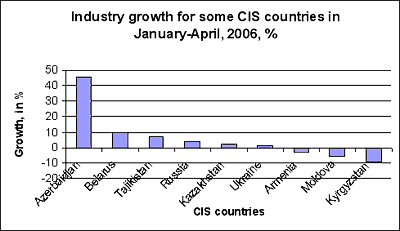
Moldova, Kyrgyzstan and Armenia are the only countries in the Commonwealth of Independent States (CIS) which reported declines of industry for January-April 2006, according to data of the CIS Committee for Statistics. Kyrgyzstan has reported the highest industrial decline in the period concerned, notably 9.5%, followed by Moldova - 5.9% and Armenia 2.9%.
On the other hand, the industrial production in Azerbaijan has grown by 45.5%, in Belarus by 12.3% and in Tajikistan by 7.2%. Industries in Russia have risen by 3.5%, Kazakhstan +2.7%, Ukraine +0.4%. The average volume of industrial production on CIS rose by 4% in January-April, by one percentage point less than a year ago.
Moldova was ranked last places in CIS regarding industry in the past 2-3 years. Structural deficiencies in industry in general and latest scenarios in wine making sector in particular have had a negative influence on rises registered in the past years. The government did not update yet the 6.5-percent industry growth target for 2006.
Source: CIS Committee for Statistics
...while agriculture of Moldova seems to face a profound crisis
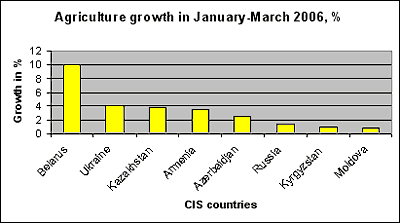
On the other hand, the same CIS Committee for Statistics said that Moldova registered the lowest rise pace of agriculture in CIS in January-March 2006, notably 0.8%, compared with the 3-percent average on CIS. The so slow rise was mostly due to the last winter frosts. The low temperatures have compromised 25% (about 517,000 tons) of the grape crop and Moldova harvested only about 300,000 tons of fruits.
The agriculture of Belarus has grown the most, by 10%, followed by Ukraine - by 4%, Kazakhstan by 3.8%, Armenia by 3.5%, Azerbaijan by 2.5%, and Russia by 1.3%. Georgia did not deliver statistics to the committee. The agricultural production in CIS increased by 3% on average in the 1st quarter compared with 2% in the similar period of last year.
The agricultural production has grown by 16% in 2001-2005, but the rise was often rated as modest. Although the agriculture offers jobs to 40% of labour force, its share in Gross Domestic Product does not exceed 20%. The agriculture is still backward and extensive as before. The farm land is divided into many plots and therefore modern technologies cannot be applied in agriculture. Double prices of fuels associated with slow reorganization of processing industry and an underdeveloped land market have pushed the agriculture to a deep crisis.
Source: CIS Committee for Statistics
* Georgia, Tajikistan and Uzbekistan did not unveil statistics
2. Tax policy
Basic revenues in the amount of about 3.27 billion lei (193 million euros) went to the state budget in January-May 2006, by 10.8 % more than expected. In comparison with the similar period of last year, basic revenues in the state budget have grown by 17.4%. Indirect taxes (VAT, customs duties, excises) had the main contribution to collection of incomes, as they held about 65%. The Tax Inspectorate has launched a campaign to inform agricultural about fiscal facilities for this year by using a guide available in consulting offices of territorial tax inspectorates.
...while Tax Inspectorate awards subsidies and reduces some taxes
The size of subsidy paid to agricultural producers who delivered agricultural production account for 4.1 million lei. Starting January 1, 2006, a 20-percent VAT is in effect for agriculture, compared with the same tax established for 2005. Under legislation, agricultural producers receive subsidies from the state budget in the size of this tax paid to the budget. At the same time, the Tax Inspectorate has established discounts for land and real estate taxes, while citizens who will pay the land tax before June 30 will benefit of a 15-percent discount.
3. Prices in inflation
The consumer price index rose by 1.2% in May 2006 compared with April and by 7.2% in the first five months of this year. Prices of food products, especially of fruits and vegetables, grew the most last month, while the highest prices rises for manufactured goods were registered for fuels.
Also, ttariffs for interstate railway transportation services, air transport grew in May. Prices of gasoline and Diesel oil rose again in June and these rises "will contribute" to the growth of inflation for sure. The government and the National Bank predict a 9-10 percent inflation rate for this year, but these forecasts will be unlikely achieved.
4. Foreign sector
Moldova's exports dropped by 10% in January-April 2006 for the first time after 1998, down to 313 million dollars, as a result of Russia's restriction on Moldovan exports to this country. The restriction of exports to the main market for Moldovan products, Russia, (which absorbed more than 25% of Moldovan exports) and the fulminating rise of imports have challenged a record advance of trade deficit, by 42.7% compared with January-April 2005, up to 421 million dollars.
In particular, Moldova exported goods and services worth 86 million dollars to Russia in January-April 2006, by 32% less than last year, registering a trade deficit with this country for the first time, At the same time, deliveries to Romania have dropped by 4%, down to 39 million dollars, while exports to Italy have decreased by 15%, down to 33 million dollars. At the same time, Moldova's imports have increased by 14.2%, up to 734 million dollars. As for example, imports from Russia have grown 1.9-fold, up to 143 million dollars, from Romanian 1.6-fold, up to 81.3 million dollars.
5. Banking sector
The reserve official assets of the National Bank of Moldova (BNM) were evaluated at 645.3 million lei in late May. However, the currency reserves of BNM dropped by 2.8 million dollars in early June down to 642.5 million lei, after the central bank has purchased Moldovan lei on market. The reserves have declined after they rose by 37.91 million lei in May, as the first part of about 17 million dollars from the 118.2 million dollars credit of the International Monetary Fund entered the account of the central bank and due to currency purchases of the National Bank on domestic market. The programme with IMF stipulates currency reserves in the amount of 750 million dollars for this year, by 152.57 million more than in late 2005.
OSCE believes it is time to start serious discussions regarding the transformation of the current peacekeeping mission to Moldova, the OSCE Chairman in Office, Belgian Foreign Minister, Karel de Gucht, said during his visit to Moldova on 31 May - 1 June.
The transformation of the current peacekeeping operation into one with international mandate and recognition would enhance security both for Chisinau and for Tiraspol, De Gucht said.
At the same time, the OSCE will insist that Russian troops and weapons are withdrawn from the Republic of Moldova. The OSCE is ready to allocate 10 million euros to support the withdrawal process. "This amount will be enough to conclude the withdrawal process in three months. It is an absolutely feasible task," De Gucht was quoted by Infotag as saying.
Earlier the Russian Foreign Minster, Serghei Lavrov, told the Parliamentary Assembly of the Council of Europe that Russia had fulfilled all its Istanbul commitments regarding Moldova and Georgia, and the troops still present in these countries are peacekeepers. The extra 500 - 600 Russian military located in Transnistria are there to guard the Russian weapons warehouses, which serve as a guarantee for Transnistria that "Moldova will not swallow the region as a unitary state", Lavrov said.
During his stay in Moldova, Karel de Gucht had a series of meetings with Moldovan officials and representatives of the civil society. On 1 June he travelled to Tiraspol where he met with Transnistrian leader Igor Smirnov. In Tiraspol De Gucht called upon the Transnistrian leaders to take a constructive attitude and return unconditionally to the negotiations in the "5+2" format. At the same time, De Gucht reiterated the OSCE stand on the principles of settling the Transnistrian conflict i.e. through a peaceful solution of the conflict respecting the territorial integrity and sovereignty of the Republic of Moldova.
The OSCE high official showed happy with the activity of the EU Border Assistance Mission at the Moldovan-Ukrainian border and expressed support for the new customs regime introduced by Moldova and Ukraine on 3 March. "There is no way back to the old system. We cannot change the rules of international trade. I urge you to negotiate the terms of foreign economic activity of Transnistrian firms. I call upon the Moldovan authorities to show flexibility in this sense," said De Gucht in Tiraspol, according to an OSCE communique.
After the meeting with Karel de Gucht, the Transnistrian leader Igor Smirnov held a press conference, which he told that Transnistria will return to the negotiations table only after Transnistria will be provided international guarantees for conducting foreign economic activity independently.
On 2 June the OSCE Chairman in Office travelled to Kiev where he met with Ukrainian President, Victor Yushcenko, whom he thanked for his interest and role played in the Transnistrian settlement efforts. "We have to continue applying the Yushcenko plan, adjusting it to all obstacles and delays, and we must ensure that the "5+2" process is back on track", De Gucht said in Kiev.
Observers qualified the statements by the OSCE CiO as a change of rhetoric and discourse of this European organisation and yet another signal that the European Union understand ever more the urgency of finding a viable solution to the Transnistria conflict. At the same time, the issues raised by De Gucht during his visit did not touch upon the most important and problematic aspect of Transnistrian settlement - the future status of the region, while the practical application of the proposal to transform the peacekeeping operation into one under international mandate will be a real trying stone for an organisation that takes all decisions by consensus.
On 1 June, the deputy Secretary of the Russian Security Council, Iuri Zubakov, paid a several hours visit to Chisinau. According to a presidential press communique, President Vladimir Voronin had a meeting with Zubakov, during which the two discussed the "prospects and mechanisms of some qualitatively new approaches to the Moldovan-Russian relations. Special attention was paid to the Transnistrian problem". No further details were published regarding the objectives and contents of the Russian official visit to Moldova.
According to observers, Zubakov's visit only several hours before the arrival to Chisinau of the OSCE Chairman in Office is not a coincidence, its purpose being to test the ground regarding the position of the Moldovan leadership on the Transnistrian issue.
Zubakov's visit seems to have been meant to test the degree to which the Moldovan leadership holds on to its position [after the introduction of the new Moldovan-Ukrainian customs regime on 3 March] and whether it is ready to compromise more that it used to, analyst Andrei Popov commented on Zubakov's visit in an interview with Info Prim Neo. "The Moldovan authorities need to be prudent and realist, and understand that Russia is undergoing a radicalisation of its foreign policy discourse and that on the eve of presidential elections in 2008 one can hardly expect it to compromise on anything," Popov stated.
In this context, we would like to mention the statements made recently by the Official Representative of the Russian Foreign Ministry, Mihail Kaminin, regarding the South Ossetia conflict. In a comment published on the website of the Russian Foreign Ministry on 1 June, Kaminin said that although Russia respects the principle of territorial integrity, in the case of Georgia this principle is "a desirable situation rather than an actual political-legal state of affairs", whereas the position of the South Ossetians is based on a principle "as widely recognised by the international community, that of self determination".
Titled by the Russian and international media as a "diplomatic sensation", Kaminin's statements were interpreted by many as an open and official recognition by Russia of the right of break away entities from the former USSR to self determination. According to the Russian publication "Kommersant", if until recently Russia proffered to give tacit support to the unrecognised regimes in Georgia and Moldova, now Russia is officially taking their side. This change is attributed to the West's insistence that Russia withdraws its armies from Moldova and Georgia, but also to the European integration course taken by the two countries.
"Against the two states immediately started the commercial and gas wars. To chill out the non-obedient neighbours, Russia decided to connect another important leverage - the conflict areas," the Russian publication states.
According to analyst Andrei Popov, given that one can hardly expect Russia to change its position in the next 2-3 years, in the meantime the Moldovan Government cannot but promote the necessary internal reforms and continue its rapprochement with the European Union, thereby increasing the attractiveness of the right bank for the inhabitants of the left bank of Nistru River.
The president of Moldova has met Terry Davis, secretary-general of the Council of Europe (CoE) at the Summit of the Black Sea Forum for Dialogue and Partnership in Bucharest and discussed cooperation between Moldova and CoE. The CoE secretary-general saluted the activity of Moldovan authorities aimed to implement the recommendations of CoE, indicating particularly the creation and necessary functioning of the National Institute of Justice.
The CoE Committee of Ministers held a new meeting on supervision of execution of the European Court of Human Rights' judgments (Article 46 of ECHR) on June 6-7, 2006. The meeting examined issues concerning:
The ECHR reported to the Moldovan Government on June 13 the Chamber's judgment on case Istrate vs Moldova. The judgment is not final and indicates the violation of Article 6 (right to a fair trial) of the European Convention on Human Rights. Applicant Andrei Istrate is a retiree to whom a Moldovan law court awarded victory in 1998 which was partly executed but the Court of Appeal had outlawed it. The ECHR ordered the Moldovan Government to pay 258 euros to the applicant in pecuniary damage, 1,500 euros in non-pecuniary damages and 100 euros in costs and expense.
The prime minister has asked the CoE at the trilateral meeting European Commission - Council of Europe - Republic of Moldova in Chisinau to identify methodical, material, logistic and financial possibilities to continue assisting Moldova in some key sectors" - continued adjustment of national legal framework to European standards; - democratisation of the Transnistrian region of Moldova; - consolidation of democracy, etc.
On June 7, Moldovan experts participated in the first round of negotiations with representatives of the European Commission regarding possibilities to facilitate the visa regime for Moldovan citizens. Representatives of Moldova reported the latest evolutions in the process of implementation of provisions of the Moldova-E.U. Action Plan on fight against trafficking in human beings and organised crime, illegal migration, security of national travel documents, and other issues which create the framework on talks on these matters. The Moldovan side reported the difficulties faced by Moldovan citizens while willing to obtain Schengen visas. According to a press release, the European Commission's delegation took notice of requests and arguments voiced by Moldovan experts at the meeting and expressed readiness to study the provided information and to continue the dialogue.
The European Parliament in Brussels has hosted a tasting of Moldovan wines under generic "replying the Russian Federation's embargo." The organisation of exhibition was supported and promoted by the European Parliament's Delegation of the Moldova-E.U. Committee for Parliamentary Cooperation and its chairwoman Marianne Mikko. Invitees learned the capacities of Moldova's wine industry and appreciated the quality of Moldovan wines. Participants in the event made common cause with Moldova in the difficult situation challenged by the Russian Federation's restriction of Moldovan and invited Moldovan producers to reorient their exports to other markets.
The European Union will allocate 500,000 euros to Moldova within a food security programme to finance the renovation of the Republican Veterinary Diagnosis Centre, regional centres in Donduseni and Cahul. Most of this money will be used to modernise food certification laboratories, so that to restart talks on extended possibilities to export some agro-industrial products to the E.U. after their reopening.
A delegation of the European Parliament intends to visit Valeriu Pasat in prison. The co-chairwoman of the Moldova-E.U. Parliamentary Cooperation Committee, Marianne Mikko, has regretted a failed visit to Pasat in early May, expressing hope that there will be no obstacle to halt a visit to the former defence minister of Moldova in late June. European parliamentarians said that they are carefully monitoring the evolution of Pasat's situation and they have some questions regarding circumstances and arguing of his case.
A project called Support to Partnership and Cooperation Agreement (PCA) and World Trade Organisation Implementation and to E.U./Moldova European Neighbourhood Policy Action Plan (ENPAP) was launched in Moldova. Total budget is about 4 million Euro allocated by the European Commission. The project will be implemented the next three years. International experts assisted by local experts will work out strategies on readjustments of Moldovan legislation to community norms, will consolidate the system of monitoring of reports on implementation of the Moldova-E.U. Action Plan.
The E.U. Border Assistance Mission has totalled a stage of its activity at the Moldovan-Ukrainian border. According to a communication of the Mission, Moldovan and Ukrainian border guards have confiscated more goods during a 10-day joint operation than in the past three months. They held 322 persons on illegal border crossing attempt to, confiscated more than 52 tons of meat products (especially fowl), 63 tons of vegetables, 11.3 kilograms of drugs, at least 5,500 boxes of matches and more than 2,500 litres of alcohol. According to General Ferenc Banfi, head of the E.U. Border Assistance Mission to Moldova and Ukraine, these facts reveal the success of a deep cooperation between departments participating in border monitoring process on behalf of the two countries.
Romania's exports to Moldova grew by about 30 percent in January-April 2006. while imports rose by 2 percent (Moldova exports animals, beef and pork, canned meat products, dairy, fruits, clothes and footwear, wine to Romania and imports energy, furniture, cosmetics, fertilisers, agricultural machines, etc., from Romania). The bilateral trade balance favours Romania, as Romanian exports to Moldova totalled 326 million dollars while imported turned over 85 million dollars. A new agreement of economic cooperation will be signed soon instead of the free trade agreement, which will be denounced when Romania will join the E.U.
Bucharest hosts the Week of Moldovan Economy in Romania from June 12 to 17, which includes several key events: the national exhibition Moldova Presents, a business forum and a cultural programme. As many as 100 Moldovan firms present their offers in different sectors: packing, textiles, food and wine industries. According to statistics, Romania ranks the 7th place regarding investments in Moldovan economy (4 percent of overall investments).
A group of members of Moldovan and Romanian NGOs protested on June 14 in front of the Palace of the Parliament in Bucharest, demanding the Romanian authorities to award the citizenship to all Moldovans. The manifestation was organised by Oleg Brega, chairman of NGO Hyde Park. Protestors have delivered a petition to the Parliament, Justice Ministry and president of Romania seeking "the recognition of citizens from over the Proute River as citizens of Romania, given the fact that the Romanian citizenship was withdrawn from them through violence." The petition was signed by about 1,000 persons and organisers expect the competent authorities to answer it within 30 days.
On June 11, more than 300 Romanian nationals and Moldovan students protested in front of the Moldovan Embassy in Bucharest against investigation under Penal Code of four students who have broken the ?Moldovan-French" name of the lyceum Gh. Asachi in Chisinau.
Minister of Foreign Affairs and European Integration Andrei Stratan has asked the Moldovan Embassy in Bucharest to solicit information regarding the presentation of an own plan on settlement of the Transnistrian conflict by Romanian President Traian Basescu. Chisinau wants an official confirmation in order to comment on this issue. According to Stratan, "a proposal related to the Transnistrian settlement must be discussed both with Chisinau and Moscow and with the European Union, the United States and Ukraine." Asked by Chisinau mass media to comment on this case, Romanian Foreign Minister Mihai Razvan Ungureanu said that it is being discussed whether the Romanian president will table his proposals on settlement of the Transnistrian conflict to Chisinau or not.
The Russian deputy premier and defence minister has said that Russian peacekeepers and troops will remain in the region until settlement of the Transnistrian conflict. Sergey Ivanov told journalists that an eventual evacuation of Russian troops and ammunition cannot be discussed "as long as a political solution between Moldova and Transnistria is unavailable," while the 1,500 Russian peacekeepers "prevent a war in the region." Ivanov delivered such statements in Baku to the council of CIS defence ministers.
The Russian authorities did not accept the resumption of agricultural products from Moldova a year after having restricted them. Negotiations have failed, with the Moldovan being sure that Moscow is not interested to resume the imports of vegetal production from Moldova, though experts of the Russian service for veterinary and phyto-sanitary control do not raise essential reservations against quality of Moldovan agricultural production any longer. According to estimates, Moldovan exporters lost about 12 million dollars last year due to the Russian embargo on agricultural production.
Negotiations on contracting of natural gas of the Russian giant Gazprom that started earlier this month have been postponed for June 19. The Russian side turned down proposals of Moldova but did not make a final decision yet.
Russian Ambassador with special missions Valeri Nesterushkin has commented the situation in Transnistria, saying that a certain stance regarding a referendum in the region is unavailable because the situation of referendum was not determined yet. According to Nesterushkin, the situation of "crisis" in the region was not completely settled, though many economic agents accept the new conditions and get registered with the relevant authorities in Chisinau.
The Russian Foreign Ministry has commented the results of the conference on implementation of the Conventional Forces in Europe Treaty that took place in Vienna, Austria, from May 30 to June 2. Russia does not warm the stance of NATO and GUAM member countries regarding conditioning of ratification of the treaty with its military presence in Georgia and Moldova. It considers that the treaty "is mostly old and does not correspond to the current military-political realities."
The border guard service of Moldova has reported that the number of citizens trying to enter the Schengen are with fake documents is on the rise. Border inspectors discovered many Moldovan or foreign citizens this year who present fake acts or documents of other persons as theirs in order to cross the state border. More than 3,000 breaches of this kind were registered this year and 210 cases were filed under Penal and Administrative Codes.
Electoral race begins in Transnistria
Igor Botan
Two social-political movements in Transnistria have recently turned into parties. They are the so-called international corporation "Proriv", created a year ago with the direct participation and support of a high-ranking Kremlin functionary and transformed into the People's Democratic Party, and the movement "Obnovlenye", created before the December 2005 elections in the Supreme Soviet. The fact that these movements have turned into political parties at the same time marks the start of the presidential electoral campaign in the region scheduled for next December.
The visit in the same period of separatist leader Igor Smirnov to the Ribnita-based metallurgical plant, which contributes with more than 50 percent to the budget of the breakaway enclave, is another indicator of the start of the electoral race. This visit launches tries to remake the relations of Smirnov with business from the region. The interdiction introduced by the separatist leader against entrepreneurs based in the region to register their firms with the State Registration Chamber of Moldova in order to undertake import-export operations after the implementation of a new customs regime in the Transnistrian section of the Moldovan-Ukrainian border had a negative impact on attitude of business toward the Smirnov regime.
On the contrary, Evghenii Shevciuk, elected as head of the "Supreme Soviet" in January 2006 who has founded the social-political movement "Obnovlenye", which won the legislative elections in the breakaway enclave, has affirmed himself as exponent of local business and holds chances to be its favourite for an eventual participation in elections. Shevciuk threw the glove to Smirnov a year ago by initiating the modification of constitution in order to limit the competences of the separatist leader. The cause of changes was that the administration of Smirnov has led the privatisation process in the region to a direction that favoured his friends from Russia in the detriment of circles from the region. Political and business circles from Russia have become the main political allies of Smirnov then, while the local business in Transnistria is regarded as the ally of Shevciuk. As the setting up and maintenance of the Transnistrian regime is the work of certain circles from Russia, it is easy to presume who of the two leaders may enjoy more support. However, Shevciuk and his movement "Obnovlenye" won last December from the movement "Republica" supported by Smirnov.
But the conduct of any electoral campaign requires financial resources and support of local groups of influence. That's why Smirnov had to allow the registration of the Transnistria-based enterprises in compliance with Moldova's legislation after nearly three months. Of course, electoral campaigns are not held on own money, while the money of business blocked by Smirnov's voluntary policy could be used to get rid of such a policy. For this reason, the visit of the separatist leader to the Ribnita-based metallurgical giant was mediated as a sign of care for resumption of activity of local business. However, it may be presumed that Smirnov's visit aimed to persuade the big business that he is also capable to remedy the situation and guarantee conditions for its development.
The third indicator of the start of the electoral race is related to the specific outbreak of the propaganda machinery whose main target is to assure the residents of the breakaway region that the economy of Moldova, its financial system are about to fall down after the exportation to the Russian market was restricted, while the next blows on Chisinau will be linked to higher gas prices and introduction of visa regime by Russia. Of course, the Transnistrian propaganda does not forget to note that Russia punishes Moldova through these measures for its attitude toward the separatist regime, while the fall of the acting Chisinau government is the expected effect. It is insinuated that certain political forces from Moldova would like to see this scenario applied and they even participate in its staging. The conclusion for those who launch such messages is clear.
The fact that the separatist regime strictly controls the political life in the Transnistrian region through its repressive bodies and propaganda must not be demonstrated. Officials and informal structures of the Russian Federation ensure the other ways of protection of the regime, including through the Russian military presence in the region. Russian political technologists close to the Kremlin administration have made public their recommendations to promote the interests of pro-Russia separatist enclaves. The most important thing envisages the legalisation of the separatist regimes in eyes of the international public opinion through elections and apparently pluralistic and democratic and controllable evolutions, but they should be at least comparable with those from constitutional and recognised regimes. This approach is needed to invoke the arguments: how could some regimes, even separatist and unrecognised, be forced to return to the constitutional bottom of recognised states that they have left if the latter are less democratic than the unrecognised ones?
The creation of the "Proryv" corporation by the Kremlin administration and the appearance of the movement "Obnovleny" perfectly fit the scenario of "ad hoc building of civil society" and many parties before the December 2005 legislative elections. But at the same time, the dangerous developments related to the modification of constitution last summer have been annihilated after a visit of Modest Kolerov, adviser for Russian President Vladimir Putin. Also, the eventual conflict linked to the election of the Supreme Soviet chairperson after the movement "Obnovlenye" has defeated the movement "Republica", created with the direct support of Smirnov, was also settled in Moscow, visited by the two contestants, Shevciuk and Maracutsa, in order to be heard and conciliated.
It should be acknowledged that these actions have been efficient enough because the information potential of Russia is immeasurable compared with the potential of Moldova. But one more fact should be also taken into consideration. If President Vladimir Putin has imposed a "directed democracy" in Russia, it is easy to understand the level of direction of "democracies inoculated" on imperial mother plant.
Thus, designers of the separatist regime may be very interested in staging a real political battle, which would take place in controllable limits. Smirnov remains the person who nominally controls Transnistria and interested Russian circles did not identify yet a proper candidate to replace him. At the same time, it seems that the team of Smirnov regards speaker Shevciuk as the main potential rival, a supposition confirmed in a recent open letter of the social-political movement "Republica" to Evghenii Shevciuk.
It may be said without any details that Shevciuk and his party "Obnovlenye" represents the soft line, while Smirnov and "Republica" represents the severe line. The difference between them is that unlike Smirnov, Shevciuk proposes to cross a path of Kosovo or Montenegro, that means to follow some precedents with the participation of international institutions such as the United Nations, etc., which would finally repeat the way to independence of the two provinces of former Yugoslavia through some intermediary states and apparently legal tools such as referendums.
The severe version of Smirnov is very short - an independence referendum under the auspices of the Russian Federation. Smirnov wants this referendum because he does not need political manoeuvres in relations with Chisinau and his credibility as potential adept of reunification of Moldova is null.
Of course, the version of Shevciuk is much delicate; it leaves room for manoeuvres to certain political forces from Moldova to cooperate in this process. Also, it leaves room for some intermediary compromises to business in Transnistria and the final goal is the same.
As regards the preferences of Russian influent circles for a candidate, it should be mentioned that it is important for them that the Transnistrian region remains under the Russian Federation's control, no matter if Smirnov or somebody else will rule the enclave. It was mentioned that it is important for Russia and its propaganda-making machinery at this stage to demonstrate to the international public opinion that Transnistria has a "democratic regime" like Moldova. That's why Russian officials and political technologists will never say clearly whom they support. Unquestionably, the direct support will come closer to elections, when the eventual pressure of the West will become clearer and the effects of Russia's economic pressures on Moldova will be deeper. Perhaps these circumstances will determine Russia to rely on the severe or soft line.
However, Smirnov holds much bigger chances. He may use the support of the Russian Federation for survival of the "economic blockade" imposed by Moldova and Ukraine. It had an effect of consolidation of population from Transnistria. Smirnov controls the militia, security and defence bodies of the secessionist region, as well as the customs, the providing of the region with gas, with the help of his two sons. Even more, the "civil society" from Transnistria gathered in the anti-strike committee created by Smirnov supports the separatist leader. But things and preferences may change in dependence of conjuncture.
But for Moldova, both Smirnov and Shevciuk are the heads of the same dragon which grow from the same body of interests of the Russian Federation in this region, a country which controls the eastern districts of Moldova over Ukraine's territory.
The Moldovan authorities must clarify some issues. But what is clear is linked to the fact that:
The following contributed to this issue:
|
© 2001-2015 Association for Participatory Democracy "ADEPT" Reproduction of the materials is welcomed provided the source is indicated | e-mail: [email protected] |