
Participatory
Democracy
Original: /en/e-journal/20061215/index.shtml
| Association for Participatory Democracy | Print version. Published on www.e-democracy.md Original: /en/e-journal/20061215/index.shtml |
Activity of Public Institutions
1.1. Legislative acts
Certain expenditure is reduced on account of implementation of some priority projects: 4 million lei is withdrawn from the reform strategy of the central public administration and the national strategy on building of information society E-Moldova in connection with achievement of reorganisation procedures for 2007.
1.2. Parliamentary control. Statements
Questions. Interpellations
Deputy Vitalia Pavlicenco has demanded explanations regarding legality of a circular letter by Prosecutor-General's Office seeking control on activity and financing of nongovernmental organisations by territorial prosecutor's offices. She has also requested the Superior Council of Magistracy to assess the legality of a decision by the Supreme Court of Justice, which revised a final and irrevocable decision passed by the same court several years ago.
Our Moldova Alliance Deputy Vasile Grozav has invoked abuses committed in the process of implementation of amendments that ban some activities based on entrepreneur's patent and asked the Government to provide ample information about measures taken in this field.
Communist parliamentarian Ludmila Borgula has asked the prime minister to report on use of medical and biological waste in Moldova.
Social Liberal Deputy Igor Klipii has asked the Ministry of Foreign Affairs and European Integration (MFAEI) to explain the diplomatic scandal produced by groundless convocation of Romanian ambassador to Moldova by MFAEI in order to be warned over conduct of some persons who do not represent public institutions of Romania.
Social Democracy Party Deputy Dumitru Braghis has appealed to Moldovan president to report on agreements reached with Russian president at the CIS summit in Minsk.
Christian Democratic Deputy Ion Varta has asked the Government to report on measures taken to reduce the coal price and to resolve the problem of supplying citizens and institutions with coal in the heating season of the year.
Democratic Deputy Valentina Buliga has appealed to ministries in charge with social affairs and public health system to report on their cooperation with civil society organisations, signing of cooperation agreements between these structures.
Deputy Valentina Cusnir has asked the executive to report on efficiency of technological machine and tractor stations created in the past years. He invoked cases when such enterprises went bankrupt or shut up because of inefficient management.
Social Liberal Deputy Igor Klipii has proposed the Parliament and its leadership to take an attitude toward anti-corruption fight, invoking some accusations brought by Moldovan president against parliamentarians and findings of surveys that respondents regard the chief of state as a corrupt person. Klipii's appeal was turned down.
Statements
Our Moldova Alliance (AMN) leader Serafim Urechean has released a statement on inadequate implementation of the European Union - Moldova Action Plan, invoking shortcomings signalled in a recent report on this issue by the European Commission. The AMN faction has also launched a statement describing the conduct of Moldovan president as unconstitutional, as Vladimir Voronin told a national conference against corruption that the justice, associative sector, religious denominations are most corrupt and accused parliamentarians of avoiding a concrete approach of actions against "big corruption".
Deputy Vitalia Pavlicenco has enunciated a statement on the world day against corruption, saying that the adoption of some amendments on exemption from taxes for operations with agricultural fields and real estate by Parliament reveals some lobbyist and corrupt interests of certain representatives of the state power.
Social Liberal Deputy Oleg Serebrian has presented a statement on relations between Moldova and Romania in the perspective of the forthcoming integration of the neighbouring state in the European Union. Another Social Liberal deputy, Igor Klipii, has read a statement criticising the attitude of the Government toward municipal broadcasting, intentions to privatise the TV channel Euro TV and the radio channel Antena C. According to the statement, arguments invoked for these actions are not cogent, while reforms are promoted subjectively, for political purposes.
Christian Democratic Deputy Gheorghe Susarenco has presented a statement on public broadcasting, replying to intention of the parliamentary majority to annul the provisions of the Parliament's Regulation that oblige the live broadcasting of plenary sittings of legislature and decisions of the Chisinau Municipal Council to privatise the municipal radio and TV channels. Susarenco described these actions as political, aimed to limit the information of public opinion about real situation in Moldova. Also, the parliamentarian recalled that the reorganisation of state press and broadcasting was part of the ten conditions raised by the Christian Democratic People's Party when Vladimir Voronin was elected chief of state.
2.1. Appointments. Reshuffles
Vladimir Grosu, professor at the Law Faculty of the Moldova State University, was appointed governmental agent of Moldova to the European Court of Human Rights and chief of the relevant directorate of the Ministry of Justice.
2.2. Decisions
Decision on state register of legal acts. The executive has approved the concept of the automatic information system called state register of legal acts of Moldova and the regulation on this register. The system will be an official electronic data bank that includes electronic texts of legal acts published after June 23, 1990, with edited ties of accession and complementary data of these acts, while the Ministry of Justice (the Centre of Legal Information of the Ministry of Justice) will own this system. The document entrusts the Centre of Legal Information to collect legal acts from issuing authorities and to complete the register, while the activities of collection and processing of existing information will be finalised within 3 months.
Decision on allocation of finances for printing of state trademarks for spirits. As much as 1.3 million lei was allocated from the reserve fund of the executive for printing of trademarks and opening of a centre in charge with spirits circulation record (formation of the registered capital of the state-owned centre for the record of circulation of ethyl alcohol and spirits). Starting January 1, 2007, a special trademark will be applied on all wine production exported from Moldova. Some producers affirm that the exports of spirits to the Russian Federation will not restart soon including due to the lack of these trademarks.
Decision approving the national programme on implementation of the Moldova-NATO Individual Partnership Action Plan (IPAP). The programme for 2006-2009 covers all fields of the security sector, including cooperation with European institutions, reforms in security area, participation in joint operations. About one billion lei is needed to implement the IPAP, and financing will be identified within budget and from foreign assistance.
Decision on implementation of provisions of the law on popular guards in 2005-2006. The executive noticed that the contribution of members of popular guards to maintenance of law order is insufficient, there are many obstacles for achieving the goals established by the Law # 1101-XIII from 06.02.1997.
Decisions approving some draft legislative acts:
2.3. Sittings. Decisions. Statements
Road building
The prime minister has convoked a working sitting with the participation of managers of the largest Moldovan road building companies and told them that the Ministry of Transportation and Road Management is actively working on a long-term plan on reconstruction of the network of roads in Moldova and implementation of road building projects included in the minimum programme for 2007. Vasile Tarlev noted that in spite of the financial coverage of these projects, it is problematical to select companies to implement the projects. In this context, interested organisations were told to table proposals on fulfilment of the tasks proposed by Government for construction of some high quality roads to fit European standards.
Agreement on Millennium Challenge Corporation Program
The Moldovan and U.S. Governments have signed an agreement on the Preliminary Program of the Millennium Challenge Corporation (MCC) worth 24.7 million dollars. The project aims to reduce corruption in state apparatus, while the funds will be spent in priority fields considered to be affected by corruption: the judicial system; healthcare system; tax system; customs system and police. The Preliminary Program will support the reformation and consolidation of capacities of the Centre for the Struggle Against Economic Crimes and Corruption.
Activity of consumption cooperative
A working sitting hosted by Government has heard the results of activity of the Central Union of Consumption Cooperatives from Moldova in the past two years. It was noticed a better situation in the area (growth of sales, raising of profit, opening and renovation of markets), as well as some unused reserves (acquisition of agricultural products and functioning of service providing sector in rural localities). The prime minister has asked the Ministry of Economy and Commerce to monitor the inclusion of the Central Union Moldcoop in the list of beneficiaries of development projects.
Monitoring of investment commitments
The governmental commission for the privatisation of the energy complex has established that Union Fenosa Company has fulfilled all investment commitments assumed under the contract on privatisation of the power distribution grids RE Chisinau, RED Centru and RED Sud. The commission confirmed investments in the amount of 227 million lei made by Union Fenosa in 2005. Overall, Union Fenosa invested 58.4 million dollars in the monitoring period 2001-2005, compared to 56.2 million dollars stipulated by privatisation contract. A representative of the company said that though the mandatory investment plan was already completed, Union Fenosa will continue investing in development of power grids in Moldova, better quality of services granted to consumers. Prime Minister Vasile Tarlev demanded more attention to enlargement of power grids in rural localities of Moldova.
3.1. Decrees
Under presidential decrees, the Labour Glory was awarded to:
3.2. Sittings. Decisions. Statements
Plan of Plans
Moldova's president has addressed a broadened sitting of members of the cabinet of ministers, heads of departments, leadership and chairpersons of permanent commissions of the Parliament. His speech focussed on elaboration of a National Development Plan of Moldova, better quality of public administration. It is needed to follow the elaborated and adopted plans by using efficiently the means planned for these purposes. Vladimir Voronin considers that the governmental team holds the necessary tools and experience for a complex planning of the state development, but the participation of civil society in this process, its transparency, adequate information of population is a very important element of planning the country development.
The National Plan will be worked out for 4-5 years and will include concrete indicators of quality of life of people, quality and quantity indicators of all sectors of economy, will reflect the proximity of Moldova to the European Union regarding democratic rights and freedoms and quality of life of people. The elaboration of the National Development Plan must be included in the 2007 Action Plan of the Government, being a task for all ministries and departments.
Progresses and prospects of repressing corruption
Moldovan president has addressed the national conference on progresses and prospects of repressing corruption and tackled the prevention and combat of corruption in the light of new visions. In particular, Vladimir Voronin said that:
Road development prospects
Moldovan president has convoked a sitting on development prospects of transportation structure in country, outlining the need of a road infrastructure development programme, which would establish short and medium-term priorities. The roads Chisinau-Leuseni, Orhei-Rezina, Chisinau-Comrat, Causeni-Palanca, other routes including bridges will be built in 2007, and approximately one billion lei is foreseen for this purpose. Vladimir Voronin highlighted the need of a new approach of problems related to road building, with ensuring a quality in accordance with European standards being the main criterion. The chief of state underlined the importance of examining existing possibilities of supplying necessary building materials, estimating reserves of the country, opportunities of importation of building materials from abroad, for perspective of launch of roads building and rebuilding projects.
Restoration of cultural-historical heritage
Moldovan president has convoked a sitting on reconstruction, restoration or repairing of some objectives of the national cultural-historical heritage. Vladimir Voronin informed about preparations for renovation of the museum house Alexei Mateevici in the village of Zaim and renovation of the residence of Lazo family in the village of Piatra, the district of Orhei. Speaking about reconstruction of the National Creation Centre Moldovan Village Buciumul in the Chisinau municipality, the chief of state recommended the issuing of a list of objectives of this complex which will be renovated in 2007. The sitting examined the restoration of some buildings of the National Museum of Fine Arts, situation at the Academy of Music, Theatre and Fine Arts of Moldova. Finally, decision makers were told to demonstrate a responsible attitude, a spirit of initiative in implementing reconstruction projects, restoring or repairing objectives of the cultural-historical heritage of national importance.
Symmetry in rules of importation of some products
Moldovan president chaired a sitting on December 16 that focussed on production, sale and importation of meat, importation of spirits. The sitting heard and discussed reports by director of the Agro-Industrial Agency Moldova-Vin, minister of economy and commerce, minister of agriculture and food industry regarding situation in the fields concerned. Vladimir Voronin indicated the opportunity of applying the one-stop-shop mechanism for importation of spirits, with the Agro-Industrial Agency Moldova-Vin being the only institution in charge with issuing these certificates. The chief of state also outlined the importance of intensifying activity for developing animal breeding sector and growing the volume of meat produced in Moldova, as well as for taking some measures to strengthen the state control on production and sale of meat and regulation of meat imports.
1. Inflation and prices
The Consumer Price Indicator rose by 1.7% in November compared with October, while the cumulated inflation rate for 11 months was 12.7%. In spite of governmental efforts, prices have grown slowly but strongly, especially of food products. Prices of most vegetables have gone up once the weather grew cold. But it is still curious how the two-fold rise of the price of imported gas was not followed by higher electricity, heating, water tariffs. Prices of fuels including for coal deliveries have grown among manufactured goods.
The higher inflation could be a result of the "lower" unemployment rate. The economic theory says that if the Government of a country is trying to reduce the unemployment rate to maximum, it runs the risk to face an increasing inflation because the money allocated to new salary earners will press the prices. The inflation could reach 14% by the end of this year (our forecast of 13.5-14% made earlier this year could become true), and this value would exceed the Government's expectations regarding the inflation rate updated in September up to 12%. We consider that nor the rise of the base interest rate from 14% up to 14.5% by the National Bank of Moldova (aimed to stop the growth of inflation) would help the Government obtain the updated inflation rate. The central bank decided in early December for the second time this year to increase the base interest rate in order to attenuate the pressures of the internal demand supported by rise of credit on foreign deficit and inflation.
In addition, remittances of those working abroad and higher salaries (both in public and private sectors) also endanger the inflation. The rise pace of prices may also fix the inflation when authorities would try to correct the trade deficit or when an uncertainty of the calendar of administrated prices would exist. The evolution of prices of food products and manufactured goods is also part of the risks of targeting inflation. We do not know how the price of crude oil will develop, while administrated prices may appear at any moment through a political decision. At the same time, the CIS Committee for Statistics has said that Moldova registered the highest inflation in the commonwealth in January-October 2006, notably 12.4%.
According to data of the National Bureau for Statistics, the economically active population in Moldova count for 1.48 million people in the 3rd quarter of this year, of them approximately 1.4 million persons were employed. At the same time, the unemployment rate was 5.4%(!). The highest unemployment rate (70%) was registered among persons aged between 50 and 54 years. According to the structure of population on fields of activity, about 40% out of the employed people work in agriculture. The share of people hired in industry was 10.6%, trade and hotels - approximately 15%, healthcare and education - 13.1% of the total.
It is interesting that the unemployment rate is placed at a comparable level with the one of more developed countries. Either the reduction of taxes disclosed jobs or the working abroad has maintained this low rate, but the unemployment does not "seem" to be a problem. However, the reality demonstrates another situation.
Firstly, to be jobless is not a simple economic mark for a person, but a social condition, even a state of class. It is a label that has a deep psychological influence on a job seeker. The unemployment is becoming a factor of risk capable to make people follow another way than the legal one, become an alcohol addict or behave violently in family. We often observe such negative influences in Moldova. Secondly, the unemployment is a grave form of wasting resources needed to achieve economic growth and raise larger incomes. In its turn, the growth must produce new jobs, improve the living standards for large masses of people and reduce the inequalities in distributing incomes. If not so, relatively few people benefit of the created revenues. We face such a situation in Moldova, when 40% of population is employed in or subsidised from agricultural activities that produce very low incomes.
At the same time, salary arrears rose by more than 21 million lei...
In spite of some salary rises (both in public sector and in private sector), salary arrears on economy amounted to about 135 million lei in late November, by over 21 million lei more than on July 1. The highest salary arrears were recorded for workers in agriculture and processing industry, notably 60 million lei and 24 million lei. Salary arrears in industry accounted for about 30 million lei in the period concerned. The building sector was owing 4.7 million lei for salaries, while the transportation sector 4.8 million lei. Although the Government has promised more than once to combat salary arrears, they are registered in continuation (and even more, they are growing). Of course, many enterprises face big financial problems but the Government should sanction managers of businesses which admit illegalities for payment of salaries, the way financial organisations demand reports from Government on any occasion.
3. Financial-banking sector
The total assets of the banking system in Moldova rose by about 17% in the 1st-3rd quarters of this year compared with 2005, and totalled approximately 21 billion lei (1.6 billion dollars) in early October. In comparison with the similar period of 2005, the banking assets have grown by about 29%. The credit portfolio of banks has grown by 22% up to 12.3 billion lei, while the supply of deposits has increased by 15.2% up to 15.9 billion lei. The 1st-degree capital of commercial banks accounted for 3.37 billion lei and rose by about 20 percent compared with 2005. Commercial banks raised an undistributed net profit of about 2 billion lei (150 million dollars) in nine months of 2006. This trend reveals that new deposit inflows and incomes are the main factor that increased the assets. This is a proof that the banking system continues to be one of the most dynamic sectors in economy.
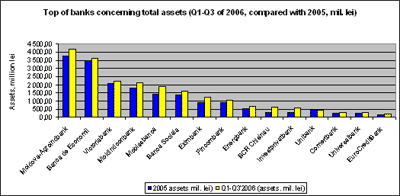
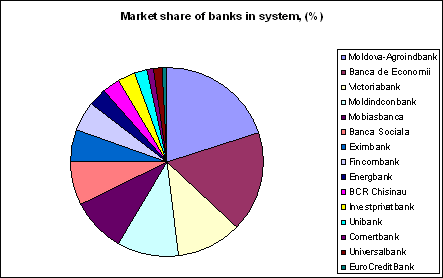
The six big banks (Moldova-Agroindbank, Banca de Economii, Victoriabank, Moldindconbank, Mobiasbanca, Banca Sociala) hold assets worth between one and four billion lei or 75 percent of the banking market, while the first leading eight banks hold more than 86% of the total assets. Traditionally, Moldova-Agroindbank remains the leader in holding assets and notably it owns assets worth about 4.2 billion lei, followed by Banca de Economii - 3.62 billion lei, Victoriabank 2.24 billion lei, while Fincombank closes the top of banks that hold assets worth over one billion lei. Other banks own assets worth between 160 and 700 million lei. Mobiasbanca - 74%(!) and Eximbank 73%(!!), institution which climbed on he 7th place in the top of banks, achieved the highest rise of assets in the 1sr-3rd quarters of 2006. Assets of BCR Chisinau have also grown spectacularly, notably by 46% (see the table).
Sources: NBM, magazines Profit and ������������� O��������
4. Real sector
The industrial production declined by 7% in January-October 2006, compared with the same period of 2005, down to about 17.5 billion lei. The fall of production was particularly linked to the wine crisis, though other branches such as tobacco growing or oil making have also declined. According to official statistics, the wine industry has declined 2-fold (holding about 10% of the sector, the reduction of wine production has decreased the production per total industry by 9.2%), while the making of distilled spirits has dropped by 33% (reducing the industry per total by 1.4%).
The cigarette industry has declined by 20%, oils and fat - by 7%, paper and cardboard by 11%, glass and glass articles by 7% (the last two being in a direct correlation with wine industry). The machine and equipment manufacturing has declined by 6%. Finally, the production made by food and drink enterprises has declined by 19%. The Government has reduced the 2006 growth forecast for industry from 6.5% down to 1% after Russia had restricted the Moldovan wines, hitting seriously wine enterprises and companies working in related branches. However, certain experts doubt over this forecast, fearing that the industry will finish this year with a regress.
Situation in agriculture is also bad...
Nor the agriculture enjoys a better situation. According to the relevant ministry, the agriculture will stagnate in 2006 after an insignificant rise (1%) in the past two years. The agro-industrial production is expected to be worth approximately 14.5 billion lei (1.16 billion dollars), a value comparable with the one registered in 2005. According to forecasts, farmers will obtain an agricultural production worth about 9 billion lei, while the food industry will made goods worth 5.5 billion lei. The stagnation is seemingly linked to reduction of grape, wheat and fruit production, as well as of cattle livestock and milk production. A 3.6% rise was anticipated earlier this year. The forecasts were updated after the agro-industrial sector declined by 4% in the 1st-3rd quarters of 2006. The agro-food industry covers 28% of the GDP and deliveries of this production covers 75% of the overall Moldovan exports.
5. Foreign trade
Moldovan exports to the European Union rose by 6.5% in the 1st-3rd quarters of 2006, up to about 240 million dollars. Thus, the volume of domestic goods exported to the United Kingdom rose nearly 3-fold in January-September 2006, deliveries to France grew 1.7-fold, Slovakia by 35.2%, Poland by 18%, etc. At the same time, Moldovan imports from the E.U. totalled about 560 million dollars and rose by 6% compared with the similar period of 2005.
However, Moldovan exports have declined by about 7%, down to nearly 816 million dollars, in spite of the growth registered in January-October 2006. Moldova's foreign trade was close to 3 billion dollars, by 12.3% more than in the similar period of 2005, but the trade deficit (about 1.3 billion dollars) has grown by about 38%.
During the meeting in Washington of the Moldovan Minister of Foreign Affairs and European Integration, Andrei Stratan, with the US State Secretary; Condoleezza Rice, the latter assured that the US will continue to support the efforts aimed towards the territorial reintegration of the Republic of Moldova. The American State Secretary stated that the US will further contribute to the international efforts in this direction. "Moldova is a good friend of the USA. We will contribute to overcoming the obstacles hindering the development of your state. A successful implementation of reforms will contribute to the achievement of the European integration of Moldova", said Rice, according to a communique from the MFAEI. Minister Stratan in his turn thanked the US for its continuous and consistent assistance for territorial reintegration, economic development and democratisation of Moldova. Stratan also thanked the US for the support granted to Moldova at the recent NATO Summit and the OSCE Ministerial Council in Brussels regarding the implementation of the obligations assumed by Russia to withdraw its troops and munitions from Moldova.
The 14th OSCE Ministerial Council took place on 4-5 December in Brussels. At the summit the Republic of Moldova called upon the Russian Federation to fulfil the obligations assumed in Istanbul in 1999 to withdraw its troops and munitions from the territory of Moldova and thus demonstrate its respect for the sovereignty, independence and constitutional neutrality of Moldova.
"The current re-opening of the bilateral Moldovan-Russian dialogue, the proposals of the President of Ukraine and the documents adopted by the Moldovan Parliament in 2005 create a new atmosphere, one which is favourable for the resolution of the Transnistrian conflict. In this sense, we call upon the Transnistrian authorities to remove as soon as possible the obstacles for the free movement of people and goods, to take the region out of the current isolation, to ensure the respect for fundamental rights and liberties in the region", the Moldovan Minister of Foreign Affairs and European Integration, Andrei Stratan, stated in Brussels.
The Moldovan position was supported by delegations of the European Union, US, Romania, Bulgaria, Czech Republic, Slovakia, Turkey, Latvia etc., wich have expressed their firm support for the sovereignty and territorial integrity of Moldova.
Erkki Tuomioja, the Finnish Foreign Minister, speaking on behalf of the Presidency of the European Union, reiterated the EU support for a sovereign and territorially integral Moldova and called for a resumption of the "5+2" negotiations with a view to reaching a comprehensive agreement on political, economic and security problems, including the reorganisation of the peacekeeping operation. At the same time, the UE reiterated the lack of progress in the process of withdrawal of Russian troops and munitions from Moldova and called upon Russia to fulfil its obligations unconditionally.
The US Deputy State Secretary on political issues, Nicholas Burns, criticised Russia for the pressure exerted on Moldova and Georgia and for the failure to fulfil its commitments to withdraw troops and munitions from the two states. Burns also stated that the US will insist that Russian meets its 1999 Istanbul obligations, whose fulfilment is but a "matter of time".
On the other hand the Russian Foreign Minister, Serghei Lavrov, blamed Moldova for the fact that Russia has stopped the process of withdrawal of its troops and munitions from the Transnistrian region. Answering journalists' questions, Lavrov stated that the withdrawal of Russian weapons from Transnistria will only take place after the effects of the unilateral actions of Moldova will be overcome and as a result of the resumption of the political negotiations. At the same time, Lavrov stated that reaching of an agreement between the two sides will only be possible with the participation of all sides involved and expressed hope that after the recent meeting between the Russian and Moldovan presidents there will be progress in this sense. Referring to Russia's Istanbul commitments, Lavrov said that these are often the subject of speculation and are linked to the ratification of the adapted Treaty of Conventional Forces in Europe. "There was no link between the settlement of conflicts in Georgia and Moldova and the ratification the adapted CFE Treaty in Istanbul", Lavrov said.
The works of the OSCE Ministerial Council did not result in the adoption of a final statement. For the fourth consecutive year, this has happened duet o divergences between the majority of the OSCE Member States and Russia. Likewise, no final regional statement on Moldova was adopted. The Belgian Foreign Minister presented the view of the OSCE Chairman in Office regarding developments in the OSCE. The SUA, EU and NATO presented Final Statements in which they expressed their views on the results of the forum. They have unanimously called upon the Russian Federation to finalise as soon as possible the process of withdrawal of its troops and weapons from Georgia and Moldova.
On 10 December in the Transnistrian region so-called "presidential elections" were held, at which the office of "president" was contested by four candidates: current Transnistrian leader, Igor Smirnov, Chairwoman of the Communist Party, Nadejda Bondarenco, independent candidate, Piotr Tomaili, and the editor in chief of the newspaper "Novaia Gazeta", Andrei Safonov.
According to the data of the Transnistrian "central electoral commission", Igor Smirnov received 82.5 % of the votes of the 257,000 (66% of voters in the voter rolls) voters who participated in the poll. Thus, Smirnov will hold the "presidential mandate" for the fourth consecutive time; he has been the leader of the region since its self proclamation in 1990 and to date. Smirnov is followed by the communist candidate - Nadejda Bondarenko, with 8 % of votes. Andrei Safonov gathered almost 4% of the votes, and Piotr Tomaili - 2%. Against all voted 1.6% of the participants in the vote.
According to tradition, the "presidential" elections in Transnistria have been monitored by international observers, including a group of deputies in the Russian State Duma. The latter organised a press-conference after the ballot at which they said that they did not observe any irregularities during the electoral campaign or on election day that could have put a question mark on the validity of election results. According to the deputy Chair of Russian Duma, Serghei Baburin, "despite the problems related to the registration of Andrei Safonov, the opinion of the people, as expressed at elections, was not affected".
On the other hand, the candidate of the Transnistrian "opposition", Andrei Safonov, expressed his lack of trust in the official results of the ballot. He said that the data of the "central electoral commission" did not correspond with the data of some independent sociological studies according to which Smirnov would not have gathered more than 64% of the votes. We would like to remind that Safonov was registered only a few days before the elections, following a court ruling annulling the initial refusal of the region's electoral body to register him on grounds that the number of false signatures presented in his support exceeded the legal threshold.
Moldovan authorities have condemned the "elections" in the Transnistrian region and have called upon the international community not to recognise them. The US, EU, OSCE and Ukraine said they did not recognise either the legitimacy of the Transnistrian "elections" or its results.
The Committee of Ministers (CM) of the Council of Europe (CoE) has held the last of the six special meetings for 2006 for the supervision of the execution of judgments of the European Court of Human Rights (ECHR). The Committee supervised the payment by respondent states of just satisfaction to applicants (855 cases), the adoption of other individual measures granting the applicants the appropriate redress (127 cases or groups of cases) and of general measures preventing new similar violations (186 cases or groups of cases). The Committee examined among others the Response to the 4th Interim Resolution in the case of Ilascu and others v. Russia & Moldova where the Court found the applicants' detention in the "Moldovan Republic of Transnistria" to be arbitrary and unlawful and ordered the immediate release of the applicants still in detention; general measures for the prevention of ill-treatments applied by police registered Hungary, Russia and Moldova (Case Boicenco); better detention conditions in Moldova (Case Ostrovar) and Croatia.
On occasion of the international day of human rights marked on December 10, CoE Secretary-General Terry Davis said in an official communication that the imprisonment of Andrei Ivantoc and Tudor Petrov-Popa in an illegal jail in the middle of Europe is "a disgrace and a blatant violation of the European Convention of Human Rights." Speaking about the ECHR judgment passed two years ago on Ilascu and others v. Russia & Moldova, Davis said that it is unacceptable that the Russian Federation continues to dispute the validity of the judgment as a whole and claims it is unable to secure the applicants' release. The obligation of Council of Europe member states to abide by the judgments of the European Court of Human Rights is unconditional and non-negotiable, while the refusal to abide by the Court decision is inexcusable and puts at risk the enforcing mechanism of the Convention, Davis added.
The ECHR has sentenced Moldova in a new case, Nistas GMBH v. Moldova. The applicant, a German society, complained that final judgments in its favour were quashed in supervisory review proceedings, at the request of the prosecutor's office. In 1997-2001 this company rented a certain number of carriages to the state-owned railway company of Moldova CFM, which should honour some payments. Starting 2001, CFM stopped honouring payments and the German society sued it, with the economic court and the Supreme Court of Justice awarding victory to the applicant. At the request of prosecutor-general, the Supreme Court of Justice quashed the previous judgments in 2003 and reduced the damages for the applicant. Examining the case, the ECHR noted that a final and binding judgment in the applicant's favour was set aside by a higher court in supervisory review proceedings, following an application by a public prosecutor, whose power to make such applications was not subject to any time-limit, so that judgments were liable to challenge indefinitely. There had therefore been a breach of the principle of legal certainty and of the right of access to a court in the applicant's case. Accordingly, the Court held, unanimously, that the setting aside of the judgment in supervisory review proceedings violated Article 6 � 1. There being no public interest defence justifying that interference, the Court also held, unanimously, that there had been a violation of Article 1 of Protocol No 1. The applicant was awarded 60,597 euros for pecuniary damage, 2,000 euros for non-pecuniary damage and 2,400 euros for costs and expenses.
According to a press release by a representative of the applicant, the Moldovan Government was notified on December 6, 2006 that Megadat.Com S.R.L. has appealed to the European Court of Human Rights against violation of the right to property by being illegally deprived of its licence. The Government was asked whether the company's right to private property was violated and if the company faced a discriminatory treatment.
On December 4, 2006, the European Commission released two important documents in the context of the European Neighbourhood Policy (ENP): Communication from the Commission to the Council and the European Parliament on strengthening the European Neighbourhood Policy and Communication from the Commission to the Council and to the European Parliament on the general approach to enable ENP partner countries to participate in Community agencies and Community programmes. The first communication is accompanied by other documents of the Commission such as: Overall Assessment (of reports within ENP between the European Union (EU) and the first 7 states which signed action plans with it); Sectoral Progress Report and ENP progress reports.
Communication [�] on strengthening the ENP outlines the main developments within the ENP, notes that the ENP remains distinct from the E.U. enlargement process, presents the main problems and challenges within ENP and raises proposals aimed to strengthen the ENP and substantially improve the impact of this policy. Overall Assessment presents in a synthetic manner the progresses achieved by Ukraine, Moldova, Israel, Jordan, Palestinian Authority, Tunisia and Morocco in implementing the action plans, as well as actions taken by the E.U. to support the implementation of these plans. Sectoral Progress Report reveals developments on sectors in the seven states concerned in the ENP context.
ENP Progress Report on Moldova is of a high interest for Moldovan public opinion. The document tells the opinion of the European Commission regarding the way Moldova honoured in February 2005 - November 2006 the commitments assumed in front of the E.U. through the EU-Moldova Action Plan. Unfortunately, the document does not make an exhaustive assessment of implementation of the Action Plan by Moldova and reveals only the main progresses and problems of this process. The report mentions among important and moderate progresses: management of the Moldova-Ukraine border; cooperation with international financial institutions; cooperation with the EU on certain problems of foreign policy; obtaining of the EU generalised system of preferences plus (GSP+); accomplishments against organised crime, including trafficking in human beings; improvement of investment climate; Moldova's joining to the Bologna Process; reformation of research, development and innovation sector, etc. On the other hand, the main problems include: deficient implementation of reform strategies; lack of clear priorities of action; aspects related to functioning of democratic institutions; restriction of freedom of mass media; wide spreading of corruption; Government's interference in business; unclear situation of parliamentary immunity; insufficient respect for human rights; limited independence of the judiciary, etc. ENP Progress Report on Moldova notes also that the EU executive has proposed the Council to increase the financial assistance for Moldova, assistance expected to improve the governance, to encourage democratic accomplishments, to promote regulatory reforms and reduce poverty. If the recommendation of the Commission is accepted, Moldova could become the second recipient after Palestinian Authority, depending on volume of financial assistance of the EU. The Commission proposed that a flexible assistance regime for Moldova be introduced starting with 2007 and financial allocations be gradually increased. The European Neighbourhood and Partnership Instrument (ENPI) within ENP stipulates 210 million euros for Moldova for 2007-2010. Also, another 45 million euros will be released in grants to cover the balance of current payments.
Moldovan authorities have received the assessment by the European Commission with a relative satisfaction. But there are independent observers who, though admit some progresses achieved by Moldova in implementing the Action Plan with the EU, note that overall assessment of the ENP by the European Commission places Moldova below performances achieved by Ukraine, Jordan and Morocco within this policy.
Finally, the second Communication by Commission published on December 4 recommends two distinct approaches of participation of states within ENP in: (1) community agencies and (2) EU programmes.
The Moldovan-Romanian relations have been tense in the period concerned.
The Moldovan Ministry of Foreign Affairs and European Integration (MFAEI) convoked the Romanian ambassador in Chisinau, Filip Teodorescu, on December 5 in connection with "defying conduct toward the Republic of Moldova and legitimate authorities of the country" demonstrated by Ion Caramitru, chairman of the Romanian Theatrical Union (UNITER), who has recently visited Chisinau on the 60th anniversary of the Moldovan Theatrical Union (UNITEM). Ambassador Teodorescu was notified over need to respect the diplomatic norms at events involving the Romanian Embassy.
According to observers, Moldovan authorities have been troubled by a series of statements delivered by Caramitru to the newspaper Jurnal de Chisinau. Caramitru said among others that: "It is symptomatic that the communist party did not gain elections in any former Soviet countries, but in the Republic of Moldova only. Let's hope that this is the last cry of the disappearing bear."
Contacted by MEDIAFAX, Caramitru said that his statements are not a "defying conduct toward the Republic of Moldova", while the convocation of Ambassador Teodorescu by MFAEI is "a jump over normality" and the Romanian Embassy did not have any connection with his presence in Chisinau.
As a symmetrical response to the gesture of the Moldovan MFAEI, the Romanian Foreign Ministry has convoked the Moldovan ambassador in Bucharest, Lidia Gutu. According to MEDIAFAX, it was said at the meeting that "the unusual diplomatic request of MFAEI unfits the situation, as the UNITER chairman is a private person free to express his opinions." Also, the Romanian side noted that the opinions expressed by UNITER chairman cannot be interpreted as official stances of Romania and the declared attachment to the European community of values requires Moldova to respect the right to opinion.
The Romanian side demanded "explanations in connection with tone of some recent statements by representatives of Chisinau executive authorities, criticism against Romania's concerns to participate in strengthening of the European option of the Republic of Moldova." The request envisages statements by Moldovan President Vladimir Voronin published by a Russian-language portal on December 1, with the chief of state accusing Romania of meddling in Moldova's interior affairs. Voronin also noted that "Moldova is capable to achieve the European integrity and internal democratic development of the state and to improve the social-economic condition of workers [...] without pretensions and advocates who are imposed to us from the other side of the Prut river."
In spite of frictions in Moldovan-Romanian relations, Romania has reconfirmed its readiness to back all appeals of Chisinau aimed at bringing Moldova closer to the EU. In this context, Romanian Foreign Minister Mihai Razvan Ungureanu noted that Moldova is present in all formats of subregional cooperation in Balkans and other South East European cooperation arrangements thanks to Romania only and underlined that Romanian authorities will continue insisting on Moldova's inclusion in the package of the Western Balkans and seeking thus a European perspective for Moldova, "no matter what a character or another from Chisinau is saying."
Moldovan-Russian relations have expanded in the period concerned. Their "warming up" is considered to be linked to agreements reached by Presidents Vladimir Voronin and Vladimir Putin in Moscow on August 8 and in Minsk on November 28. The resumption of traffic of trains on the Chisinau-Moscow route and the possible restart of wine and meat exports to the Russian Federation on basis of a new scheme are believed to be results of previous talks between the two presidents.
On the other hand, the Moldovan-Russian relations do not progress in the context of settlement of the Transnistrian conflict. Russia reiterated its stance regarding the need of a political solution to the Transnistrian conflict for resumption of the process of withdrawal of its munitions and troops from Moldova, at the December 4-5 OSCE Ministerial Council in Brussels. In its turn, Moldova urged Russia to honour its commitments on withdrawal of its forces from Moldova and to demonstrate respect for Moldovan sovereignty, independence and constitutional neutrality through this gesture.
More details about Moldovan-Russian relations in the context of the Transnistrian settlement and debates held at the OSCE annual meeting in Brussels read in the chapter Transnistrian problem of this issue of the journal.
Moldovan deputy Premier Andrei Stratan, minister of Foreign Affairs and European Integration, paid an official visit to the United States on December 13-15. Stratan met with American high-ranking dignitaries, including U.S. Secretary of State, Condoleezza Rice, and J.D. Crouch, deputy adviser for National Security.
The Moldovan minister thanked the U.S. for supporting Moldova's efforts for territorial reintegration, economic development, advance to democratisation, as well as for the strong stance expressed by the US at the NATO summit in Riga and the OSCE Ministerial Council in Brussels regarding the need of honouring the 1999 Istanbul commitments by Russia. Stratan also highlighted the need of substituting the present peacekeeping operation in the Security Zone with a multinational force under aegis of an international organisation.
In their turn, American officials assured that the US will help Moldova overcome difficulties on way of its development and will continue efforts aimed to settle the Transnistrian conflict.
Elsewhere, Stratan indicated the importance of the assistance program given by the US Millennium Challenge Corporation to Moldova. In this context, it should be noted that the visit of the Moldovan diplomat to Washington coincided with the signing of the Preliminary Program of the Millennium Challenge Corporation in Chisinau on December 15. Moldova will benefit of assistance worth 24.7 million dollars to support anti-corruption reforms.
Consultative group of donors for Moldova
Brussels hosted on December 12 a sitting of the consultative group of donors for Moldova under the aegis of the World Bank and the European Commission. That was the third meeting of the Group. The first two took place in 1995 and 1997. Taking part in the sitting was a delegation of Moldovan high-ranking officials led by Prime Minister Vasile Tarlev and representatives of important international organisations such as the World Bank, IMF and the European Commission.
The meeting evaluated the implementation of structural reforms stipulated by EGPRSP and the EU-Moldova Action Plan and decided to grant a joint financial support of 1.2 billion dollars to Moldova. This amount, which exceeds the financial assistance received by Moldova after 1991, will be released within three years to support the promotion of structural reforms. Half of this amount will be unreimbursable credits, while the another half will be long-term credits with an interest rate of up to 1.5 percent a year. Also, 25 percent of the entire amount will go to support budget and balance of payments.
Moldovan prime minister said when he came back to Moldova that the financial assistance will be used: to implement reforms in the judicial system; to implement the public administration reform; for education; healthcare; infrastructure; to create new jobs; to develop agriculture; to offer long-term credits for a low interest rate, etc.
Corruption perception in the world
According to a recent report, the American organisation Gallup ranks Moldova on the 88th place among 101 countries included in a corruption perception ranking that covers state bodies and business structures.
According to the document, Moldova is rated 89 out of 100 available points regarding corruption rate in 2006 and it is ranked the same place with Latvia, after the Russian Federation and Ukraine, which ranked the 93rd place with 90 points, and Lithuania, which was ranked the last place and rated 94 points. Following countries recorded the lowest corruption rate: Finland (12 points), New Zealand (21 points), Singapore (22 points) and Saudi Arabia (25 points). The post-Soviet countries with a low corruption rate include Uzbekistan, which was ranked the 18th place (54 points), Belarus the 26th place (63 points) and Georgia the 31st place (68 points).
For comparison, the 2006 report by Transparency International-Moldova shows that Moldova is ranked the 81st place among 163 countries covered by a corruption perception index.
GDP is on the rise, but citizen does not feel it much!!!???
Iurie Gotisan
 Official statistics have released a communication showing that the "character" called GDP, which was capable to ensure Moldovans with many things that they wanted, rose by 4.6% in January-September. Of course, not like characters but close to them. However, this is a strong enough rise, given the internal and external shocks faced by economy this year.
Born from calculations like the goddess from foam of the sea and because it became so important, the GDP does not need only a value to make it addressable, but also a visual identity. A table is the easiest thing and it is often done this way: my vision on world made me doubt over correctness of the GDP expressed in advances and declines. Balancing the Mr. GDP with my own experience, the commentary that came in my head was "there your are" in direct and indirect meanings.
I am discovering in books that other persons have also experienced my dilemmas regarding GDP; the first example is the creator of GDP, Simon Kuznets, laureate of the Nobel award for giving birth to GDP, who warned at the 1934 American Congress that the welfare level of a nation can be deducted approximately only after calculation of the national revenue. Late senator Robert Kennedy was more plastic and that's why I will cite him: "The Gross Domestic Product includes air pollution and advertising for cigarettes, and ambulance to clear our highways of carnage. It counts special locks for our doors, and jails for the people who break them. It is indifferent to the decency of our factories and the safety of our streets alike. It does not include the beauty of our poetry or the strength of our marriages, or the intelligence of our public debate or the integrity of our public officials. It measures everything, in short, except that which makes life worthwhile."
Three important economists of the time, Cobb, Halstead and Rowe, have compared the GDP with a calculating machine that can add but not subtract. The production of any kind was and it is from Americans and now Moldovans the indispensable element to measure the welfare. According to critics of GDP, the big mistake is that any economic activity is considered good and valid for national wealth: increased consumption of fuels is equal with welfare even if it means use of natural resources and pollution; consumption of alcohol and tobacco is OK because it also increases the consumption of drugs and medical costs, but is it a better quality of life? It means that the GDP is a bit wrong.
A fellow who came back home after staying one year in the West has told me much things about effect of finding again Chisinau and fewer facts about what happened in the West: it seems easier to accept and get used to the normality that some have it and we would like to have it, too, and it is harder to find again the daily occurrence from seven hills, though our situation is better regarding the GDP rise. We all have experienced either on our skin or found in tales of comrades what my fellow is living. This is a standard which would not be equal to percent or values per capita.
But why things go wrong in Moldova? This is a question with multiple and diverse answers. Where is the beginning? What is the main cause of the evil? Let's try to answer this question. Perhaps all evils in Moldova have one fundamental cause: the poverty. Roads are deteriorated because mayoralties are short of money to repair them. It seems that prices are high because we earn low salaries. Moldovan products are not very competitive because enterprises lack money to invest in modernisation, etc. The poverty is the cause of everything. It has two serious components with grave consequences: a component affects the state and its institutions and halts the modernisation, renovation of roads, friendly and efficient institutions, etc.; the second component affects directly everybody and its effects are very clear. But the poverty in our country is regarded as a natural phenomenon, a curse. Some countries face earthquakes. Others face floods. Moldova is facing poverty. However, there are explanations, there are solutions. We will give details with figures, GDPs, etc. Perhaps we should understand a little what is happening around us.
The medium salary on economy is the measure of poverty (or wealth). The National Bureau for Statistics said that the medium salary on economy in Moldova was 124 dollars. Thus, a Moldovan earns 124 USD a month. We know that this is embarrassing, but what does this really mean? Economies of all countries are becoming more interconnected. Nor Moldova is an exception in this respect. The times when a country or even a geographical area could ensure alone all necessary products had passed; now some countries are specialised in manufacturing laptops, others in producing petroleum. A major consequence of this phenomenon is that prices of products that may be exported are becoming closer in any country one visits. Thus, a laptop tends to cost in Moldova like in the United States. The same is effective for a barrel of petroleum or a costume Armani. Of course, some products (generally the domestic ones: vegetables, fruits, etc.) have different prices, but they are actually comparable.
OK. But why we earn only 124 dollars a month? We must study the dear GDP in this respect. The GDP is the value of all products made by economy of a country in one year. The GDP is actually the measure of wealth produced by an economy. When the GDP is divided to the number of residents, the GDP per capita is obtained. For example, the GDP per capita in the U.S. is approximately 36,300 dollars (the U.S. was taken as a reference, but any western economy may be analysed instead). It means that the wealth created by American economy in one year is worth 36,000 dollars for every American. The welfare create by Moldovan economy in one year (GDP per capita) is approximately 900 dollars per capita. The American GDP (per capita) is 40-fold higher than the Moldovan one.
Let's come back to salaries: the medium salary in Moldova amounts to 124 dollars. The U.S. pays a medium salary of 3,500-4,000 dollars a month. This ratio (1:40) is actually maintained: the medium salary of an American is about 40-fold higher than of a Moldovan. The Moldovan GDP is directly establishing the size of salaries in Moldova and the poverty rate and living standards. Finally, the equaliser "per capita" of the present GDP does not advantage us at all as individuals and individualities; I would like to stand out through a more decent, careful and human First Welfare Indicator, which people would understand.
The contributors to this issue are:
|
© 2001-2015 Association for Participatory Democracy "ADEPT" Reproduction of the materials is welcomed provided the source is indicated | e-mail: [email protected] |