
Participatory
Democracy
Original: /en/e-journal/20061230/index.shtml
| Association for Participatory Democracy | Print version. Published on www.e-democracy.md Original: /en/e-journal/20061230/index.shtml |
Activity of Public Institutions
1.1. Appointments
The Parliament has appointed members of the Board of Observers of the national public broadcasting company TeleRadio-Moldova, with at least 3/5 lawmakers voting every candidate selected by the competent parliamentary commission. The Parliament appointed Ludmila Barbus (for a 3-year term); Alexandru Burean (2 years); Viorel Cibotaru (2 years); Veaceslav Ionita (2 years); Anatol Dubrovschi (3 years); Boris Focsa (4 years); Victoria Musteata (3 years); Igor Munteanu (4 years); Mariana Slopac (4 years). The Board of Observers has the following tasks: approves the statute of the company; assesses the performance of the company and its administration; confirms the chairman of the company, director of the radio department and director of television, etc., on basis of a contest.
1.2. Legislative acts
1.3. Totals of activity
Totals made by parliamentary factions
Eugenia Ostapciuc, chairwoman of the parliamentary faction representing the Communist Party of Moldova, has said that the Parliament adopted a number of legislative acts of major importance, remarking distinctly the 2007 state budget law. She acknowledged that parliamentarians have also approved some legislative acts with a "certain negative impact on some categories of population", but their implementation will improve the life of residents.
Serafim Urechean, chairman of the Our Moldova Alliance, has noted that other opposition parliamentary forces avoid criticism against governance, while chief of state did not want to attend the festive plenary sitting. Urechean considers that the rescuing trends registered at the end of the year are due to citizens and foreign partners, international organisations that support Moldova, rather than to Government’s efforts.
Valentina Buliga, representative of the parliamentary faction of the Democratic Party of Moldova (DPM), has described the Parliament’s activity as productive, though the majority does not hear the opposition sometimes. DPM will call for a constructive approach of problems related to the Power-Opposition relations, considering the boycott and bitter criticism as inefficient measures.
Iurie Rosca, chairman of the Christian Democratic People’s Party (CDPP), has outlined two key accomplishments in his speech: political stability and partnership between Power and Opposition. CDPP has understood much better that all economic and social difficulties must be tackled constructively in order to find practical and lasting solutions. Rosca noted that the Power and Opposition have solitarily voted for the first time in 15 years of independence the state budget law that included a majority of proposals and amendments by CDPP. He also highlighted the cooperation in implementing the Broadcasting Code, modification of legislation on local autonomy, improvement of Parliament’s Regulation, adoption of a new law on political parties in the first reading. The considerable financial support of donor institutions and state is a success of interior and foreign policy, it is a response to the "atmosphere of cooperation and political stability due to the Power-Opposition partnership."
Totals made by speaker
Marian Lupu has revealed quantity parameters in his speech: the Parliament adopted 168 legislative acts, including 22 new laws, at 27 plenary sittings from the autumn session. The main documents include: the 2007 state budget law; the 2007 state welfare budget law; the 2007 law on mandatory health insurance funds; the law on public debt, state guarantees and state re-crediting; the law on technical regulation activity; the law on general security of products.
The implementation of the legislative action programme that results from Moldova’s tasks as a member of the Council of Europe included amendments on judicial reform (adoption of the law on status of penal investigation officer and law on international legal assistance in penal matters), consolidation of local autonomy (the package contains the law on administrative decentralisation; the new law on local public administration and the law on modification of the law on local public finances, the law on regional development), amendments and completions to the Parliament’s Regulation, recent adoption in the first reading of the law on political parties. The legislative programme was partly implemented in 2006 because the Government did not present a number of drafts included in this programme and this situation raises the concern of lawmakers and requires a more serious approach, especially regarding adjustment of legislation to the "acquis communautaire".
The speaker considers that more attention should be paid in future to exercising of the parliamentary control function, and new tools are needed for this purpose. The prospects include the start of some projects aimed to analyse the socio-economic impact of legislation, to diagnose their implementation.
2.1. Appointments. Reshuffles
Valeriu Turcanu was relived from the post of deputy minister of culture and tourism, as this office was suppressed from ministry.
Valeriu Grumeza was relived from the post of chief of the Balti Territorial Office of the Ministry of Local Public Administration.
2.2. Decisions
2.3. Sittings. Decisions. Statements
Results of implementation of Government’s action programme
According to a generalised report, the main components of the 2005–09 Government’s action programme Modernisation of the Country – Welfare of People are: the Economic Growth and Poverty Reduction Strategy Paper (EGPRSP), the Moldova-European Union Action Plan and the National Programme Moldovan Village. The document making the totals for 2006 notes that the development of national economy was affected by negative impact of foreign factors, which hit the macroeconomic indicators and economic sectors. Evolutions in 2006 reveal some problems in development of national economy, which may have a negative influence on its further development:
Better discipline
Moldova’s president has told the last governmental sitting in 2006 that discipline in executive has improved much in the past years. Vladimir Voronin noted that in spite of the complicated situation in 2006, the development principles of Moldova were maintained, national plans and programmes were implemented and, therefore, the chief of state is satisfied with Government’s activity. Voronin indicated among shortcomings the process of implementation of the E.U.-Moldova Action Plan and the Transnistrian problem.
A new sitting on passenger carriage system
A working sitting chaired by prime minister has warned competent bodies over need of modernising, distributing and including all motor stations in a single service system. Vasile Tarlev highlighted the need of holding a complete technical control on motor coaches, training motorists at a high level, ensuring transparency of the system, especially of money circulation record. The prime minister ordered an analysis in the field of formation of prices for cargo and passenger carriage services and solutions for this sector.
Implementation of social programmes
A sitting with the participation of officials in charge with welfare and healthcare sectors has studied the pace of implementation of the programme on free ensuring of retirees and invalids with eyeglasses, which was launched and it is implemented accordingly to the schedule.
A programme on free ensuring of deaf people with hearing devices was recently launched and an auction was already held to purchase the first 1,500 devices, which will be delivered to beneficiaries in early 2007 (more than 2,500 devices are needed).
The first 600 tons of coal went from state reserves to socially vulnerable people who paid accessible prices.
Serial manufacturing of devices invented by Moldovan scientists
Prime minister has ordered the creation of a task force to work out an efficient mechanism for certification, manufacturing and sale of devices invented by Moldovan scientists. The decision was made after Premier Tarlev has visited the Institute of Electronic Engineering and Industrial Technologies of the Moldovan Academy of Sciences. Tarlev wants a more efficient use of scientific elaborations, with the Government regarding their inclusion in economic circuit as a key direction of economic growth.
3.1. Decrees
Chief of state has appointed chairpersons and deputy chairpersons of law courts, judges (who were selected at a contest for selection of instruction judges before age limit). This way, nine vacant offices have been filled.
3.2. Sittings. Decisions. Statements
Annual news conference
Vladimir Voronin summarised some problems "of general policy" in an introducing speech delivered at a December 20, 2006 news conference: European integration; neutrality and relations with other states. The chief of state reproached journalists with reporting sombre scenarios regarding Moldova’s future, not liking the governance and not supporting authorities’ efforts from information point of view. As regards political problems, Voronin said that:
Sitting on implementation of the European Union-Moldova Action Plan
The next day after he has shown the "red card" to the Government for failures related to European integration, the Moldovan president chaired a sitting on implementation of the EU-Moldova Action Plan, with the participation of heads of central public administration authorities in charge with implementing this document.
The Government was bitterly criticised for inefficiently coordinating activities in the process of implementation of the Action Plan at national level, insufficient cooperation between all executive structures for adjustment of integration efforts. In particular, the chief of state was unsatisfied with how Moldova honours its commitments on reform of justice and prosecutor’s office, highlighting the need of "a strict parliamentary control on the reform process in the field."
Vladimir Voronin also indicated the opportunity of establishing a concrete mechanism of presentation of Moldova’s official stance regarding certain issues based on a tight cooperation between all ministries and departments participating in its elaboration to European institutions. He outlined the need of introducing a single national mechanism with clear competences of competent institutions, which would consolidate the capacity of absorption of financial assistance of the E.U., with funds being directed to priority fields and administrated efficiently.
The chief of state concluded that he would not tolerate some irresponsible attitudes toward implementation of the E.U.-Moldova Action Plan, a document of strategic importance which is fundamental for future of our state, and he is waiting for immediate and firm actions of heads of central public authorities that must shortly produce clear results.
Concerns with exploitation of subsoil
A sitting of the Supreme Security Council convoked at the initiative of Moldovan president has examined the legality, ecological and economic security of exploitation of subsoil. The chief of state raised concern with alarming situation in this field, created due to the lack of an adequate control of the state. Vladimir Voronin revealed that subsoil in Moldova is exploited and administrated extremely inefficiently and this field of activity has turned into a very profitable field dominated by illegal and criminal interests. He bitterly criticised the existing practices when economic agents participating in exploitation of mineral substances establish prices of extracted natural resources without any grounds, while taxes paid to the state budget for activity in this field are symbolical or the obligation of paying these taxes is neglected.
The Moldovan president said that the introduction of strict regulations by state in the field of exploitation of mineral deposits could and should normalise the prices of building materials and prices of residences implicitly. The state is in charge with establishing conditions for use and administration of goods of subsoil, including policy on prices of useful mineral substances. Competent authorities were told to take complex measures in order to ensure a strict control on administration and exploitation of subsoil of Moldova, so that to prevent grave damage on interests of state and citizens in future.
1. Inflation and prices
The inflation rate will unlikely be lower than 1.5 percent in December 2006 and, therefore, we may expect an inflation rate of over 14 percent for this year. The growth will be particularly due to higher prices of food products, which will be produced, of course, by euphoria of winter holidays inclusively. Inflation means a devaluation of salary, pension, savings from banks and other earnings for a common citizen.
Where it is more reasonable to buy fruits and vegetables in this period?
(Medium prices established in lei)
Name              Supermarket   Central market   Wholesale market
Potatoes          8             3.5-4            3
Tomatoes          23            18-20            16-18
Cucumbers         20            14               12
Peppers           40            33               25
Garlic            25            20               16-17
Onion             9             5-6              4
Cabbage           8             3-4              2
Beet              4             3                2
Carrots           4-5           3.5              2
Vegetable marrows 30            26               23
Eggplants         34            30               25
Dates             30            22               17
Oranges           25            16               12-13
Mandarins         21            15               12
Kiwi              35            25               22-24
Bananas           22            15-16            12
Lemons            18            14               11
Pomegranates      36            25-28            22-25
Source: Our estimates
2. Real sector
The Ministry of Economy and Commerce (MEC) has made some forecasts for 2007 at the end of this year. It forecasts a 4-percent economic growth and a 10-percent inflation rate. The GDP rose by 4.6 percent in ten months of this year and MEC estimates a growth of about 4 percent for the 12 months of this year.
According to generalised results of implementation of the Government’s action programme Modernisation of Country – Welfare of People in 2006, the indicator of industrial production was 92.9 percent compared with January-November 2005 and it declined by 7.1 percent compared with the similar period of 2005. The decline of industrial production in the period concerned, compared with January-November 2005, was due to reduction of production volume by producers of wines, distilled alcohol drinks, cigarettes, glass and glass items, paper and cardboard.
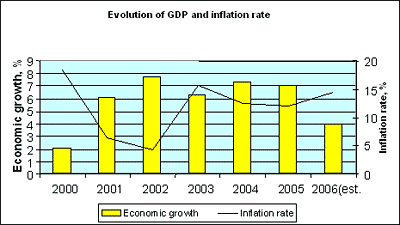
Source: NBM, NBS and our estimates
3. Financial-banking system
According to statistics of the National Bank of Moldova (NBM), the 1st-degree capital in the banking system rose by 22.2 percent in ten months of 2006, up to about 3.45 million lei (265.4 million dollars). At the same time, the share of foreign investments in capital of banks was 55.2 percent and rose by 4.6 percentage points compared with late 2005, after the registered capital has grown on account of investments of non-resident shareholders. At the same time, the total assets of the banking system rose by about 21.7 billion lei (1.67 million dollars) or by nearly 21 percent in January-October 2006.
Credits offered to industry and trade count for 48.9 percent of the total, followed by those for agriculture and food industry – 20.4 percent, real estate, construction and development 9.2 percent, and consumption 8.6 percent. As of November 1, 2006, 15 stock commercial banks were working in Moldova, including three branches of foreign banks. There were 956 specialised institutions of banks.
Currency reserves of NBM are evaluated at about 721 million dollars. According to the programme with IMF, currency reserves of Moldova are expected to account for 750 million dollars at the end of 2006, by 152.5 million dollars more than registered in late 2005. The central bank will probably intervene in continuation on currency market by massively purchasing currency, but these measures will perpetuate more the inflation, contrary to the priority goal of NBM – stability of prices.
4. Labour market
The medium salary on economy amounted to 1,875 lei (140 dollars) in November or by 95.3 lei more than in October. The medium salary in budgetary sector amounted to 1,553 lei (119 dollars), while the average pay in real sector of economy accounted for 2,049 lei (157 dollars).
Statistics also show that teachers earned 1,231 lei (94 dollars) on average in October, doctors and social assistants were paid by 1,377 lei (105 dollars), while farmers got 1,353 lei (104 dollars) on average. Salary arrears on economy exceeded 134 million lei (10.3 million dollars) on November 1, by 21.1 million lei (1.6 million dollars) more than on July 1, 2006.
5. Foreign trade
Trade exchanges between Romania and Moldova will decline in the first three months of 2007 after cancellation of the free trade agreement between the two sides. At the same time, they could be influenced by incapacity of Moldovan firms to meet and respect the standards of the European Union.
On the other hand, the Chisinau authorities invest big hopes in the new free trade agreement CEFTA, which was recently signed in Bucharest. Moldovan exports to Romania were valued at 120 million dollars in January-October 2006 and grew by 32.4 percent compared with the same period of 2005, while imports rose by 34.8 percent, up to 280 million dollars.
After a year when the political talks on Transnistria were basically stopped, the joint bodies of control set up according to the ceasefire agreements practically did not function, the Russian Federation has granted more massive and overt political, economic and social support to Transnistria than ever, and the Transnistrian authorities have strengthened their position by staging two actions with significant propagandistic effect – the September referendum and the December "presidential elections", the end of 2006 has witnessed a number of quite optimistic statements on the prospects of the Transnistrian conflict settlement from Moldovan, Russian and Ukrainian officials.
Thus, between 19–20 December the Moldovan Reintegration Minister, Vasile Sova, and the Presidential adviser on foreign policy issues, Mark Tkaciuk, visited Moscow where they discussed Transnistria with a number of high-ranking Russian officials. According to a Ministry of Reintegration communique, the sides stressed the need to continue consultations among all actors regarding the resumption of political talks. The visit has been a reason for the Russian Foreign Minister, Serghei Lavrov, to state that "the dialogue with Moldova proceeds well". "There is an honest, correct and professional dialogue on all issues, including the commercial-economic ones. All these problems are being solved consistently. We are happy with the way the agreements reached between the Russian and Moldovan Presidents are being implemented", said Lavrov, referring to the agreements reached between the two presidents during their bilateral meetings in August in Moscow and November in Minsk in 2006.
Resonating with these statements, President Voronin has stated during his end of the year press conference that "certain progresses" have been achieved on the Transnistrian settlement. He expressed his special satisfaction at the course of consultations between Moldovan and Russian officials, "which are taking place in an open manner, with EU Member States ambassadors being kept informed on each round".
And finally the Transnistrian issue was on the agenda of the discussions between the Russian President Vladimir Putin and his Ukrainian counterpart during the former’s visit to Kiev this December. According to the electronic news portal NR2.ru, during the joint press conference the two spoke about the progresses reached on Transnistria in the past months. "In the past months we believe that certain progresses have been reached. On the one hand, the customs regime is ensured, which has reduced the tension to a large extent, and, on the other hand, the passenger and goods traffic has been re-established as has been the railway transportation between Ukraine, Russia, Transnistria and Moldova", President Yushcenko stated. "We believe that today there exist all the premises to speak about the prospects of resumption of the "5+2" talks", Yushcenko added. On the other hand, President Putin stated that Russia and Ukraine "can give a new push to the Transnistrian settlement".
In the meantime in Tiraspol took place the "inauguration" of the new elect "president" of Transnistria, Igor Smirnov. The pompous ceremony gathered the cream of the Transnistrian "establishment" as well as guests of honour, such as for example the "president" of another unrecognised republic, Sergei Bagapsh of Abhazia. After making the oath with his hand on the "constitution", Smirnov held his inaugural speech in which he reiterated the break away entity’s orientation to Russia and has noted the progress already reached in harmonising the Transnistrian laws with the Russian ones, cooperation projects in the social and cultural fields, etc.
The Transnistrian "presidential" elections and Smirnov’s "inauguration" have triggered numerous comments by observers both from Moldova and abroad. Thus the Moldovan political analyst, Oazu Nantoi, has remarked in a comment that Smirnov’s fourth mandate will also be his final one. According to Nantoi, this will happen because in the next years the "value of the Transnistrian pawn for its Moscow masters" will significantly decrease. The latter might want to replace Smirnov with a "cleaner successor" and thus the "absurd theatre show called the Transnistrian conflict will go on". A more optimistic scenario however could be that the process of territorial reintegration of Moldova might be relaunched before a successor to President Putin takes over in Moscow. According to Nantoi this is the scenario that President Voronin is trying to put into practice and to which the latest developments in the Moldovan-Russian relations indicate.
In a comment published on 14 December, the News Agency Moldpres has forecast that although Smirnov will have to remain loyal to Moscow mainly due to the large Transnistrian debt for Russian gas consumption, Russia might abandon Transnistria at some point in exchange for more loyalty from the West or concessions from Ukraine. According to Moldpress, hence Smirnov’s efforts both during his electoral campaign and after it to maintain Transnistria in the Russian range of attention. At the same time it is expected that Smirnov will reform the Transnistrian administration, which has fully proved its inefficiency. However, his biggest challenge will be to preserve the balance of power with the Scheriff Company whose power ambitions are on the rise, concludes Moldpres.
On the other hand, the British analytical centre, Oxford Analytica, has written that the 10 December "elections" have considerably consolidated Tiraspol’s position in its relations with Chisinau and have considerably distanced an eventual resolution of the Transnistrian conflict. The think tank assumes that the resumption of Moldovan wine exports to Russia might have been conditioned by Moscow with the revitalisation of the ill-fated Kozak Memorandum. And given that Ukraine seems incapable of counter-balance Russian influence, Moldova finds itself in a very vulnerable position and only US and EU support may consolidate Chisinau’s position.
The European Court of Human Rights (ECHR) sentenced Moldova on December 19, 2006 in the case Moisei vs. Moldova. The ECHR concluded that a previous judgment in favour of the applicant was not executed without plausible grounds, so that Article 6 (1) and Article 1 of Protocol 1 of the European Convention on Human Rights were violated. As the applicant did not benefit from an effective appeal, the ECHR has also indicated the violation of Article 13 of the Convention. The Court ordered the payment of 192 euros in pecuniary damage, 500 euros in non-pecuniary damage and 600 euros in costs and expenses.
The same day, the ECHR decided on the case Oferta Plus vs. Moldova. The applicant has claimed the violation of the right to a fair trial and protection of property through non-execution of a final judgment (on payment of 20 million lei) by national courts and its further revision, at the request of the Prosecutor-General’s Office. The ECHR noted that the non-execution of the final judgment and its annulment contravene to Article 6 of the Convention and Article 1 of the Additional Protocol. The Court considers that the penal investigation against director of the applicant and his arrest aim to discourage the applicant in maintaining his application to the ECHR, this being a violation of Article 34 of the Convention. The problem of non-pecuniary and pecuniary damages (estimated at 1.2 million euros), costs and expenses will be resolved under a distinct ECHR judgment. Representatives of the applicant in front of ECHR have published the names of persons who are to blame for the sentencing at www.lhr.md.
On December 19, 2006, the European Union (EU) Council adopted mandates that empower the European Commission to negotiate agreements on readmission and facilitation of visa regime between the EU and Moldova.
The signing of these agreements is stipulated by objectives 47 and 48 of the EU-Moldova Action Plan, the start of negotiations on facilitation of visa regime being a priority of Moldova’s dialogue with the EU in 2006. Given this: an interministerial working group was created in March 2006 so that to work out a draft national action plan on facilitation of visa regime for EU; the Parliament adopted on June 8, 2006 the law on abolition of visa regime for citizens of EU member states, the US, Canada, the Swiss Confederation and Japan, a list completed in December with Norway and Iceland; the Government approved in November 2006 the mentioned national action plan.
However, President Voronin was unsatisfied at a news conference held to make the totals of 2006 that negotiations on facilitation of visa regime did not start in 2006 and he was angry with the lack of a visible progress in gaining the Autonomous Trade Preferences of the EU. For comparison, assessments by the European Commission regarding implementation of the first seven action plans signed with the EU within the European Neighbourhood Policy (ENP), published on December 4, 2006, show that Ukraine initialled the agreements on readmission and facilitation of visa regime with EU in October 2006.
Generalising his dissatisfaction with the pace of the European integration process, President Voronin warned that "I will show a red card to Government, if things go the same way in continuation." President Voronin has reiterated similar criticism at a meeting on implementation of the EU-Moldova Action Plan, with the participation of important decision makers. The chief of state invoked: the inefficient coordination at the national level of the activities undertaken in the implementation process of the Action Plan; the unsatisfactory coordination between ministries and departments participating in cooperation with community institutions; failure of Moldovan representatives to honour commitments or their late fulfilment.
In the context, Vladimir Voronin demanded that 2007 become the stage of some decisive and unordinary measures aimed at proximity with the EU. For this purpose, he highlighted the need of working out an action plan on basis of an analysis of the progress report for Moldova within ENP, published by the European Commission on December 4, which would exclude any possibility to fail the recommendations by European experts. The president also indicated the need of establishing a single national mechanism with well-chosen competences of responsible institutions, which would consolidate the capacity of absorption of financial assistance from EU.
Later, President Voronin has told the last sitting of the cabinet of ministers held in 2006 that mistakes and delays in the European integration process "were not committed deliberately, but on the contrary."
Romanian President Traian Basescu has said among others in an interview with the French publication Les Dernieres Nouvelles d’Alsace that many Moldovans are trying to obtain the Romanian citizenship. At present, Basescu noted, there are 450,000 naturalisation applications submitted especially by youths willing to study or work in Romania. At the same time, the Romanian president hinted that Romania will not take unilateral measures to award the Romanian citizenship and this issue will be consulted with the EU.
Speaking about Transnistrian problem, President Basescu said that its resolution would be simple, if the international law was respected and if the international community respected the integrity of every state and inviolability of borders. In the context, the Romanian president called for respect for international law and invited Russia to honour its commitments and withdraw its troops from Transnistria.
President Vladimir Voronin has told the totalling news conference mentioned above that the atmosphere in which the Moldova-Russia dialogue is developing is based on new principles. Moldova and the Russian Federation, the president continued, have never worked in such a tight contact and such an intense regime before. According to President Voronin, the Moldovan-Russian ties have gradually improved after his August 8, 2006 meeting with Russian President Vladimir Putin. The Moldovan president noted that Russia was and will be the strategic partner of Moldova and he expressed his belief that stances of Chisinau and Moscow regarding the Transnistrian settlement process will also approach.
Russian Foreign Minister Sergey Lavrov has appreciated the Moldovan-Russian relations in a relatively similar manner. He told a conference held to make the totals of the diplomatic year 2006 that Russia’s relations with Moldova are based now on "a honest, concrete and professional dialogue, including commercial-economic ties." According to the Russian minister, existing commercial problems are gradually resolved and a favourable base for resolution of other problems is being created. This dialogue, Lavrov continued, is "normal, without elements of show […], as the two heads of state have agreed," noting that Russia is satisfied with implementation of the earlier reached agreements.
Some recent evolutions in bilateral dialogue confirm the trends to extend the Moldovan-Russian relations. Experts of the Russian Service Rosselihoznadzor have inspected some Moldovan meat processing enterprises to identify companies "which respect all sanitary-veterinary requirements" for resumption of meat and sausage exports to Russia. Secondly, the signing on December 27, 2006, in Moscow, of a bilateral Protocol on concluding negotiations between Russia and Moldova regarding accession of Russia to the World Trade Organisation (WTO) may be invoked. Minister of Economy and Commerce Igor Dodon was announcing earlier that Moldova would like to obtain instead the signing of an export taxation agreement, especially the one on Russian natural gas. Russia is still applying VAT on natural gas exports by Moldova, while WTO requirements stipulate that the destination country, not the exporting country must apply the VAT.
Under recent agreements with Russia’s Gazprom, Moldova will pay 170 dollars per 1,000 cubic metres of natural gas in 2007, 75 percent of the European average in 2008, 90 percent in 2009, and the price will be adjusted to the European average starting with 2011. This gradual rise of natural gas price is seen as a result of the extension of bilateral relations. At the same time, Russian media outlets said that Moldova accepts to cede the gas distribution networks to Gazprom and to increase the participation of the Russian concern in the Moldova-Gaz society in exchange for a gradual rise of the gas tariff. First Deputy Premier Zinaida Greceanii replied that Moldova will capitalise the distribution grids and will include them in the registered capital of Moldova-Gaz, while the sides have agreed not to touch the shares.
Moldova attended the CEFTA summit in Bucharest on December 19, 2006. Taking part in the meeting were also Albania, Bosnia and Herzegovina, Bulgaria, Croatia, Macedonia, Montenegro, Romania, Serbia and Kosovo. Moldova along with other participating states signed the agreement on modernisation and enlargement of CEFTA, becoming part of this agreement, and undersigned to a joint declaration.
The agreement on modernisation and enlargement of CEFTA, known as CEFTA 2006, replaced the old Central European Free Trade Agreement signed in 1992 and bilateral free trade agreements. CEFTA was created in December 1992 by founding members the Czech Republic and Slovakia (Czechoslovakia in that period), Poland and Hungary. Romania joined the CEFTA in 1997, Bulgaria in 1999, Croatia in 2003 and Macedonia in 2006. An initial goal of CEFTA was to prepare member countries for accession to the EU and this aim remains in force for CEFTA 2006, being reiterated in the joint declaration. The Czech Republic, Slovakia, Poland and Hungary had withdrawn from CEFTA when they joined the EU, taking over the commercial policy of the EU, and Romania and Bulgaria will do the same on January 1, when they will become EU members.
CEFTA 2006 calls for the annulment of import and export duties, quantity restrictions and other taxes with equivalent effect in trade with industrial products and majority of agro-industrial products. The new agreement also contains provisions on trade with services, intellectual property, procurements, investment promotion, customs management and preferential origin rules, procedure and conditions for implementation of safeguard measures and commercial protection tools. CEFTA 2006 corresponds to WTO norms and obligations of the Parties in relations with the EU.
Minister of Economy and Commerce Igor Dodon represented Moldova at the 32nd sitting of the CIS Economic Council in Moscow on December 27, 2006. The sitting tackled problems related to energy, transportation, construction, etc. Also, the Council examined measures to combat the penetration of counterfeited medications on CIS markets and the draft concept on tariff policy in the field of railway transportation coordinated by CIS members.
Political year 2006
The political year 2006 was difficult for Moldova. It began with the gas crisis and the gas price rose two-fold in the second half of 2006. It was followed by Russia’s embargo on wines, Moldova’s main products for export. The wine crisis was speculated by Patria-Moldova organisation based in Moscow, which claims to represent the interests of all Moldovan guest workers, with the purpose to produce a financial crisis in Moldova. Patria-Moldova called upon all Moldovan citizens in April-May to withdraw their deposits from commercial banks in order to challenge a financial collapse. These actions have raised concerns among businessmen and banking sector. The National Bank besides international financial institutions had to intervene and stabilise the situation, and they succeeded completely.
The introduction of the new customs regime in the Transnistrian section of the Moldovan-Ukrainian border on March 3 challenged the reaction of the Russian Federation toward restoration of "equality of the conflicting sides," imposing the embargo against Moldova. The open economic, political and diplomatic support of Russia for Transnistria followed.
On August 3, the Government adopted an action plan on use of conclusions of the report "Thawing a frozen conflict: legal aspects of the separatist crisis in Moldova", worked out by the Association of the Bar of the City of New York, in the country reintegration process. The Government obliged the Ministry of Foreign Affairs and European Integration to submit a joint request on behalf of GUAM to the U.N. General Assembly president and the General Committee concerning the additional inclusion of a point on examination of conflicts in the Black Sea and Caspian Sea region in the agenda of the 61st session of the General Assembly.
Minister of Foreign Affairs Andrei Stratan told the viewpoint of Moldovan authorities on settlement of the Transnistrian conflict within the September U.N. General Assembly: the need of transforming the peacekeeping mechanism into an international peacekeeping mission with international mandate; Russia’s respect for the commitments assumed at the 1999 Istanbul OSCE summit; conditioning of ratification and enforcement of the CFE Treaty with implementation of all decisions of the 1999 OSCE summit. The December 2006 OSCE ministerial meeting reconfirmed Moldova’s stance on conflict resolution conditions.
Russia has openly joined the separatist regime, supporting the September 17 Transnistrian referendum on joining of Transnistria to Russia. This way, Russia has used all means to support Transnistria. Acting this way, it revealed the fact that it cannot afford the incorporation of Transnistria into itself and the recognition of independence of the secessionist republic. As a result, the Transnistrian conflict remained frozen for an indefinite period.
The failure on December 3 of the candidate supported by the Communist Party to succeed to the runoff vote for the post of Gagauz governor is the surprise of the year. Consequences of results of the Gagauz elections will be felt in 2007, they are not dramatic for the ruling party, but will have a major impact on relations between Chisinau and Comrat.
The scandal of 2006 was challenged by adoption and start of implementation of the Broadcasting Code. The broadcasting is a very strong tool to gain money from advertising and the most important tool to influence the electoral opinions of citizens. Although provisions of the initial draft Broadcasting Code were repaired and improved, the implementation of this document regenerated older political antagonisms. The appointment of members of the electronic media watchdog CCA, promotion of decision on reorganisation-sale-privatisation of the municipal radio and TV channels Antena C and Euro TV developed into protests of some political parties and journalists on one hand and motivation of the need of privatisation through lack of finances to maintain them in municipal property and accusation of these channels of political partisanship on the other hand. These accusations are formally right. Indeed, they are absurd. A consultation of election monitoring reports released by the OSCE in the past years reveals that the two channels have been biased somehow. But the easily biased nature "corrected" the clear bias of the main broadcasting institution of Moldova – TeleRadio-Moldova Company. Hence, the scandal is linked to fact that there are tries to regulate some older political antagonisms under coverage of new legal norms.
Moldovan authorities shirked from adopting new concepts on foreign and security policies in 2006. There were premises for their adoption: these documents were drafted on basis of presidential decrees in March; surveys show clearly what external political course the absolute majority of citizens would choose; there is a disciplined parliamentary majority, which could vote the two documents. Explanations of experts over this state of things are reduced to affirmations that facts are more important than the solemn announcement of a course, which would be limited and without flexibility later.
The security and foreign policies of Moldova remain strongly influenced by Transnistrian factor at this stage, better saying by interests of neighbouring states participating in the settlement of the separatist conflict. The change of the vector of foreign policy in 2003 was argued through the need of "internationalising the conflict resolution process."
Year 2006 was the year of plenary manifestation of effects of internationalisation of the Transnistrian conflict. The internationalisation did not approach the conflict resolution, but it explained the attitudes of neighbouring countries and great powers toward this conflict. The support of the United States and the European Union was decisive to help Moldova resist to Russia’s economic pressures and for efforts to restore the territorial integrity. As a result, Moldovan authorities were obliged to take the measures needed to settle relations with international financial organisations and to obtain a support over expectations (1.2 billion dollars) from the board of donors created by the European Union, the International Monetary Fund and the World Bank.
The E.U. and the U.S. have implicitly influenced the attitude of Ukraine toward the Transnistrian problem. This influence is the collateral effect of Ukraine’s interest for maintaining good relations with the U.S. and E.U. For this reason, Ukraine was and remains in continuation the main lever of influence on Transnistria, no matter if it wants this or not, including by maintaining the new customs and control regime in the Transnistrian section of the border with Moldova.
In spite of some bitter replies and inadequate rhetoric of the top leadership, Moldova has enjoyed the support of Romania to become a full rights member of SEECP in May and a CEFTA member in December. These performances fuels hopes expressed by Moldovan authorities regarding the signing of an Association Agreement with the E.U. in a predictable future.
Events with a big impact on further development of Moldova are scheduled for 2007. Firstly, 2007 is an electoral year. The importance of general local elections set for May is decisive for the political configuration of the country the next years. The results of elections will establish a rating of main political forces before the 2009 parliamentary elections besides the proper significance of elections for local public administration, which is permanently reformed.
Elections for the People’s Assembly of Gagauzia will take place in September 2007. These elections besides the May-scheduled local elections will establish the political configuration in the Gagauz region at least for the period till the March 2009 parliamentary elections.
In 2007, Moldova will have to negotiate the adoption of a new document with the E.U. to establish the framework of political relations, replacing the Partnership and Cooperation Agreement and the Moldova-E.U. Action Plan, which will expire next year.
Elections in Gagauzia – a new beginning or deja vu?
Igor Botan
1) The failure of the power’s representative to succeed to the runoff vote was a surprise, rather than the victory of the opposition’s candidate. There are at least three related factors that explain this phenomenon:
For these reasons, it was expectable that all these factors play be manifested at the elections of Gagauz governor. Also, it was expectable that one candidate of the opposition only regarded as a politician not administrator be able to claim the victory. In this respect, I will recall that persecutions against Formuzal through the 8 penal cases filed for alleged economic crimes committed as mayor of Ceadir-Lunga have started shortly after Formuzal became the main rival of CPRM candidate at the 2002 governor elections. That’s why Formuzal was regarded as the politician of the opposition at the recent elections, whose electoral programme and slogans contained clearly the factors mentioned above. It is interesting that the opponent of Formuzal at the runoff vote, Nicolai Dudoglo, could not claim the role of politician capable to oppose eventual pressures of Chisinau, though he actually launched similar electoral promises. As a result, enjoying the same rating in the first round of the scrutiny and a supposed support of Chisinau in the runoff vote, Dudoglo failed to attract the majority of sympathies of those who elected the power’s candidate in the first round. Thus, it may be concluded that the persecution of Formuzal has turned from a handicap into an electoral trump. It is true that this fact could produce big headaches in future during exercising of the mandate of governor. On the other hand, acting the same way in continuation, Chisinau will permanently cultivate opponents in Comrat, this being an useless and dangerous thing.
2) The conduct of elections in Gagauzia at the same time with the election of "president" of Transnistria was a coincidence related to pre-established terms. Nevertheless, the interest for comparing the two campaigns was very big, especially in Tiraspol. The Ukrainian plan on settlement of the Transnistrian conflict, on which the Moldovan and Ukrainian authorities insist in continuation, stipulates that this should be achieved through democratisation of the separatist region. Following mechanism of start of the democratisation process was identified – fair elections monitored by competent international missions. Tiraspol has opposed the Ukrainian plan, but the insistence of Kiev and the dependence on its stance made separatist leaders deal seriously with certain factors of democratic decor: a) "building civil society" through controllable organisations like Proriv; b) cloning political parties which are rather "heads of the same dragon" that grow from the "separatist body"; c) gathering an old "international clientele" devoted to the separatist regime, alleging that it is an "international election monitoring mission," etc. All these organisational and financial efforts have been disclosed suddenly and unexpectedly by the so-called foreign minister of Transnistria, Valerii Litskai, who has publicly acknowledged a truth from vainglory of alleged originality – the Transnistrian democracy is a "democracy of war"; it means regressive and very faulty. Litskai has paid much for his sincerity.
For these reasons, an eventual failure of elections in Gagauzia would be rescuing for Tiraspol leaders from several aspects. Besides attenuation of effects of Litskai’s sincerity, the failure of elections in Gagauzia would give an important argument to the separatist regime in the fight for international recognition supported openly by Russia. Professor Christofer Borgen from The Association of the Bar of the City of New York (ABCNY) says in the excellent study "Thawing a frozen conflict: legal aspects of the separatist crisis in Moldova", released in Chisinau in July, that the international practice takes into consideration the levels of democracy of recognised states and separatist regimes fighting with them, when their recognition or non-recognition is decided. Tiraspol’s efforts to influence the elections in Gagauzia by a) organising some alleged surveys by Transnistrian institutions; b) creating the branch Proriv in Comrat; c) releasing information about organisation of a clandestine congress of the Gagauz in suburbs of Chisinau, an alternative of the one held by Comrat authorities, information which cannot be verified; d) publishing in Comrat a publication with the support of a candidate to the governor post, etc., can be understood namely from this perspective. All these provocative actions should probably influence the results of elections and produce their contestation for an eventual failure of the power’s candidate. This goal could be achieved after the first round of scrutiny. It seems that messages of foreign ambassadors and of missions of international institutions in Chisinau eliminated the danger of such a scenario. President Voronin could mean ambassadors when he has recently indicated the need of "awarding" those who have contributed to organisation of a fair electoral process in Gagauzia!?
Comparing elections in Gagauzia and Transnistria, there is one more interesting thing to be mentioned – the opposition’s candidate was harassed at the Transnistrian elections when it became clear that CPRM would not contest the failure of its candidate. Anyway, Transnistrian authorities decided to register the opposition’s candidates for elections shortly before the election day, immediately after the failure of the power’s candidate in Gagauzia was recognised, so that he could not make electoral propaganda in his favour. Of course, the non-registration of candidate of the Transnistrian opposition would be a less important event on background of eventual contestation of results of the Gagauz elections by power’s candidate. It was not so, but the correlation of events seems to be impressive any how.
3) Any kind of elections focuses the lines of conduct of the power, opposition, competent public institutions, specialised local and international institutions, etc. No report on eventual successes of implementation of the European Union – Moldova Action Plan would be credible if elections in Gagauzia were described undemocratic. In this regard, the attention paid by ambassadors of the E.U., including of future E.U. members, of the U.S. and Turkey to elections had a decisive impact on fairness of elections. The "happy end" of the Gagauz elections is mainly due to the clause of the E.U,-Moldova Action Plan that foresees express the need of ensuring free and fair elections. This fact was invoked in joint appeals by ambassadors and representatives of these institutions. The effect was very positive both for the Gagauz opposition and for Moldova’s image. A stronger proof of free and fair elections but the victory of the opposition’s candidate in an bitter campaign and without major scandals cannot exist in principle. From this point of view, Chisinau has gained "the competition for democracy" from Tiraspol. Truly, the opposition has gained a strong electoral battle in the Gagauz autonomy and the same person "has won" the elections in Transnistria for the forth time under conditions of a "war democracy", and leaders of the most chauvinistic political parties from Russia have been "international observers".
4) The Chisinau-Comrat relations are again in the forefront after elections. It may be said that Moldovan authorities enjoy an excellent occasion to improve their international image after the Gagauz elections gained by opposition. For this purpose, the problem of further relations between Chisinau and Comrat must be treated with maximum prudence and intelligence. There are grounded hopes and premises for such an approach. However, there are also big risks.
Firstly, the loss of elections in Gagauzia does not imminently attract a major danger for quality of CPRM as dominant party in the Republic of Moldova. According to findings of recent surveys, the trends of relative decline of the rating of CPRM are not linked to effects of the "Gagauz syndrome". CPRM does not have reasons to be afraid of results of the Gagauz elections, which only confirm some trends established in 2005. This trend is typical to Gagauzia alone, not to Moldova in general. Of course, the opposition has used the "Gagauz syndrome" for propagandistic goals, but the impact will be insignificant.
Secondly, certain experts exaggerate the risks of a separatist conflict in Gagauzia after the victory of the opposition. In this regard, the electoral platform and slogans of Mihail Formuzal did not contain anything to raise the concern of Chisinau. Apparently, the most provocative things from Formuzal’s platform were a loyal reproduction of some clauses from Moldova’s laws and of some promises made by the ruling party and expressed somehow ironically: modification of Constitution by inserting the clause on Gagauzia’s right to external self-determination, if the Republic of Moldova loses sovereignty; clearer delimitation of competences of the centre and the region, etc. In this regard, it is curious that the rival of Formuzal, Nicolai Dudoglo, whom the CPRM supported more in the runoff vote, has introduced in his electoral programme the clause on mandatory participation of Gagauzia in negotiations on the process of settlement of the Transnistrian conflict. Invocation of the fact that Formuzal was supported by separatist regime in Tiraspol because the newspaper Gagauz Halci that backed him is published there produces laugh. This fact may be rather treated as an innocent joke about CPRM, which was also publishing polygraph production in Transnistria when it was in opposition. Indeed, there are no serious premises and real possibilities for separatism in Gagauzia: a) the status of the region was established long ago, while European democratic institutions have described it as excessively generous from Chisinau, with the problem resting rather with capacity of Comrat and Chisinau to apply its provisions adequately; b) there are no foreign troops and ammunition depots in Gagauzia; c) the economic potential of the region does not allow its leadership to challenge the centre without grounds because of eventual measures of economic repression. From this viewpoint, the statement delivered by Mihail Formuzal after elections, who called in his quality of winner for maintenance of relations of cooperation between new Comrat authorities and Chisinau authorities was absolutely predictable. This fact confirms the adequate understanding of situation and his political maturity. However, it will be possible to discuss the complexity of governing conditions of Formuzal after one year. Thus, general local elections will take place in May 2007 and mayors and local councils in the Gagauz autonomy inclusively will be elected then. The results of these elections will have a decisive impact on configuration of the Parliamentary Assembly of Gagauzia, which will be elected in August-September 2007. Of course, the CPRM will want to take revenge in these public institutions, while Formuzal will join the competition with the central power to create conditions for free and fair elections in the region.
In general, a pragmatic and positive approach of relations between Chisinau and Comrat could improve much the image of Moldova in Europe, while Gagauzia could be treated and presented as a "condiment" of Moldovan political life.
5) Although latest statements by President Voronin regarding the results of elections in Gagauzia seem to be encouraging, the experience of last years raises enough reasons of concern. The things will become clear after investiture of Formuzal as governor, who will be also appointed as a member of Moldovan executive under a presidential decree, in line with the law on special legal status of Gagauzia (Gagauz-Yeri), and the way it was earlier done (the chief of state has traditionally attended all ceremonies of investiture of Gagauz governor). But questions about the Comrat-Chisinau relationship will not disappear then. Formuzal is a leader of the Republican People’s Party (RPP), a promoter of the most vehement and bitterest criticism against CPRM and President Voronin. RPP accuses the acting Moldovan governance of usurpation of state power. It is unknown so far how Formuzal will feel in the double office of member of the Government on one hand and RPP leader on another hand.
From several points of view, the situation of Formuzal recalls the situation faced by Serafim Urechean, leader of the Our Moldova Alliance, some years ago. Persecutions against him started when he was mayor-general of Chisinau and Government member. He was lifted from quality of Government member under legislative amendments. Following his re-election as Chisinau mayor in 2003, in spite of public opposition of President Voronin, Urechean could not work normally and tendered his resignation in 2005, at half-term of his mandate, choosing the office of parliamentarian. The claim of Urechean to take over the power in Moldova as leader of the united opposition at the 2005 parliamentary elections failed. The role of leader of parliamentary opposition was also eroded later.
Eventual parliamentary ambitions of Formuzal will be also tested at the 2009 elections, as well as the durability of his relationship with RPP. But relations between Formuzal and central governance will have to take the "Burgudji" test until then. Apparently, Formuzal does not have any obligation toward Ivan Burgudji. But the things are not so simple, if we recall the relationship between former governor Dmitri Croitor and Burgudji. Croitor has dramatically deteriorated his image in Gagauzia after he stepped down from the post of governor, following pressures of the centre, and accepted to serve as Moldovan ambassador in Geneva, as he did not get involve in the fate of Burgudji any longer. The latter was jailed for delaying a referendum declared by the People’s Assembly of Gagauzia in February 2002 to recall Dmitri Croitor. The essence of the problem is that Burgudji, chief of the legal directorate of the People’s Assembly, has met written indications of regional authorities.
Resuming talks on Formuzal, we should mention that he has enjoyed in the electoral campaign some support of the newspaper Gagauz Halki, published by Burgudji in Tiraspol, where the latter is living for more than one year after expiating his penal punishment in 2004. Burgudji did not appear in Gagauzia since then but on the day of the runoff vote, when the police held him. Strangely, it is unclear so far why he was held. Burgudji is an extremely controversial character; he had headed the paramilitary unit Bugeac in the early 1990s during the separatist conflict, and he was involved in other political conflicts later, but there are no reasons to limit his constitutional rights after he expiated the penal punishments. Or, this thing raises concern in the case of his recent arrest. Speculations that Burgudji, who is a courageous man, no matter what is said about him, fulfils a mission of "Trojan horse" of the Tiraspol separatist regime remain speculations as long as officials do not explain why Burgudji was held.
Given a sad tradition implanted in Moldova, when political opponents of the governance are held or persecuted for a long time, it would be extremely important that the recent "Burgudji case" be clarified as soon as possible. This case will be treated in the light of relations between the central power and the autonomy. Otherwise, governor Formuzal will not allow the lack of courage to call openly and trenchantly for elucidation of the "Burgudji case" to spot his recent victory, given the story of Croitor. It would be counterproductive and even harmful for Chisinau to exercise new pressures on Formuzal through this case. Also, the problem of examination and settlement of cases filed against Formuzal remains open because the moratorium introduced throughout electoral campaign has expired. The rapid settlement of these cases would be a positive signal.
Dilemma of economic growth
Iurie Gotisan
Prime minister has told the latest cabinet sitting that a stability and economic growth were achieved in spite of a complicated enough year. However, the over fulfilment of the most optimistic forecasts for the economic growth achieved this year made some wonder over truth of statistics. But there is no serious reason for the time being to doubt over statistics. I think that the problem is another. The problem rests with quality: what the registered growth consists of and what to expect from it, depending on this composition? Who and what crop will harvest?
If we look at economic growth engines, we mainly see the consumption that rose by about 20 percent and investments in a smaller extent. Theoretically, both investments and consumption have an important contribution to GDP and we should expect at least a similar evolution in the near period. But there are also limits from theoretical viewpoint. These limits are also represented by a shortage of financial, human and material resources besides those existing in the external, industrial and agricultural sectors. The economic growth was not capable to go the same step with expansion of internal demand, while its effects created strong pressures on prices. The first signs of "economic growth" started appearing in inflation, which was 12.7 percent in 11 months. I think that inflation will grow in continuation because the pressure of a booming consumption finally arrives in prices in real economy through salaries and costs. But the level of interests depends on these evolutions and this rate could grow, and this thing is much more important for any investor, domestic or foreign, and it should be part of agenda of NBM officials.
As a rule, we think more about gifts in this period of the year. I would like transparency alone from NBM in 2007. This is a small gift, but capable to protect us from big volatility and losses of economic growth. Hence, by implementing the priority goal of targeting inflation, the central bank should give more transparency and continuity. Unfortunately, it is not so. It has favoured the appreciation of the leu through massive currency purchases. The current account deficit has rapidly increased on basis of stimulation of imports. But these are only long-term effects. Let’s study the causes. Contradictory signals from NBM led to a higher volatility, reduced the saving and investment power of population. All these happened with the risk of some repercussions for the long-term economic growth because population consumes instead of saving money.
What is behind this attitude? Higher interests mean higher financing costs and lower investments. High interests maintain inflationist expectations for a longer period, which are translated through substitution of saving and investments with consumption. This attitude induced to population and firms on a short term multiplies the GDP, but it will mean only higher prices and more painful reforms on long term. What should NBM do? It should communicate more. Members of the central bank boards in developed countries seize any occasion to give information to market in order to guide it not to go too much one or another direction. We must have at least a resume of talks held in the NBM Management Board, in order to learn the concerns of leading bankers of the country. This way, the central bank would give more information about evolution of interests and would ease the life of those willing to save money and to invest for a long term.
As regards investments (I mean foreign investments only), they are directed more to distribution of electricity and gas, telecommunications, banks, sectors with maximum and sure profitability. Domestic capital remained in second-ranking sectors where profit is hardly raised and with big investment efforts. Of course, foreign investments, which are not very strong but are influent compared with investments of entities with domestic capital, produce however economic growth, but with a low employment rate and polarised distribution of its crops. Statistics illustrate this fact. The best proof is that the employment stagnates for a strong economic growth on one hand, failing to increase the number of jobs, while on the other hand, an insignificant number of people benefit of crops of this economic growth, but most of them do not enjoy anything. We have a big or small economic growth, but it is not healthy. Let’s hope that 2007 will be more productive, while common people will also feel it. Happy New Year!
Implications of Romania’s accession to EU on Moldovan-Romanian bilateral relations
Monica Sitaru
Thus, as an EU member, Romania is interested in strengthening the European option of the Republic Moldova because Bucharest would like a stable, democratic, prosperous neighbourhood linked to European circuits. Romania continued to support the implementation of the European Neighbourhood Policy (ENP), which Bucharest regards as a distinct opportunity of strengthening the EU relations with third countries. Romania have especially posted readiness to support the implementation of the EU-Moldova Action Plan, given the immediate priorities of Chisinau and modalities of assistance that Romania can offer.
On the other hand, but not less important, as Romanian president has also said, Romania wants to persuade the EU to include the Republic of Moldova in the package for the Western Balkans.
In spite of some fluctuations in bilateral relations, Bucharest consider that nothing but a privileged partnership and cooperation may develop between Romania and Moldova and Romania’s support for the Republic of Moldova may have a distinct connotation, once Romania joins the EU.
At the same time, Romania has expressed more than once all readiness to share its experience in the field of European integration, in the forms and modalities accepted by the Republic of Moldova. As a matter of fact, Romanian high-ranking authorities have noted more than once that actions of foreign policy of Romania also seek a European solution to the Republic of Moldova, supporting the process of integration of Moldova in the EU without reservations.
Bucharest is sure that Moldova’s population needs and deserves a European destiny. The commitment to support it like good neighbours in order to be witnesses of a successful transformation of this country and its readjustment to the areas of European values results from this profound conviction, if Chisinau authorities like it.
But, besides the political commitment that Romania assumes to promote the European cause of the Republic of Moldova, there are also concrete fields and contributions that Romania will bring in its relationship with Moldova once it joins the EU.
The financial assistance through which the EU has supported the process of transition to democracy and market economy in Moldova (and Ukraine) was provided via the TACIS Programme starting the 1990s. This programme will be replaced in 2007 by the European Neighbourhood and Partnership Instrument, which will provide assistance worth 209.7 million euros to Moldova in 2007–2010 for bilateral programmes EU-Moldova. The funds allocated for transborder programmes ENPI-CBC 2007–2013 are added to these finances, with Moldova participating in two programmes, both with Romania. Romania will significantly contribute to the budget of transborder cooperation programmes with Moldova and Ukraine with amounts of 63,363,841 euros. The technical assistance tools TAIEX and Twinning raise a special interest for cooperation with Moldova and they have demonstrated their efficiency in the enlargement process.
In addition, the Republic of Moldova like other states benefits of foreign assistance tools: the Macro-Financial Assistance Tool, the Humanitarian Assistance Tool, the Tool for the Promotion of Human Rights and Democracy, the Tool for Cooperation and Development (only for thematic programmes on food security, environment, migration, etc.), the Nuclear Security Tool.
After accession, Romania as an EU member state will contribute to budgets of the tools mentioned above (the amounts were not established yet) and will be eligible for participation in financial programmes/ projects via all these tools through its public institutions and agents of private sector and civil society registered in Romania.
Assistance for development
Romania’s accession to the EU will produce the change of its status as beneficiary of assistance for development with the status of international donor. In this context, the Republic of Moldova will be one of priority states to benefit of the future bilateral assistance for development offered by Romania. Also, Romania will assist Moldova in a special framework, especially through contribution to financing of the foreign assistance tools of the EU, which Romania will financially support, through general contribution to the community budget.
Bilateral assistance
Romania will assist Moldova to implement individual development strategies and to achieve the Millennium Development Goals (MDGs). At the beginning, the profile of international donor of Romania will correspond to own capacities of technical, financial and humanitarian involvement, which means that our country will mainly act in a limited number of priority fields, where the experience in the field could be used in comparison with other donor states. Romania intends to give Moldova 10 million euros in 2007 as assistance for development.
Border security
Using financial tools of the EU, joint projects on formation of qualified personnel, feasibility researches, exchanges of good practices and equipment needed for a strict control at borders of neighbouring states which are not EU members could be implemented.
Operational cooperation could develop in this framework and this fact could be advantageous both for Romania and EU implicitly, and for the states concerned, which are interested in achieving some progresses in the field of borders and fight against transborder crime, in order to facilitate the free move of own citizens in the EU area.
For this purpose, the bilateral legislative framework will be revised and adapted after accession in compliance with the new status of Romania and goals proposed with these neighbouring states, which will be helped to seek a political and material support from the European Commission for all partners participating in this process. The results of activities will be materialised through a very strict control at Romania’s border, as the move of people and goods will grow.
In order to consolidate the legal and institutional framework of Moldova, Romania participates with experts in the project Granting Information Support to Competent Central Public Authorities to Adjust Legislation Accordingly to Acquis Communautaire, financed by the British Embassy in Chisinau, and it has posted readiness of its Foreign Ministry to organise training courses for diplomats working in the Department of European Integration of the Moldovan Ministry of Foreign Affairs and European Integration.
Also, representatives of Moldova have been told the address where they may read the acquis communautaire translated into Romanian, which may be used for initiatives aimed to adjust the Moldovan legislation to European legislation.
Romania’s accession to EU has a certain effect in many fields for sure, but I would like to recall that two normative acts with direct impact on move of Moldovan citizens in Romania were adopted in 2006:
The introduction of the visa regime will be an important impact of Romania’s accession to EU on move of Moldovan citizens. Romania was the last EU candidate to introduce the visa regime with Moldova. The treaty on visa regime stipulates maximum facilities allowed by Schengen requirements. It is a simple and very flexible, asymmetrical visa regime; Moldovan citizens travel to Romania with visas issued free of charge.
In a move to enhance the capacity of absorption of visa applications, the consular section of the embassy was modified in line with Schengen norms and necessary requests were submitted to Moldovan authorities to open two general consulates in Cahul and Balti. We are waiting for the consent of the Ministry of Foreign Affairs and European Integration to take logistic measures for functioning of the two consulates. By opening the two consulates, the embassy meets Moldovans who will apply to the consulate in the area of their domiciles. The personnel and technical endowments will be established depending on the number of visa applications.
The rapid opening of the two consulates also depends on a prompt reaction of Moldovan authorities.
The Romanian Embassy in Chisinau will introduce an online application, so that Moldovans and foreign citizens allowed to stay in Moldova be apple to get appointments to apply for visas. This facility comes to support applicants and brings main advantages:
I cannot end without noting one more time that Romania’s accession to the EU must be regarded as a chance for the Republic of Moldova, which will benefit of a greater attention of the EU by becoming a neighbour of the bloc, but also a chance in terms that Moldova will be able to benefit of all support and experience obtained by Romania in many years within its efforts to reach the standards imposed by the EU membership, if Moldova wants this.
The contributors to this issue are:
|
© 2001-2015 Association for Participatory Democracy "ADEPT" Reproduction of the materials is welcomed provided the source is indicated | e-mail: [email protected] |