
Participatory
Democracy
Original: /en/e-journal/20070131/index.shtml
| Association for Participatory Democracy | Print version. Published on www.e-democracy.md Original: /en/e-journal/20070131/index.shtml |
Activity of Public Institutions
1.1. Appointments. Reshuffles
Iurie Bucincschi was relieved from the post of senior state adviser in social development matters and assigned to head the social protection directorate of the Chisinau municipality.
1.2. Decisions
Decision approving the detailed plan on implementation of the strategy on central public administration reform (CPA) for 2007. It notes the progresses achieved in 2006: functional analysis of 159 central public authorities and bodies and 24 disbanded public services (various authorities have been reorganised or created after analysis; personnel cuts have been operated); the draft law on public service and status of public functionary, draft law on central public administration are being worked out; the fiduciary fund for sustenance of the reform is created. Reservations regarding participation and communication, awareness and promotion of public functionaries, as well as concerning strategic planning capacities, drafting of sectoral policies, use of potential of functional competences were noticed in the process of implementation of the CPA reform. The approved plan contains more than 40 actions for six priority areas of the CPA reform.
Decision approving the action plan on implementation of the Preliminary Country Plan within the U.S. Millennium Challenge Account. The program aims to prevent and combat corruption and stipulates financial assistance in the amount of 24.7 million dollars for this purpose.
Decision approving the national strategy on instruction of public functionaries and local councillors for 2007–2010. The strategy aims among others to strengthen the institutional training capacities and to improve the instruction standards. It contains 28 activities aimed to contribute to implementation of the goals in 2007–2009.
Decision approving the priority action plan on implementation of the Moldova-European Union Action Plan in 2007. The document was not publicly consulted, interested persons and institutions could not debate on included measures and modalities of implementation.
Decision on entrepreneurial patent. The document obliges the State Certification Chamber, the Interior Ministry and the Terminology Centre (of the Moldovan Academy of Sciences) to provide free of charge all services for registration of individual entrepreneurs on basis of entrepreneurial patents held formerly. Ministries, other central administrative authorities and participating institutions will monitor and inform the Ministry of Economy and Commerce every half-year over funds spent to register individual entrepreneurs, while the Government will establish later the mode of coverage of this expenditure. Experts presume that this decision came after protests of patent holders and their refusal to get registered as legal entities that require higher administration expenses, fees and taxes than for patent-based entrepreneurial activities.
Decision on creation of an integrated automatic system for migration. The Interior Ministry as beneficiary jointly with the Ministry of Information Development, the Ministry of Foreign Affairs and European Integration, the Ministry of Economy and Commerce, the Border Guard Service, the Customs Service and the Information and Security Service will create and implement the integrated automatic system in the field of migration (departmental information resource within the basic information resource called state register of population) by September 1, 2007.
Decision on development of network of supermarkets. The Ministry of Economy and Commerce will organise an international contest to select an investor to build a network of supermarkets in Moldova (in 2007–2011). The investment project is estimated at 15 million dollars and this decision is made to modernise the domestic trade, to create jobs and to attract investments in various regions of the country. Observers remark that Moldovan president has earlier asked the Government to work out new strategies on development of domestic trade, in order to make order in this field. At present, the trade is one of the most profitable and dynamic fields of activity, as import of products is permanently developing and this business is a rapidly recoverable investment with low risks, if it is extended.
Decisions approving some draft laws:
Decision on organisation of agricultural census. Farm land, number of fruit trees and vineyards, animals, park of machines, population working in agriculture will be evaluated at the agricultural census (which will begin in 2008). According to preliminary estimates, about 5.5 million euros will be needed to hold the census and this money will be attracted from competent international organisations.
1.3. Sittings. Decisions. Statements
Hearing of development reports
A sitting convoked by prime minister has heard reports on preliminary data on economic development of Moldova in 2006. Minister of finance reported that the 2006 budget law was executed with an essential exceeding of planned collections (revenues in the amount of 11.89 billion lei were raised to the state budget, by 173.7 million lei more than the rectified plan). The minister of economy and commerce said that the evolution of economic and social indicators in 2006 confirm the maintenance of macroeconomic stability and gradual improvement of living standards of population (GDP rose by 4.6 percent in January-September and by over 4 percent in 2006, according to forecasts). According to the governor of the National Bank of Moldova (NBM), Leonid Talmaci, the banking system has achieved an essential development (currency reserves of NBM amounted to 775 million dollars in late 2006, assets of commercial banks continued to grow, reaching about 20 billion lei in late 2006). The prime minister demanded a strict control on tasks stipulated by approved programmes, strategies and plans, as well as on fulfilment of commitments toward international partners. He reiterated the need of paying a special attention to attraction of stable and long-term investments in export-oriented sectors of national economy with a high competitiveness potential.
Creation of a centralised system of bus stations
A working sitting chaired by prime minister has discussed the problem of passenger and luggage carriage. Officials of competent ministries noticed an efficient cooperation in the field of development of passenger carriage and its legalisation and underlined that the situation has changed after some measures. However, fiscal evasion schemes and mechanisms still persist inclusively in record and remuneration system (according to data of the Tax Inspectorate, real collections from passenger carriage are 6.5-fold higher than those declared by carriers). The prime minister indicated the need of creating a centralised system of bus stations and opening at least a bus station in every district, and a working group was created to study the situation in the area, the international practice and to propose a concrete action plan. The working group will work out an efficient mechanism to establish technical condition for legal passenger carriage and a mechanism of calculation of travel tariffs.
New concerns with pipe connection prices
The Government has heard a report on delayed elaboration of methodical instructions on implementation of the "mode of formation of prices for projecting and building of natural gas and drinkable water systems." It was decided that the Government will regulate the formation of prices for projecting and building of natural gas providing systems for population. The decision is motivated by fact that entrepreneurs who execute these works establish exaggerated prices and residents cannot connect their residences to natural gas pipes. According to data of the Agency for Constructions and Territorial Development, the connection of a residence to a gas pipe would really cost about 1,200 lei (approximately 100 dollars), while owners have to pay 10,000–15,000 lei (more than 1,000 dollars).
Revision of agriculture subsidising policy
Prime Minister Vasile Tarlev has attended a meeting with representatives of agro-food sector, which focussed on agriculture subsidising policy of Moldova. According to a report by the Ministry of Agriculture and Food Industry, the 2006 fund for direct subsidising of farmers comprised 220 million lei, while the 2007 fund will include 240 million lei. In 2007, categories of subsidised crops and agricultural activities is expected to be enlarged (granting of subsidies to sustain the development of ecological agro-food production, planting of nut trees, repayment of VAT for purchase of agricultural equipment). Economic agents seek funds for investment activities, in a move to enhance the competitiveness of goods.
Sitting of the Collegial Council of CSECC
Prime minister has told a sitting that the action plan on implementation of the national strategy on prevention and combat of corruption was successful in terms of the struggle against economic-financial crimes. At the same time, many problems must be resolved:
Hearing reports presented at the sitting, Premier Tarlev highlighted the efficient execution of the 2006 budget law and growth of budgetary revenues over annual plan, asking competent functionaries to give an impulse to collection of budgetary incomes in 2007. Tarlev also underlined:
Although it was noted that the central apparatus and subdivisions of the Ministry of Justice executes its functions, there are many drawbacks and shortcomings in activity of the ministry:
Prime minister has told a sitting held at the initiative of the Confederation of Free Unions Solidaritate that the Government is concerned with the present state of things in the field of remuneration of budgetary workers, especially in education and culture sectors. Hearing proposals by unionists from several areas, the premier urged competent functionaries to study the situation in the field and to table proposals on amendment of the law on pay system in budgetary sector.
Dissatisfactions with assembly of trolleys and tractors
Prime minister has described as unsatisfactory the actions of competent persons, at a working sitting on assembly of trolleys and tractors in Moldova, noting that though the winner of the tender had pledged to launch the production, the proper activities did not begin so far. Vasile Tarlev demanded that the results of the tender be annulled because the contractual conditions were not executed and a new contest be organised to select an investor with potential and real interest for manufacturing trolleys in Moldova. The premier announced severe reprimands for members of the tender commission for the inefficient contest and monitoring of execution of the contract. Tarlev outlined the importance of increasing the production volume of Moldovan tractors, raising concern with slow development of the Tracom plant and demanding the urgent implementation of a business reorganisation plan.
Sitting of the National Commission for European Integration
The first sitting this year totalled the taken actions, with ministers reporting on implementation of the E.U.-Moldova Action Plan. Premier Tarlev warned competent ministries and agencies over need of an active cooperation in implementing the plan. Also, it was noted that all documents related to fulfilment of the European integration tasks will have a special code for priority examination. The Ministry of Local Public Administration will have to mobilise the local authorities to implement some special plans on fulfilment of integration tasks. According to Vasile Tarlev, a special attention will be paid to relations between authorities and civil society and mass media. The premier asked all participating institutions to assist the Ministry of Foreign Affairs and European Integration to promote Moldova’s interests for facilitation of visa regime. He indicated among basic goals for this year the urgent opening of the E.U. Visa Issuance Centre in Chisinau; the awarding of the Asymmetrical Trade Agreement and Association Agreement with the E.U.
2.1. Decrees
Prosecutor-General Valeriu Balaban was appointed as adviser for Moldovan president for special missions and coordination of foreign assistance. Under another decree issued the same day (939-IV from 15.01.2007), the structure of the Apparatus of Moldovan president was modified (the post of V.Balaban was introduced in the structure, but without assistants and advisors. Under the law on Prosecutor’s Office, the prosecutor-general is appointed by Parliament and proposed by speaker for a 5-year term. Under another presidential decree, Balaban was awarded the 3rd-class Homeland Faith Order.
The chief of state has confirmed Governor of Gagauzia Mihail Formuzal as member of the Government.
Under presidential decrees:
2.2. Sittings. Decisions. Statements
Monitoring of financial assistance
Moldova’s president has chaired a sitting on monitoring of financial assistance in the amount of 1.2 billion dollars, which Moldova will receive under a decision by foreign financiers made in late 2006. The money will be used to continue the implementation of the regulatory reform, improve public administration, develop infrastructure, ensure economic growth and reduce poverty. A monitoring council was created to administrate the money and it also includes foreign experts. The chief of state warned over the need of an efficient and right use of the allocated finances and proposed that Valeriu Balaban, adviser for special missions and coordination of foreign assistance, be part of the monitoring council. Vladimir Voronin considers that the experience gained by Balaban when he was prosecutor-general will be useful to monitor the management of the money and prevent corruption in the process of implementation of projects. The chief of state noted that works within these investment projects must be mainly implemented by attracting domestic labour force or foreign competent specialists, if not possible.
Meeting with Mihail Formuzal
Mihail Formuzal was sworn as member of the Government in presence of Moldova president, prime minister and presidential advisers. The swear-in ceremony was preceded by a meeting between Formuzal and Moldovan president, with the participation of head of the Gagauz People’s Assembly. They discussed the social-political situation in Gagauzia, process of constitution of the new executive body of the territorial unit and main directions of activity of the new Gagauz administration. Voronin underlined the interest of Moldovan leadership for continuing an efficient cooperation with authorities of the administrative territorial unit, inclusively in implementing national programmes and some investment projects. Formuzal was invited for a plenary participation in Government’s activity and contribution to implementation of the programme of the cabinet of ministers.
Sitting of the Interior Ministry College
The chief of state has invited the Interior Ministry at a broadened sitting to focus on prevention of crimes and a more active attraction of people’s guards in these actions. Vladimir Voronin recommended the Interior Ministry’s administration to work out an action plan aimed at adjusting the ministry’s activity to standards of the European community in the field, and the ministry will clearly establish its role in the European integration process. The president also tackled the problem of high staff fluctuation among policemen, recommending the revision of the mechanism of stimulation of police on basis of the principle of estimation of individual contribution.
Sitting of the broadened college of Prosecutor’s Office
Hearing a report presented at the sitting, the chief of state estimated that the Prosecutor’s Office honours its tasks stipulated by law, but demanded more exigency in ensuring the protection of human rights, preventing and combating corruption, respecting legal terms for examination of appeals of citizens and cases.
College of the Ministry of Education and Youth
Moldova’s president has told a sitting that the draft Education Code, an initiative of the chief of state that covers all law relations in the field of education (primary, secondary, higher, post-graduation), will be finished soon, with the draft being tabled for public debates. President Voronin noted that the education must become the field of some growing investments from state and private companies, as this ideological concept is of principle for the acting Government. The president noted among other priorities the establishing of primordial goals of state education and fields that should receive budgetary funds, resolution of the problem of pedagogical-didactic potential, which is degrading very much. According to the chief of state, the situation must change so that departments to have educated, competent persons, patriots of own country, not patriots of another state the next 5–10 years.
Permanent concerns with situation in vine growing and winemaking sector
On January 3, Vladimir Voronin chaired a sitting on fulfilment of budgetary tasks and implementation of the spirits quality information system. The spirits control and identification system was launched on January 2, 2007 and it must give sure guarantees to foreign and local consumers. The chief of state indicated the need of informing all foreign partners of Moldova in the area of sale of wine products about implementation of the new system for record and control of conformity and quality of Moldovan spirits. Also, the president raised some proposals regarding the process of control and certification of quality of products aimed to make it fairer and to prevent corruption.
On January 23, President Voronin convoked a sitting on situation in viticulture and winemaking sector and existing problems related to organisation of export and import of spirits, reiterating the obligation of a strict respect for established requirements concerning organisation of Moldovan wine exports and importation of spirits via the one-stop-shop, with the Agency Moldova-Vin being the only institution in charge with issuing the trademark of Moldova and quality certificates for wine production. Voronin was unsatisfied with delayed resumption of Moldovan wine exports to the Russian Federation, noting that the lobbyism in selecting wine exporting enterprises is inadmissible. Also, he raised concern with some violations related to importation of spirits. At the same time, Moldova-Vin was asked to intensify efforts in order to plant the planned vineyards this year.
On January 24, President Voronin chaired a sitting on building of the Wine City, which examined the general plan of this complex. The chief of state reiterated the importance of building the complex and invited the persons participating in implementation of this project to demonstrate more responsibility in their activity. He also stressed the need of speeding up the conduct of an auction to sell fields to future residents, accordingly to the General City Development Plan, and building the infrastructure of the complex by the state-owned enterprise Wine City. The chief of state was also unsatisfied with delayed construction of the Vine Monument, ordering the opening of the Wine City at the 2008 Wine Holiday.
Revision of stance regarding law on remuneration of budgetary employees
The chief of state has convoked a sitting on implementation of the law on remuneration of budgetary employees after some provisions of this law were suspended in late 2006 due to the lack of funds. It was noted that the events that took place in late 2006 and in the first month of this year have essentially clarified the situation, while the state budget is executed faster than planned. Positive factors created premises for resumption of talks on accelerated implementation of the second stage of the law on pay in budgetary sector, with the chief of state recommending the Government to take necessary measures. It should be noted that the parliamentary opposition has bitterly criticised the suspension of the rises planned for January 1, 2007 and budgetary employees had a negative reaction to this decision. At that stage, many experts said that the decision would be revised very soon, especially due to the forthcoming general local elections (earlier, rises of salaries and pensions often coincided with the pre-electoral period).
Dissatisfactions with implementation of SALT programme
Vladimir Voronin considers that the presidential programme Salt (Jump) is implemented too slowly, while the results of the implementation process are unsatisfactory. It was said at a presidency-hosted sitting that drawbacks and shortcomings rest with creation of a single system to direct the information system, lack of funds to purchase computers, acquisition of used equipment, low Internet connection rate, inefficient activity of the National Centre of Information and Communication Technologies.
1. Inflation and prices
The inflation rate rose by 1.2 percent in December 2006. The general rise of consumer prices was especially influenced by higher prices of some food products (vegetables and fruits, flour, eggs, dairy, etc.). The cumulated inflation rate for 2006 was 14.1 percent and it was even higher than the Government’s updated forecast (12 percent) for last year.
The inflation in 2007 will be the target of targets, perhaps at a bigger extend than in the past years, while its decline will be more difficult. Other macroeconomic indicators will depend on evolution of inflation and they will have an impact on wide public. At the same time, the inflation remains the indicator with the strongest impact in economy.
However, it may be supposed for the time being that the annual inflation rate is "credited" with big chances to exceed the governmental forecasts (10 percent), given the higher prices of imported energy agents, uncertainty that still persists on foreign markets for Moldovan products and the prediction of an unfavourable agricultural year. The administrated prices could also grow, and this would rather happen after the general local elections. In addition, the internal growth will induce an additional pressure on inflation. All these factors could make the Government and the National Bank of Moldova face an inflation that does not continue the decreasing trend any longer.
2. Public finances
Although the industrial production dropped visibly in 2006, the plan of incomes in the national public budget was executed 101.6 percent. This state of things demonstrates us one more time that the budgetary revenues depend more on economy of consumption than of production. The cumulated payments to the budget exceeded 17.8 billion lei (about 1.34 billion dollars). The final incomes of the national public budget exceeded by more than 22 percent the revenues of 2005 in 2006 and by over 23 percent the state budget incomes.
The fiscal returns were the main source of state budget collections, while the rise paces of internal tax collections exceeded those afferent to external economic activity. Thus, collections produced by value-added tax on goods made and services granted in the country have grown by more than 33 percent, while those produced by VAT on imported goods by approximately 29 percent. However, indirect taxes contribute with about 70 percent of all budget returns, and this state of things shows that the domestic production sector still does not progress. In addition, the higher rise of imports than expected allowed the compensation of losses with higher collections from VAT and excises on imports.
3. Banking sector
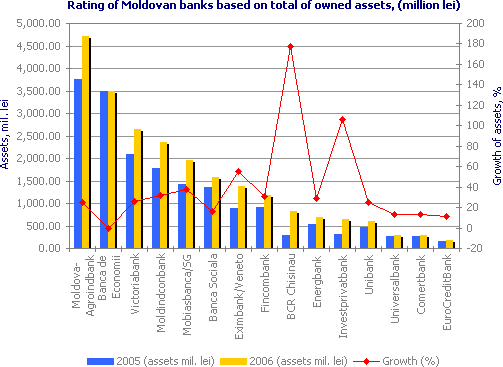
The banking system strongly developed in 2006. The clientele and portfolio of commercial banks have extended and, therefore, the volume and level of products offered by financial-banking institutions from country have grown. In addition, the legislation on banks generally fits the European requirements and this fact increased the confidence of clients and attracted strong international players in 2006. The arrival of some actors such as Raiffeisen Bank, Veneto Banca di Italia and the soon arrival of the French group Societe Generale on Moldovan banking market is an extraordinary beginning.
If other big groups will join the banking market soon, we consider that they will be rather the result of international concentrations, as for example the acquisition of the bank Mobiasbanca. Although banks from member countries of the European Union (E.U.) may join the domestic market after a simple notification submitted to the National Bank of Moldova, few banks will truly enter the market, but some offices or representatives may open to "observe the market". Individuals and small and medium firms will be the main segments of clientele for banks because they will have high growth rates. Even more, the arrival of some international players could be associated with a development of exchanges, investment and pension funds, as well as of insurance, segments which are at a primary stage of activity in Moldova.
The average interest rate on deposits rose in 2006 from 10.8 percent in January up to 13.4 percent in December, in spite of a higher inflation rate. Therefore, interests on credits in lei have also grown, notably from 17.9 percent in January, up to 18.6 percent in December, while the average interest rate on loans in foreign currency remained at the level of 11 percent. The supply of forward deposits rose by more than 21 percent in 2006, while the supply of credits grew by about 31 percent. Assets of Moldovan banks rose by approximately 27 percent or 4.8 billion lei in 2006, up to roughly 22.8 billion lei (1.74 billion dollars) in early 2007. They represent 50 percent of GDP (2006). Bank assets in countries from the euro area exceed 100 percent of GDP.
4. Foreign trade
Moldova’s exports were valued at about 932 million dollars in January-November 2006, but this value was by 5.4 percent lower than in the same period of 2005 due to the interdiction against Moldovan products on Russian market. They could exceed one billion dollars in all 12 months of 2006. The CIS absorbed 41 percent of Moldova’s exports in the period concerned, compared to 51 percent in 2005. At the same time, the imports were valued at 2.36 billion dollars, by 16.5 percent more than in the same period of 2005. Therefore, this evolution of foreign trade accumulated a deficit of trade balance in the amount of over 1.43 billion dollars in January-November 2006, by 386 million dollars (or 36.8 percent) more than in 2005. We consider that the trade deficit for 2006 will reach 1.6 billion dollars after the data on foreign trade for the whole year will be processed.
On the other hand, if the trends registered in 2006 do not change, Moldova’s exports to the E.U. could exceed 40 percent of the total in 2007 (now the exports to the E.U. count for 34 percent of the total). In January-November 2006, 34.3 percent of exports went to the E.U., which is by 5.1 percentage points more than in the similar period of 2005. However, trade exchanges with the E.U. have modestly grown, being lower than the Government’s forecasts, though Moldova benefits of a preferential system (GSP Plus) of E.U. Moldova could raise larger profits from implementing the GSP Plus in 2007, if companies rely on quality of products and a more aggressive marketing. Moldova continues the dialogue with the E.U. in order to be included in the list of beneficiaries of the Autonomous Trade Preferences of the E.U., a freer preferential trade regime.
5. Production sector
Industrial enterprises in Moldova made production worth over 22.2 billion lei (1.7 billion dollars) in 2006 or by about 7 percent less than in January-December 2005. The decline of industrial production in 2006 was due to a 2-fold fall of wine production, distilled alcohol drinks – by 37 percent, cigarettes by 23 percent, oils and fat by 9 percent, glass and glass items by 6 percent, etc. The production volume of food and drink enterprises has declined by 19 percent. Many economic experts explain the recession of industry as a consequence of Russia’s embargo on Moldova.
However, we should mention that the recession of some industrial branches was not directly correlated with Russia’s commercial barriers (oils and fat, engineering and equipment, rubber and plastic, glass manufacturing). Important rises in other branches (carpet, footwear, furniture manufacturing, cement and other building materials, electricity) failed to compensate the recession of wine industry.
On the other hand, the higher price of imported natural gas had also a negative but more moderate impact. It mainly conditioned the rise of production costs in glass moulding branch and reduction of its competitiveness.
On 26 January in Madrid took place a new round of consultation of mediators and observers in the Transnistrian settlement process at which they discussed the prospects of resumption of the negotiation process with the OSCE Chairman in Office, Spanish Foreign Ministry, Miguel Anhel Moratines. As a result of the consultations, the mediators and observers signed a common protocol in which they called for the resumption of talks on Transnistria. "The sides reiterated their readiness to contribute to the peaceful settlement of the Transnistrian problem respecting the territorial reintegration of the Republic of Moldova and the development of a special status for Transnistria", the document says. The mediators and observers sent the leaders in Tiraspol and Chisinau an address in which they proposed to resume the talks in the "5+2" format in February 2007.
Asked by the news agency "Novyi Region" about the agenda of discussions in Madrid on the eve of the meeting, EU Special Representative for Moldova, Adriaan Jakobovits de Szeged, said that the lack of negotiations is a negative thing and regretted the fact that the Transnistrian side put forward a series of conditions for its comeback to the negotiations table. According to the European diplomat, after the transit of goods and the resumption of railway passenger transportation, all obstacles for the resumption of talks on the main issue – Transnistria’s status, have been removed.
In January the Minister of Reintegration, Vasile Sova, and the presidential advisor on internal policy, Mark Tkaciuk, continued consultations on the Transnistrian issue with the mediator states. On 18 January they visited Moscow where they continued to examine a large spectre of issues related to the Transnistrian problem on the basis of agreements reached during their visits to Moscow in late 2006. After the consultations in Moscow, the two Moldovan officials went to Kyiv, where they had meetings at the Ukrainian Foreign Ministry and the National Security and Defence Council.
The European Commission allocated 9 million Euro for a new project of technical assistance at the Moldovan-Ukrainian border. The project is entitled "Improving the border control at the Moldovan-Ukrainian border" (BOMMOLUK) and will be implemented until 2010. The project was drafted within 12 working groups set up by the Consultative Council of the EU Border Assistance Mission (EUBAM) in February 2006. They prepared draft project proposals in the following fields:
We would like to remind that on 21 November 2006 in Brussels, Moldova and Ukraine signed an agreement on the exchange of information regarding the transit of goods and people across the Moldovan-Ukrainian border. The agreement was signed as a result of the trilateral EU-Moldova-Ukraine meeting on border issues in Brussels and the cooperation of the two states with the EUBAM. According to the agreement, the Moldovan and Ukrainian border guards will exchange information at national, regional and detachment levels, on the basis of which they will draft monthly reports on border security which will be presented at the monthly EUBAM coordination meetings.
The European Court of Human Rights (ECHR) has sentenced the Republic of Moldova in 4 cases in the period concerned. The ECHR obliged Moldova to pay 8,000 euros as a pecuniary damage and 1,500 euros in costs and expenses in the case Kommersant Moldovy vs Moldova. The newspaper had claimed the violation of the freedom of expression after it was closed for publishing some articles in June-September 2001, in which it criticised the actions of Moldovan authorities in the "Transnistrian case".
The Court has obliged Chisinau in the second case, Mihalachi vs Moldova, to pay 3,080 euros in pecuniary damage and 1,800 euros in non-pecuniary damage. The applicant had claimed damages for annulment of a final judgment by the Supreme Court of Justice, in which the law court awarded victory to him.
The Strasbourg-based Court has obliged Moldova’s authorities to pay 8,000 euros in non-pecuniary damage and 1,400 euros in costs and expenses in the case Pruteanu vs Moldova. The applicant has complained to the ECHR that he had faced a degrading and inhuman treatment of police, while national authorities did not investigate this case.
Moldova will have to pay 2,000 euros in non-pecuniary damage and 1,250 euros in pecuniary damage in the forth case. Applicant Artur Bujnita has complained to the ECHR of the lack of a fairy trial.
Moldova will have to pay damages in the amount of 27,030 euros overall in the four cases. The ECHR has sentenced Moldova in 44 cases until now.
On January 23, 2007, the Forth Chamber of ECHR, examining the Guja vs Moldova case, decided to forward the case to the Great Chamber of the Court. According to the Organisation "Lawyers for Human Rights", the Chamber takes this action very rarely and the Ilascu case is the only examined Moldovan case to get through this procedure. The applicant, Iacob Guja, former employer of the PR Department within the Prosecutor General’s Office, claims the violation of his freedom of expression right, by being dismissed for realising to mass media two letters received by this institution. One of the letters was signed by the Parliament Deputy Speaker Vadim Misin, who was expressing his disapproval concerning the penal legal actions brought against some Ministry of Interior Affairs employees and was asking the Prosecutor General to intervene so that to solve this case "in tight conformity with the law". Afterwards, the penal case was stopped.
The January 19 meeting of the National Commission for European Integration (NCEI) was one of the main events in early 2007 in the context of Moldova’s European integration efforts. The NCEI made the totals of the actions that the Government took in 2006 to implement the E.U.-Moldova Action Plan and outlined tasks for 2007. Prime Minister Vasile Tarlev and NCEI chairman told the sitting that it is important for Moldova to improve its relations with the E.U. and to implement entirely E.U.-Moldova Action Plan in 2007. In the context, the premier named the opening of the single E.U. visa issuance centre for Moldovan citizens in Chisinau, the awarding of the Autonomous Trade Preferences and the E.U. Association Agreement among basic goals in Moldova’s relations with the E.U. in 2007. According to Minister of Foreign Affairs and European Integration Andrei Stratan, the single visa issuance centre will open in April 2007 and it will be based in the Hungarian Embassy in Chisinau, while visas will be processed by consular officers of Austria and Slovenia. The opening of the centre is complementary to the dialogue on facilitation of visa regime with E.U., with the first round of negotiations in this respect being scheduled for February 9.
However, the accomplishment of the last goal named by premier is unrealistic. The E.U.-Moldova Action Plan, Communications by the European Commission released in late 2006 in the context of the European Neighbourhood Policy (ENP), the joint programme of German, Portuguese and Slovenian presidencies of the Council till mid-2008, other documents by E.U. institutions, including the E.U. Enlargement Strategy approved in 2006, do not announce anything about the eventual association of Moldova. It is hard to believe now that Moldova would manage to persuade the E.U. to introduce in 2007 the problem of association of Chisinau in its very busy agenda.
Tarlev also told the NCEI sitting that reports on actions taken by governmental institutions to implement the Action Plan will be heard at Government’s sittings in 2007 and "a special code will be applied on all documents related to fulfilment of European integration tasks and they will be examined first of all." The Ministry of Public Administration was instructed to draft special plans on mobilisation of local authorities to implement the E.U.-Moldova Action Plan, while the Ministry of Foreign Affairs and European Integration (MFAEI) was told to work out an efficient mechanism for participation of journalists in coverage of the implementation process.
On January 24, the International Trade Committee of the European Parliament (EP) decided to give green light to an initiative by the European Commission and Council to allocate a financial assistance worth 45 million euros to Moldova. This aid aims to support the trade balance and the balance of payments of Moldova. The EP Committee made this decision but imposed certain conditions to Moldova: transparency of public finances; implementation of macroeconomic and budgetary priorities demanded by IMF and respect for human rights, including those of national minorities.
President Vladimir Voronin reconfirmed on January 26, while addressing representatives of the diplomatic corps to Moldova, the great interest of Chisinau authorities for European integration. In this context, the chief of state acknowledged the need of advancing more decisively and exigently in this direction, highlighted the importance of obtaining the four freedoms guaranteed in the E.U. area and reiterated that Moldova is not completely satisfied with the E.U. offers given within the ENP.
Romanian President Traian Basescu paid an official visit to Moldova on January 16 in connection with difficulties faced by Moldovan citizens to obtain Romanian visas after the neighbouring country has joined the E.U. His visit agenda included a meeting with his Moldovan counterpart Vladimir Voronin and visits to the Romanian Embassy and its consular section.
The visit of the Romanian president was anticipated by certain comments on Moldova-Romania relations made by Romanian Foreign Minister Mihai Razvan Ungureanu, member of one of the Romanian ruling political parties, the National Liberal Party (NLP). MEDIAFAX quoted Ungureanu as saying at the January 12 Extraordinary Congress of NLP that Moldova is a priority for NLP and Romanian Liberals are interested to help "Moldova not to tremble in front of the political wind, especially when the wind comes from the east." According to Ungureanu, "the Republic of Moldova needs a chance and it could come from its electorate that should separate the totalitarianism from Moldova’s European destiny."
Foreign Minister Mihai Razvan Ungureanu delivered important statements in the context of Moldovan-Romanian bilateral relations in an interview with the Moldovan radio channel Vocea Basarabiei on January 13. Ungureanu said that Romania is "not only an ally [of Moldova], but a big European partner […], whose word, good faith are reliable." The Romanian foreign minister emphasised that Moldova is present in all regional cooperation frameworks in South East Europe thanks to Romania and Bucharest will be cogent in seeking Moldova’s inclusion in the package of the Western Balkans, so that to open "the windows toward an European horizon." Also, Ungureanu recalled that Romania is the No.2 donor for Moldova after the United States and he was puzzled that the Chisinau City Hall is not answering to a request seeking more room for the consular section of the Romanian Embassy and central authorities keep silence in connection with the opening of two general consulates of Romania in Balti and Cahul.
Speaking about the invitation that Romanian President Traian Basescu has reportedly made to his Moldovan counterpart to let Moldova join the E.U. together with Romania, Ungureanu said that this is "a metaphorical formulation of what the Republic of Moldova should do in order to persuade Brussels that it both deserves or can meet the European requirements and it is ready to become a good European, a country with a predictable foreign policy." Finally, the Romanian foreign minister reconfirmed the financial, logistical assistance and support in expertise matters that Romania stands ready to give Moldova for free, in order to ease its route to the E.U.
The main result of President Basescu’s visit to Moldova is an agreement reached with President Voronin to open two offices of the Romanian consular section in Balti and Cahul within 10 days. Romania wants to open these offices to handle the big number of visa applications from Moldovans.
The two presidents have also discussed the political agreement between Moldova and Romania, with Voronin expressing conviction that it will be shortly signed; the border agreement; assimilation of finances offered by E.U. within ENP for implementation of transborder projects; the Transnistrian problem and the regaining of Romanian citizenship. In the context, President Basescu said that Romanian authorities hold now more than 530,000 applications seeking appointments for submission of the acts needed to gain the Romanian citizenship and promised that the law on citizenship will be shortly modified with the consent of Chisinau authorities, so that to make clear how the new law should treat this problem.
Meantime, the number of employees of the Romanian Consulate has been completed and new visa application processing terminals have been installed to enhance the capacity of the consular section to process visa applications of Moldovans.
On January 26, 2007, Grigore Porcescu, ad-interim chief of the Moldovan veterinary medicine department, and Evgeni Nepoklonov, deputy chairman of the Russian service for phyto-sanitary and veterinary control Rosselhoznadzor, signed an agreement on resumption of Moldovan beef imports in Russia. Only three Moldovan enterprises selected after a December 2006 inspection, notably Tehnosel-Car based in Hincesti, Mistor-Bras in Calarasi and Nevelina in Chisinau, will be able to export beef. According to Minister of Agriculture and Food Industry Anatolie Gorodenco, who has recently visited the Russian capital, an agreement on resumption of exports of pork and vegetal products from Moldova to the Russian Federation could be signed within one month.
A delegation from the Millennium Challenge Corporation (MCC) visited Chisinau in late January. The delegation led by John Hewko met President Vladimir Voronin, Speaker Marian Lupu, Prime Minister Vasile Tarlev, first Deputy Prime Minister Zinaida Greceanii and civil society representatives.
The goal of the visit was to present the Compact Program of MCC aimed to contribute to poverty reduction in 25 countries through a sustained economic growth. Moldova was selected in this group of 25 countries among more than 80 countries with low income. MCC has evaluated the selected states, including Moldova, on the basis of 16 performance indicators in three fields of reference: (1) quality of governance; (2) investments in human capital and (3) economic freedom. In this context, it should be noted that Moldova is participating in the preliminary program of MCC and it will receive 24.7 million dollars to combat corruption.
Moldova will have to start an ample consultative process with the participation of diverse elements of Moldovan society in order to take part in the Compact Program of MCC. It will have to establish maximum 2–3 priorities after consultations, for which MCC could grant hundreds million dollars. According to Hewko, the establishing of priorities after the consultative process remains at Moldova’s latitude and they may envisage the education system, healthcare, infrastructure, etc. It is important for MCC that the resolution of the 2–3 problems identified by Moldova contribute to poverty reduction and cast sure economic growth trends. MCC has signed so far assistance agreements with 11 countries within the Compact Program: Madagascar (109.8 million dollars), Cape Verde (110 million dollars), Georgia (295.3 million dollars), Benin (307.3 million dollars), Honduras (215 million dollars), Nicaragua (175 million dollars), Vanuatu (65.69 million dollars), Armenia (235.65 million dollars), Ghana (547 million dollars), Mali (461 million dollars), El Salvador (460.94 million dollars).
On January 30, Erhard Busek, Special Coordinator of the Stability Pact for South Eastern Europe (SPSEE) paid an official visit to Chisinau. He had meetings with President Vladimir Voronin, Speaker Marian Lupu, Prime Minister Vasile Tarlev and with Moldovan Foreign Minister Andrei Stratan. Among the main subjects discussed are to be mentioned: Moldova’s participation to the Regional Cooperation Council (RCC); results of Moldova’s participation within the SPSEE activities; progress and problems of Moldova on the European integration itinerary.
In the context of the first mentioned subject, Erhard Busek has told that SPSEE is to conclude soon its activity and that it will transfer its competences to the RCC. The latter is to start its activity in 2008 and to harmonise political initiatives and processes in South Eastern Europe. The main activities of the RCC are to be developed in the field of economic and social development in South Eastern Europe, infrastructure, justice and home affairs, security cooperation, building human capital and parliamentary cooperation. Moldovan officials have shown interest in this new regional initiative and assured Erhard Busek that Moldova is ready to participate in RCC activities.
Moldova has handed over the annual chairmanship in the International Commission for the Protection of the Danube River (ICPDR) to Romania in Vienna. Taking part in the event organised jointly by Moldova’s Embassy to Austria and the ICPDR Secretariat were official representatives of 13 Danube states, important international organisations and interested media institutions.
According to the press service of the Ministry of Foreign Affairs and European Integration, Victor Postolachi, Vienna-based Moldova’s representative to international organisations, has presented the main results of the 2006 Moldovan ICPDR chairmanship at the event. The Moldovan diplomat noted among others that a meeting of the permanent working group of experts from the Danube region was organised in Chisinau in June 2006; the Danube Day was marked on June 29 and Chisinau hosted the forum of Danube NGOs in October.
ICPDR member states were invited for a tighter cooperation, with participants highlighting the need of respecting the framework directive of the E.U. on waters and promoting the interests of ICPDR within other European and international organisations.
The 2007–11 UNFPA Programme for Moldova was adopted at a joint session of the United Nations Population Fund (UNFPA) and the United Nations Development Programme (UNDP) at the U.N. Headquarters in New York on January 24, 2007. The UNFPA Programme for Moldova is part of the United Nations Development Assistance Framework (UNDAF). Activities of UNFPA in Moldova aimed mainly at improving the human health, especially the reproductive health until now.
Moldova within ENP. First assessment report by the European Commission
Sergiu Buscaneanu
The success of Chisinau’s European path depends on how it will accomplish 80 goals and 294 actions in seven fields of activity together with the EU by the end of 2007. Most of these goals and actions rest with Moldova’s responsibility, 14 clearly refer to the EU, while another 40 envisage both Parties at a relatively equal extend. This way, the EU-Moldova Action Plan, like other action plans signed within the ENP, except for the EU-Israel Action Plan, reveals an asymmetrical volume of tasks and defining characteristics of the "centre-periphery" relations.
According to the EU-Moldova Action Plan, the progress in implementing the document is monitored by bodies created under the Partnership and Cooperation Agreement (PCA) and the European Commission. The Commission released on December 4, 2006 its first report on implementation of the Action Plan by Moldova. The same day, the European executive launched two important documents in the ENP context: Communication from the Commission to the Council and the European Parliament on strengthening the European Neighbourhood Policy and Communication from the Commission to the Council and to the European Parliament on the general approach to enable ENP partner countries to participate in Community agencies and Community programmes. The first Communication is accompanied by Overall Assessment (of relations between the EU and the first seven states that signed Action Plans with the EU within ENP); Sectoral Progress Report and ENP progress reports, including the Progress Report on Moldova.
The Communication […] on strengthening the ENP highlights that the ENP remains distinct from the EU enlargement process, presents the main problems and opportunities within ENP and recommends to strengthen the ENP and to improve much the impact of this policy. The main premise of this Communication is that the ENP is indispensable, it has confirmed its big potential and it should stimulate much its neighbours, including financially for a more sustainable promotion of reform processes in the EU neighbourhood. In the context, it should be noticed that most of experts have described the offers made by EU for its neighbours after the ENP was launched as insufficient to produce consistent reforms in its neighbourhood. Therefore, by recalling the successful alignment of Central and East European countries to the EU standards through a strong conditionality and stimulants to the extent of meeting the EU conditions, many experts recommended the EU to propose a more consistent offer to its neighbours. Otherwise, the impact of the ENP will remain limited, the ENP will continue to be seen as a "Potemkin village", while reforms will drag on in continuation or will come late in the EU neighbourhood. From this viewpoint, its seems that this Communication of the Commission and the second Communication come to complete the offer that the EU has earlier made to its neighbours and to remedy an older handicap and the discrepancy between conditions of "Europeanisation" and stimulants given instead of this "Europeanisation". Using one of epithets from specialised literature, this Communication comes to tell that the European Commission stands ready to give a bigger "carrot" to states in the EU neighbourhood in exchange for a decisive promotion of internal reforms by these countries.
The Overall Assessment presents in a synthetic manner the progresses achieved by Palestinian Authority, Jordan, Israel, Morocco, Moldova, Tunisia and Ukraine in implementing the action plans, as well as actions taken by EU to implement these plans. The Sectoral Progress Report refers to evolutions on sectors in the seven states mentioned above achieved in the ENP context.
The second Communication of the Commission published on December 4, 2006 recommends two distinct approaches for the participation of the states covered by ENP in: (1) agencies and (2) programmes of the EU.
The Progress Report on Moldova raises a major interest of Moldovan public opinion. The document brings light to the European Commission’s opinion about how Moldova honoured its commitments toward the EU in February 2005 – November 2006 by implementing the EU-Moldova Action Plan. The report highlights the main progresses and problems of this process. It indicates among important and moderate progresses: the management of the Moldova-Ukraine border; cooperation with international financial institutions; poverty reduction; reformation of research, development and innovation sector (appreciated as "good progress"); gaining of the Generalised System of Preferences Plus (GSP+) of EU; achievements against organised crime, trafficking in human beings; Moldova’s joining to the Bologna Process (appreciated as a "progress"); cooperation with the EU in certain problems of foreign policy; better investment climate (appreciated as a "some progress"), etc.
On the other hand, the main problems include: (1) faulty implementation of reform strategies; (2) insufficient freedom of mass media; (3) wide spreading of corruption; (4) Government’s interference in business; (5) insufficiently clear regulations on parliamentary immunity; (6) lack of clear priorities of action; (7) lack of optimal conditions for business start-up and management; (8) insufficient respect for human rights; (9) limited independence of the judiciary, and (10) extended and indefinite prerogatives of the prosecutor’s office. The report does not classify the problems on the hierarchical system on basis of their gravity, but the 1st, 2nd, 3rd and 4th problems may be regarded as most serious, depending on tonality of used formulations.
The Progress Report on Moldova also says that the EU executive has recommended the Council to increase the financial assistance for Moldova, assistance which would be used to improve the governance, to encourage democratic accomplishments, to promote regulatory reforms and to reduce poverty. In the context, is to be recalled that the Commission has recommended the introduction of a flexible assistance regime for Moldova and a gradual growth of financial allocations, starting 2007. Moldova is expected to be allocated 210 million euros in 2007–2010 via the European Neighbourhood and Partnership Instrument (ENPI) within the ENP. Also, another 45 million euros will be released as grants to cover the current account balance.
Moldovan authorities have received the assessment by the European Commission with a relative satisfaction. Truly, the Commission has given a positive general mark to Moldova. This mark results from the Progress Report on Moldova. At the same time, if we compare the Progress Report on Moldova with progress reports on Palestinian Authority, Jordan, Israel, Morocco, Tunisia and Ukraine, we will also find reasons of dissatisfaction. Although the European Commission did not make a comparative assessment, such an analysis of reports on these countries would place Moldova below performances achieved by Morocco, Ukraine and Jordan. If such a rating is maintained after the period for implementation of action plans, Morocco and Jordan will have more reasons than Moldova to demand the promotion of their contractual relations with the EU, though they are not part of Europe. In such circumstances, Moldova would have to continue dreaming nicely the association with the EU.
"Happy" accident and foreign financing
Iurie Gotisan
I have nothing against this updating and those who process the data. Although domestic economic analysts and experts often doubt over correctness of the economic growth (GRP) expressed in rises and declines, the recent updating should make us happy, not confuse because the "advance" achieved by economy in the past years seems to intensify. But if we study the things more carefully, we raise one question only: how healthy are the latest growths? The generally valid and known answer is that the bases of economic growth are pretty rotten: massive imports and greedy consumption. We may say that the performance of the economic growth achieved until now is firstly due to anaemic structural reforms and consumption of population.
In spite of a declining productive sector, the economic growth was achieved on basis of massive imports from which considerable taxes on product and import are collected, while the final consumption of households has violently grown. The IMF mission that visited Moldova in late 2005 warned the Chisinau Government then that "such an economic growth is not sustainable and it will slow down the next years due to appearing internal and external factors." Forecasts by IMF experts have become true. We have what we have. The economic advance registered in the past years was rather conjectural and it did not have healthy bases, while most of the structure of Moldovan economy did not change in the past decade.
President Voronin said last week that "the impressive bonus received by Moldova from the Group of Donor Countries at the recent Brussels meeting is an advance on account of future transformations and a proof of "solvency of Chisinau’s policy and a trust vote given to the European modernisation course of Moldova." The 1.2 billion dollars which will fuel the country’s economy starting 2007 is regarded as an engine and key of success. However, the fact that foreign finances cannot treat an ill economy must be taken into account. The foreign financial assistance is a dangerous trap for transition economies, if it is not accompanied by inversion of proportions of power between state and private sectors, reforms needed for this purpose.
It happened so in the mid-1990s in Asia, Africa and Latin America, recipients of massive infusions of foreign funds. The foreign financing eliminated the pressure of governments to implement reforms, supplying them with resources, with which they had often nationalised own economies. The assistance created dependence and stopped the development of private sector. If the reformation of Moldovan economy does not become a priority, we run the risk to face the experience of some states from Africa, Asia or some of new members of the European Union, which received a lot of money but failed to administrate it. The economic condition of countries such as Mozambique or Uganda is known. What is demanded now from authorities is the existence of a strategic vision capable to encourage an efficient management of foreign finances. However, the implementation of such a vision requires an "intellectual control" on public policy, which is a desideratum of transition in Moldova so far.
The contributors to this issue are:
|
© 2001-2015 Association for Participatory Democracy "ADEPT" Reproduction of the materials is welcomed provided the source is indicated | e-mail: [email protected] |