
Participatory
Democracy
Original: /en/e-journal/20070304/index.shtml
| Association for Participatory Democracy | Print version. Published on www.e-democracy.md Original: /en/e-journal/20070304/index.shtml |
Activity of Public Institutions
1.1. Appointments
Dumitru Pulber and Elena Safaleru have been appointed judges of the Constitutional Court for a new 6-year term. The two judges have been sworn in together with Victor Puscas (who was appointed by the Superior Council of Magistracy (SCM) for a new mandate) and Valeria Stirbet (appointed by SCM). Two judges appointed by Moldovan president in 2002 and 2004 kept their offices. Mircea Iuga is the only member of the previous composition of the Constitutional Court who was not appointed this time. Judges of the Constitutional Court have chosen Dumitru Pulber as chairperson. Valeria Stirbet was relieved from the post of chairwoman of the Supreme Court of Justice, as she was elected judge of the Constitutional Court, and this post became vacant.
Svetlana Caitaz was appointed judge of the Supreme Court of Justice. The major faction did not support the other two candidates proposed by SCM (N.Budai and E.Zinenco) and opposition representatives reiterated statements that the parliamentary majority appreciates the candidates under political aspect inclusively and the status and competence of SCM are affected. The Christian Democratic faction did not raise objections at the February 22 sitting, though it has earlier warned that these attempts and attitudes of the majority affect the parliamentary political consensus.
The Parliament has voted several decisions on appointments in the Prosecutor-General’s Office:
1.2. Legal acts
Law on prevention and combat of domestic violence. The document derives from national plan on respect for human rights and Moldova’s commitments toward community institutions. The law aims to protect and consolidate family, respect basic principles of legislation on family and strengthen the mechanism of ensuring equal chances to women and men in exercising their human rights. It chooses the legal and organisational bases of prevention and combat of domestic violence, established by authorities in charge with preventing and combating domestic violence, establishes the procedure of signalling and settling cases.
Law approving the regulation on military discipline. The action of the regulation will extend on military serving in the National Army, Border Guard Troops and Carabineer Troops.
Law on modification of the law on ecological agro-food production. Single Article 8 (2) and Article 12 (2), under paragraph 5 of Law 115-XVI from June 9, 2005 concerning ecological agro-food production (Monitorul Oficial of Moldova, 2005, issue 95–97, Art.446) are excluded.
Law on modification and completion of the Execution Code. It introduces regulations on execution of arrest and contraventional arrest. However, the law does not stipulate the transmission of preventive detention facilities from administration of the Interior Ministry to the Justice Ministry, accordingly to international regulations and recommendations.
Law on modification and completion of some legal acts (welfare of magistrates). The document approved by Parliament was not promulgated by chief of state and was delivered for re-examination. The chief of state raised objections against change of financing source for pensions of judges and prosecutors (payment from state budget, not from collections to the state welfare budget be maintained by 2010), and maintenance of the present pension calculation mechanism for cases when documents confirming the size of salary have not been preserved. Parliamentarians accepted the objections and adopted the law with amendments by chief of state.
Law on abrogation of the law on property. The 1991 law is out-of-date, it does not correspond to present regulations and it is not applied since enforcement of the new Civil Code, which minutely regulates aspects on property.
Law on modification of the annex to the law approving the list of units whose farm fields are owned by state. The law stipulates the granting from state property of 7.7 hectares to the Singera mayoralty, which will be distributed to 17 owners who did not accept compensations for fields expropriated to build the railway portion Revaca-Cainari[1].
Laws on ratification of some international acts:
Decision approving the list of public communal services in the commune of Pelinia, the district of Drochia, proposed for concession and mandatory clauses of concession contract. The document is approved accordingly to the law on concession, with granted services including water, heating providing services, sewerage services, used water cleaning services, sanitation services, greening services and local public carriage services being part of granted services. The document is enounced as a first experience of building a public-private partnership in this field, and a special contest will be organised to implement this project and the results of the experiment will be taken into consideration to work out and implement a new regulatory framework in the area.
Draft law on public acquisitions. The law is proposed to be applied on contracts of public acquisitions whose estimated value without VAT is equal or higher than 20,000 lei (for contracts on public acquisitions of goods); 25,000 lei (for contracts on pubic acquisitions of works or services); contracts on public acquisitions subsidised directly with more than 50 percent by contracting authorities. It also aims to regulate particularities of applying contracts of public acquisitions whose estimated value without VAT is equal or higher than 2,500,000 lei for contracts on public acquisitions of goods and services; 99,000,000 lei for contracts on public acquisitions of works.
Draft law on emergency bodies. The document was included in the 2005–09 Legislative Programme and it stipulates a legal framework, principles of activity, attributions, competence and responsibility of persons serving in emergency services, their status, place and role in state and society. Essential objections raised by parliamentary commissions and opposition lawmakers envisaged the subordination of competent department (to the Government directly, not to the Interior Ministry), but the specialised commission turned down the proposals, saying that the activity of this department and Interior Ministry "has a tangency".
Draft laws on regenerating energy resources. The Parliament passed the following draft laws in the first reading:
Draft law on conversion of debts of Stock Society Chisinau Enterprise of Crop Products into shares. The draft adopted in the first reading stipulates the conversion of old debts in the amount of 6,976,149 lei toward state budget and 54,684,600 lei toward the Finance Ministry for credits offered from foreign sources into state shares, accordingly to the situation on April 1, 2006, suspending the calculation of current payments (interests and penalties) starting April 1, 2006 till enforcement of the law. The converted old crediting debts will be converted into shares of additional issue and will be used to increase the registered capital of the Stock Society Chisinau Enterprise of Crop Products, which will be managed by state-owned enterprise Moldresurse.
Draft law on modification and completion of Article 2 of the law on additional social protection for war invalids, participants in the World War II and their families. It stipulates monthly allocations (worth between 100 and 400 lei) for persons incapable to work, who arrived from another region (Chernobyl) in 1986 and received the Moldovan citizenship," as well as to husbands who survived but are incapable to work, participants in WWII or battles in peaceful times among killed military or participants in cleanup of consequences of the Chernobyl disaster who died or war invalids who died.
Draft law on completion of the law on free economic zones. It introduces a new paragraph saying that the resident will place goods introduced formerly under customs regime of free zone under another customs regime accordingly to legislation in force, when a free zone (subzone) stops working or if the status of resident is revoked until a free zone (subzone) stops working.
1.3. Parliamentary control. Statements
Deputy minister of economy and commerce has reported the implementation of amendments to legislation on entrepreneur’s patent. The executive says that these reforms aim to introduce a modern and certified trade system, ensure protection of consumers and competition, enhance budgetary revenues and reduce possibilities of eluding the fiscal legislation.
A representative of the building and territorial development agency informed lawmakers about structure of prices for connection to gas pipes, saying that 45 percent of this price goes now to materials and 55 percent to manual labour (the agency seeks equality). The State Inspection has controlled the building sector and found out that price for connection to gas and water networks is too high. The Government has worked out a special methodology, so that the connection of a house to the gas network would cost maximum 3,000 lei. A representative of the executive avoided saying if the larger amounts paid by people to connect their homes to gas pipes will be repaid.
Chief of the inspectorate for supervision of spirits has informed lawmakers regarding resumption of wine exports to the Russian Federation. According to a report, competent authorities have taken some measures, had nine meetings with Russian experts, the Russian side has received an action plan on ensuring quality and safety of exported production. Russian experts have presented additional requirements, which do not essentially differentiate from technical and quality norms respected now and formerly by Moldova. Problems linked to exportation via "one-stop-shop" are not clarified completely, the Russian Federation lacks a clear policy and requirements on this field, the reason why a planned visit of Russian experts who should choose enterprises to restart exports was postponed till March. Opposition lawmakers recommended the executive to appeal to the international arbitrage to impose the Russian Federation to recover losses of Moldovan entrepreneurs.
The parliamentary majority turned down a proposal by Deputy Valentina Cusnir to create an investigative commission to clarify the situation in vine growing and winemaking sector and an initiative by Social Liberal lawmakers to create an investigative commission to administrate resources of the Parliament and to investigate the politicising of the legislature’s apparatus.
The Government has informed the Parliament about execution of legislation on compensations for victims of political repressions. It reported that the main problems are related to activity of local commissions, lack of material and financial resources for plenary execution of legislation in the field, lack of experience and low competence of local public administration authorities.
Questions and interpellations
Deputy Vitalia Pavlicenco has appealed to prime minister over use of licensed software in Moldova, number of computers held by state authorities and measures taken to prevent consequences in connection with expiration of moratorium introduced by big producers of certified software to improve protection of copyrights.
Democratic Deputy Valentina Buliga has sought information about organisation and conduct of baccalaureate examinations in 2007, under aspect of ensuring necessary financial and material resources (accommodation of students, secret carriage of acts, selection of observers, etc.).
Deputy Vladimir Braga has demanded explanations regarding Government’s strict restrictions on exportation of wine in bulk, warning that economic agents practicing such activities face grave difficulties.
Democratic Deputy Vladimir Filat has asked the Ministry of Finance to take measures in order to deduce losses produced by Russian restriction against Moldovan wines and to resolve the problem of not sanctioning exporters, who delivered wines to Russia and did not receive appropriate payments due to actions of Russian authorities, for non-repatriation of currency.
Statements
Deputy Vitalia Pavlicenco has delivered statements on visas for Moldovan citizens who travel to European countries and possibility of working in Romania. She criticised the stance of Moldovan governmental authorities who reject the participation of Romanian authorities in facilitating the administration of the joint E.U. visa issuance centre and signing a labour exchange agreement between Moldova and Romania. Another statement read by Pavlicenco in front of the Parliament criticises the actions taken by governmental authorities and representatives of parliamentary majority in relations with Romanian authorities and citizens.
The faction representing the Social Liberal Party has released a statement seeking the creation of a national commission to investigate events during the Dniester armed conflict.
The lawmaker representing the Party of Social Democracy, Dumitru Braghis, has read a statement condemning assaults of declared privatised media outlets on free press, libels and insults against cultural personalities of Moldova.
The Our Moldova Alliance faction has released statements concerning:
2.1. Appointments. Reshuffles
The Government has proposed the recalling of Eugen Carpov from the post of Moldova’s representative to the European Commission.
2.2. Decisions
Decision on implementation of the national strategy on prevention and combat of corruption and activity of the Centre for the Struggle Against Economic Crimes and Corruption (CSECC) in 2006. The document notes that the CSECC has taken some practical-organisational actions to implement the strategy in the field and to reduce corruption, to combat and prevent this phenomenon. Cooperation with competent nongovernmental organisations is remarked and appreciated at a high level. Following drawbacks and future tasks were named:
Decision approving the regulation on compensation of value of goods of victims of political repressions and payment of compensations to relatives of persons killed in political repressions. Under Law # 186 from 29.06.2006 on modification and completion of the law on rehabilitation of victims of political repressions (published on August 8, 2006), the Government should table within three months proposals on adjustment of legislation in force to this law and adjust its normative acts to these amendments. The law entered into force on January 1, 2007 and the executive could and should adopt the necessary acts later, in order to ensure the implementation of this law, but it delayed these actions. Christian Democratic Deputy Stefan Secareanu has recently called on the Government, invoking the non-execution of this law by competent authorities. Under new regulation, the value of goods confiscated, nationalised or dispossessed in connection with political repressions will be compensated on basis of demands by rehabilitated persons or their successors to special commissions created by district councils. The demand may be submitted within three years after the repressed person or successors were informed about rehabilitation and will be studied within six months after submission. If the goods are worth maximum 200,000 lei, the compensation will be paid within three years in proportional annual instalments. If the goods are worth more than 200,000 lei, the compensation will be paid in 5 years.
Decision on implementation of anti-corruption survey. The document stipulates the modification of a previous decision, extension of anti-corruption survey on Government’s normative acts, creation of a subdivision in CSECC to be in charge with anti-corruption survey of draft legal and normative acts.
Decision on results of execution of legal acts and indications of Moldovan president in 2006 by ministries and other central administrative authorities. The document says that:
Decisions approving some draft laws:
2.3. Sittings. Decisions. Statements
Alternative energy resources
The use of regenerating energy resources was the topic of a working sitting chaired by Prime Minister Vasile Tarlev. It was noted at the sitting that the national programme on use of regenerating resources till 2010 was worked out in line with Government’s indications. Three investment projects on building of Aeolian stations with a total power of 200 MW, industrial making of bio ethanol from sugar sorghum and implementation of mini hydro-stations were tabled for examination. According to the prime minister, the implementation of projects is slow and he demanded the specialised coordinating council to work out an action plan and choose competent persons and concrete terms of implementation. The prime minister also demanded task books for projects on building of Aeolian stations and making of bio ethanol, conduct of an auction in optimal terms in order to attract investors in these sectors.
Goals of budgetary-fiscal policy for 2008–2010
A sitting chaired by prime minister has examined measures needed to coordinate the main directions of tax policy with the Government’s action programme, to create a more attractive fiscal system for taxpayers. The prime minister outlined the need of promoting a more progressive fiscal policy in order to ensure faster development paces of national economy and to enhance the investment attractiveness of Moldova. The fiscal policy for 2008–2010 must focus on ensuring equity, stability and fiscal transparency, encouraging investments, creating new jobs, supporting development of real sector of economy. The document should promote "a better service for taxpayers and extend the range of services," inclusively by developing the information system of presentation of electronic fiscal reports. The need of ensuring a functional and structural consolidation of the State Tax Service, improving the fiscal procedures by widely applying information technologies was also outlined.
Priority of some producing branches
The situation in the milk, dairy and beef producing sector was studied at a working sitting chaired by Prime Minister Vasile Tarlev with governmental decision makers and producers working in this field. It was noted that the situation has improved starting 2002, when the first offices for artificial impregnation, veterinary services and milk acquisition opened, when subsidies for development of this field were allocated for the first time. The lack of finances and limited access of farmers to preferential credits needed to build and renovate farms on basis of modern technologies, shortage of qualified personnel still are the main problems of this sector.
Vasile Tarlev noted that this segment plays a very important role in agricultural circuit and promised that the Government will grant the necessary support for a quality and efficient growth in this area. In the context, the Ministry of Agriculture and Food Industry was told to make an additional analysis of situation and to propose a larger financial support system for activities in this area. The Ministry of Economy and Commerce and the Ministry of Agriculture and Food Industry will analyse the price formation system for dairy and will work out a better mechanism in this field. The prime minister proposed the creation of an association of milk producers to protect the rights of this category of farmers.
Premier Vasile Tarlev chaired a sitting on situation in tobacco growing sector, which studied problems faced by tobacco producers and processors and development prospects of this branch. It was noted that the tobacco industry is a priority for Moldovan agriculture, but its potential is not used completely. The enterprise Tutun CTC must play an important role in this area and it will enhance investments in crediting producers and acquiring tobacco for exportation. The prime minister instructed decision makers to shortly implement an efficient mechanism aimed to support the development of tobacco industry, which would essentially increase the tobacco fields, enhance tobacco processing volumes and encourage exports. Tarlev supported an initiative on creation of a product council in tobacco sector to evaluate the price formation methodology for tobacco and raise argued proposals on measures needed to establish transparent criteria of activity in this sector. According to estimates by the Ministry of Agriculture and Food Industry, tobacco fields will grow up to about 5,600 hectares in 2007, compared with 2006, and they are expected to be extended up to at least 10,000 hectares by 2010.
3.1. Decrees
Moldovan president has awarded the Labour Glory order to:
3.2. Sittings, Decisions. Statements
Opening of the first European Information Centre
President Vladimir Voronin has reiterated, at a regional conference occasioned by opening of the European Information Centre in Cahul, the firm and irreversible commitment of Moldovan authorities to take all actions needed to fulfil the European integration goal. He noted in this respect the cooperation between public administration and civil society, stressing that the common goal may be reached with joint efforts of all segments of society. The president noted that authorities must pay more attention in 2007 to a better implementation of reforms and laws adopted at central and local levels, in line with European norms.
Meeting with ombudsmen
The chief of state has visited the Moldovan Centre for Human Rights, being informed about most frequent and gravest breaches of human rights discovered by ombudsmen and personnel of this institution:
Admission in educational institutions
A sitting on results of admission in educational institutions in 2006 and admission plan for the academic year 2007–08 was held. According to competent authorities, the implementation of new admission requirements confirms some positive trends: rise of the number of students at pedagogical and technical faculties, specialties needed by national economy; reduction of discrepancy between real offers and demands on labour market. It was noted the need of reducing in continuation in 2007 the admission at specialties for which an essential surplus of specialists is observed on labour market (particularly by reducing the admission for educational tuitions). The president highlighted the importance of ensuring an enrolment in strict compliance with admission plan and quotas, working out an admission plan for 2008, forecast of admission in educational institutions for 2009–2010. The chief of state also underlined the need of intensifying the process of specialisation of educational institutions and post-accrediting assessment, monitoring of strict respect for requirements on licensing of activity in this area. He also recommended the establishing of a minimum competition mark for admission at universities and called for reduction of the number of students who attend fewer courses, given the unsatisfactory quality of education.
Difficulties and priorities of agriculture
The chief of state has attended a sitting of the College of the Ministry of Agriculture and Food Industry and described the work of the ministry and subordinated institutions in 2006 as generally satisfactory. Also, he signalled some problems:
1. Foreign trade
The European Union is becoming a main destination of goods made in Moldova. The share of this market in the total of Moldovan exports rose up to 35 percent in 2006, compared with 29.7 percent in late 2005. For comparison, the share of the E.U. in Moldovan exports was 13 percent only in 1998. According to official statistics, Moldova exported products worth about 370 million dollars to the E.U. last year, which is by nearly 14 percent more than in 2005.
Commercial relations with E.U. member states have developed, though the implementation of the GSP Plus system in trade with Moldova did not produce the expected effect. However, larger incomes could be raised from implementation of GSP Plus in 2007, but with the condition that companies improve the quality of products. Deliveries of Moldovan goods to E.U. will grow after Romania and Bulgaria have joined the E.U., though a slower free exchange regime will affect the trade exchanges with these countries at a first stage.
2. Banking
The share of foreign investments in capital of Moldovan banks is estimated at 63.85 percent of all investments. In comparison with late February 2006, investments of foreign capital in the banking have grown by about 14 percent. The share of foreign investments grew in early 2007 after the French group Societe Generale has acquired 70.6 percent of shares in Mobiasbanca. In 2006, Dutch and Slovenian investors purchased important stocks in Moldova-Agroindbank after new actors have joined the domestic bank market.
…but bank market did not grow up enough
Of course, the arrival of new players on market will have a positive impact, especially on medium and long terms. They will contribute to investment of cheaper funds for a longer term, while new tools of operation and stronger competitiveness will have a favourable effect on development of Moldovan banking. On the other hand, the domestic market did not grow up enough regarding relationship between clients and bank. Also, banks are not very transparent when they present costs of crediting, since the commissions are still high and interests are low. Unfortunately, Moldovan banks particularly focus on attracting new clients and enhancing the market share, not on developing or selling new products like western banks.
3. Real sector
The volume of industrial production made by domestic enterprises dropped by 10.2 percent in January 2007. The decline of industry was due to a 5-fold fall of wine production, 3-fold fall of spirits, 23-percent decrease of cigarettes, etc. At the same tine, the production volume of food and drink enterprises has decreased by more than 28 percent because of economic calamities and external shocks. We may certanly affirm that the industry suffered in January 2007 the biggest decline in the past seven years.
…While agriculture declined by nearly 5 percent in 2006
Nor the agriculture enjoyed a better condition. The agricultural production dropped by 4.6 percent in 2006 because of a strong decline of cereal products, tobacco and fruits. According to preliminary estimates, the agricultural production was worth about 13.7 billion lei (1.1 billion dollars) in current prices. Low temperatures last winter have compromised many crops and the production of cereals and beans decreased by 21 percent compared with 2005. The reduction of fruits by 13.6 percent and of grapes by 10.5 percent had also a sensible impact. The vegetal production has decreased by 8.5 percent in general, so that the 4.4-percent rise of animal production could not reduce the handicap.
4. Currency, exchange rate, foreign debt
The appreciation of the leu versus main reference currencies this year is a primary cause of some capital inflows, remittances of citizens working abroad and evolution of the euro/dollar pair. For example, official remittances of Moldovans exceeded 850 million dollars in 2006 and rose by 25 percent compared with 2005. According to estimates by IMF, remittances and labour compensations of Moldovans working abroad legally or illegally amounted to 1.16 billion dollars in 2006.
In addition, if we study the number of transactions we may observe that half of them are commercial and another half are financial; it means that appreciation or depreciation occurs on background of confidence of financial investors, not only on performances of economy. However, other factors, which have a certain impact on evolution of domestic currency such as deficit of trade account (that rose by more than 90 percent in 2006 compared with 2005), foreign direct investments (they accounted for about 204.5 million dollars in 2005), consumption, inflation, budgetary deficit, etc. must not be neglected beside these factors.
Another element with a bigger influence on evolution of domestic currency, notably the monetary policy of the National Bank of Moldova must be superposed on impact of these indicators. At the same time, the globalisation also influences the leu. Evolutions of economies in the region and particularly of domestic currencies versus euro will have a growing influence on leu. Although the correlation is not very tight, we estimate intensification for the following period.
Foreign debt is on the rise…
Moldova’s gross foreign debt amounted to about 2.49 billion dollars in 2006 or more than 80 percent of GDP. The stock of public and public guaranteed debt has grown by 13.2 percent up to 876.7 million dollars, while the unguaranteed private debt has increased by 23.4 percent up to about 1.62 billion dollars. According to data of the National Bank of Moldova, the private debt has particularly grown after new loans were contracted from affiliated companies and new arrears for credits were raised. The private sector benefited of new credits worth nearly 344 million dollars, of which the banking contracted more than 20 million dollars. In addition, the Government’s commitments toward IMF have grown by 47.8 percent. Under these conditions, the direct governmental debt has grown by 10.2 percent.
On 15 February 2007, the European Council appointed Kalman Mizsei as the new EU Special Representative for Moldova. Kalman Mizsei will replace Adriaan Jacobovits de Szeged, who concluded his mandate at the end of February 2007.
Javier Solana, the EU High Representative for the Common Foreign and Security Policy, saluted the decision of the Council to appoint Kalman Mizsei, and expressed hope that Mr Mizsei will contribute to a greater EU engagement with Moldova, in particular with regard to the Transnistrian conflict settlement. "Moldova is now a direct neighbour of the EU and it is high time to find a viable and lasting solution to this conflict", Javier Solana stated.
Kalman Mizsei was born in 1955 in Hungary and until 2006 he was Director of the Regional Bureau for Europe and the CIS of the United Nations Development Programme.
The mandate of the new EU Special Representative covers principally the EU contribution to the peaceful settlement of the Transnistrian conflict, but also includes some new fields, such as the EU contribution to strengthening of democratic institutions, the rule of law and the respect for fundamental rights and freedoms in Moldova, the promotion of good relations between the EU and Moldova on the basis of common values and interests, assistance in combating trafficking in human beings and weapons and other goods from and through Moldova, etc.
It is worth mentioning that during the same period the European Council extended the travel ban for 17 Transnistrian leaders; the candidate countries, the countries of Stabilisation and Association Process, EFTA and EEA aligned themselves to this decision.
The Moldovan Ministry of Foreign Affairs and European Integration issued a press statement in which it expressed concern regarding a commentary by the Russian Foreign Ministry which called the Transnistrian leader, Igor Smirnov, the "president of Transnistria". The commentary refers to the meeting between the Russian Foreign Minister Serghei Lavrov and Smirnov on 20 February in Moscow, during which the two discussed about the need to solve the customs and transport issues that emerged in March 2006. According to the commentary, identification of "compromises" with the Moldovan side on these issues would lead to the emergence of the necessary conditions for the resumption of the Transnistrian settlement process.
Moldovan Foreign Ministry has regretted the practice whereby Russian state structures qualify representatives of the break away entity as "president" and "foreign ministry", which is but an attempt to legitimise the unrecognised authorities. In this context, the Moldovan Foreign Ministry stated that "the use of such propaganda methods arises bewilderment and natural suspicion regarding the impartiality and constructivism of Russia, as well as its capacity to act as a mediator in the Transnistrian settlement process, hence it would be more reasonable to give them up".
It is worth mentioning that according to a press communique of the Presidency, President Vladimir Voronin met on 3 March 2007 with the Deputy Secretary of the Russian Security Council, Yuri Zubakov, to discuss the prospects of the Transnistrian conflict settlement. The communique does not offer any further details regarding the meeting.
According to the Organisation Lawyers for Human Rights, the European Court of Human Rights (ECHR) sentenced Moldova in two more cases on February 27, 2007. The Strasbourg-based Court sentenced the Chisinau authorities for violation of the right to a fair trial, freedom of thinking, consciousness and religion, right to protection of property and ban of discrimination.
The applicant claimed in the first case Moldovahidromas vs Moldova that Moldova had violated its right to a fair trial and the right to respect for goods by annulling an October 1992 final judgment. The ECHR will establish pecuniary, non-pecuniary damages and costs and expenses under a distinct judgment.
In the second case True Orthodox Church of Moldova and others vs Moldova, some Moldovan citizens have complained of authorities’ refusal to register the applicant church. The ECHR told the Government to pay 10,000 euros in non-pecuniary and pecuniary damages and 2,000 euros in costs and expenses to parishioners.
According to a statement by Vladimir Ristovski, special representative of the Council of Europe Secretary General in Chisinau, an adequate solution capable to ensure an independent editorial policy and autonomous functioning should be found for the Antena C and Euro TV channels in the context of forthcoming local elections. Ristovski noted that the reorganisation of the two broadcasters should not affect the fundamental right to freedom of expression and information, so that the public be not deprived of alternative information sources. In the context, Ristovski is sure that legal authorities will give an adequate response by applying the principle of supremacy of the law as regards the legality of the decision by the Chisinau Municipal Council on reorganisation of local public broadcasting services.
2nd anniversary of EUMAP
Moldovan Minister of Foreign Affairs and European Integration Andrei Stratan held a news conference on February 22, 2007, on occasion of the 2nd anniversary of the E.U.-Moldova Action Plan (EUMAP), and made the totals of the process of implementation of EUMAP. He noted that Moldova is "on the last 100 meters" in implementing this document and most of tasks from this document have already been fulfilled.
Minister Stratan named among key accomplishments the full rights membership of Moldova to the South East European Cooperation Process (SEECP); joining to CEFTA; abolition of death penalty; reform of Election Code; adoption of a new Broadcasting Code; cooperation with civil society, etc. On the other hand, the main drawbacks in implementing the EUMAP were also outlined. They are generally linked to implementation of reforms and laws. Minister Stratan said in this context that the existing deficiencies will be the object of Government’s serious concerns in 2007, and noted that the executive approved an action plan in this respect on February 3. According to Stratan, a task book indicating the main actions for 2007 was worked out for every ministry.
Generalising the priority actions for 2007, Stratan revealed among others the permanent diversification of political dialogue with E.U. member states and institutions; gaining of autonomous trade preferences; implementation of the European integration communication and information strategy; extension of mandate of the E.U. Border Assistance Mission (EUBAM) to Moldova and Ukraine, etc. Once it implements the EUMAP, Stratan continued, Moldova will want to sign with E.U. a document similar to those guiding the course of relations between E.U. and the Western Balkans. The name of the document will not be very important in this case, but it must award the same prospects to E.U. candidates.
As regards the opening of the joint European visa issuance centre, Minister Stratan reiterated that it will open in the Hungarian Embassy in April 2007, with the participation of Austria and Slovenia at the beginning. Denmark, Estonia, Italy and Latvia have also posted readiness to participate in activity of the centre. Minister Stratan emphasised that the centre will issue Hungarian, Austrian and Slovenian visas at beginning in shorter terms and by operating simpler formalities. Speaking about Romania’s initiative to create and coordinate a similar centre, the foreign minister said that political competitions should not be launched to open such centres and "any desire to create something in Moldova should be consulted with Chisinau authorities before tackling such issues in Brussels or other European capitals." According to a communication by the European Commission Delegation in Chisinau, Romania’s proposal "should be closely coordinated with Hungary’s initiative."
The European Commission Delegation in Chisinau said also that the joint visa issuance centre will process at least 10,000 visa applications a year. Applications for transit visas, airport transit and short-term visas will be collected and delivered to consulates for processing at least once a week. According to the E.U. diplomatic representation, visa applicants will submit a copy of application and necessary documents and a card containing basic information about visa applicant and application. The card will also contain a picture of the applicant and his digital fingerprints will be introduced later.
Meeting of E.U.-Moldova Troika in Berlin
Berlin hosted a meeting between E.U. Troika and Moldova on February 27, 2007. Taking part in the meeting on behalf of the E.U. were Michael Schafer, political director of the German Foreign Ministry; Helga Schmid, chief of the Political Directorate of the Council Secretariat; Lars-Erik Lundin, deputy political director of the E.U. Commission; and Vasco Bramao Ramos, political director of the Portugal Foreign Ministry. Moldova was represented by Valeriu Ostalep, deputy minister of foreign affairs and European integration; Ion Stavila, deputy minister of reintegration; and Igor Corman, Moldovan ambassador to Germany.
According to the press service of the Moldovan Ministry of Foreign Affairs and European Integration, the talks focused on five basic directions: the internal reforms in Moldova; the Transnistrian conflict; the EUBAM; frozen conflicts and Black Sea cooperation. The sides also focused on future E.U.-Moldova relations after the implementation term of EUMAP will expire. In the context, E.U. officials highlighted the importance of an efficient implementation of EUMAP as a base for continuing talks on future relations between the two sides, expressed the readiness of E.U. to extend the mandate of EUBAM for a two-year term and the interest of E.U. for supporting some projects on Black Sea cooperation.
Opening of Pro Europa Centre in Cahul
The first interactive centre Pro Europa opened in the State University "B.P. Hasdeu" in Cahul on February 20, with the support of the Eurasia Foundation Moldova Representative Office and Ministry of Foreign Affairs and European Integration of Moldova. The centre aims to provide information about E.U., European Neighbourhood Policy (ENP), implementation of EUMAP and European integration process of Moldova. President Vladimir Voronin reiterated at the opening of the centre that the reintegration process of Moldova is irreversible and noted that this process will cover the whole territory of the country thanks to this centre. A similar centre will open in the Balti municipality.
Tensions produced by a February 20, 2007 decision by the Bucharest Court of Appeals and a visit of representatives of the Community of Moldovans in Romania (CMR)[1] have marked the bilateral relations between Moldova and Romania in the period concerned. The Bucharest Court of Appeals has ruled in response to an application by Sorin Alexianu, son of former governor of Transnistria, that Ion Antonescu is not guilty of all accusations for which he was sentenced to death and the war for liberation of Bessarabia and Bucovina was legitimate until the imminence of the Soviet military danger was eliminated. The Moldovan Ministry of Foreign Affairs and European Integration has released an official communication in connection with this decision, raising concern with rehabilitation of actions taken by marshal Antonescu during the World War II and with recognition of "Romanian occupation of the territory of MSSR and North Bucovina" as legitimate. Also, the ministry noted that "all Moldovan society has received this decision with indignation" and "the capacity of Romanian justice to create legal grounds for rehabilitation of cases that the entire international community univocally considers as invasion, aggression and occupation" of the territory of the present Republic of Moldova from June 22, 1941 to August 24, 1944 is surprising. It is worth mentioning that the academic community places itself in dissonance with diagnosis of the Moldovan Foreign Ministry, which cites the attitude of "entire international community," and the academia non-univocally interprets the events that took place in the period mentioned in the ministerial statement.
The February 22–23, 2007 visit of CMR representatives to Chisinau also launched controversial talks on both banks of the Proute River. They met President Vladimir Voronin after a visit to the Parliament and participated later in a TV programme aired by TV channel Moldova 1. According to the chief of state, who gave an ample interview about his meeting with CMR representatives to MOLDPRES, the sides have discussed the topics Moldova – "the common homeland inherited from Dragos and Stefan the Great, Moldovan culture and tradition of "Moldovans’ statehood continued by present Republic of Moldova." According to Voronin, the fact that Romanian legislation does not include Moldovans among national minorities of Romania is "the main obstacle for legalisation of Moldovans and their culture in Romania," and they "count for a population of about 10 million persons who live in Romanian Moldova." Voronin stated to MOLDPRES that the Chisinau authorities are ready to contribute to the opening of a "house of Moldovan culture" in Romania and to consider a proposal of CMR representatives to award the Moldovan citizenship to Moldovans from Romania in a facilitated regime. The Moldovan citizenship, Voronin continued, could be a serious legal support for "Romanian Moldovans to defend their identity." Many observers consider that Voronin’s statements could be a reaction to the high number of Moldovan citizens who seek the Romanian citizenship.
CMR has said in an official communication after the visit of its representatives to Chisinau that it intends to self-dissolve in order to prevent "certain groups of interests" from using the CMR as a political tool capable to affect the relations between the two states.
Moldova’s relations with the Russian Federation still tarry in a frame of suspicions and reciprocal objections. After a high-ranking official of the Russian Foreign Ministry raised concern in the first half of February 2007 with non-accreditation of Russian diplomats in Chisinau, Chisinau released an official communication at the end of the same month to raise puzzle and suspicion over fairness and constructivism of Russia as a mediator of the Transnistria settlement process. Having this quality, Chisinau noted, state institutions of the Russian Federation should refrain from using the words "president" or "foreign minister" for representatives of Transnistria. The Russian Foreign Ministry has used such words to report a recent meeting between Russian Foreign Minister S. Lavrov and separatist Tiraspol leader I. Smirnov.
Moldovan Minister of Finance Mihai Pop was quoted by BASA-press as saying that the state budget of Moldova fails revenues in the amount of 40–50 million lei a month, as the Russian Federation restricts the wine exports. The Moldovan state budget lost 400 million lei in 2006 for this reason.
The Bucharest-based Swedish ambassador to Moldova, Mats Aberg, has told a meeting with Moldovan Speaker Marian Lupu that Sweden will adopt soon a new strategy of cooperation with Moldova in order to intensify bilateral relations and to back the European integration aspirations of Chisinau. According to the parliamentary press service, the Swedish diplomat revealed that the new strategy will aim to support reforms, improve good practices of governing and assistance for developing the country’s regions and ensuring the energy security of Moldova. Sweden will assist Moldova with about 11 million euros a year the next three years in order to implement this strategy.
The capital of Azerbaijan, Baku, has hosted the second plenary session of the Moldovan-Azerbaijani intergovernmental commission for economic cooperation. The sides signed six bilateral agreements at that session. The intergovernmental agreements envisage environment protection, migration and geodesy, cartography and cadastre, while the interdepartmental agreements refer to healthcare and medical sciences, public finances and statistics.
Moldovan officials revealed Chisinau’s interest to participate in the Nabucco project and sought Azerbaijan’s support for this purpose. The Nabucco project aims to build a natural gas pipe to carry gas from Central Asia and the Caspian region to Europe. The pipe is expected to be put into operation in 2011. Also, the Moldovan side invited Azerbaijan to participate in an international tender on prospecting of petroleum and gas reserves in Moldova, which will open soon.
Perception of foreign relations (Part II)
Igor Botan
The internal political stability in Moldova is strongly influenced by its foreign relations in the virtue of certain factors. However, it seems that authorities are not steadfast in ensuring an appropriate legal support for new trends, though the perception of foreign relations by citizens has essentially changed after the March 2005 parliamentary elections. Recently, notably on March 1, 2006, it was exactly one year since the chief of state received the drafts of the new concept of foreign policy and security of Moldova. These documents have been drafted by two national commissions created under presidential decrees. It is significant that these decrees have been issued immediately after the findings of the Barometer of Opinion conducted by the Institute of Public Policy (IPP) in December 2005 were made public. The barometer revealed an essential change of how citizens perceive the foreign relations, while further measures confirmed and outlined the new trends.
Although the documents mentioned above have been drafted and delivered to the chief of state in due terms, a fact that revealed the interest for them at the stage of elaboration, very little things were known about their fate – when opposition lawmakers tried to introduce the problem of Moldova’s withdrawal from CIS in the Parliament’s agenda and on less sounding occasions. At present, it seems that the problem of adoption of concepts of new security and foreign policy does not concern the authorities any longer. In this respect, it was hinted that new security and foreign policies, which would limit the field of manoeuvre in relations with foreign partners and produce useless talks, must not be officialised indeed.
1. Relations with Russia
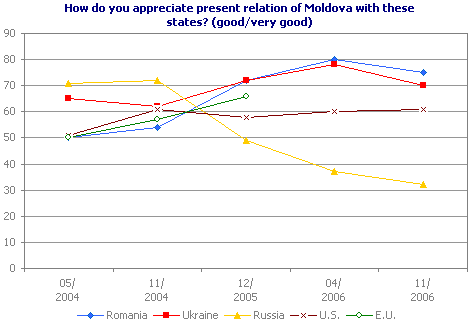
The perception of Moldova’s worse relations with Russia is the most discernible. Approximately 40 percent of citizens have noted this trend in the past two years. Accusations brought against Moldovan authorities that they have broken up with the strategic partner are not grounded after Russia had broken off with its most loyal ally – Belarus. The conduct of the Russian Federation toward CIS member states reveals that this commonwealth is provisory. The three resolutions adopted by Russia’s State Duma in February 2005, with 2–3 weeks before the parliamentary elections, were particularly addressed to Moldova, containing open threats against it. Russia has realised almost all threats by embargoing the vegetal, animal products and wines made in Moldova.
At present, the bad relations between Moldova and Russia are a fact that does not raise doubts. This happens in spite of talks that took place between Moldovan and Russian presidents on November 28, 2006 during the CIS summit in Minsk, with the two sides announcing the thawing of bilateral relations and elimination of barriers on way of Moldovan exports to the Russian market. That was a propagandistic statement, being useful both to President Putin and President Voronin.
The situation during the summit was extremely difficult for President Vladimir Putin:
It is true that President Voronin also needed the positive event from Minsk to improve the perception of his foreign policy:
Three months after the discussion of Presidents Voronin and Putin we have an official proof that the "thawing" of relations was butaphorical, a PR action. Thus, on March 1, exactly one year after the chief of state received the new draft concepts of foreign and security policy, the state-owned official agency "Moldpres" made public an ample commentary saying that:
2. Relations with Ukraine
Of course, Ukraine is another partner of Moldova in CIS, whose relations raise the interest of respondents. It was expected that the perception of relations with Ukraine would change after the presidential elections held in this country in late 2004. Truly, the number of those who consider that relations between Moldova and Ukraine are good or very good has grown by 15 percent in one year and half. These trends are explained by fact that positive news about Ukraine released by Moldovan media referred to a new attitude of the new authorities toward the separatist Transnistrian regime and joint actions within GUAM.
The comeback of the Party of Regions headed by Viktor Yanukovich to the power on summer 2006 reduced the number of people who were optimistic with relations with Ukraine. The perceptions have changed much before former foreign minister Boris Tarasyuk revealed that the minister of transportation from Yanukovich cabinet was an accomplice of Russian authorities in blocking the railway communication of Moldova via Ukraine, in order to force the Moldovan authorities to accept a railway communication that favours the Transnistrian regime.
Later, it was reported that Ukrainian magnates are co-owners of the Ribnita-based metallurgical plant together with Russian magnates and they have a huge capacity of making lobby in order to weaken pressures on the separatist regime in Transnistria. Also, Ukrainian analytical media has started warning insistently that the participation of Kiev in border control within EUBAM harms Ukraine in favour of Russia, which has established a quasi-territorial control on Transnistrian economy. Thus, it becomes clear for Moldovan authorities and citizens that two factors only make the Ukrainian authorities plead for EUBAM: the interest of E.U. for controlling the Transnistrian section of the border, which Kiev cannot ignore in the virtue of the need to maintain good relations with Brussels; fears that modalities of settling the Transnistrian conflict promoted by Russia could be dangerous precedents to encourage the separatist trends in Crimea and eventually in the south-east region of Ukraine.
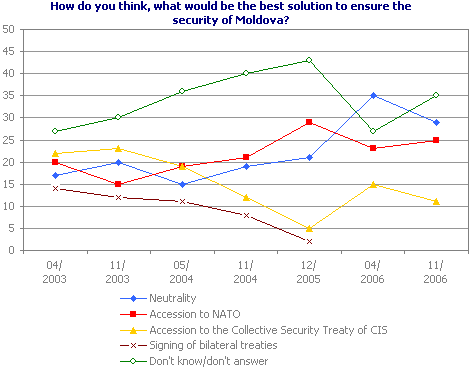
Given these relations of Moldova with the main partners from CIS, it is not surprising that the percentage of those thinking that the national security of Moldova could be ensured on basis of bilateral treaties has declined. Even more, the number of those thinking that Moldova’s accession to the Collective Security Treaty of CIS would solve security problems has significantly declined.
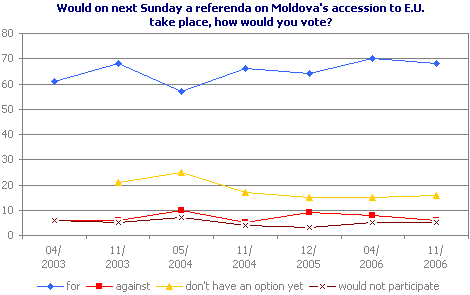
Surveys conducted the last years confirm that the E.U. integration would be the most wanted objective for Moldovan citizens. Starting 2003, when the ruling party pledged to become a promoter of European integration of Moldova, the number of Moldovan citizens who would vote this objective count constantly for between 60 and 70 percent. It is clear what Moldovan citizens would like and what the E.U. is giving us within the European Neighbourhood Policy.
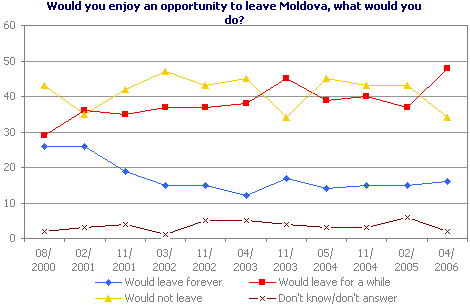
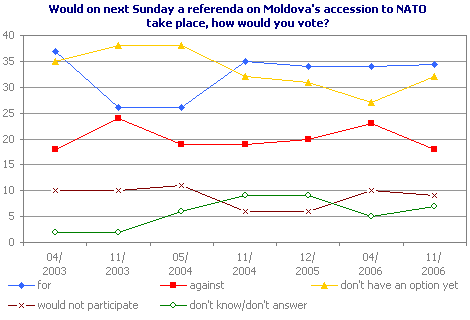
The recent rhetoric of Chisinau authorities aimed to discourage new trends has appeared on background of massive applications of more than half a million Moldovan citizens for Romanian citizenship and promises of Romanian authorities to facilitate the procedures in this respect. Concerns of Moldovan authorities were also amplified by a wider political context: Russia and Romania signed the basic treaty in 2003, condemning the Ribbentrop-Molotov Pact; in 2005, Russia started supporting ostentatiously the separatist Transnistrian regime, while in late 2006 the Romanian justice was asked to declare its opinion on "Antonescu case" in the light of the same Ribbentrop-Molotov Pact; in 2006, the Parliamentary Assembly of the Council of Europe recommended member states to condemn crimes of communist regimes and both close neighbours of Moldova, Romania and Ukraine, did this in different manners, with the latter condemning the "Golodomor". Of course, leaders of the Moldovan ruling Party of Communists do not like such evolutions, particularly when they do not have field of manoeuvre, as Russia has embargoed some CIS members and the Russia-Belarus conflict leaves very little hopes for reanimation of the CIS.
Under these conditions, Moldovan authorities consider that signing basic and border treaties with Romania and rejecting Romania as a promoter and advocate of its interests for European integration would be a salvation. They insist on this though the sides have agreed to work on the two treaties after President Basescu visited Chisinau in January. More, a month after Basescu visit to Chisinau Moldovan authorities launched a campaign of "protection of the rights of ethnic minorities in Romania", with the last detail being a clear indicator of deterioration of the Chisinau-Bucharest relations.
Those events come in contrast with the progress achieved in a very sensitive problem such as identity of Romanian and Moldovan languages. Thus, President Voronin has acknowledged in a recent interview with the official news agency "Moldpres" that Romanian and Moldovan languages are identical. Perhaps this is due to Chisinau’s desire to sign the two treaties as soon as possible and avoid talks on language of the documents. But a compromise in this respect was reached already in 2000, when the text of the Moldovan-Romanian treaty was initialled. The progress is remarkable particularly on background of the stance expressed immediately after the Party of Communists gained the power in February 2001, when an ideologist of the party, Ivan Grec, stated to party press that: "Be the Moldovan language three times identical with the Romanian language, we must insist on the name of Moldovan language from geopolitical and ethno-political reasons." It is even more curious that the Party of Communists publishes on its official website an article by Victor Borsevici, former ambassador of Moldova to China, titled "Trajectory of Moldovan myth in mirror of geopolitical reality", telling unimaginable things: "Yes, by origin and language we are Romanians. But our mentality and – most important – self-identification rest with Moldovan; one can easily call us dumb and forgetful of the "spirit of Romanianism", even though hundreds of academicians and linguists keep reminding us about that." In this context, the author tried to indicate in a fogged manner the risks faced by Romania for what he calls as "spreading of Romanianism" in Moldova. He hinted that Bucharest authorities should avoid annexing Moldova because this could turn into federalisation of Romania, as Moldova and Transylvania could claim the status of subjects of federation. He substantiates his thesis invoking that "Union to Moldovans," not "Union to Romanians" was the main slogan of the National Rebirth Movement in the former Moldovan Soviet Socialist Republic when part of USSR.
From this perspective, relations between Moldova’s ruling Party of Communists and the newly-created "Community of Moldovans from Romania" want to be a fist impulse to raise the awareness of "10 million" Romanian citizens that they are a Moldovan minority indeed, with Chisinau authorities pledging to protect their rights to identification. This event was widely mediated, condemned and ridiculed. However, Moldovan authorities should be aware that they run a very high risk by getting involved in such a project. In particular, they should do this now, when the "Patria-Moldova" organisation, declared opponent of Moldovan authorities that claims to represent the interests of more than half a million Moldovan season workers, is preparing the third congress in Moscow to raise pretensions against authorities of their native country. It is known that "Patria-Moldova" also pledges to protect the rights of minorities from Moldova and it has already called for better Moldovan-Russian relations, including by supporting the claims of Transnistria and Gagauzia for federalisation or even con-federalisation of Moldova. Apart from this, the Chisinau authorities will have to meet at beginning the wishes of the new Gagauz leadership regarding the right of creating regional parties, better saying ethnical parties, as well as the right of territories to be represented in the supreme legislative body of the country, etc. From this point of view, the option of Moldovan authorities for rights of minorities from Romania should first be confirmed by respect and awarding of similar rights in the own country.
The facts ascertained above were necessary to reveal the problems that concern the Moldovan authorities in the European integration process and to try understanding why concepts of foreign and security policy are not adopted.
The contributors to this issue are:
|
© 2001-2015 Association for Participatory Democracy "ADEPT" Reproduction of the materials is welcomed provided the source is indicated | e-mail: [email protected] |