
Participatory
Democracy
Original: /en/e-journal/20070401/index.shtml
| Association for Participatory Democracy | Print version. Published on www.e-democracy.md Original: /en/e-journal/20070401/index.shtml |
Activity of Public Institutions
1.1. Appointments
The legislature has given green light to an initiative of the Superior Council of Magistracy and appointed Ion Muruianu, deputy chairman of the supreme law court, as chairman of the Supreme Court of Justice.
The Parliament ascertained the vacancy of mandates of Communist Deputies Galina Balmos and Albert Datco. The Constitutional Court validated the mandates of substitute candidates Vladimir Panfilov (who will be member of the legal commission for appointments and immunities) and Elena Parpalova (who will be member of the commission for social protection, health and family), the 70th and 71st candidates of the Party of Communists of the Republic of Moldova (PCRM).
Under a parliamentary decision, PCRM Deputy Anatolie Zagarodnii was appointed secretary of the legal commission for appointments and immunities.
1.2. Legal acts
Law on modification of Article 46 of the Election Code. It established that the electoral candidates benefit of the right to be suspended from their permanent offices during the electoral campaign. The Government promoted this initiative under the pretext that the recent norms of legislation would produce major budgetary expenses, but it should be noted that this text was included in Article 46 of the Election Code when it was adopted for the first time (in 1997) and it stipulated that: "The electoral competitors benefit of the right to be relieved from permanent offices throughout the electoral campaign and they are paid medium salaries from allocations for elections." In the effective formula adopted in 2005 (Law # 176-XVI), Article 46 (3) stipulates that the "Central Election Commission will pay the medium salary from allocations for elections, in accordance with remuneration documents presented by candidates, within three months since election day." Opposition lawmakers criticised the Government’s initiatives, saying that the estimates of the executive are unreal (these amounts count for tens thousands lei), while the lack of possibilities of remuneration throughout the campaign will make candidates who run public offices not to suspend their activity, so that administrative resources may be also used during the electoral campaign. It is worth to note that this draft law was adopted by violating the Parliament’s Regulation (Law # 430-XVI from 27.12.2006 enforced on 23.03.2007), with Article 63/1 stipulating that:
Law on registers. The law regulates the creation, maintenance, reorganisation and erasure of registers; legal relations developed in this process; functions of supervisors of registers. The provisions of this law will cover all types of registers, regardless of form of property or mode of keeping them. The registers will be created and kept on basis of distinct principles: legality; protection of the right of individuals and legal entities; protection of personal data of individuals; continuity; single identity; awarding of sanctioned access, etc.
Law on modification and completion of the law on administrative-territorial organisation of the Republic of Moldova. The territorial structure of the Cahul district was modified at the initiative of a PCRM deputy, with the village of Tudoresti being transferred from composition of the commune of Bucuria to the commune of Tartaul de Salcie. The Communist lawmaker motivated that "the village of Tudoresti was included in the village of Bucuria" from reasons unknown by public authorities and it is supposed that this was done from a "mechanic mistake". It was also said that in spite of legal regulations in force for many years, " the Tartaul de Salcie mayoralty kept and keeps all records on Tudoresti, but residents of the village are included in the additional list of this mayoralty at all parliamentary and local elections," though legally they are part of another entity.
Law on modification and completion of legal acts on activity of prosecutor’s office. The law derives from the legislative action plan on implementation of the Council of Europe’s recommendations and the European Union-Moldova Action Plan (ensuring of impartiality and independence of prosecutor’s office, consolidation of administrative capacity of this institution). It explains the regulations on hierarchy of rankings of prosecutors, terms of mandates of territorial prosecutors, includes new norms on social guarantees, immunities awarded to prosecutors to ensure the equilibrium between facilities granted to judges and prosecutors. The speaker said that by adopting this law, the Parliament finished the adoption of legal measures deriving from the CoE recommendations on judicial reform.
Law on modification of the law on salary system in budgetary sector. The approved document establishes three stages of implementation of salary rises, which the parliamentary majority has earlier suspended at the Government’s initiative. Under amendments, the salary of medical personnel and social assistants must grow by 30 percent on average, of scientists by 22 percent, cultural and sport personnel by 40 percent. Salaries of lecturers will grow by 50 percent, teachers from pre-school and extra-school education by 32 percent and teachers from secondary general education by 17 percent. Opposition lawmakers criticised the attitude of authorities in this field, describing previous and recent actions as populist, aimed at influencing the opinion of voters before elections. They criticised the proposed mechanisms, the lack of clear criteria to argue the salaries of different categories of employees, described the rises as insignificant in comparison with the resources needed for a decent living. Representatives of the parliamentary majority argued that the rises are not essential, given the budgetary problems produced mainly by restriction of exports to the Russian Federation.
Law on modification and completion of the law on physical education and sport. The law aims to modify the provisions on social protection of performance sportsmen, who will be paid life indemnities (in percent, depending on value of medals they gain). Athletes who are citizens of Moldova and gain gold, silver or bronze medals at Olympics, World and European Championships for seniors will fall under incidence of this law.
Law on completion of Article 7 of the law on free economic zones. The law stipulates that if the free zone (subzone) stops working or the status of resident is revoked before the free zone (subzone) stops working, the former resident will place the goods introduced earlier under customs regime of the free zone under another customs regime, in line with legislation in effect.
Law on modification and completion of the law on international treaties of the Republic of Moldova. The document approved in two readings stipulates that if the international treaty does not contain an authentic text in official language, its authentic text will be presented in Parliament in a foreign language and it will be translated into the official language and legalised by the Ministry of Foreign Affairs and European Integration of Moldova. Earlier, the translation and its certification were needed only to publish the text of the international treaty.
Law on modification of some legislative acts (simplification of the tax reporting system). It stipulates the simplification of the fiscal reporting system for individual enterprises which have maximum 3 workers, as well as for reporting of transfer of social insurance premiums and mandatory health insurance premiums. The document is a response to recent protests of holders of entrepreneurial patents, who invoke the reticence toward registration of individual enterprises, costs and complicated fiscal reporting procedures.
Law on modification and completion of the law on state social pensions. Under regulations, "the length of service that grants the right to a pension must cover the period of study for doctor’s degree in the post-graduate system, if this study was completed before this law took effect." The expenses for implementation are estimated at about 4.2 million lei for approximately 2,200 candidates to doctor’s degree registered at present.
Law on modification and completion of the law on publishing and enforcement of official acts. The document stipulates the publishing of a resume of the European Court of Human Rights’ judgments on Moldova in the official gazette Monitorul Oficial within one month since they become definitive. The composition of "resume" will be established by Moldova’s governmental agent to the ECHR, in spite of proposals of representatives of opposition factions who insisted on publishing of the whole judgments for a full information of all those interested.
Law on abrogation of the law on rent. It is considered that this act is out-of-date and invalid, as the new Civil Code was enforced. At the same time, a distinct law on rent in agriculture (198-XV from 15.05.2003), which aims to consolidate the farm land, is still in effect.
Decision on date of general local elections. The document tabled by representatives of all parliamentary factions established that the general local elections will take place on June 3, 2007. The mandate of acting councillors runs off on May 27, 2007, but its term is extended till the date when new bodies of local public administration will be created.
Decision on creation of the special commission for optimisation of legal framework for regulation of entrepreneurial activity. The commission was created to finalise and ensure the continuity of the process of optimisation of the legal framework for regulation of entrepreneurial activity, in line with the mechanism established under the Law # 235-XVI from July 20, 2006 concerning basic principles of regulation of entrepreneurial activity. The chairman of the Parliament will head the commission and most members of the commission represent the Communist faction. The special commission will examine reports and proposals on modification of legal acts that regulate the entrepreneurial activity, will issue the list of legal acts which will be abrogated. The commission will work out draft legal acts for modification and completion of legislation on entrepreneurial activity. The special commission "will be assisted by the World Bank’s Better Competitiveness Project, independent experts and the Business Consulting Council made up of organisations working in associative sector."
Decision on modification of fields of activity of permanent commissions of the Parliament. Under amendments, the legislative aspects and parliamentary control on touristic activities were transmitted from the commission for public administration, environment and territorial development to the commission for culture, science, education, youth, sport and mass media. This initiative came from the chairman of this commission, Communist Deputy Victor Stepaniuc, with experts describing it as faulty, though the tourism is linked to the territorial development and economic development, while the previous amalgamation of fields in the Ministry of Culture and Tourism was not preceded by serious analyses and the situation in both fields remains complicated.
Draft law on public fields and their delimitation. It seeks the delimitation of public fields of the state and public fields of the administrative-territorial units. Public fields are the fields owned by state and administrative-territorial units and the right to possess, use and control them belongs to the Government and local public authorities. These fields may be part of the public and private areas of the state, with the public fields being imperceptible and imprescriptible.
Draft law on modification of the law on economic law courts. It abrogates Article 38 (3) of this law, after the ECHR has condemned Moldova (case Asito vs Moldova), with the European court describing the right of the prosecutor-general to contest final judgments as a violation of the principles of a fair trial.
Draft law on completion of the Code of Administrative Contraventions. The Parliament has passed in the first reading some completions on sanctioning for violation of legislation on beekeeping. The minimum sanction counts for 10 conventional units (200 lei) and it is applied for non-registration of address of bee gardens with mayoralty, while the maximum fine is 200 conventional units (4,000 lei) and the object is confiscated; a similar sanction is applied for violation of some rules on importation of biological material with confiscation of the object of the administrative contravention (for swarms, queens)." Lawmakers said that these sanctions are exaggerated and may essentially affect the persons working in this field.
Draft law on modification and completion of legislative acts (harsher sanctions for violation of copyrights). The document passed in the first reading aims to modify the Code on Administrative Contraventions and the Criminal Code. Many lawmakers raised objections against exaggerated sanctions, extended rights of police bodies and, therefore, the speaker told the newly-created special commission for optimisation of the legal framework for regulation of entrepreneurial activity to study the draft.
1.3. Parliamentary control. Statements
The Parliament has modified the action plan for April-June, deciding to hold one sitting a week.
The parliamentary majority refused to convoke the interior minister for a plenary hearing in connection with abuses and breaches of democratic norms (abusive holding of some persons, journalists, sequestration of copies of some publications).
Also, it refused to invite Government representatives for a hearing on respect for copyright (use of pirated software, including by lawmakers and functionaries of the Parliament) and situation in winemaking sector.
Questions and Interpellations
Social Liberal Deputy Igor Clipii has asked the Government and subordinated bodies to report on:
National Liberal Deputy Vitalia Pavlicenco has submitted interpellations seeking:
Christian Democratic deputy Valentina Serpul has appealed to the Central Election Commission to ensure the right to vote of citizens who have a permanent domicile in some fruit growing associations in the Chisinau municipality but their residence is not legally confirmed.
Statements
Deputy Valentina Cusnir has read the Appeal of the Extraordinary Congress of the Moldovan Union of Oenologists. The appeal evaluates the situation and problems in the field, asking the authorities to take a series of measures:
The parliamentary faction representing the Democratic Party of Moldova has released a statement on children without parents’ care, warning over the high number of children (about 35,000) who do not have parents to look after them (both parents left the country). The party asked the Government to take efficient measures in this field, notably to create a network of social assistants in all localities, to simplify the procedure of tutorship and guardianship, etc.
Deputy Vitalia Pavlicenco has presented statements:
2.1. Appointments. Reshuffles
The executive has dismissed Serghei Iatco from the post of director of the State Service for Religious Denominations. Although he was relived from office "at the demand," many experts link the dismissal to a recent ECHR judgment that sentenced Moldova for not registering the religious denomination "True Orthodox Church of Moldova". Competent representatives of the Service for Religious Denominations delayed the registration in spite of a final decision by the Supreme Court of Justice and it was supposed that the omission was linked to administrative influences from high-ranking officials.
The executive has appointed Vitalie Iurcu as director of the leading board of the National Agency for Energy Regulation, with a delay of several years. Iurcu has worked in private structures and USAID/Moldova.
2.2. Decisions
Decision on indexation of social insurance conscriptions and some state social conscriptions. The document establishes the coefficient of indexation of conscriptions in 2007 at the level of 20.7 percent, given the annual rise of Consumer Price Index by 12.7 percent and annual growth of the medium salary on country by 28.7 percent in 2006. Starting April 1, 2007, the minimum indexed pension will be 361 lei – retirement pension for workers in agriculture; 406 lei – retirement pension for other beneficiaries of pensions; 196, 278 and 288 lei – pension for invalidity (3rd, 2nd and 1st degrees). Military pensions and state social allocations for some categories of citizens will be indexed by 12.7 percent only.
Decision on transmission of some fields. The document stipulates the free transmission of five fields covering more than two hectares in diverse sectors of the Chisinau municipality to the National Housing Service, with the declared purpose "to create conditions for resolving the problem of building social residences in the Chisinau municipality."
Decision on activity of the Agri-Industrial Agency Moldova-Vin in 2005–2006. The Government considers that the agency has taken some measures to accomplish the goals from governing programme and priority programmatic documents, ensuring the creation and improvement of the institutional framework needed to revitalise and develop the vine growing and winemaking complex. It notes the following accomplishments:
Decision on rise of scholarships. Under the document, scholarships for students of universities and colleges will grow by 35 percent, up to between 285 and 365 lei. Scolarships of students of vocational institutions will be increased from 120 lei up to 200 lei, at the initiative of prime minister.
2.3. Sittings. Decisions. Statements
Sitting on development of districts
A republican sitting with the participation of heads of ministries, districts and city halls has focussed on social-economic development, execution of budgets and development of taxable base, spring agricultural works, sanitation and arrangement of localities, etc. The prime minister outlined the need of fulfilling all budgetary plans for 2007, including through efficient development measures and enlargement of the taxable base, welcoming the trends of increasing own incomes in the districts of Dubasari, Ocnita, Anenii-Noi, Floresti, Briceni, Orhei, the Chisinau municipality and raising concern with the decline of own revenues in the districts of Edinet, Glodeni, Taraclia, Calarasi. According to a press release, Vasile Tarlev outlined the "necessity of applying the Tax Code efficiently and transparently, in order to prevent the blocking of activity of economic agents, to establish programmes on payment of owed taxes and to combat illicit financial-economic activities in cooperation with competent bodies." The prime minister emphasised the efficient implementation of the national gasification programme, elaboration and implementation of the drinking water providing and sewerage strategy, ensuring with electricity, renovation of national and local roads, attraction of investments in territories among development priorities of districts.
Sitting of the National Commission for European Integration
The commission has evaluated the implementation of the Moldova-E.U. Action Plan, hearing a report on results of implementation of the plan in the first quarter of this year and priorities for the next period. The minister of foreign affairs and European integration described 2007 as a year of crucial importance for implementing the E.U.-Moldova Action Plan and gaining the quality of associated member of the E.U., indicating the existing shortcomings in this process. The signing of the visa facilitation agreement and gaining of autonomous trade preferences remain among basic goals of Moldova in 2007. The prime minister particularly noted the importance of a priority implementation of chapters of the Action Plan concerning respect for human rights and principles of the state based on the rule of law, reformation of the judicial system and struggle against corruption.
3.1. Decrees
The chief of state has awarded the "Labour Glory" Order to:
3.2. Sittings, Decisions. Statements
Concerns with human rights and health of population
Vladimir Voronin has convoked a sitting on optimisation of activity of the Moldovan Centre for Human Rights and growth of the role of ombudsmen. The participants exchanged opinions about actions needed to improve the services of this institution, work out a complex of legislative and institutional measures aimed to enhance the efficiency of the centre. The president also noted the need of updating the law on ombudsmen in compliance with E.U. standards, backing proposals saying that the national legislation must oblige public authorities to react promptly and adequately to appeals of ombudsmen, to help an operative examination and settlement of cases of violation of human rights and to contribute actively to respect for human rights and fundamental freedoms.
Moldova’s president has asked the Government to launch the procedures needed to sign the U.N. Convention on the Rights of Persons with Disabilities approved on December 13, 2006 and opened for the signing on March 30, 2007. According to the chief of state, the signing of this convention will mean that our country recognises the international principles of promotion and protection of rights of disabled persons.
President Vladimir Voronin has attended a conference on national health policy: importance and prospects, which focussed on the draft National Health Policy. The chief of state said that the document is necessary and welcome and it must become a mechanism of systemic approach of health problems and joining of inter-sector efforts for better lives and health of population from birth to old.
Generous donations for cultural institutions
The Moldovan president has visited the Republican Theatre Luceafarul to greet the staff on the World Day of Theatre and to give a modern car from state leadership. They discussed the stage of elaboration of projects on reconstruction of the theatre, with the chief of state calling for the radical and rapid renovation of the institution.
The chief of state, prime minister and minister of culture have presented the building of the former entertainment complex Moscova to the staff of the Eugene Ionesco Theatre, as the state authorities gave it to this cultural institution. Vladimir Voronin noted the opportunity of adapting the rooms of the building to needs of the staff and proposed the elaboration of a project on rearrangement of the building. The state has recently recovered the building because of considerable debts of former owner. The price of the acquisition was not made public.
1. Financial-banking system
According to data of the central bank, the total assets of the domestic system rose by 5.32 percent in January-February 2007, up to about 23.990 billion lei (1.91 billion dollars). The assets of commercial banks rose due to the growth of big and medium-size banks. It was based in turn on growth of foreign investments in the capital of Moldovan banks. Thus, the share of foreign investments in the capital of Moldovan banks rose by 1.18 percentage points in January-February 2007, up to nearly 64 percent and by 13.8 percent compared with the same period of 2006.
At the same time, the credit portfolio of commercial banks rose by 2.3 percent this year, up to 14.14 billion lei, while the balance of deposits grew by 4.7 percent, up to 18.05 billion lei. In comparison with the similar period of 2006, they have grown by over 38 percent and 31 percent, mainly due to capitalisation of banks. Total assets of the banking rose by about 27 percent on account of foreign investment inflows. The assets rose most in the last quarter of the year, notably by 1.8 billion lei, compared with nearly 3 billion lei in the 1st-3rd quarter of 2006.
…and they are comparable with assets of a medium-sized Czech bank
BCR Chisinau, which became meantime the daughter bank of the Austrian giant Erste Bank, has achieved the most spectacular growth of assets, notably by 178 percent. EximBank, purchased by Italy’s Gruppo Veneto Banca, ranked the 2nd place after registering a 55-percent rise of assets, followed by Mobiasbanca – 38.1 percent and Moldindconbank – 31.8 percent[1].
Share of insurance market in GDP grows, but below level of developing states…
At the same time, the share of Moldovan insurance services in GDP reached 1.43 percent in 2006 and rose compared with 2005, when it was 1.1 percent. However, it is lower than the level of developing states, not to mention the developed countries. In particular, insurance services in transition countries cover up to 3 percent of GDP, compared with about 6 percent of GDP in majority of developed states. The enforcement of the new law on insurance that the Parliament has recently re-voted will strengthen the insurance market. According to estimates, about 22–25 insurance companies could continue operating on market, compared with 32 in 2006.
2. Currency
Currency transfers via formal channels accounted for about 855 million dollars in 2006, which is by 25 percent more than in 2005. Moldovan banks perform money transfers via the rapid systems Western Union, Unistream, SWIFT, Strada Italia, Trabex (Spain), Turciye Express (Turkey), Lider (former Vip Money Transfer), Rus Express (Russian Federation), Strada Italia, Banco Espirito Santo (Portugal). Moldova was ranked the 1st place in the World Bank’s standing, with migrants’ remittances covering nearly 20 percent of GDP, according to the report "Migration and Remittances: East Europe and the former Soviet Union." Moldova is one of biggest countries in the world in terms of emigration, World Bank experts estimated. Considerable remittances to Moldova facilitated the reduction of poverty of households and offered an essential exchange.
Besides all positive effects of migration correlated with remittances, constant remittances make the families who depend on emigrants are becoming more inert in seeking jobs or building individual business. The reduction of labour force inside the country is also a negative effect of emigration on domestic labour market. The reduction of labour force offer has also compromised some percentage points of the growth achieved in 2000–2005. Even more, the degradation of quality of human capital cannot be neglected. All these drawbacks must urgently find a place in Government’s agenda.
Share of total foreign debt in GDP is about 83 percent…
Moldova’s foreign debt has grown by about 757 million dollars (some 44 percent) in the past six years, up to 2,482 million dollars at the end of 2006. It covered about 83 percent of the GDP of 2006 (approximately 3 billion dollars). The total foreign debt, which includes the debts of governmental and private sectors, has annually grown by 10 percent on average, except for years 2001 and 2004, when it declined by more than 44 million dollars and, respectively, 39 million dollars, compared with the precedent years. The foreign debt rose more in 2006, notably by 402 million dollars (more than percent 19 percent), compared with 2005.
According to the National Bank of Moldova, the debt of the governmental sector dropped by nearly 100 million dollars (12 percent) in late 2006, compared with early 2001, down to 718.6 million dollars. At the same time, the governmental debt rose by more than 9 percent (60.6 million dollars), compared with 2005. The share of the governmental debt in the total foreign debt was around 30 percent.
…while deficit of current account is among highest in the region as share in GDP
At the same time, the deficit of current account of Moldova’s balance of payments rose by more than 65 percent in 2006, up to approximately 399 million dollars, holding over 13 percent of GDP (relatively high). According to preliminary data, the deficit of trade balance (which is the main component of the balance of payments) with goods and service accounted for about 1,597 million dollars.
On 21 March in Vienna took place a new round of consultations of the mediators on behalf of the OSCE, Russian Federation and Ukraine, and the observers on behalf of the EU and US, with the participation of the OSCE Chairman in Office, Spanish Minister of Foreign Affairs, Miguel Anhel Moratinos. The consultations concluded with the signature of a final statement in which representatives of the mediators and observers have called for the resumption of the negotiations in the "5+2" format as soon as possible. According tot the statement, both the mediators and the observers are concerned with the lack of dialogue between Chisinau and Tiraspol. At the same time, the signatories expressed their readiness to organise in the nearest future a joint meeting with the political representatives of the two sides.
We would like to remind that the negotiations round scheduled for 15–16 February 2007 did not take place because of "lack of consensus between participants", and that meetings in this format have ceased to be organised since February 2006. It is worth noting that during the first trip to Moldova of the new EU Special Representative for Moldova Kalman Mizsei he met with the Transnistrian leader Igor Smirnov who expressed his availability to resume the dialogue with the Moldovan authorities.
On 17 March the Government of the Republic of Moldova adopted a series of amendments to the procedure of issuing certificates of origin to economic agents from the Transnistrian region. According to the amendments, the Transnistrian economic agents registered permanently or temporarily with the Moldovan State Registration Chamber will be granted certificates of origin of type "C", "A", "CT-1" and "EUR", which will allow them to enjoy the same commercial preferences granted by the EU to Moldovan economic agents. According to an information note of the Ministry of Reintegration, "the proposed amendments are part of the measures taken by the Ministry of Economy and Trade with a view to obtaining the Autonomous Commercial Preferences from the EU and are to contribute to the process of socio-economic reintegration of Moldova". According to the Ministry of Reintegration, at present 290 economic agents from Transnistria are registered with the Moldovan authorities: 124 on a permanent basis and 166 on a temporary basis. Among the Transnistrian economic agents registered permanently in Chisinau are the shoe factory "Tighina", textiles factories "Tirotex", "Vestra", "Intertentr-lux" etc. Temporary registration has been granted to the Ribnita Metallurgical Plant, Ribnita Cement Factory, "Moldavcabel" Factory, Electrical Power Station from Kuciurgan, Wine Factory "Buchet Moldavii" etc. In January 2007 the Moldovan Trade and Industry Chamber issued to Transnistrian economic agents 574 of certificates of origin, including 74 preferential ones ("T-1–63", "EUR-11").
On 26–27 March in Chisinau took place the International Conference "Settling the Transnistrian Conflict in the Context of Moldova’s Europenisation", organised by the Foreign Policy Association with the support of the PBF Project and the British Embassy Chisinau. The conference was attended by a series of Moldovan high level officials, representatives of EU institutions, OSCE, heads of diplomatic missions accredited to Moldova as well as renown experts from the EU, Ukraine, Russia, Romania, US and Moldova.
In his welcoming address to the conference participants, Chairman of the Parliament of Moldova, Marian Lupu, said that the last EU enlargement round has placed Moldova in a new regional context, the Transnistrian conflict being a source of instability for the whole European security system. Speaker Lupu welcomed the participation of EU as observer in the "5+2" format and the signature of teh EU-Moldova Action Plan as prerequisites for a viable partnership with a view to the Transnistrian settlement.
Lupu reiterated Chisinau’s position on the Transnistrian issue, founded on the principle of territorial integrity and non-violability of the borders. "The democratisation and demilitarisation of the region remain our stated priorities as the adopted approach to Transnistrian settlement", Speaker Lupu stated. He proposed a series of measures to attain these objectives: launch of an OSCE Mission to evaluate the situation of democratic institutions and inspect the military sites in Transnistria; honouring of Russia’s commitments assumed at the Istanbul OSCE Summit in 1999; transformation of the current peacekeeping operation into an international one to include military and civilian observers with international mandate; opening in Bender an EU Information Centre by the model of the centres in Chisinau, Balti and Cahul; strengthening of the civil society and supporting civic initiatives aimed at the democratisation of the region.
The EU representatives, including the Head of the EC Delegation to Moldova, Cesare de Montes, Head of the European Parliament Commission for cooperation with Moldova, Marianne Mikko, and the Senior Advisor for Ukraine, Belarus and Moldova in the Policy Unit of the Secretariat of the European Council, Pirkka Tapiola, strengthened the need to increase the attractiveness of Moldova for the citizens from the left bank of Nistru River by steeping up the European integration efforts and the democratic reform process. Pirkka Tapiola stated that the European Union will continue its efforts to identify a final and comprehensive solution to the Transnistrian conflict. The key principle of the settlement will be the respect for the sovereignty and territorial integrity of Moldova, and the European Union will not give up on this principle. According to the European official, "the final settlement model will not involve necessarily the status of autonomy, federal or confederal subject for Transnistria, key attention should be given to the delimitation of competences between Chisinau and Tiraspol". At the same time, any solution should be a viable one, and contribute to the European integration of Moldova and a life in dignity for people on both sides of River Nistru. Marianne Mikko in her turn expressed concern at the frequent violations of the freedom of the media registered lately in Moldova and the lack of sound civil society institutions. "Chisinau should understand that the process of Europenisation is not only about nice words, it’s also about passing laws, applying them, and imp0lementing the democratic reforms", stated MEP Marianne Mikko.
The European Court of Human Rights (ECHR) sentenced Moldova on March 27 in the case Istrati and others v Moldova for violating the right to freedom and security, the right to private and family life, using inhuman and degrading treatments. Applicants Viorel Istrati, Alexandru Burcovschi and Roman Lutcan have invoked improper detention conditions, lack of medical assistance and violation of the right to communicate with their lawyers in private. The ECHR told Moldova to pay 6,000 euros, 4,000 euros and 5,000 euros in pecuniary damages and about 4,000 euros in costs and expenses to the applicants.
The Moldovan Parliament amended the law on publishing and enforcement of officials acts on March 29. Under amendments, ECHR decisions and judgments against Moldova will be published in brief in the official gazette Monitorul oficial.
The Berlin Declaration
The European Union (E.U.) marked on March 25 the 50th anniversary of the signature of the treaties that created the European Economic Community (EEC) and the European Atomic Energy Community (EUROATOM). These documents are also known as the Treaties of Rome because they have been signed in the Italian capital. They have really given a new route to post-war Europe, toward peace, prosperity, democracy and the state based on the rule of law. Now they are part of the visiting card of the E.U. The signing in Berlin of a European solidarity declaration (the Berlin Declaration), which summarises the main accomplishments of the E.U., outlines major challenges on way of the E.U. and establishes the future goals of this community,[1] was the main event linked to the 50th anniversary of the Treaties of Rome.
On occasion of this anniversary, President Vladimir Voronin has signed a letter saying that the Republic of Moldova welcomes the Berlin Declaration and subscribes to the E.U. principles, declaring its irreversible adhesion to the E.U. values. This symbolical gesture was very necessary since Moldova is bidding to join the E.U. in its way toward prosperity and democracy. But Moldova will have to demonstrate that it is a reliable long-route partner, in order to make this gesture of symbolical adhesion credible. The implementation of the whole Moldova-E.U. Action Plan (EUMAP) could be a cogent proof in this respect. However, regrettable actions taken by police on March 27 throw doubts on sincerity of Chisinau, which easily allows the defiance of some values of the Berlin Declaration, though it subscribes to this document.
Sitting of NCEI
Minister of Foreign Affairs and European Integration Andrei Stratan presented a report on results of implementation of the EUMAP in the first quarter of 2007 and priorities for the next period, at a sitting of the National Commission for European Integration (NCEI) on March 27. Stratan noted that the signing of a visa facilitation agreement with the E.U. is a basic priority of Moldova in 2007. Elsewhere, Minister of Economy and Commerce Igor Dodon said in a report that Moldova is advancing in negotiations aimed to obtain the Autonomous Trade Preferences (ATP) and the Chisinau authorities have met all requirements of the European Commission in this respect. On the other hand, a group of experts of the European Commission who visited Chisinau in January-February to attend a meeting of the Moldova-E.U. Cooperation Subcommittee "Economy, Finance and Statistics" said that Moldova should do more to boost the credibility of the goods origin certification system, to improve the customs management and the auditing at exporting enterprises before gaining the ATP.
Joint visa issuance centre
Mihaly Bayer, Hungarian ambassador to Moldova, has recently said that the joint European visa issuance centre, which will formally open in the diplomatic representation of Hungary on April 25 to issue E.U. visas to Moldovan citizens, will accept visa applications starting April 12. This action aims to adapt the activity of the centre before the formal opening and to shortly remedy all deficiencies. We recall that this centre will issue Hungarian, Austrian and Slovenian visas at the beginning and Estonia, Latvia and Denmark will join the centre meantime. According to Bayer, Moldovans will have access to information on services of the centre round o’clock and the centre will finish and launch its website www.cac.md[2]. The Hungarian ambassador noted that Moldovans apply for about 12,000 visas for Hungary, Austria and Slovenia a year, while the centre will be able to process about 50,000 visas a year. A communication by the European Commission Delegation in Chisinau has earlier said that the centre will be capable to issue at least 10,000 visas a year.
Opening of Pro Europe Centre in Balti
After the first centre Pro-Europe opened in Cahul on February 20, a second similar centre was inaugurated in Balti on March 30. Both centres opened with the support of the Representation of Eurasia Foundation in Moldova and the Ministry of Foreign Affairs and European Integration of Moldova. The centres aim to provide information on E.U., the European Neighbourhood Policy (ENP), implementation of the EUMAP and the process of European integration of Moldova. The centre opened after the conference on cooperation between local public authorities, civil society and mass media in the European integration process, at which the strategy on information and communication for European integration was launched for public debates. We will describe this document in a future issue.
While the political relations between Moldova and Romania still are difficult, the economic ties seem to be different. The Ministry of Economy and Commerce has reported that commercial exchanges between Moldova and Romania rose about 1.9-fold in January-February 2007, compared with the similar period of 2006, up to 135.7 million dollars. Moldova exported goods worth 34.1 million dollars in the period concerned (1.7-fold more than in January-February 2006) to Romania and imported goods worth 101.6 million dollars (2.1-fold more than in January-February 2006). These figures deny previous estimates by experts who forecasted a decline of the trade between the two countries after Romania’s accession to the E.U. and cancelation of the free exchange regime. However, the significant rise of the deficit of trade balance with Romania up to 67.5 million dollars, compared with 29.4 million dollars in January-February 2007, should raise concern.
Igor Colenov, director-general of the Border Guard Service of Moldova, and Nikolay Litvin, chairman of the State Guard Service of Ukraine, signed a plan on development of bilateral cooperation in 2007 at a March 22 meeting. The meeting also focussed on situation at the Moldova-Ukraine border and outlined the necessity of extending the information exchange between border guard services of the two states.
The State Administration of Civil Aviation has said in a press release that the exploitation of the Chisinau-Kiev flights by Moldovan and Ukrainian air operators is still uncertain. The sides met on March 23 and failed a compromise on number of weekly flights. The Moldovan side seeks six flights a week distributed equally, while Ukraine seeks ten flights a week. The existing dissensions between the two sides are expected to be settled at a new round of negotiations.
A parliamentary delegation of the Russian Federation headed by Aleksander Moskalets, deputy chairman of the State Duma committee on constitutional legislation and state building, visited Moldova on March 20–22. The Russian delegation visited Chisinau to attend a sitting of the Moldovan-Russian interparliamentary cooperation commission. That was the first meeting at this level after an agreement on parliamentary cooperation was signed in 2003. Also, Russian legislators met with President Vladimir Voronin and Prime Minister Vasile Tarlev.
The sides discussed many issues, including the Transnistrian problem, with the Moldovan side underlining that Moldova calls for a strategic partnership based on pragmatism and mutual understanding with the Russian Federation.
Moldovan and Russian legislators have adopted a statement at the sitting of the Moldovan-Russian interparliamentary cooperation commission. It stipulates that the sides will work out recommendations on settlement of existing problems in bilateral relations, including the Transnistrian conflict, at the next sitting set for September 2007. The recommendations will be raised to executive bodies of the two countries.
It was assured in the period concerned that Belarus will restart importing Moldovan wines soon and the Moldovan-Belarusian company Moldbelvin will be the only one in charge with deliveries of wines in bulk. The company was founded by AgroVin Bulboaca of Moldova and Belgospisheprom of Belarus. They own 80 percent and 20 percent of the statutory fund. According to Belgospisheprom director Leonid Senko, Moldbelvin will deliver wines in bulk to all consumers from Belarus.
Earlier, Iurie Mudrea, chief of the analysis and forecast service of Moldova-Vin Agency, has assured that "the [Moldovan-Belarusian] enterprise will not monopolise the exports of wines in bulk" to Belarus.
Fiscal revolution: for or against?
Iurie Gotisan
The Government has recently examined the draft tax policy of Moldova for 2008–2010, in which several scenarios of policies have been evaluated, including very bold ones on reduction of taxes. In particular, it seeks the reduction of income tax for individuals by two percentage points, from 20 percent in 2006 down to 18 percent in 2008, as well as of the tax on corporate income. Also, annual exemptions for individuals are expected to grow from 4,500 lei in 2006 up to 10,800 lei in 2008–2010 and a 12-percent single taxation quota. The Government is preparing a "fiscal revolution", but many economists and businessmen call it evolution. However, the public debate could be seized by concern to demonstrate superiority of a certain fiscal commitment.
I do not think that there is any economy to function perfectly (even the developed western states have problems) and a fiscal optimum to satisfy the taxpayer and the state, which collects the taxes, is a rarity. Finally, the real economy does not go one direction only. In other terms, we must see which system is better: the one based on progressive taxation in our country or the one of the single taxation rate implemented in many states in the region (Russia, Estonia, and Lithuania, which achieved very good results). It is important that future changes not to affect the budget, private and corporate taxpayers. Of course, the estimates must be legally made, while changes in tax policy must be announced with at least one year before, so that population and business environment benefit of minimum predictability.
At the same time, I do not think that the fiscal burden would be too heavy for economic agents and investors, as the 18-percent tax is among lowest rates in the region. Of course, it must be gradually lowered to manage a balanced budgetary execution (incomes/expenses). These are institutional pressures, rather than exaggerated fiscal pressures that businessmen often signal. Moldova has a deficit of right interpretation of laws in legal system, which is often described as corrupt and bureaucratic, as well as a chronic deficit of execution of judgments, not a deficit of laws (even more, we may speak about a legislative inflation). If businesspersons are not confident that judges in Moldova make justice and they do not sell it to the one who pays more, we may work out inspired laws because we will have fewer investments than the economic system could absorb.
Reports by the Ministry of Finance concerning the execution of the budget reveal that 70 percent of revenues from state treasury are "extorted" from indirect taxes, notably VAT, excises, customs duties, and only 30 percent from income taxes, profit, etc. This is a structure of the budget that cannot be balanced. The economic theory says that 60 percent of budget incomes should be raised from direct taxes (income tax, corporate income tax plus social contributions, estate taxes, real estate taxes, etc.), and indirect taxes should cover up to 40 percent in a viable and functional economy. Or, the situation in our country is exactly reverse. The explanation is very simple: the structure of Moldovan economy does not allow other budget collections because the productive sector in our country does not go the same step with the internal demand. As a result, imports are massive (the big difference between exports and imports, trade deficit, etc. are a proof) and the indirect taxes prevail in the structure of budgetary collections. Of course, we have a consuming rather than productive economy.
Many economists and specialists of finances share the opinion that the single taxation quota would increase the budgetary incomes. The need of implementing such a tax system would not result from high taxes, which are medium compared with those in the European Union, but from a variety of existing taxes, hardening the following and drawing from different budgets, maintaining an administrative apparatus with many public functionaries and encouraging the fiscal evasion and bureaucracy this way.
In Romania, for example, the single taxation quota introduced in 2005 reveals that the incomes have covered the expenses of the consolidated general budget. The single quota reduced the tax on profit and personal income. But this quota may be applied on incomes in very different manners in every state and it correlates directly with dynamic of economy (growth or stagnation). An evaluation of the impact of single quota would be welcome because its introduction could produce higher fiscalisation (how much of economy is taxed) and fiscality (where taxes may grow after introduction of the single quota). Thus, we may judge the way the single quota may encourage the rise of budgetary collections, other conditions being unchanged. I will mention below the potential advantages and disadvantages of the single quota.
Advantages:
The state has often awarded fiscal concessions and has forgiven debts of some state-owned enterprises in the past years and this fact perpetuated some financial holes in the national budget. However, the risks of applying a debt freezing programme are very high. They could come from two directions. Firstly, such a measure induces the idea of a harmful fiscal treatment in economy. Big state-owned debtors could believe that they will be able to benefit of such fiscal alms again sooner or later. They could be encouraged not to pay their debts toward budget, following a simple reason: the state will pardon us again. Of course, small or private taxpayers that honour the payments to the budget with regularity and in the due time would not afford such a reason. They know that the tax services are not so tolerant with their debts toward budget. Fiscal controls "sting to the quick" as regards their debts toward budget. Here we face the second major risk: such a measure is eminently against principle of competition. Of course, this is a discriminating treatment between those enjoying facilities and those who do not enjoy them.
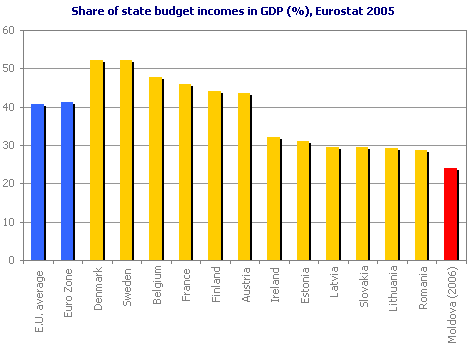
We have the same "conserved" budget built on principle of surviving day by day for 2007. The state budget remains fixed at less than one forth (about 24 percent) of GDP (see the table), no matter if the GDP grows or declines, if taxes are high or low. This share in West Europe exceeds 50 percent. The tax policy failed to grow, at least for the time being, and this is calls taxation basis. In other terms, the taxpayers did not change in Moldovan economy. In my opinion, this is one of reasons why the officially triumphed higher budgetary incomes are hardly observed in a better education, better healthcare or sanitary system, better infrastructure, etc. As a consequence, the taxation is not an essential problem of market economy and it may be also subdued to logic of electoral process. If a governing does not apply new and new taxation opportunities, another political administrator will introduce them after four years.
Fifty-eight parliamentarians representing the Party of Communists of Moldova (PCRM) and the Christian Democratic People’s Party (CDPP) adopted on March 23 a law on modification of Article 82 of the Parliament’s Regulation, which was tabled (on March 19) by Communist Deputy Victor Stepaniuc and CDPP lawmakers Iurie Rosca and Stefan Secareanu. The law adopted concomitantly in two readings modified Article 82 (2) of the Parliament’s Regulation and stipulates that plenary sittings of the Parliament, except for secret sittings, may be broadcasted live by national radio and television in compliance with the Broadcasting Code or at the Parliament’s initiative, under a decision of majority of present lawmakers.
This draft was adopted with violation of the Parliament’s Regulation (Law 430-XVI from 27.12.2006, enforced on 23.03.2007), Art.63/1 which stipulate that:
Following are the formal reasons invoked when the amendment was promoted: the need of "ensuring the budgetary austerity", "ensuring the accordance of legislation with provisions of the Broadcasting Code" and "ensuring equal conditions for electoral competitors during campaign for local elections," but these reasons are not considered plausible because a series of arguments combat them:
1. Budgetary funds are not very large even under conditions of "budgetary austerity" and in comparison with the annual budget of TeleRadio-Moldova Company (this budget exceeds 51.5 million lei in 2007). At the same time, the broadcasting on radio only would cost much less money. On the other hand, the launching of a cycle of thematic broadcasts, introduction of new programmes to cover the air time on morning will produce expenses commensurable with those for live broadcasting.
2. Arguments regarding the "editorial and creative independence" ensured by new Broadcasting Code do not resist because:
4. The Broadcasting Code contains certain direct or indirect regulations that allow and even recommend the live broadcasting of the Parliament’s sittings:
Some important events deserve to be remarked in this context.
Firstly, the interested public was not proposed another way of access to public sittings:
Not the last, it should be noted that the Parliament’s decision came with a couple of days before a new administration of TeleRadio-Moldova was elected and observers remarked a certain synchronisation of actions, saying that developers of this initiative were calm regarding the appointment of their candidates to leading posts.
We recall that the PPCD faction released a statement at the November 2, 2006 plenary sitting, regretting in connection with intention of the parliamentary majority to stop the live broadcasting of plenary sittings and noting that this is an "old and closed topic." According to the statement, the problem of long, repeat and groundless interventions is resolved through appropriate amendments to the Parliament’s Regulation (these norms entered into force on March 23, 2007). Finally, the PPCD faction appeals to Vladimir Voronin as Moldovan president and leader of the ruling party to "use its authority and influence in order to maintain the live broadcasting of parliamentary sittings." The faction did not deliver statements at the March 23 sitting, with the PPCD leader speaking out as developer of the initiative and expressing opinions on behalf of himself and his party, not of the parliamentary party. It is worth to mention that PPCD Deputy Gheorghe Susarenco said that he will quit the party, if this draft law is voted, motivating his decision through the need of respecting the previous agreements ("pacta sunt servanda"); so the decision to back this draft was unanimous not even inside the parliamentary faction.
The new legal amendments did not immediately stop the live broadcasting of parliamentary sittings. Besides the fact that the law must be promulgated and published in order to enter into force, there are some issues that seem more interesting than the talks on conduct of the parliamentary coalition.
The broadcasting can be ceased under an internal act of the company adopted by its administration, but the decision in this respect of the board of observers must be also consulted beforehand.
Further, the new administration of the company must decide on this issue, in order to establish if it will ensure the live broadcasting and choose modalities, concrete days because ad-hoc decisions may be interpreted as an unfair selection of priorities and (local, partial, new, regional) elections may take place somewhere at that moment.
These situations will be a serious testing of implementation of the new Broadcasting Code, capacities and way that the board of observers and the new TeleRadio-Moldova administration consider that they should act, the way these entities perceive the "public interest". Indeed, this will be a test of independence and readiness of new structures of the national public broadcaster for transformations.
At the same time, this situation involves a new approach of proposals-conditions raised by constructive opposition during election of the chief of state and regarding functioning of the parliamentary political consensus. These proposals, which are just formally accomplished, are tested in terms of quality and effects of implementation and, for this reason, we could observe the revision of other stances in future. As the closest events are linked to the electoral campaign and the post-election period, we may see the Parliament revising the legal regulations on elections, on local public administration, if something goes wrong and the parliamentary coalition is affected.
The contributors to this issue are:
|
© 2001-2015 Association for Participatory Democracy "ADEPT" Reproduction of the materials is welcomed provided the source is indicated | e-mail: [email protected] |