
Participatory
Democracy
Original: /en/e-journal/20070531/index.shtml
| Association for Participatory Democracy | Print version. Published on www.e-democracy.md Original: /en/e-journal/20070531/index.shtml |
Activity of Public Institutions
The Moldovan Parliament did not hold plenary sittings from May 19 to 31, 2007 with majority of lawmakers participating in the electoral campaign for the June 3-scheduled general local elections.
Legal acts
Law on modification of the law on subsidised insurance of production risks in agriculture. Under amendments, the subsidy for insurance premiums covers 80 percent of their value for all agricultural producers. When the contract with insurance organisations expires, agricultural producers present a certificate to mayoralty to confirm the existence of insured goods and pay 20 percent of the value of insurance premiums established in the contract for crops and animals for which the insurance premiums are subsidised.
Decision on modification of structure of the Parliament’s Apparatus and material ensuring of parliamentarians. The structure changes particularly aim to increase the salaries of some functionaries of bodies in charge with information ensuring and foreign parliamentary relations, as well as to allow enterprises subordinated to legislature (transportation, service) to become "public institutions with a status of legal entity subordinated to Parliament." The changes related to material ensuring of lawmakers allow parliamentarians to receive supplements for scientific degrees, annual material assistance and premiums for jubilees, professional holidays and non-working holidays.
Draft law on mediation. The document adopted in the first reading aims at a joint regulation of penal and civil mediation, including the mediation of family conflicts. Earlier, the Parliament has passed in the first reading distinct laws on penal and civil mediation, but the Moldova-European Union Action Plan and the 2005–2009 Legislative Programme stipulate that these laws should be adopted definitively by late 2006.
2.1. Appointments. Reshuffles
Dorian Chirosca was appointed as director of the State Agency for Intellectual Property. Previously, Chirosca was deputy director of the same institution.
The Government has appointed Vladimir Botnari as deputy minister of transportation and road management. Previously, Botnari was deputy interior minister and section chief in the Agency for Construction and Territorial Development.
The executive has reconfirmed Nicolae Triboi as director of the National Agency for Energy Regulation.
2.2. Decisions
Decision on creation of the judicial administration department. The department will be created on January 1, 2008 as a public institution subordinated to the Ministry of Justice in charge with organisational, administrative and financial ensuring of judges and Courts of Appeals. The personnel will comprise maximum 13 persons.
Decision approving the land cadastre on January 1, 2007. The surface did not change compared with 2005 and it covers 3,384,600 hectares, of which 228,300 hectares of irrigated fields and 69,200 hectares of drained fields. All fields comprise 23.1 percent of state fields, 21.5 percent of fields of administrative territorial units and 55.4 percent of private fields. In comparison with 2005, the surface of fields of water fund increased by 1,100 hectares in 2006, of towns and municipality by 10,500 hectares, fields for protection of nature, healthcare and entertainment by 0,700 hectares, forest fund by 6,100 hectares. At the same time, the surface of fields from reserve fund of mayoralties has decreased by 39,800 hectares and the surface of fields for industry, transportation and other destination has dropped by 0,100 hectares.
Decisions approving some programmes, concepts, strategies:
Decisions concerning:
Decisions approving some draft laws:
2.3. Sittings. Decisions. Statements
Giving up the idea to regulate natural monopolies
The Government has given up the idea to promote a draft law on natural monopolies and asked the Ministry of Economy and Commerce jointly with the National Agency for the Protection of Competition to report on opportunity of promoting this document or to exclude it from the 2005–2009 Legislative Programme.
Liberalisation reforms – dependent on implementation acts
The process of legalisation of capital and implementation of tax amnesty did not start yet because of the lack of normative acts on implementation. A special working group led by Deputy Prime Minister Zinaida Greceanii has worked out three draft normative acts on this field:
Preparations for winter
The Government has approved measures for preparation of national economy and social sector for work on autumn-winter 2007–2008, of them: the action plan on optimisation of the process of acquisition of energy resources; monthly reports on preparation and functioning of budgetary institutions and housing funds from every locality; endorsement of the regulation on management of the special treasury account, etc. The prime minister signalled the need of signing beforehand contracts on acquisition of coal and fuels for budgetary institutions, so that to prevent a deficit like the one registered the last heating season. He asked that firms which admitted irregularities in this area not to be accepted "for at least ten years" and instructed the Centre for the Struggle Against Economic Crimes and Corruption to file penal charges against persons who are to blame for laundering of public money.
Concerns with combating the shadow economy
A working sitting on improvement of situation of domestic trade has discussed the struggle against shadow economy, smuggling and support for domestic producer and consumer. Prime Minister Vasile Tarlev said that these goals may be achieved only if a civilised wholesale trade system exists. The sitting focussed on development of municipal markets, organisation of fairs, and creation of facilities to acquire agricultural products. The Ministry of Economy and Commerce is concerned with drafting a concept on modernisation of markets in the Chisinau municipality and creating a network of supermarkets nationwide.
Assessment of situation in information development sector
A report by the Ministry of Information Development was presented at a sitting on development of information sector convoked by prime minister. According to the report, the activity of competent institutions aims in continuation to improve the legal and normative framework and implement concrete projects on implementation of information systems of state importance, electronic services for citizens and business environment, training of public functionaries in the area of information and communication technologies. The educational programme SALT has built the infrastructure needed for information of all pre-university education institutions in Moldova, with educational software being tested in a number of schools. The prime minister noted that the information process must be impelled, particularly stressing the need of working out a complex information programme for central and local public authorities. With purpose to achieve a better monitoring on execution of legal, normal acts and national strategies, the Ministry of Information Development jointly with the Government’s Apparatus will create and implement the analytical information system of the cabinet of ministers.
3.1. Decrees
Moldova’s president has awarded state medals:
The chief of state has appointed Daniela Cujba as ambassador, head of the Diplomatic Mission of Moldova to the European Community. Previously, Cujba headed the directorate on political dialogue with the E.U. in the Ministry of Foreign Affairs and European Integration.
3.2. Sittings, Decisions. Statements
Talks on National Security Concept
President Vladimir Voronin has chaired a sitting of the commission in charge with drafting the National Security Concept of Moldova, with participants exchanging opinions on this draft document. It was established that the draft meets the international norms, respects the constitutional and neutrality principle of Moldova and clearly stipulates the European integration as a strategic goal of the country. The chief of state appreciated the document and thanked members of the commission for their labour and responsibility, and finally recommended the consultation of the draft strategy with civil society and experts of the European Commission before delivering it to the Parliament for endorsement. Under Decree 374/22.12.2005, the special commission should draft the National Security Concept of Moldova by March 1, 2006.
Sitting on publication of Moldovan Encyclopaedia
A sitting on publication of the Moldovan Encyclopaedia has discussed aspects related to execution of a presidential decree on creation of the commission in charge with preparing the publication. Vladimir Voronin outlined the importance of severely selecting specialists to publish the Encyclopaedia by respecting the national traditions and latest achievements in the field of publication of encyclopaedias. The chief of state called for creation of expert teams to examine the scientific articles of the future encyclopaedia.
Special anti-bureaucracy programme
A sitting of the Supreme Security Council headed by Moldovan president has focussed on legality and combat of bureaucracy during examination of petitions, penal, civil and administrative cases. Prime minister and prosecutor-general presented reports, appreciating the taken actions. At the same time, the chief of state recommended the elaboration of a special programme on this field aimed to intensify actions for a better legal framework, to clear up the notion "reasonable term" and establish "reasonable, but concrete" terms for examination of penal, civil and administrative cases. President Voronin indicated the importance of modifying the national legislation in order to establish severe criminal responsibilities for non-execution of judgments. Participants examined the implementation of the reform of normative framework on regulation of entrepreneurship (Guillotine 1 and 2), start of the process of anti-corruption survey of legal and normative acts, measures for prevention and combat of bureaucracy taken within the central public administration reform.
1. Real sector
Industry is falling in continuation…
Industrial enterprises in Moldova made production worth over 7.1 billion lei in January-April 2007 or by 6.4 percent less than in the similar period of 2006. The industry is continuing the decline that began a year ago. The industrial production has dropped in the period concerned because of a 3.2-fold reduction of wine production, 2.5-fold of destilled alcohol drinks, tobacco products decreased by about 24 percent and engineering industry declined by 9.6 percent, etc. The share of wine production in industry has declined more than 3-fold. The production of food and drink enterprises decreased by 24.1 percent in January-April 2007.
At the same time, the agricultural production has grown by 3.1 percent, according to preliminary estimates. The "ascension" of this sector was due to a 3.1-percent advance of livestock sector. On the other hand, consequences of high air temperatures in May, particularly when the summer is ahead, could lead the agriculture to the lowest contribution to GDP in the past years. Representatives of the Ministry of Agriculture and Food Industry have recently confirmed this possibility. The agriculture has suffered a 14-percent decline because of the 2003 drought. The arid climate then has affected most of cereals, vegetables and sugar beet crop.
2. Foreign sector
Wine exports are among smallest deliveries in past years…
At the same time, the agricultural production was valued at more than 14 million dollars in the 1st quarter of 2007, or over 5-fold less than in the similar period of 2006. Of course, the restriction of wine exports to Russia and the temporary blocking of deliveries of wines in bulk earlier this year explain this decline. Moldova exported about 585,000 decilitres of bottled wines worth 9 million dollars and 183,000 decilitres of wines in bulk worth 1.4 million dollars in the 1st quarter of 2007. The exports of bottled wines decreased about 9-fold in the 1st quarter, compared with the similar period of 2006, while deliveries in bulk dropped approximately 8-fold.
The Moldova-Vin Agency has recently estimated that wine makers intend to produce 13 million decilitres of wines and operate exports worth 150 million dollars this year. Moldova may grow vine on more than 150,000 hectares and may produce at least 600,000 tons of grapes a year, of which it may make wines and other alcohol drinks from about 400,000 tons of grapes. The viticulture covers about 30 percent of Moldova’s economy. Even more, Moldova is the only state in the world which exports at least 90 percent of wines and also the most vulnerable country to eventual external shocks.
3. Banking
NBM says capitalisation of banks is on the permanent rise…
According to accounts of the National Bank of Moldova (NBM), the supply of bank deposits has increased approximately 38-fold, while the credit portfolio has grown approximately 23-fold in 1995–2007. At the same time, deposits in Moldovan lei have grown 24.3-fold, and credits in lei have increased 14.2-fold. The rise trend of bank deposits has particularly strengthened in 2000–2007, when the supply of deposits has grown 7.6-fold, from 2.04 billion lei up to 15.4 billion lei (1.24 billion dollars) in April 2007. At the same time, credits in economy have increased 6.7-fold, from 2.3 billion lei up to 15.27 billion lei.
Share of medium-term credits has grown…
According to NBM accounts, the gradual rise of terms of deposits in banking has allowed banks to release credits for a longer term than in the past years. So, the share of credits in Moldovan lei released for 6–12 months count for 25.5 percent of the total in 2006, while the share of credits for more than one year has increased up to 56.6 percent, compared with 40.8 percent and 21.3 percent in 2000. The volume of credits in lei and foreign currency released in economy decreased in April 2007 compared with March, though banks have lowered the interest rates, while the supply of deposits continued to grow due to higher interests on deposits. Some commercial banks have increased the interest rates on deposits up to 16–18 percent.
4. Labour market
Approximately 500 companies owe over 87 million lei for salaries…
At least 488 enterprises owed 87.5 million lei (over 7 million dollars) for salaries last April. The agriculture and processing industry have reported the largest salary arrears. Thus, the agricultural cooperative Tvardiya has salary arrears in the amount of 4.14 million lei, Santek in Taraclia owes nearly 1.3 million lei for wages, Ciumai-Agro – 1.67 million lei, Moldsemporumb – 1.8 million lei, Tracom plant – 690,000 lei. The Labour Inspection issued more than 2,000 petitions last year, of which about 40 percent concerning labour remuneration illegalities, including fiscal evasion.
Salaries on bank cards only…
In this respect, the Government demands all state structures to pay salaries on bank cards only. The massive use of bank cards would annihilate the salary evasions and prevent the double book-keeping. According to informal data, 40–70 percent of salaries are paid by avoiding taxes. More Moldovans use the cards, particularly to withdraw cash and few people use them for cash-free payments. Thus, the value of operations carried out in Moldova with domestic cards rose up to 1.6 billion lei in the 1st quarter, but cash-free operations count for only 1.7 percent of them.
According to NBM statistics, there are more than 615,000 bank cards (debit, credit, etc.) in Moldova; so more than 15 percent of people hold cards. However, we do not know how representative this figure is because one person could hold several cards. In addition, the market of bank cards is located 80 percent in Chisinau. For comparison, there are more than 7 billion bank cards in Romania; it means approximately 40 percent of population hold cards. If going further, more than 70 percent of people in the Baltic States hold bank cards.
On 25 May in Madrid took place a new meeting of the mediators on behalf of the OSCE, Russia and Ukraine and the observers on behalf of the EU and US, upon the initiative of the OSCE Chairman in Office, Spanish Foreign Minister, Miguel Angel Moratinos. According to an OSCE communique, the sides exchanges opinions on current situation and future prospects and launched a new call upon the sides to return to the negotiations table.
"I hope the "5+2" format, in which the sides participate together with the mediators and the observers, can be resumed in the nearest future", Minister Moratinos stated after the consultations.
The EU Special Representative for Moldova, Kalman Mizsei, expressed hope that the negotiations will be resumed by the end of June, so that the sides can discuss all divergences at the negotiations table, Radio Free Europe reported. Asked about the alleged talks between Russia and Moldova on a would-be new settlement plan, Ambassador Mizsei said that he had received assurances from Moscow that there is no such bilateral agreement and that any initiative on Transnistria will be approved within the "5+2" mechanism. At the same time, the diplomat said that in Chisinau he had discussed in great detail with the authorities some Moldovan initiatives on Transnistria. Mizsei did not disclose any details of the latter, but said that they "have healthy roots".
Earlier, President Voronin had a meeting with the Deputy Secretary of the Russian Supreme Security Council, Yuri Zubakov. No details of the meeting were released, and a presidential press service communique only said that the meeting took place in the context of agreements reached between the Moldovan and Russian presidents and tackled bilateral issues, including the Transnistrian problem.
Zubakov’s mystery visit to Chisinau, his second in 2007, was commented broadly in the international press in the context of past weeks’ discussions on an alleged new Transnistrian settlement plan negotiated secretly by Chisinau and Moscow. According to the Moscow based newspaper Kommersant.ru, Zubakov came to Chisinau to persuade Voronin to sign a common statement with Transnistrian leader, Igor Smirnov, regarding their intention to formulate the principles of settlement. At its basis would lay the concept of a common state and a special status for Transnistria, which concept would be further elaborated under the close supervision of Russia.
Electronic portal EUObserver.com wrote, referring to sources from the "5+2" group, that Vladimir Putin would have approved the Moldovan-Russian plan and that the two presidents would meet on 10 June to sign the plan and then present it to the EU as a fait accompli.
These allegations seem to be supported by some theses advanced by President Voronin in an ample interview with Russian News Agency Ria Novosti. Voronin said that only with the political will of Kremlin can the Transnistrian problem be solved. "In all these years on behalf of the Kremlin, and in particular, on behalf of the Russian leadership…there has been a positive reaction to our proposals." At the same time, Voronin said that any chance to identify a solution is counteracted by all sorts of provocations, including on behalf of the West.
On 23 May the Transnistrian authorities denied access to Transnistria to a group of American diplomats, officers of the US Embassy in Chisinau, on grounds that they did not coordinate their visit with the region’s "ministry of foreign affairs". Contacted by Embassy representatives, Transnistrian foreign affairs department said they did not order any interdiction which probably came from "some other department".
"I am certain that were Russian or Ukrainian representatives in our place, there would not have been any problems and no coordination would have been required", Martin McDowell, Head of the Political Section of US Embassy, told the press.
It is for the fifth time that American diplomats are denied access into Transnistria to exercise unhindered their diplomatic activity. The US Embassy in Moldova has named the retention of diplomats as a "continuous obstruction of the diplomatic activity".
NCEI sitting
The National Commission for European Integration (NCEI) has held a sitting in the period covered by this issue of e-journal. Andrei Stratan, minister of foreign affairs and European integration, has assessed the process of implementation of the European Union – Moldova Action Plan (EUMAP) at the NCEI sitting. He noted that the Ministry of Foreign Affairs and European Integration (MFAEI) has recommended that the hearings of public authorities begin in June, given the high number of measures from action plans that must be implemented in the first quarter. Stratan stated that ministerial functionaries have met civil society representatives who work out the Euromonitor. In the context, it was noted that the Foreign Ministry receives different signals from NGOs, though ministries report a faultless cooperation with civil society. It was indicated a case when the Ministry of Transportation and Road Management has reported with delay an assistance programme in which specialised local NGOs could participate, as an example of the limited opening and non-transparent activity of ministries.
Also, Stratan drew the attention on cases of inhuman treatments applied by police representatives, fearing that they raise doubts over efficient training of police in human rights field. The minister underlined the groundless delaying of procedures for registration of NGOs.
He also indicated some failed measures stipulated by action plans. In particular, he outlined the late adoption of a package of laws against corruption, money laundering, and of relevant international conventions. Also, it was noted that Moldova should institute by March 30 an independent national mechanism to monitor the torture, but the necessary draft laws were delivered for an expertise last May. The minister warned over a possible delay in adjusting the law on meetings to European standards, non-functioning of the law adjustment centre, failure to work out a programme on sectoral decentralisation of central bodies of public administration, contradictory opinions of the Prosecutor-General’s Office and European experts and civil society regarding reformation of this institution, slow progress in restarting the activity of the national energy preserving agency, adding that the procedures for appointment of a national contact point in charge with facilitating the society establishing procedures have not been launched so far.
According to Stratan, the European Commission Delegation in Chisinau hosted a Moldova-E.U. joint video conference on April 20, at the initiative of MFAEI, regarding the implementation of the EUMAP regulations on human rights and fundamental freedoms, democracy and supremacy of law. European experts have revealed the following shortcomings in implementing the EUMAP regulations on justice and human rights: the independence of mass media and the media pluralism are not ensured in the case of Antena C and Euro TV; the unclear separation of investigation functions between the Prosecutor-General’s Office, the Interior Ministry, and the Centre for the Struggle Against Corruption and Economic Crimes; the low level of reforms on justice; shortcomings related to registration of parties and NGOs; limited editorial independence of TRM; problems related to conduct of police bodies; delayed creation of the department for judicial administration in the Ministry of Justice; faulty implementation of the Broadcasting Code; delayed ratification of the U.N. Convention Against Corruption; exaggerated duration of proceedings; deficiencies with the selection and assignment of judges; etc.
This state of things cannot be tolerated, Stratan said. Finally, he emphasised that Moldova must demonstrate by June 19, when Luxembourg will host a sitting of the Moldova-E.U. Cooperation Council, that it has achieved progresses, so that "the implementation term of EUMAP not to be extended for another period."
New Moldovan ambassador to European Communities
On May 16, the Government appointed Daniela Cujba as ambassador of Moldova to the European Communities. Previously, Cujba has chaired the Foreign Ministry’s directorate general for political relations with E.U.
Signing of the cooperation memorandum between MFAEI and NGOs
A memorandum on cooperation between the Ministry of Foreign Affairs and European Integration of Moldova and civil society organisations was signed on May 30. The document was signed by Andrei Stratan, minister of foreign affairs and European integration, and representatives of 23 nongovernmental organisations, alliances, networks and forums. The memorandum is open for signing by all public organisations interested to support and assist authorities in accomplishing the European integration goal.
Common Application Centre (CAC)
Starting May 21, Moldovan citizens will be able to apply for Danish and Icelandic visas at the CAC. According to Mihaly Bayer, Hungarian ambassador in Chisinau, Estonia could be the next state to join the CAC in August, and Sweden, Luxembourg and Cyprus are considering the opportunity of participating in this centre. At present, the CAC accepts visa applications for Hungary, the country which Embassy hosts the CAC, Austria, Latvia and Slovenia. Bayer noted that CAC has received about 25 visa applications a day in the first month of work and their number is on the rise. Overall, CAC has received approximately 500 visa applications: 38 percent for Hungary, 33 percent for Austria, 28 percent for Latvia and 1 percent for Slovenia.
Republic of Moldova – Romania
Romanian President Traian Basescu has reiterated, at the summit of Central European states in Brno, the Czech Republic, the interest of Bucharest to see Moldova capturing "the E.U. attention for a future round of the enlargement process."
At the same time, many Romanian officials including Prime Minister Calin Popescu-Tariceanu and Foreign Minister Adrian Cioroianu have resumed the talks on the need of signing a political treaty between Romania and Moldova, in order to normalise the relations between the two states. Elsewhere, Cioroianu underlined the importance of ensuring the "Five-Plus-Two" negotiations, as many media outlets have reported a possible secret deal on Transnistrian problem between Chisinau and Moscow.
Another register of problems refers to a statement by Moldovan Minister of Education and Youth Victor Tvircun, who said that Moldova will refuse again in 2007 to sign a student exchange protocol with Romania. According to Tvircun, "the offer of Bucharest is unattractive. Moldova has enough universities which have an offer like the one of Romania and provide quality education."
It is worth to recall that Moldova and Romania did not sign student exchange protocols starting 2002 because of Moldova’s unwillingness. However, Romania has continued awarding scholarships to Moldovan citizens. According to the Bucharest Ministry of Education, Romania will award scholarships to Moldovan youths in 2007 as well. Among 2000 scholarships offered in 2007, 850 scholarships are for education of Moldovan youths in high schools and 1,150 for higher and post-graduation education.
Republic of Moldova – Ukraine
Chisinau hosted bilateral consultations between Foreign Ministries of Moldova and Ukraine on May 29. The sides exchanged opinions regarding relations between these countries and the E.U., the impact of the European Neighbourhood Policy on reform processes in the two states and the process of implementation of Action Plans signed with E.U.
According to Moldpres news agency, the sides considered also aspects linked to the settlement of the Transnistrian conflict and Moldova-Ukraine cooperation in this area.
Republic of Moldova – CEI
On May 18, Sofia hosted the summit of foreign ministers of Central European Initiative (CEI) member states. Valeriu Ostalep, deputy minister of foreign affairs and European integration, represented Moldova at the meeting.
According to a press release by MFAEI, the forum focussed on concept on reorganisation of CEI, the progressive report on repositioning of CEI, the 2008 budget of the CEI Cooperation Fund, etc. Participants decided that Moldova takes over the CEI Presidency in November 2007.
Republic of Moldova – CIS
The Ukrainian city of Yalta hosted on May 25 the summit of CIS prime ministers. Prime Minister Vasile Tarlev represented Moldova at that meeting. Participants outlined the need of using better the cooperation potential in CIS, this being a wish which is traditionally raised at CIS summits for many years.
Participants examined documents, including the draft agreement on creation of a joint electro-energy market for CIS member states and the draft agreement on cooperation against counterfeited drugs.
The Russian city of Sankt-Petersburg hosted on May 30 the 28th plenary sitting of the CIS Inter-Parliamentary Assembly (CIS/IPA). The sitting was dedicated to the 15th anniversary of CIS/IPA. President Vladimir Voronin and a group of Moldovan parliamentarians led by Speaker Marian Lupu attended the sitting on behalf of Moldova.
President Voronin stressed in his speech the importance of CIS for Moldova, noting that Moldova has no plans to "withdraw from CIS" though it aims at joining the E.U. Thus, Voronin hinted that Moldova would be interested in counting its interests towards the two integrationist models.
Evolution of European option in Moldova (2000–2007)
Sergiu Buscaneanu
Fourteen BPOs have been conducted until now. The first BPO was conducted in August 2000, and the last one was launched in May 2007. Two BPOs have been conducted every year between these two dates. Every BPO is conducted on a sample of at least 1,000 respondents; it is representative for the adult population of Moldova, except for Transnistria, and has a maximum error margin of 3 percent.
BPOs contain two basic questions aimed to measure the evolution of European option in Moldova in 2000–2007. They are: "How do you think, what is the path our country should follow?" (BPOs conducted from August 2000 to May 2004) and "Would on next Sunday a referendum on Moldova’s accession to E.U. take place, how would you vote?" (BPOs conducted from April 2003 to May 2007). Two diagrams have been built on basis of answers to the two questions.
Diagram 1
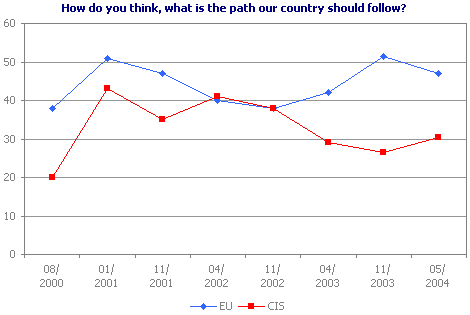
Diagram 1 indicates the distribution of answers for two options from BPOs conducted from August 2000 to May 2004: (1) "Integration within the E.U." and (2) "Integration/ Stay within the CIS". If the August 2000 BPO is taken as a reference point, the number of respondents who opted for Moldova’s integration within the E.U. has grown by 8.9 percentage points from August 2000 to May 2004. At the same, it is worth to note that the "Integration within the CIS and within the E.U." was a compromise option in the August 2000 BPO, and 32 percent of respondents have chosen it. If this option were missing like in the other BPOs by May 2004, then the separate numbers of those favouring the "Integration within the EU." or the "Integration/ Stay within the CIS" would be probably higher. Starting with the January 2001 BPO, the number of respondents who chose one of the two options from Diagram 1 was separately quantified, without offering the compromise option from the August 2000 BPO. The January 2001 BPO is a better reference point to measure the evolution of European option than the August 2000 BPO, as the same questionnaires were used from January 2001 to May 2004.
Table 1 below is complementary to Diagram 1 and features the correlation "Power – Foreign Policy Options" including the option for integration within the E.U., for August 2000 – May 2004.
Table 1. How do you think, what is the path our country should follow?
| Authorities/ Options | 08/2000 | 01/2001 | 11/2001 | 04/2002 | 11/2002 | 04/2003[1] | 11/2003 | 05/2004 |
| Government | Braghis | Braghis | Tarlev | Tarlev | Tarlev | Tarlev | Tarlev | Tarlev |
| Parliament | ADR-PPCD | ADR-PPCD | PCRM | PCRM | PCRM | PCRM | PCRM | PCRM |
| President | Lucinschi | Lucinschi | Voronin | Voronin | Voronin | Voronin | Voronin | Voronin |
| E.U. | 38 | 51 | 47 | 40 | 38 | 42 | 51,3 | 46,9 |
| CIS | 20 | 43 | 35 | 41 | 38 | 29 | 26,6 | 30,4 |
Starting from more relevance of findings of the January 2001 BPO for measuring the evolution of European option, the number of persons who opted for the E.U. in January 2001 (3rd column from Table 1: Braghis Government, parliamentary majority of ADR without PPCD and President – Petru Lucinschi) has declined by 4.1 percent until May 2004 (last column: Tarlev I Government, parliamentary majority of PCRM and President – Vladimir Voronin). For comparison, the number of respondents who opted for the CIS in the same period has decreased by 12.6 percent.
Although the May 2004 BPO was the last one to include the question on Moldova’s foreign orientation, the adhesion to the European idea may be also observed on basis of the question if respondents would vote "For" or "Against" at an eventual referendum on Moldova’s accession to the E.U. This question is included for the first time in the April 2003 BPO and it is part of BPOs conducted till May 2007, except for the February 2005 barometer.
Diagram 2 below was built on basis of answers to this question.
Diagram 2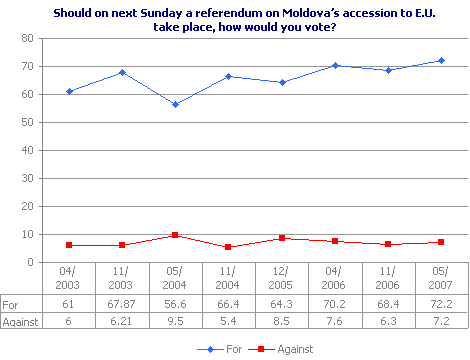
Diagram 2 indicates the distribution of answers for two options included in barometer surveys conducted from April 2003 to May 2007: (1) "For" and (2) "Against". The diagram shows that the number of people who would vote "For" at an eventual referendum on Moldova’s accession to the E.U. has grown by 11.2 percentage points from April 2003 to May 2007. At the same time, the number of people who would vote "Against" has grown by 1.2 percent. The number of respondents who chose "For" has grown by 7.9 percent and of respondents who would vote "Against" has dropped by 1.3 percent from December 2005 to May 2007, in the period when the E.U.-Moldova Action Plan was being implemented.
The 72.2 percent of respondents who would vote "For" at a referendum on Moldova’s accession to the E.U., according to the May 2007 BPO, reveals a "permissive consensus" in Moldovan society regarding the European integration. The concept was introduced by Lindberg and Scheingold in the realm of European Integration Studies in 1970, in order to explain the public support enjoyed by European integration process at the beginning.
The options from barometer surveys conducted from August 2000 to May 2007 were stratified on following criteria: (1) sex; (2) residential area; (3) age; (4) nationality; (5) education; (6) socioeconomic condition of respondents. Following are the conclusions of an in-depth analysis of findings of barometer surveys conducted in the period concerned:
Although the majority of women are "Europtimistic", their share is smaller than of men. At the same time, more men than women have opted for "Integration/ Stay within the CIS" in August 2000 – May 2004 and chose "Against" in the surveys conducted from April 2003 to May 2007 regarding an eventual referendum on Moldova’s accession to the E.U. On the other hand, more women than men answered "Don’t know" to both questions from diagrams.
Majority of respondents from urban areas are "Europtimistic", but their share is lower than in rural areas. More respondents in urban areas voted for the "Integration/ Stay within the CIS" than rural respondents, in BPOs conducted from August 2000 to May 2004, and "Against" in surveys conducted from April 2003 to May 2007. The number of respondents from rural areas who did not know to answer is bigger than of respondents from towns.
The degree of "Europtimism" or "Euroscepticism" of respondents is directly proportional with their age. The answers from BPOs were stratified on following age categories: 18–29; 30–44; 45–59 and 60 years and over. The younger the respondents are the more "Europtimistic" they are. An equal number of respondents from age categories 30–44 and 45–59 years would vote "For" at a referendum on accession to the E.U.
The same sort of proportionality is reversely valid for answers "Integration/ Stay within the CIS" and "Against". Or, the elder the respondents are, the bigger the number of respondents who chose these answers is.
Hence, it would seem at a first glance that the public support for the European integration would grow concomitantly with the change of generations. Data from Diagram 2 confirm the growth of this support for the time being. However, this hypothesis could be refuted on long term. According to European experience, the more people get elder the less ready they become to support the European building process. Then, once states advance in European integration processes, the "permissive consensus" is gradually eroding.
Moldovans/ Romanians are more "Europtimistic" than representatives of national minorities.[2] Considering data for the entire examined period, August 2000 – May 2007, representatives of Russian minority are more "Europessimistic" than respondents of Ukrainian ethnic. It is interesting that more respondents of Russian ethnic than of Ukrainian ethnic chose "For" in April 2003 – May 2007, when BPOs comprised the question about a referendum on Moldova’s accession to the E.U. Also, Russians would be readier to choose "Against" than Ukrainians would do. The bigger number of Ukrainians than of Russians who did not know to answer explains this fact.
As regards the question about Moldova’s foreign orientation included in BPOs conducted from August 2000 to May 2004, most Moldovans/ Romanians chose the "Integration within the E.U." while most of Russians and Ukrainians chose the "Integration/ Stay within the CIS". The situation is changing as regards the answers of representatives of national minorities to the question about referendum on accession to the E.U., according to BPOs conducted from April 2003 to May 2007. The majority of them would vote "For". Their number is nearly 4-fold higher than of respondents who would vote "Against".
The degree of adherence to the European idea is directly proportional to the education level of respondents. The more educated they are, the more they back the European integration of Moldova and vice versa.
There is the same kind of direct proportionality for socioeconomic condition of respondents. The better the lives of the interviewed persons are, the more "Europtimistic" they are and the number of those who do not know to answer declines.
Findings for criteria (1), (3), (5) and (6) confirm the trends of E.U. public opinion. Men, younger, more educated people with better living standards support more the European building process.[3]
The profile of "Europtimistic" group of people for August 2000 – May 2007 may be established after an in-depth analysis of BPO findings. If the number of all "Europtimists" in Moldova were to be reduced to 100 persons, the profile of this category would be as follows: 52 persons would be men, compared with 48 women; 54 persons would be from villages, compared with 46 from towns; 30 persons would have ages between 18 and 29 years, 27 people between 30 and 44 years, 26 – between 45 and 59 years, and 17 persons would be elder than 60 years; 45 persons would be Moldovans/ Romanians, compared with 55 representatives of national minorities; 30 persons would have higher education, 28 persons would be graduates from high schools or post-lycee schools, 24 people would be graduates from secondary or professional schools, and 18 respondents would have incomplete secondary education.[4]
An analysis of BPO findings also allows a hierarchy of criteria that divide the public opinion concerning the European integration. Following is the hierarchy for August 2000 – May 2007: (1) Education; (2) Age; (3) Nationality; (4) Residential area; (5) Sex.
Differences in education of respondents divide most the public opinion regarding the European integration opportunity of Moldova, while the different genders induce the smallest difference between options of respondents for European idea.
This hierarchy reveals that authorities should focus on following categories while trying to popularise the European idea in Moldova: (1) less educated persons; (2) elderly; (3) representatives of national minorities. These categories should be taken into account in the process of implementation of the Strategy on information and communication for European integration of Moldova.[5] At the same time, urban population should learn more from "Europtimism" of rural people. And not the last, men and women should learn from each other. More communication is welcome for this purpose.
The contributors to this issue are:
|
© 2001-2015 Association for Participatory Democracy "ADEPT" Reproduction of the materials is welcomed provided the source is indicated | e-mail: [email protected] |