
Participatory
Democracy
Original: /en/e-journal/20080430/index.shtml
| Association for Participatory Democracy | Print version. Published on www.e-democracy.md Original: /en/e-journal/20080430/index.shtml |
Activity of Public Institutions
1.1. Legal acts
Law on prevention and struggle against corruption. The document stipulates actions to prevent and combat the corruption, in order to ensure the protection of human rights and freedoms, public interests, national security and to remedy consequences of corruption. Although it has been worked out in a long period, the final draft is imperfect, with civil society experts signalling[1] unclear responsibility; lack of concrete terms or presence of very short terms; inefficient regulations on protection of victims and persons holding corruption evidence; competition of the draft with provisions of the law in effect, etc.
Law on modification and completion of the Code of Civil Procedure. The draft law comes after findings of an ECHR decision against Moldova (Clionov vs. Moldova case.) and aims to prevent new sentences. It allows the Supreme Court of Justice to decide, at the demand of applicant concerning exemption, deferment and gradual payment of the state tax. Also, it allows the deferment or gradual payment of the state tax by legal entities and the right of the latter to appeal. According to draft developers, the implementation of this document shall ensure respect for Article 20 of Moldovan Constitution (right to an effective redress by competent law courts against actions violating rights, freedoms and interests) and Article 6 �1 of the European Convention on Human Rights.
Law on ratification / signing of certain international acts:
Law on modification of the law concerning state medals of the Republic of Moldova. It introduces the honor titles "Artist of the Nation", "Emeritus Artist" and "Emeritus Artistic Group". This is an initiative by Moldovan President, being the 6th change promoted in 2001–2008.
Law on modification and completion of legal acts (implementation of the law on state-guaranteed legal assistance). A special attention is paid to provisions on ensuring the presence of a lawyer when this is required, regulating the mechanism of appointment of attorneys granting state-guaranteed legal assistance in criminal cases.
Draft law on social assistance. The document adopted in the first reading aims to optimise the social assistance system and direct this assistance to the poorest people by providing social aid established accordingly to the evaluation of the medium monthly overall revenue of family and need of social assistance. It regulates aspects such as:
1.2. Parliamentary control. Statements
Hearings. Motions
The parliamentary majority has turned down initiatives:
The Interior Ministry has informed the Parliament regarding means of transport registered in the Transnistrian region, reporting actions taken to monitor the situation. Controls found that about 35 percent of motor vehicles are permanently used by citizens of Moldova who reside on the right bank of the Dniester, while the vehicle registration schemes are fraudulent: motor vehicles older than 7 years are imported. The Parliament will shortly receive a draft law on legalisation of vehicles with Transnistrian number plates.
The Ministry of Justice has reported the implementation of the law on victims of political repressions, noting that a governmental commission is periodically examining occurred problems and finds solutions to them, and then it notifies territorial commissions by letters. The commission and Government cannot take actions which do not correspond to the existing legal framework and, therefore, the problem of heritage evidence and prescription terms cannot be tackled selectively for cases of victims of repressions only.
Questions. Interpellations
OMA Deputy Gheorghe Susarenco has asked the Government to provide information regarding legality of an administrative act by the Fiscal Inspectorate, which obliges notaries to demand fees for notary services by using electronic cash registers, as such provisions of a previous Government decision have been outlawed (CC Decision # 13 from 29.05.2007).
Christian Democratic Deputy Ion Varta has asked the Ministry of Economy and Commerce to report on governmental strategies aimed to redirect remittances to national importance projects.
National Liberal Party leader Vitalia Pavlicenco has asked prime minister to provide information regarding state budget allocations for capital investments of the Government Chancellery, Parliament Apparatus and Presidency operated starting 2001, allocations for capital renovation, list of entrepreneurs with which work performing contracts have been signed and copies of these contracts. Also, all documents on contracts and volumes of work contracted with an economic agent who would be called Moldconstructmarket have been demanded.
Christian Democratic Deputy Iurie Rosca has asked the Ministry of Justice to report the number of definitive judicial decisions which the Chisinau City Hall and Chisinau Municipal Council did not execute.
Communist Deputy Anatolii Zagorodnii has asked the Prosecutor-General, Government and Centre for the Struggle Against Economic Crimes and Corruption to report the goal of the visit to abroad by Mr. Anatolie Postolache, deputy chairman of the Hincesti district, on August 14–16 and December 16–23, 2007.
Statements
The parliamentary faction representing the Our Moldova Alliance (OMA) has released statements:
Vitalia Pavlicenco has presented statements by the National Liberal Party:
The leader of the Liberal Democratic Party of Moldova (LDPM), Vladimir Filat, has released a statement concerning the groundless obstruction of the small border traffic agreement with Romania by Moldovan Government.
The chairman of the Christian Democratic People’s Party, Iurie Rosca, has presented a statement "concerning doubtful financial schemes and political corruption used by Filat group," which accuses Vladimir Filat of fraudulently giving precious gifts to territorial LDPM leaders.
2.1. Appointments. Dismissals
Under governmental decisions:
2.2. Decisions
Decision on opening of the National Motor Transport Agency. The agency will take over the duties of organising and supervising the technological process of carriage of commodities and passengers in national and international transportation. It will also take over some functions of the state-run enterprise AMTAI, dissolved under the Government Decision # 153 from 14.02.2008, as well as some competences of the Ministry of Transportation and Road Management (supervision of motor stations, rationalisation and optimisation of regular passenger routes.
Decision concerning distribution of food wheat from state material reserves. In order to maintain bread prices, 7,000 tons of food wheat will be lent from the state reserve to bakery owners by September 30, 2008. The wheat will be supplied to economic agents on the basis of certain criteria: management of a bakery in the last 12 months, commitment to respect commercial addition rate for bread products, etc.
Decision concerning identity papers of beneficiaries of humanitarian protection. It approves models of identity cards and travel documents for beneficiaries of humanitarian protection which will be issued by the Interior Ministry.
Decision approving the structure of the Ministry of Economy and Commerce. The new flowchart stipulates three functions for deputy ministers and three new directorates: the directorate-general on energy security (it will take over the functions of elaboration and promotion of energy policies); the directorate-general on quality infrastructure (it will take over the tasks of the Standardisation and Metrology Service); the directorate-general on coordination of the real sector of economy. The ministerial personnel will comprise 220 employees and about 2.8 million lei will be spent on salaries and other maintenance charges till the end of this year.
2.3. Sittings. Decisions. Statements
New reorganisation of Government Apparatus
The new executive has approved the reorganisation of the Government Apparatus, with main changes envisaging:
Note by ADEPT: The Government Apparatus has been reorganised and underwent essential structural changes in 2001–2008, in spite of political and administrative stability, in particular: GD # 500 from 21.06.2001; # 919 from 12.07.2002; # 1315 from 26.11.2004; # 44 from 17.01.2005; # 637 from 29.06.2005; # 1059 from 14.09.2006 and # 1004 from 10.09.2007. Although Prime Minister Zinaida Greceanii has promised that the new structure of the Government will be "revolutionary" and efficient, one may note that the Government Apparatus was essentially modified last time (in 2005) at the indication of chief of state, being built after the model of the Presidential Apparatus, with specialised directorates and sections being dissolved and advisors for prime ministers taking over their duties. Independent experts and former high-ranking governmental functionaries described this structure as unsuccessful, but the Tarlev Government Apparatus functioned on the basis of this structure several years. Now the new Government reintroduces the former structure, which is acceptable in majority of countries with a ruling system like that in Moldova. But this situation reveals again the irrelevance and lack of conceptual, strategic approach in reforming the central public administration within which the Government Apparatus namely was reserved an important place.
Facilitated meat imports
The pork and beef imports will be liberalised for a certain period, in order to cover the meat deficit on domestic market and stabilise prices in the near future. Thus, the maximum rate of 110 tons of meat per import transaction will be cancelled for a certain period. According to data of the National Bureau for Statistics, meat prices on domestic market have grown by 40–45 percent in the first trimester of this year, while the Ministry of Economy and Commerce is explaining higher prices with the essential reduction of meat production on domestic market after the 2007 drought.
3.1. Decrees
Moldovan president has decreed the nomination of Igor Malai as deputy minister of defence.
Under presidential decrees, the "Labour Glory" Order was awarded to:
3.2. Sittings. Decisions. Statements
Priorities of state leadership for this year
Moldovan president has chaired a sitting on priorities of the state leadership for this year, ways and possibilities to fulfil tasks in the period concerned. Vladimir Voronin outlined problems related to social-economic and political processes, which require more efforts by central government and legislators, in particular, the implementation of the European Union – Moldova Action Plan and negotiation of a new legal framework on cooperation with the EU; implementation of actions aimed at building confidence between Chisinau and Tiraspol, resumption of the "5+2" conflict resolution negotiations; optimisation of the process of implementation of gasification, drinkable water providing and road building programmes; intensification of business activity in territories and growth of domestic production; development of the farm land consolidation and modernisation process in agriculture; adoption and implementation of the social assistance law; ensuring primary specialised healthcare, computerisation of the pharmaceutical sector and healthcare system in general; enhanced attention for education sector, efficient implementation of youth policies, etc. The chief of state noted that the territorial work of cabinet members is inefficient and instructed Government members to visit regions a whole day at least twice a month and visit both district centres and localities from territorial administrative units.
Accelerating the implementation of actions for the Youth Year
Vladimir Voronin has chaired a working sitting which studied the course of the action programme on the Youth Year, stressing the need of accelerating ongoing actions and finalising further programmes. Participants studied issues related to an efficient implementation of national programmes on economic redress of youths and social support for young families called Housing for All. Decisions on admission and rise of the number of state-funded scholarships in institutions of higher learning and secondary professional institutions demanded on labour market will be further made. The sitting also tackled the patriotic education of youths and civic, moral and patriotic education campaigns will be launched in educational institutions. The president demanded an ample mediation of actions dedicated to the youth, with the purpose to ensure the access of youths to all available programmes. He insisted on participation of youths in the process of elaboration of the draft youth strategy for 2009–2013.
Official visit to Azerbaijan
The visit programme to Baku included meetings with Azerbaijani President Ilkham Aliev, Speaker Oktai Asadov, Prime Minister Artur Rasizade and Rovnag Abdulaev, chairman of the State Oil Company. Vladimir Voronin has attended a festivity dedicated to the opening of the Days of Moldovan Culture in Azerbaijan.
Statements on NIT
Moldova’s president has stated on interior and foreign police during the programme "Talks with the President" aired by TV channel NIT, in particular:
1. Macroeconomics
IMF is very optimistic over evolution of macroeconomic indicators in 2008…
According to the World Economic Outlook 2008 by the International Monetary Fund (IMF), the IMF is very optimistic over evolution of macroeconomic situation in Moldova, forecasting a 7-percent economic growth and 11-percent inflation for 2008. At the same time, the IMF report says that the current account deficit compared with the GDP will be 10.3 percent. The Government and the National Bank have forecasted a 10-percent inflation rate for 2008 (but this rate was recently revised and now they forecast 11.8 percent), with this rate being also included in the Policy Memorandum signed with the IMF. The higher inflation than expected before is linked to developments on international and regional markets, as well as to the U.S. crisis.
From fiscal-budgetary prospect, IMF experts consider that prudent policies will be further promoted and the condition of maintaining a budgetary deficit of 0.5 percent of GDP will be respected. Fiscal-budgetary incomes are expected to tend to a positive evolution in continuation, while fiscal-budgetary expenses shall correspond to the Programme with the IMF, including with regard to introduction of a new nominal social assistance system next autumn.
IMF is recommending Moldova to keep austere monetary policies in order to reduce the inflation and get through pressures linked to the rise of capital inflows, in particular, of remittances from other countries. In this regard, preliminary data by NBM reveal that Moldovans working abroad have sent home more than 270 million dollars in the 1st quarter via banks from Moldova.
2. Labour market
Minimum wage rate in Moldova is 30-fold lower than in Luxembourg…
According to a rating by the Federation of European Employers (FedEE), in spite of double rises in the past years, the minimum wage in Moldova is the lowest in Europe. Starting June 2007, after collective negotiations between social partners, the minimum wage rate is 900 lei (55 euros or 6.8 euros/hour)[1]. This rate ranks Moldova in the bottom of the standing, as it is about 30-fold lower than the maximum rate in the European Union Diagram 1.
Therefore, there is much room for a rise from statistical point of view. Even more, compared with the purchase power, salary earners in Moldova seem to be justified to seek more. On the other hand, the things are changing while comparing the salary-productivity relation. Unfortunately, this correlation is not a priority for unionists, with the economic conjuncture favouring demands of higher wages at a certain extent only.
The labour market in Moldova has entered a phase when the supply is higher than the demand. Thus, seeking higher salaries is positive. Hence, if trade unions demand, employers have to give green light at this juncture. But there is one basic condition: the productivity should grow accordingly to wages.
Major developments related to the relation between social dialogue and decent salaries include the June 7, 2007 merger of the two unionist confederations (Confederation of Free Trade Unions Solidaritatea and Confederation of Trade Unions of Moldova) into the National Confederation of Trade Unions of Moldova (NCTUM), with a total number of 720,000 members. The segregation of trade unions in December 2000 has weakened the unionist movement in 2001–2006, with the image of organisations being compromised meanwhile by unsettled property conflicts.
The merger of the two confederations could essentially improve the dialogue with the Government and employers and the protection of rights and interests of employees. One of goals assumed by NCTUM at the merger and constitution congress was to obtain "a lowest wage rate at the minimum subsistence level (which is about 1,100 lei at present)." At the same time, this goal will be accomplished should the new organisation be really independent from governance.
With regard to the FedEE rating, Moldova is ranked much behind some countries from the region. In particular, the minimum wage rate in Albania is 131 euros, in Serbia 138 euros, in Romania 140 euros. The minimum wage rate in Moldova is 10-fold lower than in Slovenia, which pays at least about 540 euros per month. On the other hand, Slovenia is known as ranking a leading place regarding the dependence of the cost of living.
Luxembourg pays a minimum wage of 1,570 euros to unqualified workers; that means the minimum wage rate on economy is much higher. Ireland pays a gross minimum wage of 1,500 euros a month, while employees in the Netherlands earn roughly 1,320 euros a month. Montenegro pays a gross minimum wage like Moldova, as workers in this country earn at least 55 euros a month (but this seems to be irrelevant).
Diagram 1. Gross minimum wage in some European countries, euros

Source: FedEE
3. Banking system
Overall assets of local banks estimated at about 34 billion lei…
According to NBM accounts and media reports, overall assets of the domestic banking system were worth about 34 billion lei (over 3.2 billion dollars), as of March 31, 2008, or the equivalent to 76 percent of the 2007 GDP (4.23 billion dollars). The rise of deposits by population in commercial banks fuelled by massive remittances (they exceeded 1.2 billion dollars in eight months of 2007), as well as the general growth of people’s incomes increased the assets Diagram 2.
Diagram 2. Top of Moldovan banks regarding overall assets, as for 31.03.2008, billion lei

Source: Infomarket.md
Interesting: According to NBM, there were approximately 692,000 valid credit cards in Moldova on April 1, 2008, which is by over 12 percent more than in the similar period of 2007 (617,000 credit cards). For comparison, there are about 10 million valid credit cards in Romania. That means each second Romanian holds a credit card, compared with each fifth Moldovan.
Immediate impact of President Voronin’s meeting with Transnistrian leader
The April 11, 2008 meeting of President Vladimir Voronin and Transnistrian leader Igor Smirnov was followed by a series of important events which took place with a certain regularity and frequency worthy of being noticed. On April 14, Odessa hosted consultations with the participation of Minister of Reintegration Vasile Sova and Tiraspol foreign minister Valeriy Litskai. They preceded a seminar on building mutual confidence between the Republic of Moldova and Transnistria in the area of economy and environment held in Odessa on April 15 under the OSCE auspices, with the participation of EU Special Representative to Moldova Kalman Mizsei, the head of the OSCE Mission to Moldova, Philip Remler, and the ambassador with special missions of the Russian Foreign Ministry, Valeri Nesterushkin. The debates focussed on restoration and facilitation of railway communication, normalisation of economic and commercial relations between the two banks of the Dniester. Transnistrian representatives told the seminar that the reactivation of previous agreements (signed before August 2001) would help strengthening the confidence between the sides. They denied statements by Chisinau that customs control measures introduced after March 3, 2006 help promoting exports from Transnistria. They claimed that Transnistrian commodities undergo a double customs control and the restricted railroads mark up the Transnistrian exports very much. A day later, on April 16, Odessa hosted consultations of participants in the "5+2" negotiations. They agreed that five expert groups co-opted from both banks of the Dniester to start negotiations on economy and trade, infrastructure development, social area and healthcare, humanitarian aid, environment and agriculture. On April 17, the EU special representative to Moldova, Kalman Mizsei, told a meeting with Transnistrian leader Igor Smirnov that the EU is ready to assist joint projects which would eventually result from activity of working groups of Chisinau and Tiraspol. The same day, representatives of bilateral working groups met in Bender. Minister of Reintegration Vasile Sova and Transnistrian foreign minister Valeriy Litkai coordinate the bilateral working groups. Moldovan heads of each group are deputy ministers. It was generally decided that the working groups will meet periodically.
In spite of the rapid start of consultations, it was concluded after a week that fast progresses are impossible. The first failure was the impossibility to resume the ordinary railway traffic via Transnistria. Tiraspol said that a benevolence step by Chisinau would be to resume the traffic of the Chisinau-Odessa passenger train via Transnistria and reciprocal renunciation to transit taxes by the sides. This issue will be discussed again later. The Tiraspol administration has heard members of working groups on behalf of Transnistria and established that Chisinau is intransigent, wishing to promote own solutions and ignoring Transnistrian proposals. The Transnistrian propaganda has made an effort to explain people Russia’s new approaches of the Transnistrian problem by the wish to promote solutions capable "to keep all Moldova, not only Transnistria under control."
Previous and recent experience shows that the consolidation of confidence between Chisinau and Tiraspol depends much on President Voronin’s relations with Transnistrian leader Igor Smirnov. The quality of these relations was revealed in an April 25 interview with President Voronin, who delivered curious statements[1]:
Finally, the following key accomplishments in "building confidence" between the two banks of the Dniester in the second half of April may be noted:
European Integration
The second round of negotiations between Moldova and the European Union on Mobility Partnership
On April 22, in Brussels was held the second round of negotiations on Mobility Partnership between Moldova – European Union with the participation of representatives of the European Commission and more than 14 EU member states. The Moldovan delegation, headed by Valeriu Ostalep, the Deputy Minister of Foreign Affairs and European Integration, included the representatives of the Ministry of Interior, Ministry of Economy and Trade, Ministry of Informational Development and Border Guards Service.
During the negotiations, the text of the Mobility Partnership Document was discussed. The document will consist of 2 parts: 1)general that will draw the main directions of cooperation between Moldova and EU within the framework of the Partnership; 2)operational that will include the project proposals from the EU interested member states which will be updated according to Moldova’s needs and interests. The Moldovan delegation reaffirmed the importance to exploit within the framework of the Partnership such domains as: efficient border management, cooperation in regulation of migrational flows, reinvestment of remittances, strengthening of the national migration management system, implementation of Visa Facilitation and Readmission Agreements. In addition, there were discussed the ways to organize the cooperation platform for a better implementation of the Mobility Partnership, assessment of the projects’ impact and their update depending on Moldova’s needs.
Financial assistance provided by the European Union to Moldova in 2008–2009
According to a declaration of the Head of Political and Economic section of the European Commission’s Delegation to Moldova, Paolo Berizzi, Moldova will benefit from 50 million euros in financial assistance from the European Commission in 2008–2009. This amount is allocated to carry out and promote more infrastructure projects in Moldova. The European official highlighted that the EU financial assistance is not aimed at solving the problems faced by Moldova, but to strengthen the reforms carried out by the Government of Moldova. Besides, it was mentioned that the EU financial assistance will significantly increase in the future if Moldova collaboration with European structures will be successful.
Note. Since 1991, the EU has provided financial assistance to Moldova totaling almost 450 million euro.
Bilateral Cooperation
Republic of Moldova – Romania
The disagreements related to the signing of the Convention on small cross-border traffic between Moldova and Romania continue to rule the Moldovan-Romanian relations. In response to the declaration of Romanian president Traian Basescu that the border agreement with Moldova is not a priority for Romania, since Romania has recognized Moldova’s independence within its current borders (see e-journal no.115), on April 17, 2008, the Ministry of Foreign Affairs and European Integration of Moldova (MFAEI) made public a press release. In the press release is mentioned that Moldova launched the initiative to start the negotiations with Romania regarding the small border traffic agreement by a Political Declaration expressed simultaneously with the signing of the EU-Moldova Visa Facilitation Agreement (10 October 2007). Moreover, it is stressed the fact that the Romanian draft of the Convention on small cross-border traffic contains the collocation "Moldova -Romanian State border" that de facto exists, but without a legal bilateral documentation. Thus, according to the Moldovan authorities, the single solution to clear up the border relations between these two countries remain the simultaneous signing of the State Moldovan-Romanian border Agreement and the Convention on small cross-border traffic.
Note by ADEPT. The conditionality between the signing of the Convention on small cross-border traffic and the signing of the state border agreement generated critics from the opposition political parties. Two of them – Liberal Democrat Party of Moldova and Alliance "Our Moldova" – launched initiatives to speed up the signing of the Convention on small cross-border traffic, inclusively by collecting the signatures of citizens unsatisfied with the decision of Moldovan authorities. The tensions in Moldovan-Romanian relations only increased after, in a TV interview, Moldovan President, Vladimir Voronin accused Romania of provoking the armed conflict in Transnistria, stating that Romania imposed the former Moldovan president Mircea Snegur to break out the 1992 war..
Republic of Moldova – Ukraine
The Moldovan-Ukrainian relations were centered on solving the energy problems, especially the issue of price formation to the Ukrainian electric power and the issue of participation quota to the Hydroelectic Power Plant Dnestrovsk. Moldova claims a participation quota to the power plant that occupies a part of the Moldovan territory.
The visit of the First Deputy Prime Minister and Minister of Economy and Trade, Igor Dodon, to Kiev for solving these problems did not bring real results; the new negotiations will take place on May 19–21, 2008 in Kiev.
Republic of Moldova – Slovenia
In the related period, Moldovan Minister of Foreign Affairs and European Integration, Andrei Stratan paid an official visit to Slovenia, the country that holds the presidency of the European Union. Andrei Stratan met few Slovenian officials, among them: France Cukjati, President of the National Assembly, Dimitrij Rupel, Slovenian Minister of Foreign Affairs etc. The main subjects approached were: the Moldova-EU cooperation, in particular the future legal framework of the Moldova-EU relations; latest evolutions in the Transnistrian problem; bilateral Moldovan-Slovenian cooperation. Slovenian officials mentioned the importance for the Meeting of the General Affairs and External Relations Council to adopt a favorable decision of launching the reflections on the future Moldova-EU agreement, highlighting that Slovenia recognizes and supports the European perspective of Moldova. Regarding the Transnistrian subject, the Slovenian officials acclaimed the latest efforts of the Moldova leadership in settling the Transnistrian conflict, and Moldova’s consistency in promoting 5+2 negotiations format.
The Moldovan minister stressed that the cooperation with Slovenia, inclusively as the state holding the EU presidency, represents a priority for MFAEI and, as a consequence, designated a representative of the Ministry to have systematic contacts with the MFA of Slovenia, providing the necessary information regarding Moldova’s objectives in its relations with the EU.
Republic of Moldova – Azerbaijan
On April 23–24, the Moldovan President paid an official visit to Azerbaijan. According to the presidential press service, the aim of the visit was to intensify the commercial-economic cooperation between Moldova and Azerbaijan, in particular in energy and fuel domains. During the visit 3 intergovernmental collaboration agreements were signed: 1) collaboration in energy and fuel domains; 2) collaboration and the information exchange in combating the violation of the fiscal and economical legislation; 3) collaboration in the protection of intellectual property. There was also discussed the possibility to open an air route Chisinau-Baku.
Multilateral Cooperation
Republic of Moldova – Council of Europe
On April 14–18, the delegation of the Parliament of the Republic of Moldova participated in the spring session on the Parliamentary Assembly of the Council of Europe (PACE) held in Strasbourg. Delegation was headed by Maria Postoico, Deputy Chairwoman of the Parliament.
On April 29, the European Commission against Racism and Intolerance (ECRI) made public the third report on Moldova that assesses the situation in Moldova with regard to racism, xenophobia, antisemitism and intolerance for the period April 2003 – 14 December 2007. According to the report, Moldova made some progress on discrimination and intolerance, but the main problems mentioned already in the second report (from 15 April 2003) persist. Namely, these are: limitation on the freedom of religion for minority religious and Muslim groups, lack of an adequate legislation against discriminations, ongoing discrimination of Roma etc. ECRI had also expressed its concern regarding the amendments to the Moldovan law on citizenship in order to restrict the access of certain categories of citizen to public functions. ECRI shows that the amendments to the law on citizenship which disadvantage the access of Moldovan citizen with multiple citizenship to public functions compared with other Moldovan citizen, will lead to the discrimination and a differential treatment based on citizenship.
Republic of Moldova – Organization of the Black Sea Economic Cooperation (BSEC)
On April 17, in Kiev was held the XVIIIth Meeting of Council of the Ministers of Foreign Affairs of the Organization of the Black Sea Economic Cooperation (BSEC). The Moldovan delegation was headed by Valeriu Ostalep, the Deputy Minister of Foreign Affairs and European Integration. During the meeting, the Moldovan official mentioned that Moldova pleads for a more efficient use of the existent cooperation mechanism within the BSEC, in particular the intensification of the relations between the BSEC and the EU within the framework of the EU initiative "Black Sea Synergy".
Things go wrong…
Igor Botan, 30 April 2008
The Barometer of Public Opinion (BPO)[1] released on April 23, 2008 confirmed the stability of trends outlined half a year ago. Recent findings fix perceptions of Moldovan citizens to a period marked by a series of important regional developments with an impact on internal situations, and internal events, in particular:
The recent BPO is measuring the impact on the perception of citizens regarding developments above, approximately one year after the 2007 general local elections and one year before the spring 2009 parliamentary elections. In this regard, the findings could be a reference point for political parties which are already preparing themselves for elections.
Criticism by main political parties regarding the survey confirms the utility of BPO. Leaders of the ruling party and of the main opposition party did not warm the findings. That may be a proof that the situation in Moldova is becoming more favourable for other parties which have a certain rating.
The evolution of the perception of citizens regarding the state of things in the country and their welfare had the greatest impact on stability of political life. Trends of the evolution of perceptions, rather than the proper percent are important. Credibility of findings depends directly on correlations between answers to sets of bounded questions. Thus, following the June 2007 general local elections that marked the decline of the ruling party, the discontentment with the economic condition of the country has moderately increased in continuation.
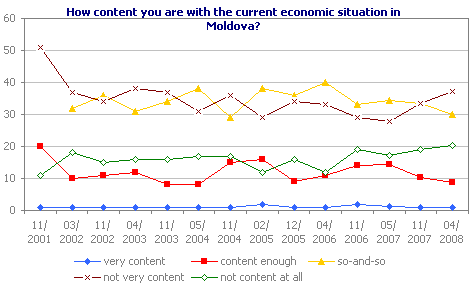
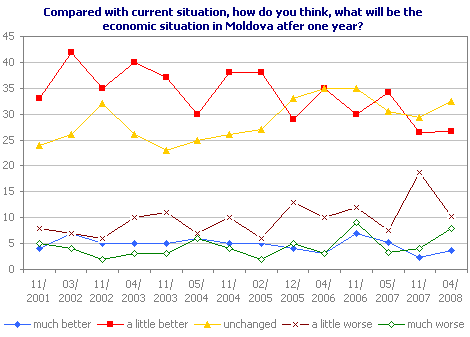
Also, citizens are rather pessimistic over further evolutions. The number of those expecting the economic situation to worse is on the moderate rise.
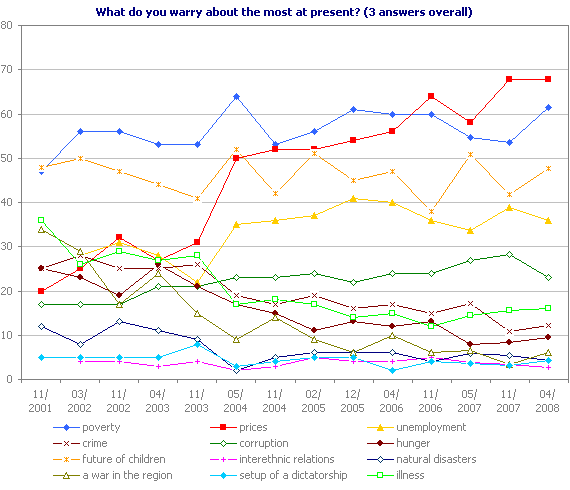
Origins of discontentment appear in the table bellow. Galloping princes and poverty are main worries of Moldovan citizens. It is necessary to remark that the galloping price rise has succeeded from the sixth to the first worry during the rule of the Party of Communists of the Republic of Moldova (PCRM). It progressed from 20 percent in 2001 up to approximately 70 percent in 2008. It is also alarming that after three years of implementation (2004–2007) of the Economic Growth and Poverty Reduction Strategy Paper (EGPRSP) and EUMAP (2005–2008), the poverty tops so far the major worries of citizens – 47 percent in 2001 vs. 63 percent in 2008, ceding the record to galloping prices. The positive side is that the fear over crime, war and hunger has decreased much.
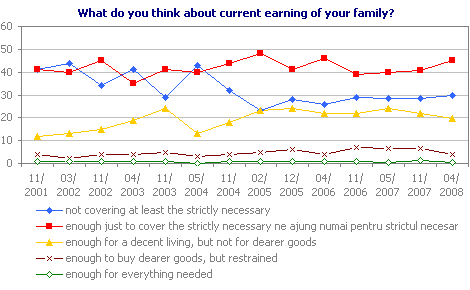
The findings above correlate perfectly with perceptions regarding earnings of families. The number of families who earn just to cover the strictly necessary on background of the decline of those earning enough for a decent living has clearly increased in the past two years. The number of families who do not earn enough to cover the strictly necessary is on the rise – approximately 30 percent.
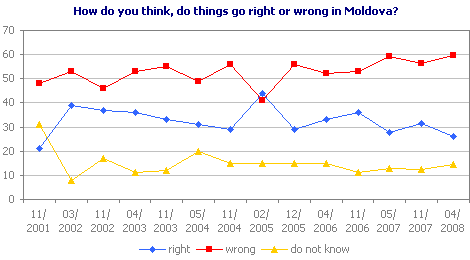
Correlated between them, answers to the questions above are part of the response to a general question about Moldova’s direction; in particular, 60 percent of respondents fear that it goes a wrong way, compared with 27 percent who believe that it goes a right way.
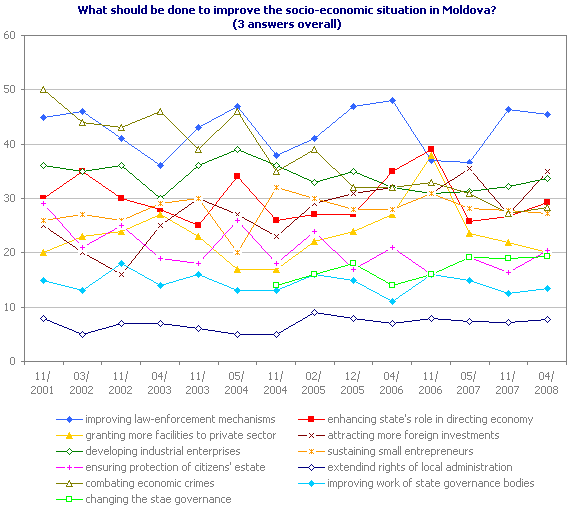
In spite of the increasing discontentment and worries of citizens, the political stability in Moldova does not run any danger. Only 9 percent of respondents would be ready to attend riots in order to protect their interests, while another 17 percent would consider such a necessity. At the same time, the table below reveals that only about 20 percent consider that new governance is needed to improve the situation in country.
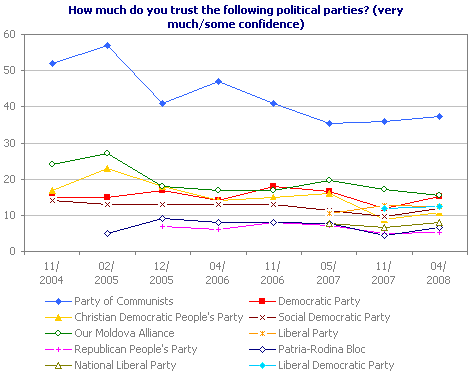
Given the previous experience, one may generally conclude that protests would be unlikely held in Moldova. The discontentment of citizens could be eventually raised publicly should institutions in charge with articulating the needs of people – trade unions and political parties, organise people. But these institutions enjoy the lowest confidence of citizens, in particular, trade unions – 20 percent and parties 15 percent.
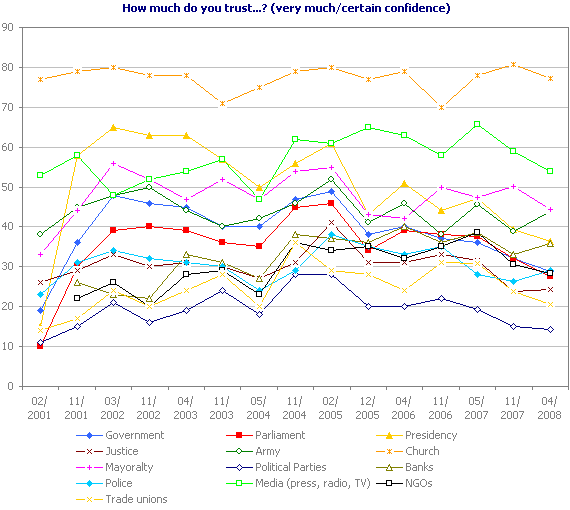
The decline of confidence towards parties may be particularly linked to the decreased confidence towards the ruling party PCRM. This conclusion comes from trends correlated by the simultaneous decline of the confidence towards chief of state, who also leads the PCRM, as well as declining confidence towards the Government and Parliament controlled by the PCRM. The confidence rating of the presidential institution has decreased by approximately 30 percent in the past six years, from about 65 percent down to 37 percent only. The confidence ratings of the Parliament and Government are equal to the rating of NGOs now, below 30 percent.
However, the ruling party holds the tools needed to attenuate the impact of the increasing discontentment and decreasing confidence towards this party, in particular, cooperation relations with the Orthodox Church, which constantly enjoys the highest confidence of citizens – approximately 70–80 percent and for which the hereafter life is the true life; the effective control on an important segment of the media, which ranks the 2nd place in the top of institutions enjoying the biggest confidence of people – about 50–60 percent. In this context, the mayoralty alone among public and private institutions including the opposition enjoys a relative high confidence. The confidence rating of mayoralties has oscillated between 40 and 50 percent in the past years. In this regard, the confidence rating of local public administration is curiously exceeding categorically and constantly the rating of each of institution of central public administration. This state of things could explain the hostile attitudes of the central government towards local administrations controlled by opposition parties. This is especially evident in the Chisinau municipality.
The political culture of Moldovans is a too complex topic, deserving well-elaborated researches. However, the BPO findings reveal some correlations which signal reactions to intimidations and the "frustration" of citizens. According to BPO, the rate of Moldovan citizens interested in politics is low. Only approximately 20 percent of respondents said that they are interested in politics much or a little. This rate is very close to the number of those who generally trust political parties.
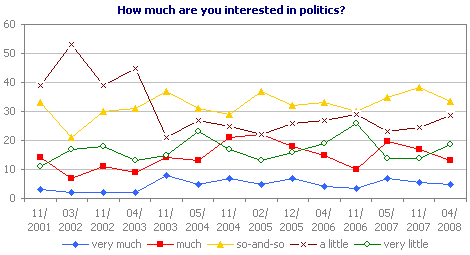
About 30–35 percent of respondents are not much and not less interested in politics. Nearly 50 percent of respondents are not interested in politics and this is in a perfect correlation with the fact that approximately 40–45 percent of respondents do not have an option when they are asked about their political preferences, which means what party they would elect. Perhaps most of them do not believe that elections in Moldova are fair and that the media is free. These perceptions constantly anticipate conclusions by periodical reports on the freedom of the media by Freedom House.
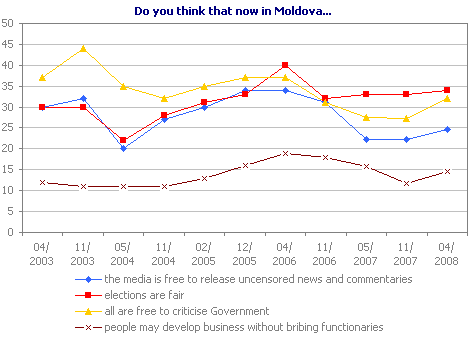
In this context, the following answers are very significant: 44.3 percent of respondents answered that "the participation of citizens in elections" is very important and another 40.3 percent that that it is important. Although this is an answer of "social desirability", it outlines the formation of the option of vote of about 50 percent of respondents who consider that none of political parties represents their interests but believe that casting ballots is important. This category probably includes the 30–40 percent of respondents who are not interested in politics. This is unquestionably the contingent which is the main target of manipulation. The main manipulation means are well-known. It is worth to note that only approximately 0.1 percent of respondents regard surveys as information sources. Thus, politicians frustrated by findings of polls shall understand that the way the mass media interprets the results of surveys, rather than the polls are a danger of manipulation.
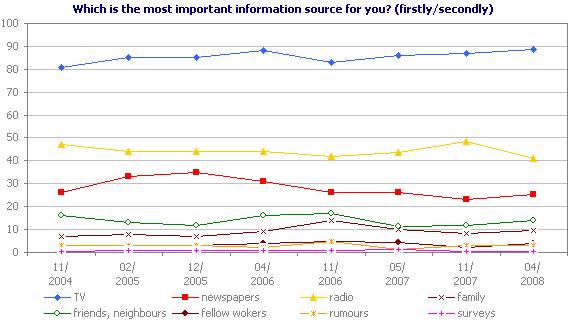
Returning to the political culture of citizens, one may notice that less than 15 percent of respondents read newspapers, while approximately 30 percent read newspapers some times a week and a similar percent do not read newspapers at all. Instead, about 80–85 percent of respondents watch the TV every day and 60 percent listen to the radio daily. That’s why "media holdings" are important. The political culture is also revealed by the fact that by about 10 percent of respondents read books daily or several times a week or a month. But about 50 percent of respondents have not read books in the past three months. Of course, adequate political messages and offers are required for such a level of information and political culture, but not all parties, particularly the opposition, realise this. Instead, the opposition is astonished of how much the pro-PCRM "media holding" is appreciating the political culture of Moldovans when it airs the programme by anonymous authors "Masked Stories", which mocks of opposition and polish the PCRM’s image. Instead, PCRM leader says that he doesn’t worry cartoon on him in opposition media and promises to organise a cartoon exhibition concerning him. In fact, it would be fair to broadcast subjects of cartoons concerning him during the same programme "Masked Stories". This would be really parity.
The trend of moderate decline of the rating of PCRM chairman Vladimir Voronin was confirmed by the recent BPO, too. The confidence rating of the PCRM leader has decreased by more than 30 percent in the past five years, from about 70 percent down to 40 percent. This is not a negative result, given the fact that the rating of President Sarkozy has similarly declined in one year, from 65 percent down to 37 percent. The French people could be faster in reacting than Moldovans are. But returning to our "mouton", one may note that former premier Vasile Tarlev and Speaker Marian Lupu, who was promoted to the PCRM Central Committee at the March 15, 2008 modernisation congress, are constant rivals of Vladimir. Also, BPO reveals that Chisinau Mayor Dorin Chirtoaca is strongly placed in the top of political personalities who enjoy the highest confidence rating. His confidence rating (about 30 percent) follows the rating of the chief of state, chairman of the Parliament and former prime minister. This places the deputy chairman of the Liberal Party (LP), Dorin Chirtoaca, among strong candidates for the role of leader of an eventual unified bloc of liberals.
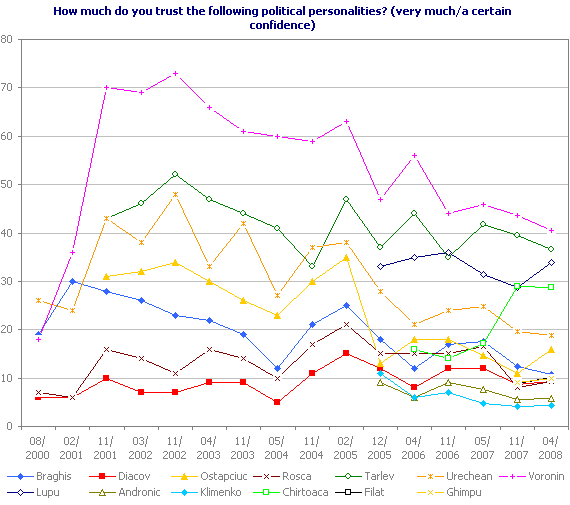
The question regarding confidence towards politicians comes to strengthen conclusions about trends revealed in the table above. The fact that Dorin Chirtoaca defeats former premier Tarlev in the answers to an open question is a very good signal for the first. It is interesting that the confidence rating of Dorin Chirtoaca is equivalent now to the rating of Serafim Urechean prior to the 2005 parliamentary elections, when the latter has become leader of the consolidated segment of the opposition. Even more, the poll reveals that the confidence towards Chirtoaca is "immune" against harassments by central authorities against the Chisinau City Hall and assaults by the PCRM-affiliated "media holding". At the same time, other liberal leaders are pretty vulnerable in front of propagandistic assaults by PCRM. An additional argument for the stability of the confidence rating of Chirtoaca is the fact that he did not try to hold any image-making campaigns in the past half a year and he did not have any support of the independent media. On the contrary, the independent media displayed disappointment with administrative performances of Mayor Chirtoaca and it was right. But citizens do not think so, perceiving him probably as a politician rather than an administrator. About 20 percent of respondents are very content with Chirtoaca’s performance as mayor, another approximately 30 percent are satisfied and only 14 percent are discontent.
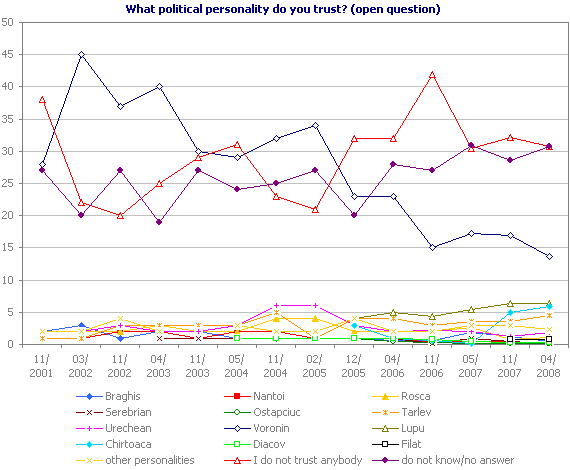
The rating of other democratic leaders was flanked in traditional limits established in the last seven years. They are credited with chances to gain a traditional score in 2009. But the probability of an extraordinary jump is narrowing once the electoral campaign is closer. In this regard, the conduct of opposition leaders is actually the life buoy of the PCRM.
It seems that the slow decline of President Voronin’s rating is not dramatic for the PCRM. In this regard, it is worth to mention that internal developments aimed at modernisation of PCRM are accompanied by a slow growth of the rating of Speaker Marian Lupu. This is a positive signal. In general, after the loss at the 2007 local elections and anger of President Voronin, the PCRM has demonstrated that it is capable to self-concentrate in order to draw the necessary conclusions, as well as that it is more adroit than the opposition in planning actions with a long-term impact. Thus, starting mid-March 2008, a series of events favouring the PCRM took place in a couple of weeks, in particular:
Each of these developments improves the PCRM image before the 2009 elections. The least the confidence rating of the PCRM has stabilised.
As regards the voting option, the situation of the PCRM has also stabilised. Given the fact that the parliamentary majority has recently modified the electoral legislation, increasing the electoral threshold from 4 percent up to 6 percent and banning pre-electoral blocs, the PCRM wants to raise advantages from a splitting of the opposition as well.
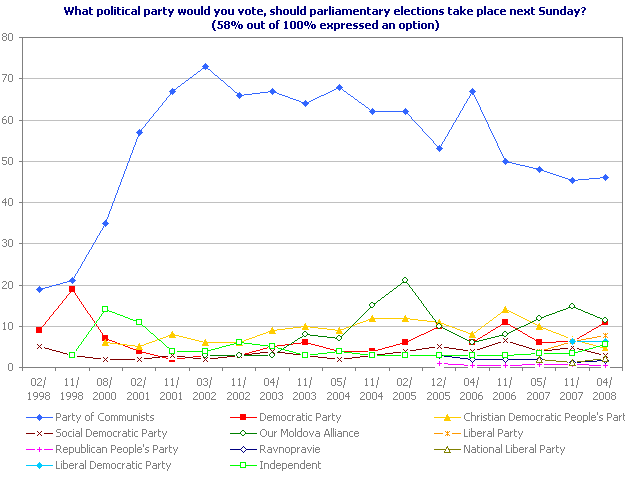
Since answers concerning voting options have troubled leaders of political parties the most, recent results of BPO shall be compared with findings of the "Omnimas" research carried out by IMAS half a year ago.
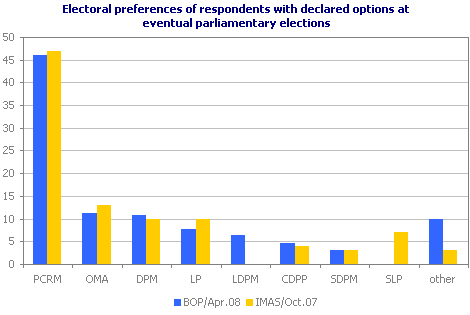
The comparison is useful both to demonstrate that polls conducted by various institutions and under different aegis reveal close results, as well as to find explanations: from and where sympathies of people migrate to. Unfortunately, changes that took place half a year ago are just perceptible. One may observe that the Liberal Democratic Party of Moldova (LDPM) has joined the Top-7 parties credited with real chances to succeed to the next Parliament. Also, the support for the PCRM, OMA and LP has just declined; the support for the Democratic Party of Moldova (DPM) and Christian Democratic People’s Party (CDPP) has just increased; the situation of the SDPM did not change. But variances fit the error margin of the survey.
Thus, mergers of social-democratic and social-liberal parties are imperceptible so far. As expected, the DPM has experienced the impact of the splitting related to the leaving of a leader of the party, Vlad Filat, in September 2007, especially when the LDPM created by the latter was outstanding in the past half a year due to a strong campaign. The merger of DPM with the Social Liberal Party (SLP) has likely compensated losses after the withdrawal of Filat and of a number of district structures from DPM. That would not be a surprise, as the SLP was outstanding both in the October 2007 IMAS survey, and at the November 2007 new local (district) elections in Rezina, garnering approximately 10 percent of the votes. In addition, SLP supporters were well-instructed and informed and many of them could have supported the merger with the DPM.
BPO reveals that the discontentment of people over general situation in Moldova is growing by and by. The implementation of EGPRSP and EUMAP did not change the perception of Moldovans regarding their welfare and democratic freedoms in country. But neither trade unions, nor opposition parties are able to focus the discontentment of people into a favourable channel for them. Even more, when they had the opportunity to voice the discontentment of patent holders, two opposition parties, SDP and OMA chose to compete for this right. Meantime, authorities have found a palliative solution to calm down protestors.
The PCRM has taken a series of actions in the last half a year to prevent the decline trends outlined clearly after the 2007 local elections, and it managed to stabilise its situation only. In this respect, the PCRM seems to be the best prepared for the 2009 elections, holding great resources for a successful campaign, compared with the opposition: access to administrative resources of which it has always abused since it rules the country; support of the Church; support of the most influent "media-holding", which is not ashamed to use most primitive but efficient propaganda-making methods to polish the image of the ruling party and libel the opposition. In addition, with some exceptions, there are no ideas with a significant impact to obstruct the regimentation of the PCRM: European integration; liberalisation and reformation of economy; "new look" of the governance; promotion of youths by declaring 2008 as the Year of Youth; patriotism, etc. Also, the PCRM has succeeded to inoculate the idea of Moldova’s neutrality in preferences of citizens (from about 20 percent in 2004 up to approximately 60 percent in 2008), limiting the field of manoeuvre of the multitude of opposition parties; raise the optimism of people that the Transnistrian conflict can be settled with the support of the EU, U.S. and Russia; improve the relations with Russia by preventing the danger of an anti-PCRM involvement of Russia in the future elections and preventing situations like in 2005, when the Russian propaganda and state institutions such as the State Duma have clearly got involved to hit the PCRM; to polarise the public opinion on the basis of identity criterion: Moldovan-Romanian, a factor activating in the myth of the external danger to attenuate the internal risk linked to the increasing discontentment of people with their material condition. According to the previous experience in Moldova, the last factor is pretty efficient during elections. But the opposition itself advantages the PCRM the most by maintaining its splitting state. Opposition parties which will fail the 6-percent threshold will be able to calculate their contribution to strengthening the positions of the PCRM. Thus, the opposition gave 21 mandates to the PCRM in 2001 in addition to the 50 mandates garnered by the ruling party, ensuring the PCRM with a constitutional parliamentary majority. In 2005, following the creation of a strong enough electoral bloc, the opposition gave 10 mandates to the PCRM, which added to the 46 mandates of the PCRM ensured a comfortable ruling majority of the latter.
Given the existence of a dominant party, the opposition is permanently degrading because of the dispersion of forces. BPO confirms that the image of the leader, electoral offer and support for a "democratic" doctrine are important for electors. In this respect, one may notice that electoral offers of opposition "democratic" parties are actually identical. Differences and nuances are the appanage of sociologists, not of electors. The ambition of leaders is the only vulnerable point that maintains the dispersed condition of democratic parties. But the voting of closed party lists makes the image of leaders a determinant factor in forming electoral options. In these circumstances, none of opposition parties can launch own attractive ideas, which would be promoted exclusively. Even more, any idea by the opposition capable to attract voters is immediately shared by the PCRM and this is already a rule. At the same time, opposition parties turn down authentic offers and ideas by PCRM. The SDPM has just recently tried to "play on the electoral ground" of the PCRM. It made public the basic principles of its electoral offer for 2009 at the April 19, 2008 SDPM congress. It explained it simply, in order to be understood by people, focussing particularly on social issues. This step made President Voronin react immediately. On April 21, he made public the Government’s priorities for 2008. It is strange that the priorities of the Government for this year were not made public earlier this year, but closer to the mid-2008. In addition, the SDPM is promoting messages that coincide with those by PCRM regarding relations with Russia, settlement of the Transnistrian conflict, neutrality of Moldova. This was enough for the PCRM propaganda and President Voronin to assault SDPM leader Dumitru Braghis in an unqualified manner. In the same context, the PCRM propaganda did not find anything else but to accuse the LP of deviating from the liberal doctrine when the liberal administration of the Chisinau City Hall announced the 20-percent rise of salaries of budgetary employees, in compliance with the legislation in effect. The declaration of the "liberal revolution" in Moldova by PCRM is not a deviation from the communist doctrine, while the implementation of social provisions of the legislation by LP is a deviation from doctrinaire principles. With regard to the perception of welfare by people, the two examples clearly show what problems the PCRM would like to be untouched by the opposition. For example, the PCRM would celebrate should the opposition focus again on national and linguistic identity issues. But the Moldovan opposition seems to be incapable of exploring at maximum its little chances to vie with the PCRM. For example, the PRO TV channel aired on April 14 reportage about the Tractor Manufacturer in Chisinau, which should become a "manna" for the opposition in combating accusations of having disindustrialised the country when it ruled it, while the PCRM is doing vice versa. According to the reportage, following the PCRM-conducted reindustrialisation experiment, the Tractor Manufacturer could not sell any tractor in the last half a year and more than 400 workers were not paid their salaries. Who needs such an industrialisation and why the Ministry of Industrialisation was recently dissolved?
While the trial of "playing on the ground" of the PCRM seems to be an idea of the SDP, an idea with a significant potential has recently appeared for liberal parties and the PCRM will be unable to join it. This is the idea of signing the small border traffic convention with Romania. Residents of 1/3 of Moldovan districts could be interested in signing this convention. The acting governance of Moldova has developed the conflict with Romania, so that the leadership of this country is not interested any longer in negotiating anything as long as the Chisinau governance is not changed. But liberal parties vie in this case, too. LDPM and OMA launched uncoordinated initiatives to convoke meetings for the support of the convention on one hand, and to collect signatures for the same purpose on the other hand. LDPM and OMA could join their efforts at a moment but the LP will likely harvest the crop, as its leaders hold personal relations with the top leadership of Romania and they could meet before elections to discuss how important the small border traffic is. Moldovan citizens will realise immediately what political leaders in Moldova may help the most to normalise relations with Romania and, therefore, to sign the convention. This example reveals that finding a way of cooperation to generate synergy, not competition would be the best strategy for LP, LDPM and OMA. But this is unlikely. OMA and LDPM alone or together are unprepared to recognise Dorin Chirtoaca as leader of eventual "united liberals". Though Chirtoaca has what the OMA and LDPM leaders do not have: the highest confidence rating and "immunity" against propagandistic assaults by the PCRM. Instead, OMA and LDPM have developed territorial structures and they seemingly have financial and media resources.
All of them will be very weak separately and some of them will be even very vulnerable in front of propagandistic assaults. Thus, OMA leader Serafim Ureachean is being harassed. This recalls the methods used by the PCRM against him in 2003 and reiterated in 2005. Urechean is perfectly right when he affirms that he does not run any risk to suffer or to be sentenced on the basis of the case fabricated on his name. But the fact that the propaganda is speculating that the prosecution wants to sentence him to a 9-year jail term has an impact on perceptions of citizens. In fact, the PCRM may follow one goal – to halt Urechean from becoming a credible leader of a capable opposition to consolidate it. The same shall be said for LDPM leader Vlad Filat. In spite of a promising start, the LDPM will be narrowed in development because it is accused of corrupting territorial branches of other parties. It does not matter what will be demonstrated. LDPM has produces an unprecedented phenomenon in Moldova, where the volatility of votes of electors was known, but now the massive volatility of territorial branches in Moldova, 5–6 branches which migrated to a new and then unregistered party, has become an absolute novelty. In any case, such a phenomenon captures attention and raises suspicions of political leaders who saw their interests affected and had to take counter-actions. Of course, opponents will continue to invoke at least the organisation of wide "political proselytism" actions. One has already seen that modalities of settling accounts and accusations are very bitter. One may hope that this political battle will not lead to the usual place of holy parents when the religious proselytism is envisaged. In these circumstances, the worst side of the things is that in parallel with launching the slogan "Moldova Without Voronin – Moldova Without Communists" the LDPM has managed to antagonise both the PCRM and several opposition parties, especially the DPM and CDPP. Relations between LDPM and other opposition parties will likely be cold in continuation because it wants to self-affirm as a leader, generator of ideas and initiatives that all other opposition parties should join. In this regard, the LDPM has already been reproached or was treated with reticence by potential partners when it proposed a referendum on modification of the electoral system and modality of election of the chief of state. The case of separate call by LDPM and OMA for the signing of the small border traffic convention with Romania was already mentioned. All these details come to confirm the scepticism regarding a joint effort of main liberal parties. However, should liberal parties consider the BPO findings, they would note that approximately 60 percent of respondents think that parties following the same objectives and programmes should unite.
The PCRM is attenuating or avoiding assaulting the CDPP and DPM. This is a signal that PCRM leaders acknowledge that they will need post-electoral allies in 2009 to elect the Government, the Parliament leadership and the chief of state. Given the results of the last local elections and BPO-revealed trends, one may estimate that the PCRM could really expect 35–40 percent of the votes. Depending on the number of parties which will succeed the electoral threshold, the PCRM could have between 45 and 50 seats in the Parliament, so that it could have even a simple majority (in Moldova it’s 52 mandates out of 101). Given the declining rating of the PCRM, 4–5 out of 7 parties credited with the necessary potential could succeed the 6-percent electoral threshold, though three parties only have succeeded at the 2001 and 2005 elections. The PCRM is probably calculating from the perspective that it will need at least 41 mandates to maintain its status of main political force (being able to block the election of the new President by The Parliament). For these reasons, it is logical to be decided to target at least two parties, the CDPP and DPM, which it avoids to antagonise. The reason is clear. Both of them have been tried through the "April 4, 2005 vote" for the re-election of President Voronin. If they voted then and generally kept their electorate at the 2007 general local elections, why should they be afraid of an eventual ruling coalition with the PCRM after the 2009 elections? In particular, President Voronin will have to withdraw from the forefront in 2009. An eventual coalition with the PCRM, which would eventually push Marian Lupu, Zinaida Greceaini and other members of her cabinet to the forefront, would not be as blameable for public opinion as the "April 4 vote" was. Now one shall wait to see whether the DPM and CDPP will succeed the electoral threshold and whether they will want to join the PCRM calculations. The situation of the DPM seems to be better than of the CDPP. Neither the PCRM, nor the liberal opposition want to antagonise the DPM, hoping that they could need its support. This fact may ensure very favourable campaigning conditions to the DPM. But the DPM may have problems because of very different visions of its leaders regarding issues of major importance. It seems that the CDPP faces multiple difficulties. The main problem rests with the very negative attitude of a segment of the media supporting the liberal opposition against the CDPP. Also, the CDPP did not face internal problems in the past 10 years related to withdrawal of many known personalities like it faces at present. At the same time, the rating of the CDPP was lower in the early 2000s than at present while the party has maintained a standard number of votes at the 2005 parliamentary and 2007 local elections.
The contributors to this issue are:
|
© 2001-2015 Association for Participatory Democracy "ADEPT" Reproduction of the materials is welcomed provided the source is indicated | e-mail: [email protected] |