
Participatory
Democracy
Original: /en/e-journal/20081031/index.shtml
| Association for Participatory Democracy | Print version. Published on www.e-democracy.md Original: /en/e-journal/20081031/index.shtml |
Activity of Public Institutions
1.1. Appointments. Dismissals
The Parliament has appointed 4 ombudsmen:
Ion Prodan was relieved from the post of Deputy Governor of the National Bank of Moldova (NBM), as his mandate is over. Under the same parliamentary decision, Mrs. Emma Tabirta was assigned NBM Deputy Governor, member of the Board of Directors for a 7-year term.
1.2. Legislative acts
Contraventional Code. The document voted in the final reading completes the list of complex legislative acts planned by the concept on judicial reform and rule of law in the Republic of Moldova. The new document was adjusted to European standards and it stipulates new practices and procedures, stricter sanctions for certain contraventions (in the area of motor traffic, protection of environment, financial market, etc.).
Law on modification and completion of the law concerning the normative price and sale-purchase of the land. In order to provide economic agents with state sustenance, the draft law modifies the coefficients to calculate sale prices of adjacent plots. At the same time, given the increasing price of fields on land market, it raises the coefficients to calculate the sale price of adjacent plots (compared with 2006, prices will grow 3.3-fold in the Chisinau municipality, 6.7-fold in the Balti municipality, 4-fold in district centres; 2–2.5-fold in other towns and villages.
Law on modification of Annex to the law concerning the management and privatisation of public property. At the initiative of several PCRM legislators, the parliamentary majority has decided to put on sale the Air Moldova Company, the hotel complex Codru and the state-owned enterprise Cafeneaua Parlamentului.
Note by ADEPT: Opposition parliamentarians have bitterly criticised these legislative modifications, accusing the ruling majority of imperfect management of public patrimony and private interests relating to these facilities and real estates.
Laws on ratification or accession to international acts:
Decision concerning the attribution of a special numbering plate to the vehicle of the SCM Chairperson. Under this decision, the vehicle serving the Chairperson of the Superior Council of Magistracy will be allotted a special numbering plate from the "RM-P" series followed by three digits.
Note by ADEPT: The legislation and traffic rules do not stipulate any priorities for vehicles equipped with special numbers, but the cases when policemen do not stop such automobiles even when they violate the motor traffic regulation have become a tradition. For these reasons inclusively, automobiles of dignitaries have been involved or were to blame for many traffic accidents.
The draft law on modification of some legislative acts regulating the remuneration of the state representative in economic structures. In particular, it eliminates legal regulations on remuneration of public servants which are members of state enterprises and state-owned joint stock societies. It aims to ensure a fair treatment to functionaries and exempt economic agents from certain expenses.
Note by ADEPT: Opposition lawmakers have warned that annulling any payments would reduce the already low efficiency of state representatives, as certain remuneration for this activity is necessary from sources of economic agents or state budget.
The draft law on completion of some legislative acts concerning the status of judge and Superior Council of Magistracy (SCM). It recommends the detachment of the judge selected as inspector of the Judicial Inspection advising the SCM throughout the mandate term (4 years), but before the 65-year-old age limit.
The draft law on completion of the Execution Code. It recommends a new article – 177/1, which regulates the civil control on detention institutions with the view to protect human rights. The monitoring will rest with special commissions formed according to the law concerning the civil control on respect for human rights in detention institutions.
Law on modification of the Execution Code. Execution offices lack funds to execute civil judicial decisions and, therefore, the execution of about 60 percent of executory documents is delayed and about 45 percent of such documents are not executed. The amendments propose the debtor to cover the expenses needed for the execution acts, while the creditor will have to "advance" the necessary spending for the execution, and it will have the right to further claim the reimbursement by debtor. Expenses for execution acts include the carriage, storage and sale of goods of the debtor, enforced opening and closing of rooms, displacement or removal of enclosures, remuneration of specialists, experts, assistant witnesses and other participants in the execution process in accordance with legislation; the move of judicial executor to the execution area; the search of debtor and its goods; the transfer (shipment) of collected amounts via post; the enforced presentation of the debtor; the organisation and conduct of an auction. Spending for the issuance of execution acts, spending by creditors for the legal assistance in the execution process, as well as household spending of the execution office are not taken into account.
The draft law on completion of the Penal Code. It introduces a new article – 239/1, which incriminates the use of budgetary funds contrary to their destination. Sanctions will be between 300 conventional units (6,000 lei) and jail terms from 2 to 5 years, with the deprivation of the right to run certain offices or exercise a certain activity for 2–5 years. The completion is argued with the insufficient sanctioning to prevent actions and activities which violate the law and interests of the state budget.
Note by ADEPT: Opposition parties and independent experts feared that these norms could be used abusively and preferentially by authorities, which could particularly apply them against local authorities led by representatives of the opposition.
Several very important framework laws have been passed in the first reading:
1.3. Parliamentary control. Statements
Hearings. Motions
The Ministry of Finance has reported expenses from the Government Reserve Fund to the Parliament. According to the report, the Reserve Fund was initially planned for the amount of 46 million lei and it was further raised to 60.8 million lei. As much as 24.6 million lei was spent to remedy consequences of natural disasters; more than 10 million lei was spent for visits by dignitaries to other countries and visas for foreign delegates to Moldova; 9.2 million lei was allocated to state organisations; 4.1 million lei went to construction works at budgetary institutions, etc.
The Ministry of Local Public Administration has reported the implementation of the law on regional development. According to MLPA, candidates for regional development councils North, Centre and South have been selected. MLPA has assisted a project funded by the British Government (DFID) and the Swedish Agency (SIDA). The draft state budget law for 2009 foresees 156 million lei for regional development projects.
The Ministry of Economy and Commerce has informed legislators about:
A representative of the Agro-Industrial Agency Moldova-Vin has reported the situation in viticulture sector and actions taken to redress it. According to the report:
The Ministry of Local Public Administration told the Parliament that the decision by the Chisinau Municipal Council to compensate heating to certain categories of citizens is illegal, since it was not signed and surveyed.
The parliamentary majority has turned down a motion by 15 opposition legislators regarding the crisis situation on foreign exchange market and inefficient economic policy of the Government.
The Interior Ministry has answered the question regarding the legality of police actions during the October 5 manifestations and the police assault on employees of the PRO TV Chisinau channel:
Note by ADEPT: The Liberal Party has released a communication regarding this information, accusing the Interior Ministry of misinforming the Parliament and demanding the dismissal of certain ministerial officials.
Veaceslav Untila, legislator representing the Our Moldova Alliance (AMN), has demanded the information of the Parliament concerning actions to sanction persons who have embezzled large funds while reconstructing the Eternitate memorial and Pan Halippa street in Chisinau.
The parliamentary faction representing the Democratic Party of Moldova (PDM) has demanded information from Prosecutor-General and the sanctioning of persons who are to blame for the sentencing of Moldova by the ECHR in the case "Oferta Plus vs. Moldova" in which the Strasbourg-based Court told Moldova to pay 2.5 million euros from the state budget.
Deputy Anatol Taranu has asked the Interior Ministry, Prosecutor-General’s Office and Information and Security Service to investigate cases recorded in Balti and Chisinau, when Russian-speaking youths have manifested violently against a peaceful action aimed to raise the awareness of people over the need to pull out the Russian troops from Moldova.
Deputy Ion Neagu has asked the Ministry of Justice to elucidate aspects related to the enforcement of the new law on political parties: in particular, the new law contains ambiguous and unclear regulations; majority of opposition political parties which tried to adjust their constitution documents to the new law have faced obstacles to register changes; ISS officers employed with the Ministry of Justice (division for political parties and nongovernmental organisations) have an unclear role; judicial consequences for political parties and social-political organisations which did not meet Article 34 (2) of the law are unclear and it is unknown whether these parties will be able to participate in the 2009 parliamentary elections or not.
Christian Democratic Deputy Stefan Secareanu has asked the electronic media watchdog CCA, the Prosecutor-General’s Office, the Centre for Combating Economic Crime and Corruption, the Information and Security Service and the Ministry of Finance to provide information about owners of the PRO TV Chisinau channel and correctness of paying taxes.
Gheorghe Susarenco, lawmaker representing the Our Moldova Alliance, has asked the Prosecutor-General and the Information and Security Service to provide information about owners f the TV channels EURO TV and Antena C and taxes they pay.
The parliamentary faction representing the Our Moldova Alliance has released statements concerning:
Deputy Dumitru Braghis has presented a statement regarding the accelerated privatisation process, asking the postponement of this process and the elaboration of a new economic development vision.
The DPM faction seeks again the modification of Moldova’s Constitution in order to ban the chief of state to be member of a political party.
Deputy Ion Neagu has read a statement raising concern with deteriorating social-political situation and police abuses, jeopardising of social environment during the 2009 electoral campaign.
Deputy Zoia Jalba has raised concern with abuses by law enforcement bodies and assaults on independent media.
2.1. Appointments. Dismissals
Viorel Dandara was appointed Deputy Minister of Finance. Previously, Mr. Dandara was deputy chairman of the Main State Tax Inspectorate.
Vasile Ursu, former-Minister of Transport and Road Management was appointed Deputy Minister of Construction and Teritorial Development.
Mihai Lupu was assigned director-general of the Drug Agency.
The Governemnt appointed Petru Railean, President of the Economic Appeal Court, Judge to the Constitutional Court for a six-year term.
Alexandru Gisca was appointed Advisor to the Deputy Prime-minister Valentin Mejinschi.
Viorel Zabolotnic was relieved from the office of adviser for deputy prime minister upon his demand.
Mrs. Ghene Jalalite was relieved from the office of director-general of the State Production Association for Geological Explorations AgeoM upon her demand.
The Government has proposed the recalling of Sergiu Stati as Moldovan ambassador to Ukraine and the appointment of Nicolae Gumenii, former director of the Government Apparatus, to succeed him.
Sergiu Tatarov was relieved from the office of Deputy Minister of local public administration "upon his demand".
Valeriu Balaban was transferred to the office of Advisor to the Deputy Prime Minister Valentin Mejinschi. Previously, Balaban was advisor to the Moldovan president in charge with special missions and coordination of external assistance.
2.2. Decisions
Decisions approving some draft laws:
The decision approving the regulation on establishing the social assistance. The document will ensure the implementation of the recently enforced law on social aid, which reportedly aims to provide monthly minimum guaranteed revenue to disadvantaged families by granting a social aid established accordingly to the overall medium revenue of every family and its need in social assistance.
The decision on the Civil Council concerning the monitoring of the Centre for Combating Economic Crime and Corruption. It approves the regulations on organising the appointment contests within the Civil Council and the Council’s regulations, which will be made of 9 representatives of civil society.
Decision concerning the rise of indemnities for orphan schoolchildren and students. At the initiative of Moldovan president, indemnities and material assistance for orphan schoolchildren and students, as well as those under fosterage or trusteeship will be increased on October 1, 2009 and January 1, 2009, accordingly. The single indemnity for clothes and footwear granted to orphan children at the beginning of school year will be raised up to 3,000 lei, and the material aid provided at the end of the academic year up to 1,000 lei. The indemnity for graduation from a pre-university institution will be raised tenfold, up to 5,000 lei, while the indemnity for graduation from professional education of all levels will be increased 20-fold, up to 10,000 lei. The monthly rent allocation will be 500 lei, and the indemnity for teaching materials and hygienic products will be 250 lei a month. Two new single indemnities will be introduced for researches and printing the bachelor’s degree work, as well as for issuance of passports for orphan schoolchildren and students delegated for education abroad. Overall, about 3,000 children and youths will be paid indemnities and 23.5 million lei is foreseen in budgetary expenses for this purpose for 2009
The decision on formation of the Sanitary-Veterinary Agency. The document approved by the Government stipulates the formation of the Sanitary-Veterinary Agency for Security of Animal Products through reorganisation of the State Veterinary Inspectorate of the Ministry of Agriculture and Food Industry and merger with territorial state veterinary services and State Veterinary Service for Border and Transport. The number of employees of the state sanitary-veterinary service is expected to be cut by 1,786 persons after the reorganisation.
Decision on reorganisation of some subdivisions of the Interior Ministry. Under modifications operated by Government:
Decision on providing free housing to the young specialists assigned and employed in public institutions from rural areas. A regulation concerning the housing and the regulation on the coordination of these activities have been approved. The Ministry of Local Public Administration will set in order the funds and the Ministry of Education and Youth will have to annually provide the first with information about the number of graduates assigned to local areas.
Note by ADEPT: This decision does not provide a preliminary estimate of the number of beneficiaries, it lacks an economic argumentation and estimate of funds needed for the implementation, but the Ministry of Finance is in charge with finding the necessary funds.
Decision approving the disciplinary statute of the State Protection and Guard Service. The statute was approved to execute Law #134-XVI from 13.06.2008 concerning the State Protection and Guard Service.
Decision on auctioning some fields of the Defence Ministry. Under the decision, more than 16 hectares of land administrated by the Defence Ministry will be put on sale. The raised funds will be spent to house the military of the National Army. According to data of the Defence Ministry, about 550 employees of the National Army need housing.
2.3. Sittings. Decisions. Statements
New resources to Eugen Ionesco Theatre building
Prime Minister Zinaida Greceanii has promised after visiting the theatre building that the cabinet of ministers will fund the renovation works and the amount will be estimated after the project is drawn up. She noted that the concept of the theatre is being draw up, and designing works will be further performed to adapt the building to necessities of a modern theatrical institution.
Customs facilities for residents of areas adjacent to the Transnistrian region
Norms on circulation of individuals and own crops grown on agricultural fields through internal customs stations have been modified. The mode to calculate taxes and fees, value of commodities carried through internal customs stations will be modified as well.
Storage of the wheat reserve
The Agency for Material Reserves, Public Procurements and Humanitarian Aid have bought 50,000 tons of food grains for the state reserve, which will fully ensure the food security of the country. The state reserve will be also completed with grains from debts of economic agents and reserves of the last year, so that it will be raised up to more than 70,000 tons of food grains. The grains where purchased in exchange for 3,000–3,500 lei a ton, which is by 16 percent more than prices offered by neighbouring countries and international exchanges.
Estimates regarding the reduction of poverty rate
According to a research on key indicators of poverty in 2007 worked out by the Ministry of Economy and Trade jointly with the National Bureau of Statistics, the number of poor people has decreased by more than 16,000 persons compared with 2006, with the absolute poverty rate being 839.3 lei, compared with 747.4 lei in 2006.
3.1. Decrees
Under a presidential decree, Marc Tkaciuk was relieved from the office of presidential advisor for political affairs on October 16, 2008 in connection with a new job (Mr. Tcaciuk will be in charge with organising the PCRM electoral campaign). Under another decree, Sergiu Stati, former Moldovan ambassador to Ukraine, was appointed presidential advisor for political affairs.
Valeriu Balaban was relieved from the office of presidential advisor with special missions for the coordination of external assistance "in connection with a new job".
Valentin Mejinschi was relieved from the office of interior minister and appointed Deputy Prime Minister without portofolio. Under another presidential decree, Gheorghe Papuc, former interior minister in 2002–2008, was appointed Interior Minister.
The distinction "Ordinul Republicii" (Order of the Republic) was awarded to Ozea Rusu, director of the Institute of Neurology and Neurosurgery.
Note by ADEPT: According to previous media investigations, Ozea Rusu has an affinity relationship with Moldovan president’s daughter.
The "Gloria Muncii" (Labour Glory) Order was awarded to:
The "Credinta Patriei" (Faith to Homeland) Order was awarded to Igor BODORIN, director of the State Protection and Guard Service.
In connection with the end of his mission to Moldova, Mr. Ray Virgilio Torres, Representative of the United Nations Children’s Fund in Moldova, was awarded the Honour Order.
The Civic Merit Medal was awarded to Viorel Cojocaru, deputy directorate chief in the Government Apparatus.
Two presidential decrees accepting the renunciation of Moldovan citizenship by 189 persons were published on October 3, 2008.
3.2. Sittings. Decisions. Statements
Meeting of the National Commission for European Integration (NCEI)
An NCEI sitting on October 21, 2008 heard a report on results of the Moldova-European Union Cooperation Committee and October 3 informal consultations on the new agreement. Also, it heard information regarding:
Following discussions, the Commission decided as follows: 1) the special interdepartmental coordination group will approve measures needed to resolve the problems signalled at the last meeting of the EU-Moldova Cooperation Committee; 2) a working group led by the Ministry of Justice will work out by March 15, 2009 a new action plan on human rights, foreseeing an efficient monitoring and evaluation mechanism; 3) the Prosecutor-General’s Office will urgently finalise the draft law on prosecutor’s office accordingly to European norms; 4) a working group of the CCECC will study international practices on declaration of incomes and estates; 5) public authorities will update its official websites within one month and will publish information about institutional budgets and public procurements.
Sitting of the National Commission for the Year of the Youth
According to a report presented at the sitting, 82 percent of the planned actions have been achieved or are being executed. The following actions have been executed:
The chief of state welcomed the course of implementation the Programme of action for the Year of the Youth and stressed the necessity of finalising draft normative and legislative acts on youth, which are being prepared. Immediate tasks to be fulfilled in order to sustain youths include among others the rise of scholarships for professional education institutions of all levels; the approval of a regulation on state-funded education on the basis of a contest, depending on the results of an academic year; the approval of the draft on free housing of young specialists who will be employed in rural areas. In a move to facilitate the employment of youths, it was stressed the importance of opening a national information centre to inform youths in connection with the labour market, enhancing the dialogue between public administration authorities. Vladimir Voronin demanded data on development of businesses that youths have started up within the national economic rehabilitation programme, stressing the importance of sustaining young entrepreneurs to develop their business as well, not only to start it up. It was also stressed the necessity of analysing the development of the Action Programme on the Year of the Youth, so that to include the problems and opportunities to settle them into the Youth Strategy for 2009–2013.
Reorganisation of the Stauceni-based College
Moldova’s president has convoked a sitting on reorganisation of the National College of Viticulture and Winemaking and preparation of this institution to work on winter. It was reconfirmed the importance of maintaining and developing the college as main secondary education institution providing the national economy with vine growers and winemakers. The chief of state indicated the necessity to work out a programme on modernisation and consolidation of the technical-material base of the institution and preparations for the 170th anniversary of the college.
Arrangement of Valea Morilor park
A presidency-hosted sitting has brought together minister of construction and area development, minister of environment and natural resources, head of the Chisinau Municipal Council, with participants sharing opinions about current situation and prospects to implement a project on arrangement of the park Valea Morilor. According to the provided information, the technical council in charge with monitoring the reconstruction of the lake Valea Morilor has studied all opinions about ways to clean up the lake and decided to openly clean the lake. Initiatives to clean up the lake by using hydrant were described as groundless, since draining the lake by using this method could last 10 years. Reports that heavy medals have been discovered on the floor of the lake are untrue and, therefore, the mud is evacuated again and stored in the industrial area Pruncul. Vladimir Voronin stressed the necessity to achieve the first round of arrangement of the Valea Morilor park, so that to start actions for the second round of the project next spring. Given the importance of the project, it was decided to recommend the Government "to find the necessary funds in the state budget."
Reconstruction of the republican creative centre for children and youth
The chief of state has visited the republican creative centre for children and youths, in order to collect facts about reconstruction works there. So far, engineering networks have been built, assembled and renovated. Exterior works will be finished and the centre will be further connected to natural gas and hearing networks. Concomitantly with the reconstruction process, furniture and equipment for the institution are being purchased and other facilities of the creative centre are being projected. Mr. Voronin instructed competent authorities to accelerate the first reconstruction round, so that to complete it by the end of 2008, accordingly to initial tasks. It was stressed the necessity to exactly respect the reconstruction technologies in order to ensure a high security of the building.
New promises for teachers
The president of Moldova has attended a festivity dedicated to the professional day of teachers, stating as follows:
Modernisation of transport infrastructure
A Presidency-hosted sitting has considered the development of road renovation and building projects, set up objectives for next year, discussed existing problems and possibilities to resolve them. Among others:
The chief of state has particularly sought a high quality of road building and renovation works, indicated the condition to attract experienced enterprises which have modern equipment and apply modern technologies in the road renovation and development process. Vladimir Voronin stressed the importance of improving the structure of institutions specialised in ensuring the exploitation of transportation networks.
Construction and renovation of cultural facilities
The chief of state has convoked a sitting on development of projects relating to construction or renovation of cultural facilities in districts of the country, hearing a report on the state of things in this area. President Voronin reiterated the importance of implementing the projects on construction or renovation of cultural facilities in the due time and by respecting quality criteria, and demanded the inclusion of cultural institutions organising intense cultural activities (competitions, festivals) into the list of cultural facilities to be renovated or built next year.
Redressing consequences of floods
According to updated data:
The chief of state welcomed the actions taken by structures involved in remedying consequences of floods and stressed the necessity to start elaborating a safe mechanism for preventing negative effects of natural disasters in future. He stressed the importance of finalising a draft law on security of hydro-technical buildings and reiterated the need of making conditions to develop the insurance process in agriculture sector.
Access to broadband Internet
The Moldovan president has chaired a meeting on development of broadband Internet systems, with participants sharing opinions about development of telecommunication sector in general and Internet systems in particular. They stressed the necessity of joining the international telecommunication area accordingly to recommendations by the International Telecommunication Union. The chief of state noted the importance of developing the process of issuing strategic documents and demanded proposals and mechanisms to set up limited frequency diapasons in compliance with the new law on electronic communications. President Voronin stressed the importance of making competitive and optimal conditions for operators on telecommunication and electronic communication market, attracting investments in information and telecommunication technologies, enlarging services provided via the broadband Internet system.
1. Prices and inflation
Inflation rate likely to fit governmental forecasts…
According to official statistics, consumer prices rose by 0.6 percent in September, compared with August 2008, as prices of food products have grown by 1.3 percent, of manufactured goods by 0.1 percent and tariffs for public services by 0.7 percent. Prices of food products rose in September, as vegetables, meat products, eggs, etc., were more expensive than in August 2008. As regards prices of manufactured goods, clothes for children, didactic supplies for school, and shoes for kids were more expensive than before, this being a clear phenomenon. Also, prices of furniture have grown by more than 1 percent.
Tariffs for services rose in September 2008 as follows: rent taxes for hostels and private apartments increased by 5.5 percent, fees for education services by 2.4 percent, housing handicraft services by 2.1 percent, and public alimentation services by 1.6 percent.
The inflation rate this year (September 2008 compared with December 2007) has grown by 6.7 percent (the inflation rate in September 2007 was 9 percent, compared with December 2006). Medium prices in the last 12 months (September 2008 compared with September 2007) have increased by 10.7 percent (by 14 percent in September 2007, compared with September 2006).
2. Macroeconomy
IMF estimates a 6.5-percent growth for Moldova for 2008–09…
The International Monetary Fund forecasts a 6.5-percent GDP growth for Moldova for 2008–09, which is below the average in the Commonwealth of Independent States. According to the IMF World Economic Outlook, the inflation rate in Moldova will reach about 14 percent this year and it is estimated at about 10 percent for 2009. The report says that the current account deficit will be about 20 percent in 2008 and more than 19 percent in 2009, with Moldova being "leader" among CIS member states regarding this indicator, which is 2–3-fold higher than the average on the region.
The World Economic Outlook estimates that the greatest economic growth in the CIS area will be recorded in Azerbaijan – 16.4 percent in 2008 and 16 percent in 2009, and Turkmenistan 10.8 percent and 10.3 percent, accordingly, as these countries are rich of hydrocarbons. Russia’s economic growth will decline from 7 percent down to 5.5 percent, while Georgia will face most serious falls – from 12.4 percent in 2007 down to 3.5 percent in 2008, and it will redress up to 4 percent in 2009. According to the IMF, this evolution is linked to the Russian military intervention in August-September 2008. Economic growth paces in Ukraine will also slow down: from 6.4 percent in 2008 down to 2.5 percent only in 2009. Also, the IMF forecasts a 3-percent global growth, assuring that there are no risks for a world recession.
3. Labour market
Average revenue per capita not covering the minimum consumer basket…
According to NBS accounts collected for the Household Budgets Research (HBR), available revenues of people in the 2nd quarter of 2008 covered 90.6 percent of the minimum consumer basket. The average revenue per capita in Moldova accounted for 1,215.2 lei (86.7 Euros) in the period concerned, while the NBS-calculated minimum consumer basket was 1,341.9 lei (95.8 Euros).
However, the minimum consumer basket rose by 2 percent in the 2nd quarter of 2008, compared with the 3rd trimester of 2008. The rise was conditioned by prices of food products included into the food basket and share of expenditures for the non-food basket (the cost of manufactured goods and services), which is established on the basis of the real structure of consumer expenditures of population, according to the Household Budgets Research.
The minimum consumer basket in urban areas was 1,437.7 lei, compared with 1,274.6 lei in rural areas, which is a difference of 163.1 lei (about 13 percent) due to the different structure of consumer expenditures and higher share of self-consumption in villages. The non-food basket in urban areas is 34 percent on average of the minimum consumer basket, compared with 21.3 percent in rural areas (this indicator is 28.4 percent on country).
The worthiest minimum consumer basket on categories of population was recorded for employable people, particularly men – about 1,510 lei. Looking for a child costs 1,228 lei on average per month, but this indicator depends on the age of the child, from 474 lei for a baby under 1 up to 1,360 lei for a child of ages 7–16. The minimum consumer basket for retirees was 85.7 percent of the average value per total and it amounted to about 1,150 lei.
4. External position of country
Moldova’s overall external debt equivalent to banking assets…
Updated statistics reveal that Moldova has an overall external debt worth over 3.7 billion dollars, which is 75 percent of the GDP. It is almost equivalent to overall assets of the Moldovan banking system. The external debt has particularly grown due to the fall of some indicators in the external sector of the country and rise of the trade balance deficit, current account deficit, following the fulminating expansion of the public and private consumption, appreciation of the domestic currency, factors which fuelled the imports and hit the indicators concerned.
How alarming is this evolution?
The indicators above confirm a trend of external deficits with the decisive "contribution" of the private sector. The unguaranteed private debt of economic agents counts for more than 2.6 billion dollars of the external debt, growing after the ascension of commercial and investment credits, which account for more than 72 percent of the overall debt. In addition, the trade deficit for eight months has reached a record of 2.2 billion dollars. However, this situation should not scare. Moldova’s debt is admissible compared with the region or some developing countries.
It was established that the external debt is rather at the private sector, or this one borrows more than the state. But there is a simple explanation here: the private sector is more rational than the public sector is (because it respects the market rules) and these deficits have natural explanations as well. Statistics prove this assessment: imports of technological equipment, machines and appliances are on the rise; therefore, economic agents invest more in the modernisation of enterprises, expecting higher profits in future.
5. Currency market
Euro falling down…
Latest developments on the currency market, in particular the appreciation of the leu versus Euro has alerted the people. There are many factors to explain this trend. First, this is a result of the international evolution of euro-dollar rate. The dollar has appreciated much versus euro in the last 18 months, growing from 1.6 (in April) up to 1.25 (in late October), after massive interventions by the U.S. Federal Reserve. But the U.S. dollar has lost its credibility as foreign currency, especially as reserve currency.
Secondly, developed economies in Asia, Japan or China are trying to modify the structure of their foreign currency reserves, it means to get rid of dollars and acquire euros or other reserve currency. The National Bank of Moldova could also be tempted to do this. Thus, it would be very convenient to pay 13 lei for a euro than 15 lei 2–3 months ago. More than that, negative evolutions of many European economies prove that they are running the risk to stagnate or even recess and this would influence the financial market.
There is a massive capital inflow (particularly through remittances) at local level; the demand does not cover it, so that the NBM is trying to control the situation on market by purchasing currency, thus influencing the exchange rate indirectly. Even more, by seeing the trends of the currency market, people are trying to get rid of the euro, worrying about the temper of eventual consequences or effects of the financial crisis. But this could also be some market speculations which are pressing the exchange rate.
Who are losers of the market conjuncture?..
In general, there are three key groups of losers of the current market conjuncture. First of all, these are the exporters who will normally raise less currency from export operations, as well as firms and companies which have commercial relations with the EU. One should not forget that more than 50 percent of Moldovan exports go to the EU. Secondly, these are people whose earnings are about 1/3 in euro, in particular from those sending money home, they lose upon exchange. And construction companies are probably hit the most. Most of them have established sale prices in euro, but all works and payments are operated in lei. Many of them have already revised their prices per square metre for sale (by increasing them).
6. Banking sector
Bank credits becoming costly so far…
Loans in Moldovan lei and foreign currency continue to become costly, with the average interest rate on credits in lei reaching about 23 percent in October and the interest on loans in foreign currency going up to about 13 percent. Bank loans in lei have increased by more than 21 percent in nine months. According to data by the National Bank of Moldova, the interest on loans "met" the rising trend of the interest rate on deposits which have grown at the same level.
…but they are on the rise as well…
Despite this situation, credits in lei are on the rise for the third month in a row. Loans in lei released to legal entities and individuals have grown up to 1.53 billion lei, as of late September, which is by 8 percent more than in August. Certain experts say that so far there is room for a growth after a potential reduction of the basic rate and mandatory reserve norm by the National Bank. More than 23 percent of loans were released for up to one month; credits for 6–12 months (about 20 percent) and those for more than 12 months (more than 51 percent) had an important share as well. Credits for one month were granted with an average interest rate of about 28 percent, while those for more than 12 months had an average interest rate of 21.5 percent.
Central bank strengthens its presence on currency market…
Following massive capital inflows from outside, particularly of remittances which were estimated at more than 1.1 billion dollars in the first eight months, the National Bank of Moldova continued in September to massively purchase currency on interbank market, in order to moderate the pressure of the currency surplus. It has purchased about 57 million dollars. Purchases operated by the central bank on the interbank market count for about 40 percent.
International reserves reached a new record of 1.8 billion dollars in late September, which is by about 100 million dollars more than forecasted for this year, and experts anticipate a rise of reserves up to 2 billion dollars by the end of this year. Official reserve assets of the state were covering four months of critical import.
Banking institutions – dearest companies at stock exchange…
The stock exchange capitalisation evaluated accordingly to the methodology of the Rating and Estimation Agency Estimator-VM amounted to about 15.35 billion lei in late September, which is by about 560 million lei more than in August. As a rule, banking institutions rank the first three places at stock exchange that means they are the most expensive. Another seven classes of shares are issued by societies working in diverse sectors of national economy, including securities issued by S.A. Asito and S.A. DAAC-Hermes Grup. Moldova-Agroindbank is the dearest company so far.
Diagram 1. TOP 10 companies with highest stock exchange capitalisation (September, 2008)

7. External trade
European Union ready to develop free trade with Republic of Moldova…
For this purpose, Moldova shall be ready to deal with effects of a complete liberalisation of the trade with the EU. Officials of the European Commission have stated that the future agreement will go beyond the effective Partnership and Cooperation Agreement and will cover the objective of a deep and comprehensive free economic zone.
The new status relating to the trade with the EU will probably allow the rise of Moldovan exports to the EU both in quantity and monetary value terms. However, it will depend most on Moldova’s efforts (economic agents) to meet EC requirements and conditions. Further, it will depend on domestic companies to be capable to use the granted preferences and manufacture goods accordingly to quality and preferences of European consumers.
But the still low quality of some groups of Moldovan products does not allow the reorientation of exports to the western markets. Moldovan enterprises would face serious problems, should they fail to improve the quality and productivity (a direct task of business managers rather than of state structures). In fact, the quality and productivity shall be a strategic priority of Moldova in 2009 and afterwards. Chisinau officials will have to provide concrete examples of progress when they will negotiate a more advantageous system than the current one with the West and even before negotiating an association agreement.
The European Union is the main sale market for Moldovan products, absorbing 52 percent after eight months. Starting March 1, 2008 Moldova benefits by the autonomous trade preferences regime. Moldovan exports to the EU have grown by about 34 percent in eight months, up to 546 million dollars. This is the highest growth compared with other markets.
Tries to organise a meeting between President Vladimir Voronin and Transnistrian leader Igor Smirnov failed in October like in September. However, Transnistrian officials have assured that Tiraspol is interested in the Voronin-Smirnov meeting so far. On the other hand, they categorically disagreed with the rhetoric of Chisinau and pejorative remarks against the Transnistrian regime, which President Voronin has blamed for having "usurped the authority in the region."
While visiting Moldova on October 27–28, 2008, the chairman of the Russian State Duma, Mr. Boris Grizlov has confirmed previous statements by Russian dignitaries that his country "is ready to do its best for a peaceful settlement of the Transnistrian conflict." At the same time, Mr. Grizlov stressed that "extreme measures are inadequate" for the conflict resolution. Following Grizlov’s visit to Chisinau, Transnistrian leader Igor Smirnov delivered an unexpected statement on October 30, saying that "Russia cannot afford recognising the independence of Transnistria for the time being, as such a step would destabilise the equilibrium of forces in the region." In this context, Transnistrian speaker Evgheny Shevchyuk has stated that Transnistria would accept a confederation with the Republic of Moldova, but it would not warm the status of autonomy within a unitary state. On that occasion, Shevchyuk stressed that the economic blockade imposed by Moldova is to blame for the massive depopulation of the Transnistrian region. It is interesting to note that Shevchyuk stated while addressing the Russian State Duma on March 13, 2008 that the cause of the massive depopulation of the Transnistrian region is the fact that Russia fuels hopes of recognising Transnistria but it does not justify this optimism with concrete actions, and this deceives the residents of the separatist region and makes them quit the enclave.
Transnistrian authorities had to justify themselves in front of Russian media outlets in order to accept and even support the installation near the Bender fortress of a commemorative plate dedicated to Ukrainian Hetman Ivan Mazepa, regarded in Russia as a traitor for having joined Charles XII in 1709 during the confrontation of the latter with Peter the Great. For this purpose, Vladimir Yastrebceak, deputy foreign minister of Transnistria, said that Ukraine’s interests should be taken into consideration as well for the survival of the Tiraspol regime. He noted that the Transnistrian budget spends funds to maintain graves of Russian soldiers killed during battles in the region. These explanations came to make clear that the Tranasnistrian regime seeks the economic and financial assistance of Russia but has to commemorate Ukrainian historical personalities hated by Russia.
Transnistrian authorities have started negotiating with GAZPROM officials the possible transmission of 13.44 percent of shares owned by the Tiraspol administration in the joint stock society Moldova-Gaz to the ownership of the Russian energy giant. Details are unavailable, but the transmission could be the price of Transnistria’s debts of over 1.5 billion dollars. In consequence, Transnistrian authorities could be allowed to sign direct natural gas supply contracts with GAZPROM. In the event this transaction is done, some statements by Smirnov that a strategy of Transnistria is to get stuck with debts towards Russia in order to further pay with the patrimony of the region and become part of Russia this way, would be confirmed.
European Integration
The Ninth Meeting of the EU-Moldova Cooperation Committee
The 9th Meeting of the EU-Moldova Cooperation Committee took place in Brussels on October 3, 2008 and aimed to assess progresses made by the Republic of Moldova in the last round of implementation of the EU-Moldova Action Plan. In particular, the meeting discussed Moldova’s progresses in the following areas: political dialogue and reforms, justice and interior affairs, political cooperation with EU, customs cooperation, trade, market and regulatory reform, etc. Representatives of the European Commission welcomed progresses made by Moldova in implementing European standards in some fields and made some recommendations:
At the same time, the European side expressed its concerns over implementation of some commitments assumed by Moldova, especially:
The meeting of the Cooperation Committee was followed by the second round of EU-Moldova informal consultations on the future Legal Agreement. Within the discussions the sides exchanged opinions regarding basic elements which the European Commission will take into consideration in the process of finalisation of the draft mandate of negotiations.
The EU General Affairs and External Relations Council (GAERC) Conclusions on the Republic of Moldova
On October 13, the EU General Affairs and External Relations Council (GAERC) adopted the following Conclusions on the Republic of Moldova:
Note by ADEPT. Although many officials have introduced these conclusions as a great success of Moldova on the European integration way, the conclusions did not offer anything special to Moldova which would be different from what the EU will offer to Ukraine, with the key objective of Moldova – "the accession perspective" – being absent in the document. At the same time, the conclusions do not provide a clear term for the abrogation of the visa regime.
The 11th Meeting of the EU-Moldova Parliamentary Cooperation Committee
During October 22–23, 2008, Strasbourg hosted the 11th Meeting of the EU-Moldova Parliamentary Cooperation Committee chaired by Mrs. Marianne Mikko and Mr. Grigore Petrenco, co-chairpersons of the Moldova-EU Parliamentary Cooperation Committee. The meeting focussed on recent social-economic developments, preparations for the 2009 parliamentary elections. European officials reconfirmed their commitment to support Moldova in the European accession process, outlining the need of intensifying internal efforts in order to efficiently implement the ongoing reforms in the field of the rule of law, human rights, media freedom. (according to press releases by MFAEI)
Bilateral cooperation
Republic of Moldova – Romania
After a period of apathy, the Moldova-Romania relations have been activated following a visit by Premier Zinaida Greceanii to Romania and works of the Moldovan-Romanian commission for economic cooperation and European integration in Bucharest. In Bucharest, Mrs. Greceanii has had bilateral meetings with Romania’s President Traian Basescu, Prime Minister Calin Popescu Tariceanu and attended the ceremony of Montenegro’s accession to the South East European Cooperation Process (SEECP), an organisation presently chaired by Moldova. During bilateral meetings the sides have discussed issues relating to bilateral and regional economic cooperation in the light of the European integration of Moldova. Romanian officials reaffirmed the support for the European integration of Moldova and called for approaching Moldova in the European accession process distinctly from Ukraine, by including it into the Western Balkans package. Otherwise, "Moldova’s perspective to join the EU is far."[1] The Moldovan prime minister gratified Romanian dignitaries for Romania’s support to Moldova within the last European Council and expressed optimism that Romania will keep supporting Moldova during negotiations on a new legal agreement with the EU. The weaknesses of the Moldova-Romania relations such as the signing of the basic and border treaties have not been touched, at least in public statements. The working agenda of the Moldovan-Romanian commission for economic cooperation and European integration included issues related to bilateral economic and commercial relations, in particular, the implementation of common infrastructure projects especially on building a 400-kW interconnection power line on the Balti-Suceava route and a 400-kW interconnection power line on the Ungheni-Iasi route, opening of the border crossing point Lipcani – Radauti to facilitate the development of bilateral trade[2]. The sides signed a bilateral cooperation programme in the area of science, technological development and innovation between the National Scientific Research Authority of Romania and the Academy of Sciences of Moldova, and a protocol of the session which stipulates bilateral actions in the field of trade, small and medium business, agriculture, sanitary-veterinary sector, food security, scientific research.
Republic of Moldova – Russian Federation
During October 27–28, 2008, the Chairman of the Russian State Duma, Mr. Boris Grizlov, was on a formal visit to Moldova and had bilateral meetings with Moldova’s President Vladimir Voronin, Speaker Marian Lupu and Prime Minister Zinaida Greceanii. According to press releases, the visit had a common purpose – to exchange information about social-political developments in Moldova and Russian Federation and to discuss the perspectives on implementing cooperation projects of reciprocal interest. Mr. Grizlov has reassured that Russia supports the territorial integrity of Moldova and it is ready, as mediator of the negotiation process, to make the necessary conditions in order to assist the parties to work out an acceptable decision for Chisinau and Tiraspol. According to Grizlov, Chisinau and Tiraspol should give up extreme positions and negotiate regardless of the format of talks (see the chapter TRANSNISTRIA). During bilateral meetings, the sides noted the ascending relations between Moldova and Russia, outlining the need of a continuous activation of bilateral relations in the commercial, economic, social-cultural and political fields. In the context, Mr. Grizlov stated that the Russian Federation will open a commercial representation in Chisinau in December 2008, while Chisinau authorities said that the Moldovan-Russian economic development programme is being finalised and it will enter into force in 2009.
Note by ADEPT. According to informal sources, the visit aimed to evaluate dispositions and expectations of Moldovan authorities in the Transnistrian settlement process, so that Russia to further establish conciliation measures capable to attenuate its image of aggressor and become an effective mediator. Russia has already done a first step forward changing its image by organising a tripartite summit between Russia, Azerbaijan and Armenia, with the presidents of the three countries signing a declaration on peaceful settlement of the conflict Nagorno-Karabakh.
Republic of Moldova – Montenegro
During October 27–28, 2008, President of Montenegro Filip Vujanovic paid an official visit to Chisinau and met his Moldovan counterpart Vladimir Voronin and Speaker Marian Lupu. The visit came to encourage relations between Moldova and Montenegro, which are growing up and consolidating. During discussions with Moldovan officials the Montenegrin president stressed the common European accession objective of the two countries, outlining the importance of joining efforts in order to advance towards the EU. For this purpose, Mr. Vujanovic proposed the formation of an interparliamentary friendship group through which the parliaments of the two countries would share experience in implementing the European legislation. The sides expressed a reciprocal interest to develop bilateral cooperation in all areas, with the Montenegrin president indicating a great potential of bilateral cooperation in the area of tourism and agriculture. Also, they focussed on developing commercial-economic relations by organising forums of businessmen from Montenegro and Moldova and intensifying cooperation between Chambers of Commerce and Industry of the two countries. During the visit, the Montenegrin president has signed the mutual customs assistance agreement between Governments of Moldova and Montenegro (according to Moldpres).
Multilateral cooperation
Republic of Moldova – Council of Europe
ECHR decisions
The European Court of Human Rights has passed a decision on the case Mancevschi vs. Moldova in the period concerned. It unanimously observed the violation of Article 8 of ECHR (right to private and family life) after a groundless searching at the office and home of the applicant. The Court decided 2,500 Euros in non-pecuniary damages and 1,535 Euros in costs and expenses.
Venice Commission (the Commission for Democracy through Law of the Council of Europe)
On October 23, 2008, the Venice Commission released a report revealing its position on the Electoral Code of Moldova adopted on April 10, 2008. According to the report, by adopting modifications to the Electoral Code, the Government did not meet previous recommendations by the Commission, inclusively those not to raise the electoral threshold, to annul the possibility of recalling CEC members and the electoral turnout, to clarify the decision-making power of CEC etc. However, bitter criticism envisaged the amendments to the Electoral Code which raise the electoral threshold from 4 up to 6 percent, ban the electoral blocs, and prohibit nationals holding dual citizenship to participate in elections and run public offices, limit the right of inmates to cast their ballots. The Commission fears that these regulations breach the Constitution of Moldova, the Code of Good Practice in Electoral Matters of the European Commission, other European conventions joined by Moldova.
Republic of Moldova – CIS
On October 10, Moldovan President Vladimir Voronin attended the works of the Council of Heads of State from the Commonwealth of Independent States (CIS), at which several documents were signed. The Moldovan side has signed with certain reserves the Economic Development Strategy of CIS until 2020; the agreement on cooperation prospects in the energy sector for 2009; the regulations on running the CIS Chairmanship. The Moldovan delegation signed without reserves the Agreement on Declaration of 2009 as the Year of the Youth in CIS and the Agreement on Declaration of 2010 as the Year of the Science and Innovation. It backed an initiative by the Kyrgyz delegation to include into the agenda of the summit and sign an agreement on priority directions of cooperation in the area of transportation until 2020, as well as the proposal to create a working group at the level of ministers of finance to consider the situation in connection with the global financial crisis with the purpose to reduce its impact on CIS member states[3]. The meeting in Bishkek decided that on January 1, 2009 Moldova will run all CIS structures: the Council of Heads of State, the Council of Premiers, the Council of Foreign Ministers and the Economic Council of CIS. As well, Chisinau was appointed to host the ordinary CIS Summit on October 9, 2009 (according to a press release by Moldovan Presidency).
Republic of Moldova – CEFTA
On October 8, 2008, Chisinau hosted for the first time a meeting of the joint committee of the Central European Free Trade Agreement (CEFTA), which brought together ministers of economy from Albania, Bosnia and Herzegovina, Croatia, Macedonia, Montenegro, Moldova and Serbia. The programme of the meeting included the examination and adoption of decisions on issues relating to the general growth trade of commerce after the enforcement of CEFTA and bilateral trade agreements; exchange of information between CEFTA representatives concerning agricultural and trade policies and their impact on food trade, cooperation between customs authorities in the area of origin of commodities, etc. Although the share of Moldova’s trade with CEFTA member states is low so far, "the CEFTA plays a very important role in supporting efforts aimed to concretise the European perspective of Western Balkans, including Moldova," Minister of Economy and Commerce Igor Dodon has stated.
Republic of Moldova – CEI
During October 8–9, 2008, Chisinau hosted the Economic Forum of the Central European Initiative (CEI), which brought together 869 delegates from 45 countries. The forum was organised under the shape of specialised sessions focussed on reforms and investments needed to encourage the private entrepreneurship, innovation and competitiveness aimed at developing regional cooperation, infrastructure, small and media business, information and communication technologies, regional integration and trade promotion, risks and modern economic challenges.
Republic of Moldova – NATO
NATO Secretary-General Jaap De Hoop Scheffer was on a working visit to Chisinau on October 30, 2008 and met President Vladimir Voronin, the deputy prime minister, Minister of Foreign Affairs and European Integration Andrei Stratan, Defence Minister Vitalie Vrabie, representatives of civil society and academia. According to a press release by MFAEI, the sides "considered aspects of cooperation between our country and the North Atlantic Treaty Organisation on the basis of the Individual Partnership Action Plan (IPAP)."[4] The NATO secretary-general appreciated the NATO-Moldova cooperation, emphasising respect for the constitutional neutrality of Moldova. In his turn, the Moldovan president outlined the necessity of continuing cooperation between Moldova and NATO, and a new Individual Partnership Action Plan, IPAP 2, will be signed between the two parties. With regard to the Transnistrian conflict, the NATO official noted that the conflict would be settled should the Russian Federation respect its 1999 Istanbul commitments to withdraw its troops from Moldova.
2 At present, Romania is the No. 1 trade partner of Moldova in terms of exports.
3 The first meeting of CIS ministers of finance took place in Moscow on October 21.
4 www.mfa.md, 30.10.2008
Stakes in the 2009 parliamentary elections
Igor Botan, 31 October 2008
I. What do findings of the recent Barometer of Public Opinion reveal?
a) Social optimism level
The findings of the recent Barometer of Public Opinion (BPO) conducted under the auspices of the Institute for Public Policy (IPP) confirms stable perceptions of Moldovan citizens, as well as a number of new trends which are becoming more obvious. In order to meet necessities of estimating the state of things, the evolution of perceptions of respondents should be examined. Thus, the monotonous or oscillating evolutions may suggest trends or fluctuations. In this context, evolutions of responses over the last ten years, since the BPO polls are carried out, indicate the credibility level as well. The correctness of methodology regarding the formation of samples and interviewing of respondents is verified in the virtue of the fact that at least five sociological companies have participated in assessing and checking the findings of BPO surveys. Correlations of answers to various questions related to both hard-to-change habitudes and subjects that may be influenced by socio-economic and political situation reveal the correctness of findings as well.
As a rule, BPO polls begin with measuring the social optimism, which has an impact on perception of political issues. In this respect, Moldovans have been pessimistic rather than optimistic over the last years. Steadily, more than half of Moldovans fear that the country is moving towards a wrong direction and only approximately 30 percent think that the direction is right. This could mean that the protest potential including the electoral one should be bigger.
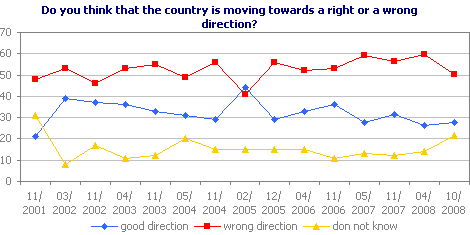
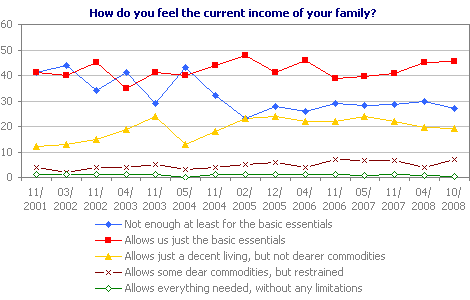
The discontentment with the country’s direction is rather linked to the current material condition of citizens, which depends on the quality of governance. The perceptions of people are based on earnings of families compared with expenditures, not statistics for precedent years as it is said for propagandistic purposes.
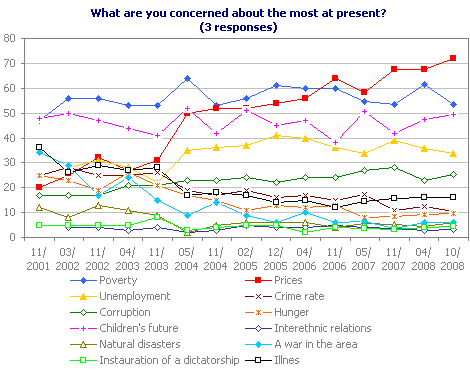
The following rule was confirmed during the previous five electoral cycles: electoral options of respondents are more or less stable in situations of relative socio-economic stability. In this regard, the most serious concerns of people motivate their political conduct. The table below reveals that the concern over price rise is already ahead the concern over poverty, though the latter is constantly a major worry so far. This concern has been manifested for the first time before the 2005 parliamentary elections, but it come to the foreground before the 2007 local elections. The concern about prices boost was probably the No.1 cause of the seriously decline in the rating of ruling party.
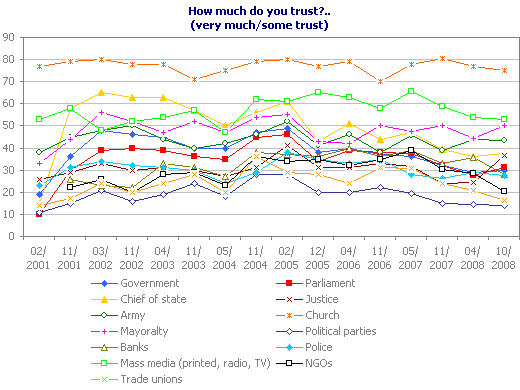
The problem of social optimism cannot be separated from the confidence in main public institutions designed to settle the people’s problems. In this respect, chances that the social optimism will redress before the spring 2009 parliamentary elections are very little, as the confidence in key public institutions – the Presidency, the Parliament and the Government – has constantly decreased after the 2005 parliamentary elections, creating a trend. Thus, it is noteworthy that the confidence in local public administration bodies controlled about 60 percent by the opposition is stable and much higher than the confidence in institutions of the central Government controlled by the Party of Communists of the Republic of Moldova (PCRM). It is important to note that in situation of a massive wave of information about the world financial crisis the trust towards Moldovan banks is on a slight decline and this may be a proof that the crisis did not affect Moldova yet as far as to alarm people.
b) Trust towards parties and their leaders in the light of interest for politics
BPO findings often raise queries like why do people elect the ruling party over years if they do not like the country’s direction? The simplest answer would be that the majority of citizens consider the acting ruling party as "the least evil" and they are not confident that opposition parties would deal better with the existing problems. The No.2 query is why the number of undecided voters is constantly so high in Moldova (about 40 percent)? The answer to this question may be found in the table below.
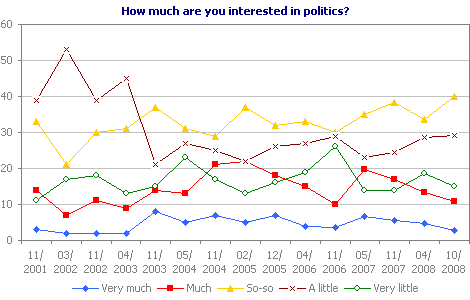
While approximately 45 percent of citizens are interested a little or very little in politics, why should one expect them give coherent responses to questions related to politics, how could they have clear intentions to vote? In this respect, the correlation between the percentage of those not very interested in politics and those undecided is not surprising. Also, these findings correlate with those on participation in elections (more than 60 percent of respondents are ready to vote in parliamentary elections).
BPO findings reveal that after the 2005 parliamentary elections the confidence of citizens in political parties correlates with the trust in public institutions represented by parties concerned.
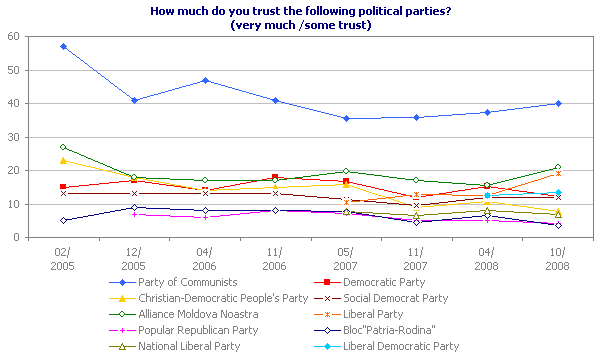
After the 2007 local elections the evolutions of perceptions clearly reveal the stabilisation of confidence in the PCRM; evident increase of confidence, over the error margin, in the Liberal Party (PL); decreasing rating of the Christian Democratic People’s Party (PPCD). As regards other parties, their trust ratings are in the common limits. The context requires mentioning the Liberal Democratic Party of Moldova (PLDM), which was registered a year ago and it is repeatedly part of political parties capable to claim representation in the Parliament, according to the BPO. The above-mentioned correlations are also effective for the evolution of trust ratings of political leaders.
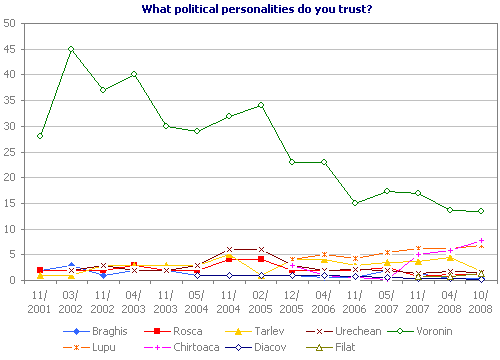
The most relevant indicator regarding the confidence in political leaders is the answer to an open question without the possibility to choose from a list. These responses clearly reveal the effects of dismissing former premier Vasile Tarlev, who is not as present in the media any longer as he was before. In this context, it seems that permanent assaults on Chisinau mayor Dorin Chirtoaca turn him in a symbol of the protesting electorate. The PCRM and its leaders know very well what the protesting wave is capable to do and what political profit it could bring when ratings of public institutions and public dignitaries are decreasing. It is true that the political messages and conduct of the Liberal Party cannot attract protesting sympathies from most of the political scene, being limited to the rightwing segment. In this respect, by joining politics on his own account, former premier Vasile Tarlev may attract the discontent left-wing voters. Administrative obstacles against Mr. Tarlev would be counterproductive, should such a trend materialise.
c) Intentions to vote "parties credited with chances"
A number of party leaders protest when the parties’ chance to accede to the Parliament are estimated on the basis of polls. Curiously, leaders of parties which gather 2–3-fold less votes at elections than the minimum number of party members needed to register a party protest the most. The cogent truth is that for mere arithmetical reasons, not all 28 parties registered in Moldova will accede to the Parliament, even if they were credited with equal chance to win at least 6 percent of votes each. Therefore, talking about "parties with great chance" and "parties with little chance" is normal and necessary. Given the inertia of electoral conduct, three factors shape speculations about the party’s chance:
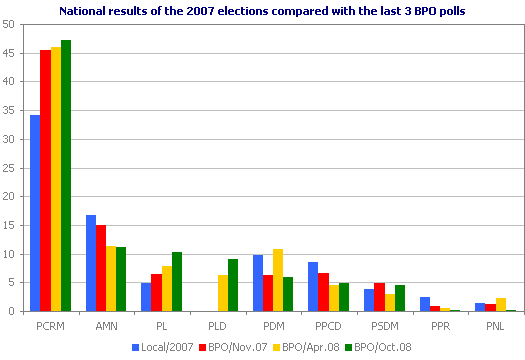
The last factor is so complex, being hidden from people so that it is implicitly manifested through the first two factors. New, emerging parties manifest themselves from the very beginning through actions aimed to capture the attention of the public opinion in order to be covered by polls, not vice versa. Even more, talks about "parties credited with chance" and those "without chance" should be organised to motivate the latter at least to revolt themselves in order to recall their existence to the public and inform citizens about this. Nevertheless, during the four campaigns for parliamentary elections held in Moldova starting 1994 the parties "without chance" have "stolen" 18–28 percent of the votes from electors, although was unrepresented in the legislative forum and raised up the number of mandates for "parties with chance". In this respect, discussions about "parties with chance" may make citizens give a "useful vote", but it is up to electors to decide. In general, it would be absurd to prohibit discussions about results of the previous elections and findings of polls because citizens could draw certain conclusions. These are official statistics or findings of sociological surveys, not manipulations. Those fearing that revealing real facts such as the party X gathers approximately three-fold less votes at elections than its number of members represents a manipulation of public opinion are hurting themselves because they doubt about discernment of citizens. It is less probable that electors would like such a conduct.
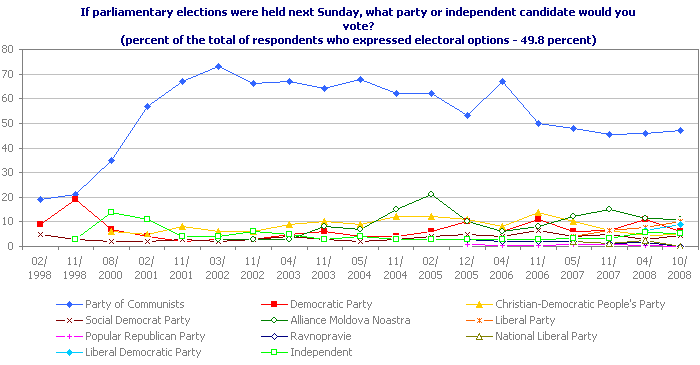
The table above, in correlation with the discussed data, reveals that intentions to vote the PCRM have been stabilised at a certain level after the 2007 local elections. Now approximately half (47 percent) of about 50 percent of respondents who expressed their voting preferences would vote the PCRM. As a rule, those who express the voting preferences are supporters of this party. In this context, the issue of undecided electors (about 40 percent) raises a major interest, being speculated very much before elections. It is impossible to predict the conduct of the undecided without conducting quantity researches in focus groups. However, one may presume that the conduct of undecided electors follows a certain rule in front of the ballot boxes. This assessment is probably effective in comparison with influent and well-known parties. As regards the PCRM, which has been ruling party for approximately eight years, citizens know what to thank it for or what to blame it for. In this regard, it is curios the proportion of the percentage of votes gained by the PCRM at national level during the three electoral campaigns since it rules the country in comparison to the percentage of electoral options expressed during polls before elections, which gives an almost constant coefficient of 0.7 percent. It could be called the "coefficient of influence on the undecided electors". This exercise lacks a scientific support in statistical or sociological terms, but it generally reveals the conduct of undecided electors over the PCRM.
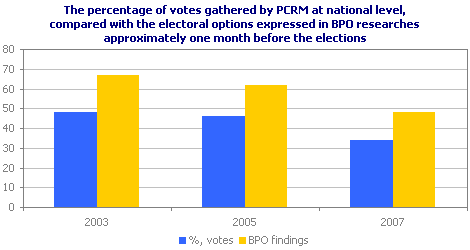
If the exercise and conclusions above contain a dose of realism and are not a consequence of bizarre coincidences, then one may state that since the percentage of those ready to vote the PCRM matches the percentage recorded before the 2007 local elections, the percentage of votes the PCRM would win if elections were held next Sunday would coincide with that from 2007 (approximately 34 percent). This exercise could be repeated before the spring 2009 elections (if the BPO is conducted), multiplying the percentage of intentions to vote the PCRM with the mentioned coefficient (0.7).
The same exercise could be done for the AMN, which has a relatively stable and known status like the PCRM. For AMN as main opposition force, the "coefficient of influence on the undecided electors" is approximately 1.3–1.4. It is easy to check: the Democratic Moldova Bloc (BMD), which was the pivot of AMN, garnered 28 percent of votes at the 2005 parliamentary elections, while the BPO conducted before the elections revealed that 21 percent of respondents planned to vote the BMD. At the 2007 local elections the AMN won approximately 17 percent of votes at national level versus 12 percent of electoral options revealed by BPO. The fact that the "coefficient of influence on the undecided electors" is higher (> 1) for the opposition and lower (< 1) for the ruling party means that the undecided electors particularly vote for opposition and the coefficient implicitly indicates the proportion.
As regards other parties, this exercise is useless, as their status is not very clear in eyes of citizens. Talking about the PCRM and AMN, the "coefficients of influence of the undecided" for both parties could decrease by the spring 2009 parliamentary elections, as the Centrist Union in Moldova (UCM) headed by former premier Vasile Tarlev could come into prominence on the leftwing of the political scene, the Liberal Democratic Party of Moldova (PLDM) and the Liberal Party (PL) are ascending, eroding the attractiveness of the two parties, so that the consequences of PCRM loosing the status of dominant party being predicable, while the status of the strongest opposition force of AMN is being contested. Thus, the undecided may massively turn to the emerging abovementioned parties.
II. Impact of elections on political stability
a) Political stability based on the PCRM domination is running short
Howsoever grounded the criticism on the Moldovan "political stability" in the last years would be, its effects are not the worst, if regarded in the light of the impact of chromatic revolutions in Georgia, Ukraine and Kyrgyz Republic on developments in these countries. However, the "Moldovan-style stability" based on the domination of a party with multiple authoritarian records will likely be over after the 2009 parliamentary elections:
Given the reasons above, a new type of political stability would be necessary after the spring 2009 parliamentary elections. As said on various occasions, a large coalition of at least 3/5 votes in the Parliament to examine in package the election of the chief of state would be necessary after the 2009 parliamentary elections, not a simple majority to elect the leadership of the Parliament and vote the cabinet of ministers. Relations between the PCRM and the acting opposition, as well as the quality of the latter are concerned as well.
b) Is the opposition able to produce political stability?
Being antagonised, dispersed, crushed by elation of its leaders, losing practical skills in key administration areas after failing to rule the country in the last 8 years, the opposition cannot make the Moldovan elector confident that by winning the elections, it could take over quickly and efficiently the control on socio-economic situation and European accession process. Two examples would be enough to point out the capacities and qualities of the Moldovan opposition. The first example is the way opposition parties have acted in front of obstacles introduced by latest amendments to the Election Code (in April 2008). Besides lamentations, good intentions and general discussions, opposition parties were incapable to take concrete actions in order to consolidate their positions and pass the obstacles. The second example is the adventures in the Chisinau Municipal Council (CMC), where opposition democratic parties were represented approximately 2/3 versus 1/3 representatives of the ruling party after the June 2007 municipal elections. The chaos in the CMC is eloquent for many district administrations. Evolutions in the CMC and other district administrations are influenced by the PCRM-controlled central government, but they also reveal the opposition’s characteristic.
Given these reasons, opposition parties should try revising their approaches and attitudes towards some matters. The experience of the 2001 and 2005 elections remains up-to-date for them. In the first case, the fragmented Parliament precluded the election of the chief of state, culminating with Parliament dissolution and dramatic change of the political configuration after the PCRM has gained constitutional majority at the February 2001 elections. In the second case, the desire to avoid the experience of 2001 has motivated some opposition parties to re-elect the PCRM leader as chief of state. Since then, the opposition is divided into "constructive" and "unconstructive" or "treacherous" and "principled", depending on sympathies. This division may have an impact on political stability after the 2009 parliamentary elections, as three out of six opposition parties credited with chance to accede to the future Parliament – the PPCD, PDM and PLDM – are led by persons who re-elected President Voronin on April 4, 2005, that means they "betrayed". Even more, the camp of "traitors" was completed last summer by the Social Democratic Party (PSD), whose municipal faction along with the PCRM and PPCD fellows helped dismissing the PL leader as CMC chairman. So, would the "principled" parties be able to cooperate with the "traitors" in order to make a large coalition?
This question makes sense, as the limits between compromises, even negative, imposed by realities and betrayals are mixed up deliberately for political profit. For example, the alternative to the April 4, 2005 "betrayal" was to block up the election of the head of state with unpredictable consequences of political destabilisation, when all 101 members of the Parliament reached the political consensus on the European integration. Since the "betrayal" poisons so far the relations between opposition parties, it is important to make clear what solutions did the "principled" parties propose to the eventual blockage in 2005. This is not a trivial question, if taking into consideration the fact that an eventual blockage is still possible in 2009 as well. Peculiarities of the 2005 elections were that in the virtue of results of the parliamentary elections the PCRM nominated two candidates to the office of chief of state while the opposition none. The obstruction by the opposition and organisation of new parliamentary elections a couple of months after the ordinary elections could have advantaged the PCRM more, so that to repeat the 2001 success. The PCRM has demonstrated its electoral force by winning 56 out of 101 seats, keeping being consolidated, motivated and holding all administrative levers to influence the repeated elections. At the same time, the opposition has split between the parliamentary and presidential elections which should be obstructed, and its components were fighting between them. By participating in repeated elections, the opposition would have run the risk to be punished by electors for organising the blockage and wasting public funds to hold repeated elections.
The arguments of the main opposition force AMN that its leader should be invited at the post-electoral negotiations to condition the election of the chief of state do not resist any criticism. The AMN did not recognise the validity of the parliamentary elections and participating in negotiations on consequences of an illegitimate action such as the election of the head of state by an illegally elected Parliament would had been at the limit of absurd[1]. Representatives of extra-parliamentary opposition parties, particularly the PL, have later justified the necessity of avoiding blocking the re-election of the PCRM leader as chief of state, though it keeps condemning the "betrayal". The PL considers that the "betrayal" had an alternative, it should be "total" not "partial" and should be realised through the delegation of two representatives of every parliamentary faction to re-elect the PCRM leader and avoid the blockage.
III. Conclusions
The contributors to this issue are:
|
© 2001-2015 Association for Participatory Democracy "ADEPT" Reproduction of the materials is welcomed provided the source is indicated | e-mail: [email protected] |