
Participatory
Democracy
Original: /en/e-journal/20081231/index.shtml
| Association for Participatory Democracy | Print version. Published on www.e-democracy.md Original: /en/e-journal/20081231/index.shtml |
Activity of Public Institutions
At the end of the session, the Parliament has proceeded to the emergent examination and adoption of some key legislative acts and drafts regarded as controversial and imperfect. The process was not transparent enough and in spite of abusive practices signalled by the opposition and civil society organizations, the law on legislative acts, Parliament’s Regulation and the concept on cooperation between Parliament and civil society were breached obviously or even deliberately when some documents were examined. This hasty legislative activity both reduced the confidence and infirm cooperation between the Parliament and NGOs, and will generate to other more serious problems in future, in particular, deficiencies in applying and interpreting the legislation, launching of unprepared reforms; lack of social and economic conditions to implement some regulations, etc. A distinct aspect is that the parliamentary majority has acted this way after the adoption of the law on transparency of the decision-making process, which did not enter into force so far, but should be taken into account anyway. And not the last, after two years of enforcing the concept on cooperation between Parliament and civil society, the formal condition to organize an annual conference aimed at assessing the cooperation and deciding new directions of cooperation between Parliament and civil society organizations was not respected. In these conditions, added to harmful developments linked to abuses by law enforcement bodies and some public institutions, the civil society was probably right to redirect its priorities for a while and turn from legislative cooperation towards more active monitoring on governance during the electoral campaign, protesting and signaling breaches and ignorance of democratic standards to local and international public opinion.
1.1. Legislative acts
Law concerning the Chamber of Auditors. Under new regulations, members to the Chamber of Auditors will not be elected any longer accordingly to principles set after the 2005 parliamentary political consensus, which awarded the majority to the opposition. They will be appointed at the initiative of chairperson of the Chamber of Auditors with a majority of votes by legislators.
Education Code. The document was initiated by the chief of state and regulates aspects relating to the educational doctrine; social principles, functions, objectives and general organisation of education; basic priorities and state guarantees in education sector etc. The education system will be structured on levels, rounds and degrees: early education and pre-school education; elementary education; gymnasium education; secondary education; vocational/technical education (professional school and college); higher education; bachelor’s degree; master’s, doctorate’s and post-graduate degrees. The education system will also include subsystems: extra-school education, recovery education, art and sport, professional institutions and continuous education.
Note by ADEPT: The Code was promoted in a hurry and even abusively, without necessary public discussions and debates, fuelling grounded criticism by parliamentary and non-parliamentary parties, experts, civil society organisations, representatives of education system etc. Objections include among others: the failure of the document to rally the education system to European standards; it introduces inconstancy and uncertainty in the education system; promotes restrained (departmental) interests of representatives of the Academy of Sciences of Moldova; stipulates a multitude de subordinated normative acts, which will require a long time in order to be drafted, adopted and enforced, so that it will be impossible to apply the Code and this will jeopardise the functioning of the education system.
Law concerning the legal status of adoption. The document regulates legal relations relating to the protection of rights of the child through adoption; establishes the legal status of adoption; cooperation between public administration authorities and nongovernmental organisations and international cooperation in the area of protection of the child through adoption. The necessity of drafting this law was established by the Supreme Security Council, which decided at a sitting in early 2005 that interventions in this field are required. The document introduces some child adoption interdictions: it bans the adoption between brothers; prohibits the adoption of a child by several persons, except for husband and wife simultaneously or successively; minimum and maximum age limits, etc.
Law concerning the prosecution. The new adopted document is promoted to execute recommendations by the Council of Europe and brings great innovations; in particular, it stipulates the formation of a Superior Council of Prosecutors (a self-administration body of prosecutors), disciplinary and qualification colleges’ introduces the patrimonial responsibility of prosecutors; social rights and guarantees, etc.
Note by ADEPT: Although it was introduced as a major progress aimed at meeting international standards, the draft was criticised by the parliamentary opposition and independent experts, with key objections envisaging the maintenance of possibilities to exert political influence; inadequate regulation of mechanisms designated to ensure the independence of prosecutors; setup of a parallel self-administration system when the Superior Council of Magistracy is operational, etc.
Law concerning the control on entities and candidates to public functions. It establishes principles, goals, procedure, forms and methods to verify information about Moldovan citizens who run or apply for public functions. The Information and Security Service will verify the information with the purpose to prevent, identify and combat some risk factors: activities contrary to public function, conflicts of interest; tolerating treason, espionage, terrorism, diversion, calling for overthrowing or violently changing the constitutional order or violent violation of territorial integrity, direct or indirect propaganda of war and other extremist actions; actions taken within the public function in the detriment of the Republic of Moldova, public authorities, society, human rights and fundamental freedoms; illegal disclosure of secret information protected by law. Entities and applicants to public dignity functions, public functions of high-ranking public functionaries and leading public functions, offices run by contracted military or other persons with a special status in public authorities which include military or special service, functions run by delegates to diplomatic or consular missions will be checked. Once receiving the SIS decision, the public authority will decide on compatibility/incompatibility of the entity (applicant) of the public function with interests of this office and will be able to decide on suspension or dismissal of the entity.
Note by ADEPT: According to independent experts, the promotion of this draft is not well-argued in compliance with the appropriate law, while the extended control and application of the law on public servants is unconstitutional and may illegally restrict the right to work and public function, which have been legally confirmed.
Law concerning the asylum in the Republic of Moldova. It establishes the legal status of foreigners seeking protection in the Republic of Moldova, the legal status of beneficiaries of protection, the procedure of awarding, ceasing and annulling a form of protection in the Republic of Moldova. The law covers aspects relating to the status of refugees in Moldova, abrogating the previous regulation in the area.
Law concerning the formation of the historic-cultural and natural-landscape reservation "Orheiul Vechi". The draft law stipulates the building of the historic-cultural and natural-landscape reservation "Orheiul Vechi" in the gullet of the Raut River, the micro-zone of villages Trebujeni, Butuceni and Morovaia in the rayon of Orhei. It allocates about 500 hectares of land with a special status to the reservation. The activity of the reservation will be funded from the state budget, budgets of administrative-territorial units, landowners’ means, special funds, donations by individuals and legal entities.
Law on modification and completion of the law on citizenship. According to new regulations, only nationals residing abroad will be allowed to apply for the renunciation of Moldovan citizenship and they will have to apply to the diplomatic representation or consular institution of Moldova.
Note by ADEPT: The necessity of restrictions is linked to a recent important rise of the number of nationals who renounce the Moldovan citizenship, compared with the number of applicants. Authorities fear that this situation disadvantages Moldova, and they decided to restrict the renunciation of citizenship by forcing nationals to keep legal relations with the state, because they could not find other methods to make citizens stay home.
Law on ensuring the construction of the Clinical Hospital of Traumatology and Orthopedy. Through derogation from the law on management and privatisation of public property, the law exceptionally declares as private property the buildings and fields covering 2.0261 hectares on which the Clinical Hospital for Trauma and Orthopedics is located. The Ministry of Health will organise a public contest accordingly to the law on public procurement, in order to select investors for the "key" construction works, including the endowment with technological, medical equipment and furniture to meet necessities of the Clinical Hospital for Trauma and Orthopedics with a capacity of 210 beds, in exchange for getting the ownership on the buildings concerned. The investor will be able to get the right to ownership on the real estates concerned within 3 months after completing the construction and finally receiving the Clinical Hospital for Trauma and Orthopedics.
Law concerning the construction of a hostel for the State University of Physical Training and Sports. Through derogation from the law on education, it exceptionally authorises the construction of a 420-bed hostel by an investor, which will become owner of the building after completing the building works.
Note by ADEPT: The parliamentary opposition and independent experts have signalled normative shortcomings of this draft, fearing that it promotes some interests contrary to the public interest.
Law on ratification/accession to international acts:
Law for modification and completion of some legislative acts (on organisation and functioning of the judicial system). The law changes the modality of formation of the Superior Council of Magistracy (it will be made of 5 judges, 4 entitled professors and 3 ex-officio members: minister of justice, Prosecutor-General and head of the Supreme Court of Justice); the modality of repeated nomination by SCM of a candidacy turned down by political authorities (only with the votes of 2/3 of SCM members); principles of constitution of the qualification college and composition of the disciplinary college of judges (to include the majority of entitled law professors).
Note by ADEPT: The new law initiated and promoted emergently by Moldovan President annuls in fact the principles of the reform carried out on the basis of the parliamentary political consensus established after the 2005 elections and reintroduces possibilities to politically control the judicial power via the SCM and its bodies, in which the majority will be formed by persons supported and promoted executive and parliamentary power. The status of SCM as a judicial self-management body is also affected, since the management becomes "external" and the poor independence of judges may become a major problem.
Decision approving the strategy on development of civil society in 2008–2011. The document sets up principles and values of cooperation and relations between public administration and civil society and establishes the following priorities:
The Government jointly with non-governmental organisations will work out and approve within 4 months an action plan on implementation of the strategy, and will annually report the execution of its regulations to the Parliament.
Decision approving the strategy of the national referrence system for the protection and assistance of victims and potential victims of trafficking in human beings. A special system in the area is needed because the existing one is not part of the state social protection system and the state does not carry any responsibility. The strategy will be a basic instrument for the implementation of the law on preventing and combating the trafficking in human beings.
Decision on completing the State-Protected Monuments Register. The State-Protected Monuments Register was completed with objects built in the Soviet period (in the 1950–1980s) which evokes controversial historical events: the Monument of Grigore Cotovschi; the monument of Komsomol Heroes; the Monument of Fighters for the Soviet Authority; the Monument of Serghei Lazo; the Monument of Liberators from Fascist Occupation.
2.1. Appointments. Dismissals
Ghenadie Cosovan was appointed deputy minister of interior. Previously, he has headed the operative service department of the Ministry of Interior.
Valeriu Mironescu was assigned chief inspector of the State General Inspectorate on Phytosanitary Supervision and Seed Control. Previously, Mironescu was director-general of the Agroindustrial Agency "Moldova-Vin" and he was relieved from office "upon own demand".
Gheorghe Rata was assigned head of the Ungheni territorial administrative control directorate of the Ministry of Local Public Administration.
Alexei Virlan was relieved from the office of deputy minister of transport and road management, as the ministry was dissolved.
Note by ADEPT: The Ministry of Transport and Road Management was dissolved under Law # 162-XVI from 09.07.2008 and the Government should take all necessary actions by the end of October 2008.
Andrei Pogurschi was assigned general director of the Sports Agency. Previously, Pogurshi was a deputy minister of interior.
Victor Coada was appointed general director of the Main State Tax Inspectorate. Previously, Coada headed a direction within the Control and Inspection Department of the Centre for Combating Economic Crimes and Corruption.
2.2. Decisions
Decision approving the regulation on signalling and monitoring of corruption rate within public authorities. According to the approved mechanism, participating in the signalling procedure will be: the monitored institution, monitor (a scientific institution, sociological agency or specialised NGO), public functionaries, and people. The signalling procedure will be internal and external and will develop the following way: employees of the institution concerned or beneficiaries of its services will anonymously fill up some reporting forms and the confidentiality will be respected. Under new regulations, reporting forms will be printed and special boxes will be installed for this purpose. Starting 2010, the mechanism will be implemented in all central public administration authorities and their territorial subdivisions.
Decisions approving some regulations:
Decision concerning the information service of financial reports advising the National Bureau of Statistics. The opening of this service is argued through the implementation of the accounting law; the new structure in charge with collecting and processing reports will have 56 employees, of them 40 will work in 2nd-level territorial administrative units.
Decision concerning working days and days-off in January-March 2009. The Government has declared January 2, 5, 6 and 9, 2009 days off, so that the winter holidays will cover the period from the 1st of January to the 11th of January 2009, while January 17 and 31, February 21 and March 14 will be working days.
Decisions approving some plans, strategies, programmes:
Decisions approving some draft laws:
2.3. Sittings. Decisions. Statements.
Governing not willing to depoliticise the function of Moldovan President
The Government has turned down a legislative initiative on incompatibility of the quality of chief of state and membership to a certain party, alleging that it restricts the constitutional rights of people to freely join parties and participate in their activity. The executive considers that the chief of state must respect the Constitution and laws of the country, protect democracy, human rights and freedoms, which means to be equidistant with political parties and all citizens, "excluding the legal possibility to promote partially the interests of a certain party."
Note by ADEPT: It is worth noting that the Government did not comment the situation of other public servants whose membership to a party is prohibited by law, and did not provide arguments in favour of such a differentiated treatment of public servants.
Funding agreements with EU
Three funding agreements have been signed in the context of the European Partnership and Neighbourhood Instrument, in particular concerning 1) the co-funding of the project on renovation of the Republican Clinical Hospital; 2) renovation of roads; 3) implementation of the joint operational programme Republic of Moldova – Romania – Ukraine 2007–2013. Grants worth 3 million Euro and 12 million Euro will be released for components 1 and 2, while the overall budget of the joint operational programme Republic of Moldova – Romania – Ukraine 2007–2013 is 137.4 million Euro. The funds will go to local public authorities, public associations, universities, research institutions, etc., which will contribute to the project with a 10-percent co-financing.
New calls upon bankers
Like her predecessor in the post of prime minister, Zinaida Greceanii has invited the bank community "to sustain the real sector of economy." During a meeting with members of the Association of Moldovan Banks the prime minister has reported macroeconomic factors, which would create conditions for the banking sector should they develop. But the premier was astonished that some commercial banks keep raising the interest rates on credits, affecting the economic stability this way. She called upon the banking system to sustain the real sector of economy, which faces difficulties to accede to funding.
Meetings with trade unions and employers
The prime minister has met representatives of the National Confederation of Trade Unions of Moldova in a broad format, with talks focussing on the need to impel efforts of the tripartite commission on labour and social-economic matters. It was noted the importance of jointly examining drafts and initiatives relating to economic and social reforms, particularly on social protection, and jointly settling collective work conflicts at national level, optimising the system of negotiations and social partnership. Trade unionists appreciated the Government’s work, but raised concern with possible consequences of the financial crisis on Moldova, being sure that the resolution of these problems requires a complex approach and participation of all competent factors. The premier noted that Government’s actions that helped reduce inflation and increase the GDP by the end of the year have also created conditions to consider opportunities for raising salaries and social indemnities, "but populist declarations in this regard shall be avoided."
At the meeting with members of the National Confederation of Moldovan Employers (CNPM) the prime minister has summarised Government’s social-economic actions and stressed that the real sector of economy has already experienced consequences of the world economy and 2009 could be more difficult in this respect. By stressing the importance of consolidating efforts in this situation, Premier Zinaida Greceanii reiterated the intention of her cabinet to focus on ensuring the social-economic stability, particularly in connection with the forthcoming parliamentary elections. CNPM representatives remarked among accomplishments of 2008 the promotion of legislative modification on remuneration and the organisation of meetings with Government members, at which they raised proposals and their initiatives were considered when governing policies were worked out. Representatives of sectoral employers asked the prime minister to order the mandatory coordination of draft legislative and normative acts on social-economic issues with employers at ministerial level. The premier assured that such a draft order is available and it will be signed shortly, promising that the execution of this order will be monitored rigorously but the cooperation shall be based on reciprocity principles.
Press conference by prime minister
Zinaida Greceanii held a press conference on December 16 and reported the activity of her cabinet for 2008. She talked about economic aspects, external activities and achievement of key indicators of the Government’s Action Plan. In particular, Mrs. Greceanii emphasised that the GDP has grown by 7.6 percent in January-September 2008; the inflation rate for 12 months was 16.9 percent in May and it declined below 10 percent for the first time in November, down to 8.5 percent; foreign direct investments have grown by more than 70 percent in the first semester and they exceeded 2.2 billion dollars; the inflation rate has decreased from 5.1 percent in the 3rd quarter of 2007 down to 3.6 percent in 2008, with job seekers counting for about 48,700 people and 38,800 job seekers were registered with employment offices; the national currency has grown by 9.0 percent versus USD and by 24.0 percent versus Euro in nominal terms; the National Bank of Moldova operated net purchases of foreign currency worth 222 million dollars on interbank monetary market in January-November 2008; foreign currency reserve assets amounted to 1.6 billion dollars in late November 2008; the evolution of the trade balance continue to raise concern, with its deficit reaching 2.7 billion dollars in January-October 2008, up by about 900 million dollars compared with the similar period of 2007.
3.1. Decrees
Moldova’s President has decreeted the appointment of Mihail BODEAN and Alexandru LUNCARI as deputy directors of the Information and Security Service.
Sergiu PUSCUTA was appointed adviser to the President of the Republic of Moldova in financial matters, a position especially created for this occasion.
Note by ADEPT: Previously, Puscuta headed the Centre for Combating Economic Crimes and Corruption (CCECC) and the Main State Tax Inspectorate. Following the meeting of the Supreme Security Council of 19 November 2008, the Government decided to dismiss Sergiu Puscuta as CCECC director at "his own request". Puscuta acted as a presidential adviser in economic and financial matters during the mandate of President Petru Lucinshi.
Serghei SIRBU was assigned deputy chief of the directorate for law and public relations of the Moldovan President’s Apparatus, and Mariana SACAREANU was appointed deputy chief of the service for presidential acts of the law and public relations directorate of the Moldovan President’s Apparatus.
Nicolae GUMENII was nominated Moldovan Ambassador to Ukraine and Eugenia KISTRUGA was appointed Ambassador, Moldova’s Resident Representative to the Council of Europe.
Andrei NEGUTA was nominated Moldovan Ambassador to Russian Federation.
Croatia’s President Stjepan MESIC was awarded Moldova’s supreme order, the Order of the Republic.
Decrees awarding the Labour Glory Order to:
Natalia MOLDOVANU, deputy chairwoman of the Supreme Court of Justice, was awarded the honour title Emeritus Person.
3.2. Meetings. Decisions. Statements
Concerns with public security and rule of law
The Moldovan president has convoked heads of some law enforcement bodies in a working meeting on optimising actions aimed at ensuring the state security and rule of law, invoking the discovery of an arsenal of weapons, munitions and explosive substances in the city of Comrat. The chief of state signalled the inactivity and non-vigilance of territorial bodies and stressed that such action of criminal groups threats the national security and worsens the crime rate. Vladimir Voronin instructed competent authorities to take necessary actions in order to find persons involved in storing illicit weapon and ammunition arsenals in Comrat and punish them accordingly to the law, as well as to prevent such criminal actions in the future.
Concerns with economic-financial situation
Aspects of the current situation in the context of the world financial-economic crisis and actions to be taken in case of pessimistic developments for Moldova were presented and discussed at the meeting. The president underlined the necessity to strictly monitor the economic-financial situation and markets in neighbouring and farther countries by setting up a strict interaction between economic bloc of Moldovan Government and National Bank of Moldova. Mr. Voronin emphasized the imperative of fulfilling strictly and in the spirit of economy the budgetary expenses foreseen for 2009, with a special attention being reserved to social-humanitarian programmes, functioning of healthcare, education, social protection, and ensuring the continuity of investment projects on modernisation of infrastructure.
Urgent reforms relating to management of judicial system
Participants in a presidential meeting have exchanged opinions regarding ways to improve actions by law courts, enhance the judges’ liability for their decisions and ensure the correctness of judicial proceedings in general. They raised proposals on necessary actions aimed at improving the current situation in this area.
Note by ADEPT: Shortly after the meeting, without holding any public debates and providing details about researches and concrete shortcomings in the functioning of justice, the chief of state has signed a legislative initiative on reforming the mode of organisation and functioning of the Superior Council of Magistracy, College of Qualification and Attestation of judges and Disciplinary Board of judges, recommending a serious reduction of the number of magistrates in these bodies and granting more possibilities to executive and legislative authorities to exert influence.
Meeting with ambassadors in Chisinau
Few days after stating that his agenda does not include meetings with representatives of public missions, the Moldovan President has met ambassadors of EU member states, U.S., Turkey, European Commission and OSCE "to discuss latest developments and prospects to develop cooperation." Vladimir Voronin highly appreciated the cooperation with EU member states, OSCE, CoE, U.S. in political, social-economic and cultural areas. In particular, he highly appreciated the dialogue between Moldova and EU, stressing that implementing previous commitments, negotiating and signing a new cooperation agreement, opening dialogue on visa liberalisation and a free exchange agreement which would provide Moldovan economic agents with new possibilities along with possibilities provided by the Autonomous Trade Preferences are priorities.
Speaking about Transnistrian settlement, Vladimir Voronin stressed Moldova’s actions aimed to ensure an international support for promoting the "package" initiatives on conflict resolution and reconfirmed that the "5+2" format must be the basic formula of negotiations.
President Voronin informed ambassadors about social-economic and political situation in Moldova, revealing that positive results are due to the political stability. Speaking about the forthcoming electoral campaign, Vladimir Voronin promised that Moldovan authorities will do their best to organise a scrutiny based on law principles, in compliance with European norms, will invite EU, OSCE observers, competent organisations to observe the electoral process throughout the campaign and elections in general.
The chief of state assured that Moldovan authorities call for a complete freedom of the media and journalists "who are legally doing their job" did not and will not face pressures. He invoked a recent decision by the Audiovisual Coordinating Council, which introduced a moratorium on contests for licenses expiring before the end of the 2009 electoral campaign, with Voronin adding that nor the license of PRO TV Chisinau will be proposed at a contest before the end of the campaign. Finally, Voronin reiterated the firm readiness of the state leadership to strictly respect the national legislation and advanced experience of democratic countries in terms of equal treatment of all participants in electoral process in ensuring and protecting the freedom of the media.
1. Prices and inflation
Inflation "perfectly" suits governmental forecasts…
According to official statistics, average consumer prices in November 2008 were at the level of October 2008. They were influenced by the fall of prices of manufactured goods by 0.6 percent and the rise of tariffs for public services by 1.1 percent, while prices of food products were at the level of October. Therefore, the inflation for 11 months was 7.5 percent.
Prices of key food products have decreased in the period concerned as follows: prices of vegetal oil declined by 14.1 percent, rice by 5.1 percent, fresh fruits by 3.3 percent (citric by 10.5 percent, apples by 6.3 percent), potatoes and mutton by 3.1 percent each, pork by 2.3 percent, sugar by 2.4 percent, wheat flour by 2.2 percent and fish by 2.0 percent. Food prices have degreased in connection with appearance of the new crop.
Prices of manufactured goods have declined as follows: fuels by 12.1 percent, bottled natural gas by 8.8 percent, drugs by 0.7 percent and building materials by 0.5 percent, etc. On the other hand, heating tariffs for households (Balti municipality and Ungheni city) increased by about 21 percent in November 2008, influencing the general price index.
Thus, the inflation rate for this year will be below 10 percent and it perfectly suits the governmental forecasts. But this rate could have been influenced, that means the state intervention into some administrative tariffs or prices. In addition, it is worth to mention the appreciation of leu, which helps reducing inflation, but directly hits domestic exporters and producers.
2. Currency
External pressures on leu…
NBM governor has recently stated that unlike neighbouring countries, the Moldovan leu is strengthening due to market relations and there are no premises for its fall. He noted that the central bank purchases up to 60 million dollars on market and it does not buy much currency now, just 50 percent of the existing daily volume. The governor added that the central bank cannot prevent the appreciation of the leu because of a major external pressure on the exchange rate of the leu. Many economists say that the appreciation of the leu is influenced by the central bank and less by demand and supply. However, the governor assured that the exchange rate depends on the demand and supply on market. "We do not have a fixed exchange rate, we did not ever have and we will never have one," he added.
At the same time, minister of economy and trade has stated that the currency available on market influences the exchange rate of domestic currency. Exports, foreign investments, remittances are main currency inflows in Moldova. However, Moldovan nationals sent home by 17 million dollars less in October than in September. According to NBM, remittances transferred from other countries via commercial banks amounted to 139.4 million dollars in October 2008. In spite of a fall of inflows in 2008 compared with 2007, the import price of some products, energy resources, gas will also fall. It means that less currency will go to imports, and this fact brings equilibrium in this situation as well. Therefore, both IMF and NBM assure that there are no factors at present to influence the situation on currency market of Moldova like those in Ukraine, Russia or Romania. Anyway, further forecasts will depend on developments by February-March.
NBM policy targets at 9-percent inflation rate for 2009…
The monetary and currency policy of the National Bank of Moldova will focus on ensuring and maintaining a 9-percent annual inflation rate by the end of 2009, with a possible deviation of +/- 1 percentage point. It is based on a 6-percent GDP growth in real terms, a 19-percent rise of exports and services, and a 24-percent advance of imports. "Rise paces of monetary aggregates will be at the level of 2008", reads the document.
The central bank promises to keep the positive basic interest rate in 2009, while the mandatory reserve norm will be established depending on inflation rate, inflationist expectations, economic situation and conditions of domestic monetary market. It will keep optimising monetary policy tools with the purpose to improve operations on open market. The monetisation of economy will be sufficient to ensure the planned economic growth. The floating regime of exchange rate will be maintained.
In 2009 the National Bank of Moldova will keep implementing the Action Plan on enforcement of the inflation targeting strategy, which aims to optimise monetary policy operations of NBM, build a centralised database and analysis, regulation and forecast framework, work out and improve public information models regarding actions to enhance confidence of civil society towards NBM monetary policy. The central bank will establish the basic rate, maintaining it at a real positive level, depending on accomplishment of fundamental objectives, situation on monetary, currency and credit markets and evolution of domestic economy, world situation, expectations and forecasts concerning the economy of the country.
3. Real sector
Elements of economic growth…
According to official accounts, GDP for January-September 2008 was worth about 47.15 billion lei and it has grown by 7.6 percent, compared with the similar period of 2007. The gross value added in commodity sector has increased by 11.2 percent compared with the similar period of 2007 and influenced by about 3 percent the real GDP growth. The rise was conditioned by a significant growth of gross value added in agriculture – by about 24 percent, while this indicator decreased by more than 32 percent in January-September 2007, compared with the same period of 2006.
The gross value added in service sector contributed by more than 62 percent to the GDP, compared with 61 percent in the similar period of 2007, while the rise pace has decreased from 110.3 percent in January-September 2007 to 106.4 percent in January-September 2008. It was particularly linked to an important decline of rise pace of the building sector, from more than 127 percent in January-September 2007 down to 108 percent in January-September 2008.
Although the share of taxes on product and import in GDP has increased from over 17 percent in January-September 2007 up to 18 percent in January-September 2008, their rise pace has decreased from 124.2 percent in January-September 2007 down to 110.4 percent in January-September 2008. It was linked to depreciation of the U.S. dollar versus domestic currency (the average exchange rate of USD versus Moldovan leu has decreased from 12.4 lei in January-September 2007 down to 10.4 lei in January-September 2008) on one hand, and rise of price index on imported goods (from 109 percent in January-September 2007 down to 120 percent in January-September 2008), on the other hand.
The GDP growth on expense elements was particularly linked to the rise of the gross fixed capital formation by 9.3 percent, compared with the similar period of 2007, ensuring a 2.4-percent real GDP rise. This element contributed by 27.6 percent to GDP in the period concerned, compared with the similar period of 2007. The investment rate (the gross fixed capital formation compared with the gross value added) has advanced from over 30 percent in January-September 2007 up to more than 33 percent in January-September 2008 due to the rise of investments.
The final consumption, another important element of use of GDP, has increased by 7.3 percent, compared with the similar period of the precedent year. The rise was particularly due to the final household consumption, which increased by more than 8 percent, compared with the similar period of 2007. The overall internal demand (final consumption and gross capital formation) went 78.8 percent to the final consumption and 21.2 percent to collections, compared with 79.1 percent and 20.9 percent in the similar period of 2007.
Governmental economic syntheses for 2008…
According to macroeconomic data, the national public budget has grown by 15 percent in 2008, compared with 2007. The inflation rate for 11 months of 2008 was 7.5 percent and the GDP for 9 months was 7.6 percent. The Government has appreciated the macroeconomic achievements as "very good". According to officials, these accomplishments are due to the fall of prices of some products and efficient governmental policies, a fact confirmed by IMF as well.
Foreign direct investments have doubled this year, compared with 2007. They exceeded 307 million dollars in the first semester of 2008, compared with 500 million dollars attracted in all 2007.
Exports. In 2008 domestic products were particularly exported to the EU – 51.4 percent, CIS 39.3 percent, and other countries 9.3 percent, and Moldova exported, in particular, textiles – 19.7 percent, food products 10.4 percent, vegetal products 11.6 percent, electronic appliances 10.9 percent.
Imports by Moldovan economic agents went, in particular, to EU – 44 percent, CIS 39.3 percent, and other countries 21.3 percent. Moldova imported above all mineral products (natural gas, fuels, etc.), electronic appliances 15.8 percent, chemical products 8.5 percent, transportation means and materials 8.1 percent, etc.
As regards human resources, 1.36 million people were declared employable in 2008, of them 49,000 were job seekers, and the unemployment rate was 3.6 percent, compared with 6 percent in 2007. The action plan for 2009 stipulates salary rises as well.
In spite of positive results for 2008, minister of economy has stated: "The Government is aware of challenges Moldova will face in the first months of 2009. In this regard, drafts are being worked out to prevent such crisis situations."
4. External economic position
IMF "praises us"…
A mission from the European Department of the International Monetary Fund (IMF) led by Mr. Graeme Justice visited Chisinau on December 4–15, 2008. The key purpose of the mission was the fifth assessment of results of the programme supported via the Poverty Reduction and Growth Facility (PRGF). Despite criticism and objects against governmental policies, the recent IMF mission has appreciated and even praised the governmental economic policies, in particular, the way the executive is managing potential effects of financial crisis, stressing that the financial system of Moldova resists to global crisis.
The mission welcomed the great performance within the programme, the reduction of inflation rate below 10 percent and the robust economic growth. Reforms planned within the programme have been generally implemented on time, but with some exceptions. The financial system resisted to the global financial crisis. At the same time, the mission shares Government’s worries with the impact of slower regional economic growth paces and discussed adequate actions aimed at promoting policies on reducing the impact on Moldova. The mission stressed the increased importance of promoting prudent macroeconomic policies in 2009. This fact was reflected in the updated Memorandum of Economic and Financial Policies (MEFP) for 2009. As a rule, the IMF leadership will revise the agreement and will further submit it to the IMF Executive Board in order to be examined.
PRGF is the IMF’s low-interest lending facility for low-income countries. Loans under PRGF carry an annual interest rate of 0.5 percent. Repayments are made semi-annually, beginning 5.5 years and ending 10 years after the disbursement. The PRGF programme in Moldova foresees a credit worth about 168 million dollars, of which about 133 million dollars has been disbursed. The IMF will give green light to the next tranche in early 2009 and the next IMF mission within PRGF is set for late February 2009.
5. Forecasts for 2009
Economic growth paces will slow down in 2009…
The economic growth rate of Moldova will slow down from 6.5 percent in 2008 to 4 percent in 2009. It will stay at the same level in 2010. According to the Global Economic Prospects 2009 by the World Bank, this is the lowest growth among CIS member states. The report says that the current account deficit will suddenly decrease from 4.4 percent of GDP in 2009 and 5.8 percent in 2010. The European Bank for Reconstruction and Development and the Economist Intelligence Unit also forecast a slowing of the economic growth pace down to 4.1 percent and 4.0 percent respectively for 2009.
The International Monetary Fund expects an economic growth in Moldova of at least 6.5 percent and a 9-percent inflation rate in late 2008. "The economic crisis did not hit so far the Republic of Moldova, which has a good enough performance due to unimportant integration into international financial markets, and governmental policies," Graeme Justice, head of the IMF European Department mission, has recently stated. WB analysts note that Moldova could gain about 25 percent of the GDP after the reduction of fuel prices. The fall of prices of goods expected in 2009 will suddenly reduce the correlation between export and import prices. About 30 countries including Moldova will gain from cheaper fuel.
Annual Ministerial Meeting of OSCE
The 16th Meeting of the OSCE Ministerial Council took place in Helsinki on December 4–5, 2008. Mr. Andrei Stratan, minister of foreign affairs and European integration, has addressed the meeting, approaching the Transnistrian settlement and OSCE’s role:
Voronin-Smirnov meeting from 24 December 2008
President Vladimir Voronin had a meeting with Transnistrian leader Igor Smirnov in Tiraspol on December 25, 2008. According to a communication released by the Ministry of Reintegration via Moldpres agency, the sides have discussed as follows:
The next day, Transnistrian leader Igor Smirnov stated that there is just one solution to the Transnistrian conflict – recognising the independence of the Transnistrian region – while Moldovan dignitaries resumed the rhetoric about negotiating a solution in the "5+2" format only.
Economic developments
Industrial production has decreased by 20–30 percent in the 4th trimester and sales dropped by 40–60 percent. In consequence, budgetary collections have declined by 20–30 percent. Developments in the metallurgical plant and cement factory in Ribnita raise the worst concern. For example, output of metallurgical plant has dropped twofold and sales fourfold. The Tiraspol Supreme Soviet has sought financial aid from Russian authorities. At the same time, the budget of the region was adopted; it foresees incomes worth about 132 million dollars, expenses in the amount of approximately 234 million dollars, a deficit of about 102 million dollars (which will probably covered with Russia’s support).
Perception of situation in Transnistria by people
The newspaper "Novaiya Gazeta" has published findings of a survey conducted in the Transnistrian region by the think tank Novyi Vek in the 4th quarter, which reveal that effects of the financial crisis are experienced. Only 3.6 percent of Transnistrian respondents consider that the economic situation in the region is satisfactory. As regards incomes of people, ¼ said that their earnings are insufficient for the strictly necessary; 47 percent can afford only the strictly necessary; 23.4 percent can afford a decent living, without affording luxury objects; 3.8 percent earn enough to buy luxury objects as well. In 2008, living standards of 40 percent of Transnistria’s population have worsened, while another 26.6 percent experienced a serious decline of their living standards. At the same time, 20 percent of respondents said that their living standards did not change, 8 percent consider that their living standards have improved, and they improved much for approximately 1 percent. The general climate in the Transnistrian region is pessimistic, as 35.7 percent of respondents fear that the economic situation in the region will not improve, while another 37.9 percent consider that the very bad situation would be redressed through radical changes, and only 10 percent are sure that the situation will improve soon.
Concerns of labour unionists
Representatives of education unions from Transnistria convened in a plenary assembly in early December 2008 to discuss the massive withdrawal of teachers from the education system. Statistics are alarming, since 412 teachers have left schools in Tiraspol, 346 in Ribnita and 142 in Dubasari in 2008. The reason is very low salaries of teachers. Unionists say that teachers with a work length of more than 15 years and maximum charge earn approximately 180 dollars a month. On the other hand, minimum wage in non-budgetary sector is approximately 200 dollars. Given existing economic difficulties, the condition of teachers will unlikely improve in 2009 and many teachers decide to quit the education system.
European Integration
European Commission releases Eastern Partnership Concept
The Eastern Partnership Concept, a new initiative by the European Commission aimed to develop political and economic relations with 6 neighbouring ex-Soviet countries – Armenia, Azerbaijan, Belarus, Georgia, Moldova and Ukraine, was released in Brussels on December 3, 2008. It stipulates a deeper political engagement by the states concerned, including the prospect of a new generation of Association Agreements, far-reaching integration into the EU economy, easier travel to the EU for citizens providing that security requirements are met, enhanced energy security arrangements benefiting all concerned, and increased EU financial assistance. All these advantages will be granted on a differentiated basis, depending on progresses and specific requirements of each country. The Eastern Partnership aims to encourage internal reforms in the countries concerned by building 4 multilateral policy platforms on democracy, good governance and stability; economic integration and convergence with EU policies; energy security; contacts between people to further support partners’ individual reform efforts. In addition, EU will support the social and economic development of the 6 countries via five high profile flagship initiatives (integrated border management programme; small and medium sized enterprise facilities; regional electricity markets, renewable and energy efficiency; southern energy corridor; and prevention of, preparedness for, and response to natural and man-made disasters). The European Union will provide 350 million Euro to fund this initiative in 2010–2013 and will redirect another 250 million Euro allocated within regional programmes under the European Neighbourhood Policy. The Eastern Partnership will be launched on spring 2009.
Note by ADEPT: The European Partnership does not provide univocally a European perspective to countries concerned, including the Republic of Moldova, but stipulates more differentiated relations with EU compared with EU southern neighbours. On the contrary, European officials have emphasized that the new EU initiative is not a prelude for a future EU enlargement.
European Commission concerned with media freedom in Moldova
On December 12, Mrs Benita Ferrero-Waldner, European Commissioner for External Relations, released a statement concerning the decision of the Moldovan Audiovisual Coordinating Council (CCA) to refuse the prolongation of the broadcasting licence of the PRO TV Chisinau television channel. The European commissioner raised concerned with the CCA decision and warned that media freedom is one of the fundamental principles of a functioning democracy, which Moldovan authorities must respect, especially in the run-up to the spring 2009 parliamentary elections.
Meetings of the National Commission for European Integration
The National Commission for European Integration convened in ordinary meetings on December 3 and 25, 2007. As usually, the chief of state, Mr. Vladimir Voronin chaired the meetings. The meeting from 3 December 2008 discussed the results of the Moldova-EU cooperation and of the European integration process, in particular:
At the December 25 meeting, the commission reviewed results of implementation of the European Integration Agenda for 2008 and discussed issues related to the drafting by Government of the European Integration Agenda for 2009. A report on implementation of the 2008 Agenda, as well as the new European Integration Agenda will be released in January 2009. Another topic discussed by the commission was the concept of the scheme of the Moldovan negotiation delegation for the new EU-Moldova Agreement, worked out on the basis of experience of Baltic countries, Croatia, Western Balkans and Ukraine. It was noted that Moldova has six months to form and train the negotiation team and get ready for negotiating the new agreement with EU. The nominal composition of the Moldovan negotiation delegation will be introduced to the Government in early 2009 in order to approve it.
Bilateral cooperation
Republic of Moldova-Romania
Relations between Moldova and Romania did not marked some qualitative evolutions; the events happened during December 2008 only highlighted the contradictory efforts of Chisinau authorities to animate the relations with Romania.
On the one hand, on December 24, the Ministry of Interior of Moldova accused in a press-release an employee of the Romanian Consulate in Chisinau of being involved in illegal activities of granting Romania visas to Moldovan citizens in their absence. As response, the Romanian Ministry of Foreign Affairs declared that the Romanian Embassy in Chisinau has repeatedly signalled the dubious activities of the accused touristic firm to the Moldovan MFAEI, presenting documents attesting that illegal acts were filled out receiving a Romanian visa.
On the other hand, on December 29, the newly-nominated Romanian minister of foreign affairs, Cristian Diaconescu, met the Moldovan ambassador to Romania, Lidia Gutu, who transmitted the congratulations of the Moldovan minister of foreign affairs. During the meeting the parts "has expressed their wish to continue the open and pragmatic collaboration between the two states for further development and deepening of bilateral relations, including for supporting Moldova’ s rapprochement to the EU". At the same time, Cristian Diaconescu has expressed his wish to meet as soon as possible Andrei Stratan. This wish of the Romanian minister of foreign affairs sticks to the main lines of Romanian foreign policy toward East, drew by the Romanian President Traian Basescu when investing the new minister of foreign affairs. Especially, Traian Basescu mentioned the need to hold on the relations with the Republic of Moldova that remains the main concern of Romania. Nevertheless, Traian Basescu affirmed that Romania made it all possible to dynamise the Moldovan-Romanian relations from both diplomatic point of view and by supporting Moldovan cause at the EU, what is not valid in the Moldova’s case.
New foreign ambassadors accredited in Chisinau
On December 16, Moldova’s President received credentials from the following foreign ambassadors:
Multilateral cooperation
Republic of Moldova – Council of Europe
ECHR decisions
The European Court of Human Rights (ECHR) has pronounced decisions in the following cases in the period concerned: Unistar Ventures GmbH vs. Moldova, Tudor-Auto S.R.L. (no. 1), Triplu-Tudor S.R.L. and Tudor-Auto S.R.L. (no. 2) vs. Moldova, Avram vs. Moldova, Levinta vs. Moldova, and Navoloaca vs. Moldova.
In the first case, the Court has unanimously established violation of the property right, as the Moldovan Government had refused to reimburse the applicant company the amount of money it had participated with in forming the statutory capital of a joint air agency, after the Moldovan Government unilaterally decided to cancel the contract on building of the joint company concerned. The Court granted 6,700,000 Euro to the applicant in pecuniary damage, 3,000 Euro in non-pecuniary damage and 9,855 Euro in costs and expenses.
As regards the cases Tudor-Auto S.R.L. (no. 1), Triplu-Tudor S.R.L. and Tudor-Auto S.R.L. (no. 2) vs. Moldova, the Court indicated violation of the right to a fair trial, property right and right to an effective recourse. The Court is further due to establish the size of pecuniary damage.
In the cases Avram vs. Moldova and Navoloaca vs. Moldova, the Court established violation of the right to a fair trial, granting 5,000 Euro in non-pecuniary damage to applicant Navoloaca.
The Court established in the case of Levinta vs Moldova the torture and violation of the right to a fair trial, granting 16,000 Euro to applicants in non-pecuniary damages and 2,000 Euro overall in costs and expenses.
Republic of Moldova has ended its Regional presidencies exercised during 2008
In December 2008, Moldova ended its Presidency in 4 regional arrangements: Central European Initiative (CEI), Centre for Security Cooperation – RACVIAC, CEFTA, and the South Eastern Europe Health Network. On this occasion on December 23, 2008, the Ministry of Foreign Affairs and European Integration posted the activity reports on the official web page of Moldovan Presidencies to regional initiatives – www.chairmanship.mfa.md.
Political year 2008
Igor Botan, 26 December 2008
1. Top events of 2008
The political year 2008 was special. In fact, it crowned the eight-year rule of the Party of Communists of the Republic of Moldova (PCRM). Many events recorded in 2008 will have a long-term impact, others have just impressed. In this regard ten events are worth to be mentioned, in particular:
2. Fulfilment of tasks for 2008
The 2008 year was also the first implementation year of the National Development Strategy (NDS) for 2008–2011. The strategy has set five priorities: the consolidation of the democratic state based on the rule of law and respect for human rights; the settlement of the Transnistrian conflict and reintegration of the country; the enhancement of the national economy’s competitiveness; the development of human resources, the promotion of social inclusion; the regional development.
The NDS tasks for 2008 were detailed at the first governmental sitting this year: going on with country’s gasification and ensuring the drinking-water supply; long-term development of the agro-industrial complex; modernising public roads; opening jobs (300,000 new jobs); three-fold rise of wages in budgetary sector; doubling the number of budget-funded seats in education sector; three-fold rise of scholarships, etc.
Prime Minister Zinaida Greceanii reported Government’s achievements for 2008 while addressing the Parliament on December 12, 2008. As usually, the premier stressed the progresses: the GDP has grown by 6.2 percent; foreign direct investments have increased by 70 percent in the first half of this year compared with 2007; the Moldovan banking system has resisted in the conditions of the international financial crisis; the number of public servants has decreased by 624 persons; the "one-stop-shop" has allowed the certification of 65 percent of new urgently opened enterprises; the Prosecutor’s Office and CCECC are combating the corruption successfully; the Republic of Moldova has organised the summit of CIS heads of state "at a high-quality level"; the share of budgetary social allocations was increased; new infrastructure projects have been developed; Transnistria-based export enterprises have been issued customs documents etc.
3. Reactions of opposition towards progresses reported by governors
The opposition has recalled governors and tried to explain citizens the true sources of the economic growth at the extent allowed by the access to the media. According to data released by the International Monetary Fund (IMF), after the 1998 Russian financial crisis and slowed world economic growth at the end of the last century, the economy of developed countries has increased by 2–3 percent and of developing countries by 6–8 percent a year in 2001–2007. After the PCRM won the rule in 2001, approximately 1/3 of employable Moldovans have got along, leaving for other countries. Annual remittances have grown about ten-fold during the PCRM rule, from approximately 150 million dollars up to about 1.5 billion dollars. Thus, remittances were equivalent to the state budget in 2007 and 2008, being estimated at approximately 1/3 of the country GDP!
In those conditions, only a Government hating own country would have failed a conjectural economic growth. However, the Republic of Moldova remained the poorest country in Europe in 2001–08, being unable to reduce the difference with other poor states. More than that, the difference is deepening so far. The table below reveals that while being an agrarian province of the USSR, Moldova was planned for an economic collapse in case of an independent development, and this occurred in 1991. The PCRM predecessors had assumed the risks of promoting deep reforms, in spite of all committed mistakes, while the PCRM has won the governing when the most painful reforms were over and the regional economic conjuncture improved cardinally.
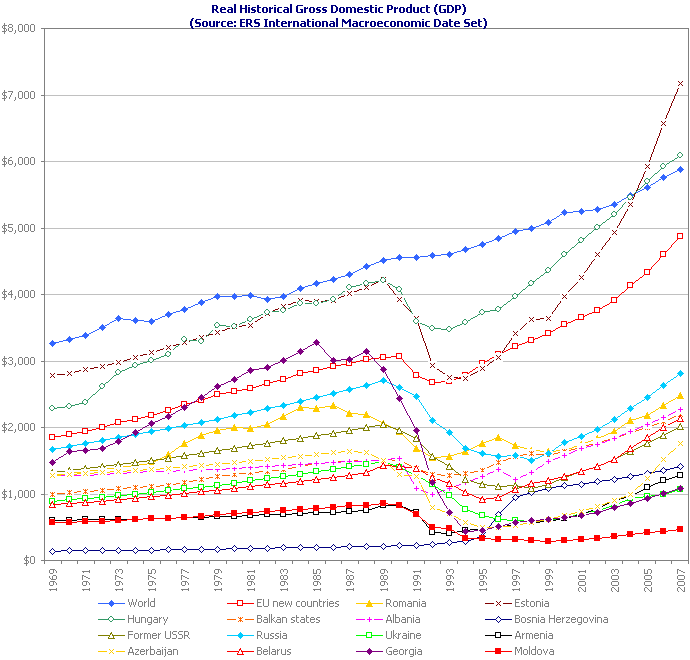
The conclusion is that in eight years of rule the PCRM did not make any significant progress, but seized on the favourable regional economic conjuncture and made propaganda. For example, speaking about enhancing the competitiveness of the national economy when the trade balance deficit in 2008 represented around 2/3 of GDP (about 3 billion dollars) is embarrassing. Statistics reveal that the deficit has increased by about one billion dollars in 2008, exports turned over 1.4 billion dollars and imports 4.1 billion dollars. By generalising all these accounts, the opposition recalls the ruling party that in 2008 "the negative trade balance was 7-fold higher than in 2000." Should authorities made something real in the economic sector, it was done contrary to the ideology and political programme of the ruling party. The "liberal revolution" declared by the PCRM in April 2007 is an example in this respect.
4. European integration and consolidation of the state based on the rule of law
2008 was a true year of good intentions. While traditionally addressing representatives of diplomatic corps, President Vladimir Voronin stated that "year 2008 is the prologue of ordinary parliamentary elections… This year claims new European modernisation efforts from Moldova, which will focus above all on improving our justice, consolidating the human rights… I believe nobody doubts any longer that Moldova is very receptive to this kind of reforms, that our statehood is becoming very strong through extension of freedoms."
In 2008 Moldovans have permanently heard the European integration theses, about good but failed laws etc. A number of standard assessments on European integration have migrated from a report to another. However, two worthy examples explain the way the state based on the rule of law is being consolidated in Moldova. The first one refers to intention of some citizens to verify the functioning of the newly adopted law on public assembly and their immediate assaulting by police. This is a joking, eloquent example of analyses on development of Moldovan democracy, though it was very hurtful for enthusiastic experiment makers. The second example is linked to the prolongation of broadcasting licence for PRO TV channel. Although this case was commented much, the "benevolence" of the Audiovisual Coordinating Council (CCA) to introduce a moratorium unstipulated by the law on execution of a special provision of the Audiovisual Code should be noted. Once the moratorium deadline is over after parliamentary elections, the CCA will organise a contest on the basis of an act under the law and contrary to the law. In fact, CCA didn’t have serious argument to refuse the automatical license prolongation for PRO TV. The PRO TV case cannot be understood well, if the context is not made clear; mainly who controls and uses the media space in Moldova, particularly before the parliamentary elections. By manifesting its "benevolence" through dodging, the CCA is doing anything but not consolidating the rule of law.
Given the above facts, EU ambassadors had to doubt publicly in 2008 over the intention of Moldovan authorities "to extend freedoms", raising their concern twice. The community of ambassadors has demanded a meeting with the chief of state at the end of the year, with the president reconfirming the positive intentions. The last occasion was a pretext for certain ambassadors to reiterate the dominant message of the last year – the signing of a new Association Agreement for Moldova will depend on respect for democratic freedoms and quality of the electoral process.
5. Transnistrian conflict
During the same traditional address to foreign ambassadors to Moldova delivered at the beginning of the 2008 year, President Voronin has promised: "We will do our best to see representatives and our compatriots from Transnistria in the next Parliament of the Republic of Moldova, which will meet in the jubilee year, the 650th anniversary of the Moldovan state, to make the residents of the region effectively participate in building a modern, European Moldova." It has become evident at the end of 2008 that Transnistrians will not participate in the parliamentary elections. Even more, unfortunately, the Transnistria settlement has become a true tale of the white bull-calf during the PCRM governing, just good to be discussed in the non-functioning "5+2" format.
In fact, what kind of relations do we have between Chisinau and Tiraspol? The former Tiraspol foreign minister, Valeri Litskai, was right when he said that de facto there are confederate relations between two Moldovan entities – the Republic of Moldova and the Dniester Moldovan Republic. It is true, as the two entities have organised common football etc., championships for many years, Transnistrian enterprises have to apply to Chisinau’s services to get customs documents etc. However, the conflict remained frozen and one can say that the legal status of Transnistria will be probably uncertain for many years ahead. That’s because Russia will unlikely change its attitude towards Chisinau and Tiraspol (like towards two equal parties) in the near future. This will be confirmed every time needed, inclusively during the "2+1" consultations accepted by President Voronin at the December 24, 2008 meeting with Smirnov.
However, some changes will probably intervene in the political life in Transnistria in a medium term and they will have an impact on the conflict resolution process as well. In 2008, Igor Smirnov has cleaned up a little the political scene of Transnistria, sweeping away some �founders" of the separatist regime. He got rid of Grigore Maracuta long ago, and this year he dismissed the foreign minister Valeri Litskai. Now is the turn of KGB head Vladimir Antiufeev and there were many allegations about his dismissal in the latest period. In this context, Igor Smirnov has promoted his son Oleg, leader of the Party of Patriots from Transnistria (PPT), on various occasions this year. Thus, Smirnov is accompanied by his son politician at meetings with important Russian envoys. Therefore, Oleg could be up for the next presidential elections while Igor Smirnov would be his No.1 electoral agent. The Smirnov dynasty is probably prepared in Transnistria.
6. Foreign policy
Things have stagnated rather than developed in the foreign policy area in 2008. In fact, the foreign policy of Moldova has been based on two dimensions in the past years: the European integration and avoiding the antagonising of Russia. Via the European Neighbourhood Policy (ENP) and recently released Eastern Partnership (EP) the EU treats its neighbours with howt they deserve. On their turn, the ruling elites of the countries included in the ENP accept EU conditionality in the measure that allows them to control the domestic situation and keep the governance. If ignoring certain European standards is needed for maintaining the governance, this happens for sure.
As regards the second factor, avoiding the antagonizing of Russia, Moldovan authorities "are redeeming a faux pas" and sometimes in an awkward manner, rather than develop relations with Russia. And all this happen after the affront faced by former president Putin in 2003 in connection with the "Kozak Memorandum". Moldovan authorities should not act "behind Europe which we want to join" when asked Putin to draft what is called "Kozak Memorandum" and probably we would not have had embargoes and the need to improve relations with Russia. Now the "things are re-fixed" by underlining constantly that the Republic of Moldova does not want to join NATO. That was the only reason why the national security concept of Moldova was adopted in 2008, to repeat again and again that Moldova doesn’t want to join NATO. Instead, the strategy drafted under the concept was not finished. Perhaps, it was not agreed in terms of limits for concessions in avoiding the antagonising of Russia.
The new foreign policy concept was not mentioned in 2008. What for? Relations with direct neighbours Romania and Ukraine did not melt anyway. However, Moldovan citizens cannot enjoy the small border traffic because of bad relations with Romania. The fact that President Viktor Yushchenko has cancelled his visit to Chisinau in 2008 points to the stagnation of Moldovan-Ukrainian relations despite the fact that good relations with Ukraine are very important to Moldova, including for the Transnistrian settlement. In this respect, it seems that relations are maintained at a certain level due to the Brussels-Kiev-Chisinau trilateral. At least, the EUBAM mandate would be extended thanks to the Brussels interest towards controlling the Transnistrian section of the Moldova-Ukraine border.
7. "Chromatic revolution" announced in 2008 or "Who is Mr. Tarlev?"
Starting 2004, PCRM propagandists have been obsessed with the danger of a chromatic revolution. All chromatic revolutions in the CIS area have been organised by former insiders. Saakashvili was minister of justice during the presidency of Eduard Shevardnadze, Yushchenko was prime minister under the governance of Leonid Kuchma, Bakyev was prime minister under the chair of Askar Akayev. PCRM strategists and propagandists in Moldova are trying to disclose possible revolutionary scenarios of insiders for a long time. Longest-sighted of them have observed the danger two years before the "rose revolution" in Georgia, suspecting premier Vasile Tarlev of subversive plans. On October 9, 2001, the website www.pro.md published the article "Who are you, Mr. Tarlev?". Many observers attributed the article to the No.1 presidential advisor, who denied that he was the author, but noted that he would have been proud should he wrote it. The writer said that "by hiding himself behind the goal to defend the interests of domestic producers, Tarlev uses Bonaparte-style corruption and protectionism methods to destroy the middle class, small and medium business in favour of foreign oligarchies"?!
If so, may be the Ministry of Justice was right when refused to register the "Russia’s Friends in Moldova" organisation, set up by Mr. Tarlev after his resignation in March 2008? May be the name of the organization indicates at the oligarchies Tarlev had plans to protect? Meantime, the PCRM governance hurries up to go ahead, giving green light to the privatisation of any public property. Even more, the Ministry of Justice refused to recognize Tarlev’s election as Chairman of the Centrist Union of Moldova (UCM) during the party ordinary congress on September 27. Thus, Tarlev’s mates had to convoke an extraordinary congress on December 13, 2008 in order to re-elect the leader of the party. In this way, Mr. Tarlev got acquainted with the grin of Moldovan democracy, which he regarded as a friendly smile when he was prime minister. Under these conditions, he has no choice but to declare the "green revolution" aimed at supporting the producers of "ecological agro-food products" provided that UCM wins the parliamentary elections.
8. Expectations from the electoral year 2009
Economic retrospectives for 2008
Iurie Gotisan, December 31, 2008
Some guidelines…
In economic terms, 2008 seems to be one of the best years for Moldova after 1998. The economic growth pace of about 8 percent (according to official statistics) made 2008 a special year in terms of dynamic of Moldovan economy in the last years (despite all disasters that hit it, climatic, financial or economic) and any critical spirit should probably admit this fact.
Diagram 1. Dynamic of key economic indicators, annual values in %

Source: NBS, NBM, IMF, Government’s forecasts and estimates by author
However, the current economic growth pace will be unlikely maintained, given external dangers (effects of financial crisis…) and internal risks (…and its implications on domestic productive sector and exports). Even more, the present economic growth is due to many conjuncture-related factors and less to healthy policies. The economy was propelled by a great agricultural production, a high consumption (both private and public), high development rate of building sector, gross fixed capital formation and a pretty attractive service sector (with a contribution of more than 60 percent of GDP).
However, if considering the factors of the growth closer, one may observe that its base is not so strong. The agricultural year 2008 will not repeat because the crop was rich due to favourable weather rather than to agricultural policy. The consumption is very high so far and it fuels imports (taxes on products and services, etc.), but it could decrease should the demand fall (in particular through decline of remittances), and the building sector has developed thanks to earnings of Moldovan nationals working abroad. In fact, the structure of economy did not change much in 2008. The agriculture is underdeveloped and extensive so far, massive imports fuel the trade deficit and current account deficit (about 20 percent), while funding for constructions is not programmatic and long-term, and it depends on international labour market.
Effects of the financial crisis did not affect Moldova much, perhaps our country is not tightly connected to international commercial inflows and financial deals or the economic system is not so dependent on outside that to experience consequences, but developments will be followed. An internal problem in 2008, which will be experienced in 2009, too, is related to "twin" trade and current account deficits. But it depends in which light they are regarded, as the deficits have actually contributed to the economic growth (imports/consumption/taxes) and modernisation of economy, but so far they are a risky zone for Moldovan economy.
The domestic real estate market has undergone a correction, like in case of the world crisis. That means a potential fall of prices on this market. But the problem of real estate market is more complicated than the one related to the price, particularly the blocking of funding for ongoing projects and transactions.
On the other hand, effects of the 2008 economic growth went to social salaries rather than to social policy elements. Other reasons than economic ones directed important amounts from the public budget to social payments (inclusively for 2009) typical to a maintained, assisted population. But the public budget is growing poor (budget deficit is on the rise…). It could fail to satisfy the vital needs of economy and assumed international obligations which mean much funds.
Authorities had a very good relationship with international financial organisations, particularly with IMF and WB, and this is a wonderful signal for investors. Relations of the Government with the European Commission have improved, with the latter disbursing funding worth tens of millions of Euro. It is noteworthy the productive cooperation between Government and Millennium Challenge Corporation, in which Moldova was declared eligible for funding the Compact programme in 2009.
Possible forecasts…
Keeping under control the world crisis will be the No.1 problem of developed economies in 2009, too, and the Moldovan economy will be unable to avoid this situation. However, the crisis could have a stabilising effect on economy through decline of inflation (reduction of demand/consumption), freezing of salaries (accordingly to some employers) and a lower demand by population. People will start making more savings. The economy will redress by the end of 2009 or early 2010, but the recovery will also depend on regional and international developments.
In fact, in 2009 Moldova will enjoy two advantages capable to guarantee a quick recovery. Firstly, the financial system (particularly the banking) was not affected – banks did not go bankrupt and Government’s intervention was not needed like in other countries. It is easier to get rid of a recession when the financial system is well. Secondly, Moldova recorded an economic growth of about 8 percent in 2008, accordingly to preliminary statistics, which is much higher than the European average, and an eventual fall would not be fatal.
Prices on real estate market could decrease in 2009, but those willing to buy housing would be wise to wait and follow developments of the real estate market. One should not forget that 2009 is an electoral year and the course of economic reforms or potential changes could change after the election of a new government. Fiscal policy and afferent budget for 2009 will be topics of talks between international financial organisations, especially IMF and Moldovan authorities. But they could also focus on salary policy, exchange rate and evolution of prices.
In 2009, perhaps more than in the last years, the inflation will be the target of targets. Other macroeconomic indicators with an impact on people will depend on inflation. One may already affirm with an "official" probity that the annual inflation rate will be in the limits of 2008, but it could be higher than forecasted, should prices of fuel and energy imports go up. Indeed, the inflation will keep being the indicator with the biggest impact in economy. It could reach the 10-percent target (-/+1%), but it could grow much in the first half of the year and decrease much on summer.
The central bank will probably practise a directed currency regime in 2009, too, especially to control the inflation. But it will depend on developments on regional and international markets as well. The memorandum with IMF is over in 2009 and a new document shall be negotiated for sure, but this would be a competence of the new government.
The contributors to this issue are:
|
© 2001-2015 Association for Participatory Democracy "ADEPT" Reproduction of the materials is welcomed provided the source is indicated | e-mail: [email protected] |