
Participatory
Democracy
Original: /en/e-journal/20090316/index.shtml
| Association for Participatory Democracy | Print version. Published on www.e-democracy.md Original: /en/e-journal/20090316/index.shtml |
Activity of Public Institutions
1.1. Appointments. Dismissals
Artur Visotin was nominated chief of the Civil Service Centre.
1.2. Decisions
Decision concerning the indexation of social insurance and some state social allowances. It sets a 20-percent indexation coefficient for 2009 and following will be indexed starting April 1, 2009: all types of pensions established and calculated on the basis of the law on state social insurance pensions; service length pensions paid from state social insurance budget; pensions for public servants established under the law on public service; pensions for customs officers established under the law on customs service; invalidity allowances established under the law on insurance for work accidents and professional diseases; pensions established under the law on social protection of citizens affected by the Chernobyl catastrophe etc. Pensions of members to Parliament, Government, public servants, local elected officials and customs officers will be indexed just the amount paid from the state social insurance budget.
Decision concerning some actions to remedy consequences of the summer 2008 natural calamities and housing of victims. It creates a group to examine the technical condition of deteriorated homes and a negotiation commission to purchase houses for victims. The Ministry of Construction and Area Development will ensure by May 1, 2009 the purchasing of building materials needed to repair and consolidate deteriorated homes and will deliver them to victims for free, while the Ministry of Finance will allocate 2 million lei to purchase necessary homes and building materials.
Decision concerning some actions for the operation of the Giurgiulesti Free International Port. The Agency for Land Relations and Cadastre is entrusted to organise works via subordinated institutions, issue necessary documents and carry out transactions relating to expropriation of private real estate assets (fields and constructions) located in the area of public works close to the Giurgiulesti village. A commission is created to settle reactions of expropriated people to related proposals.
Decisions approving some regulations:
Decisions approving plans, programmes, policy documents:
Decision on allocation of funds. The Government Apparatus is allocated 1.987 million lei to manufacture, deliver, import 500 insignia of the "Bogdan Intemeietorul" Order, manufacture 2,000 jubilee medals "650th Anniversary of Moldovan Country", 100 insignia "Artist of People", 300 insignia "Emeritus Artist".
1.3. Sittings. Decisions. Statements.
Penalties for delayed payment of increased salaries
Prime minister has ordered the sanctioning of local public administration representatives who delay the payment of increased salaries to budgetary employees. This order comes after the Ministry of Finance said that increased wages were not paid in 13 rayons before March 1 for various reasons, though more than 621 million lei was already transferred to local public administrations. Prime minister described the situation as a direct sabotage by local administrations in the context of electoral campaign, aimed to destabilise the situation in country, and ordered the creation of a working group to control local public administration bodies and resolve problems.
2.1. Decrees
The Honour Order was awarded to the Secretary-General of the Council of Europe, Mr. Terry Davis.
The crew of SAAB-200 airbus of the Carpatair Company was awarded for high professionalism and sacrifice spirit proved in the emergency which occurred during the Chisinau-Timisoara flight: the Honour Order was awarded to pilots Leonid Babivschi and Iurie Oleacov and the Civic Merit Medal was awarded to stewardesses Natalia Borozan and Violeta Tibulschi.
The Labour Glory Order was awarded to:
Outgoing United Kingdom Ambassador to Moldova John Beyer was awarded the Civic Merit Medal.
2.2. Sittings. Decisions. Statements
Increased social protection for veterans
Moldova’s president has convoked a working sitting on actions to be taken in connection with the 65th anniversary of Moldova’s liberation from fascist occupation. In particular, the sitting focused on social support for former participants and invalids of the World War II, with Vladimir Voronin raising initiatives aimed to enhance the social protection for WWII invalids and participants, including a 50-percent rise of state allocation for these people.
State security and consumer protection
A sitting of the Supreme Security Council has tackled the protection of consumer rights, with the chief of state saying that the present situation is alarming and demanding urgent actions to improve it. It was mentioned among shortcomings the imperfect legal and institutional framework; inefficient functioning of control bodies in the field of protection of consumer rights; jeopardised public health and security of population. The chief of state indicated the need to establish very strict requirements for imported commodities.
Positive evolution of macroeconomic indicators
The presidential administration has convoked a meeting on financial-economic situation and actions taken by authorities to maintain financial stability, which found that a positive evolution of macroeconomic indicators is observed in Moldova this year despite the difficult economic environment in the region. In the context of continuing the implementation of social programmes released by authorities, it was discussed the preparation of the second round of indexation of deposits of people in Banca de Economii, with the Government being expected to present an implementation mechanism shortly. Vladimir Voronin insisted on special importance of maintaining an exigent control on economic-financial situation.
Note by ADEPT: Trends of the leu devaluation versus main foreign currencies were observed shortly after the meeting concerned, with authorities blaming public statements delivered by economic commentators and published by the media for this situation.
Increased attention for agro-food sector
A meeting convoked by chief of state has considered situation in agro-food sector and necessary actions to conduct successful spring agricultural works. It was noted that autumn crops are in a satisfactory condition and all necessary seeds are available. Current problems of agro-food complex include among others the lack of sale markets, circulating means, little possibilities of agricultural producers to get bank credits, as the interest rate is very high, failure of processing enterprises to pay raw material suppliers. Participants in the sitting worked out organisational, financial-bank and budgetary proposals which shall be implemented in order to improve the situation in agro-industrial complex: auctions held to purchase 40,000 tons of fodder wheat for the state reserve shall be finalised; the Fiscal Inspectorate shall not block accounts of agricultural enterprises throughout spring works; an efficient system shall be elaborated to reimburse the VAT operatively to farmers; a mechanism shall be set up to monitor the use of funds by commercial banks and reduce the interest rate on credits granted to agriculture; credits formerly granted by commercial banks to agro-industrial economic agents shall be restructured. The chief of state stressed the necessity to plant 7,000 hectares of vineyards and 5,000 hectares of orchards and work out a schedule of payment of debts by crop processing enterprises to agricultural producers for the production purchased in 2008.
1. Inflation and prices
Prices "moving backward"
BNS data show that the Consumer Price Index (CPI) in February 2009 was 99 percent compared with January 2009 and 103.1 percent compared with February 2008 (for information, CPI was 101.5 percent in February 2008 compared with January 2008 and 114.8 percent compared with February 2007). Therefore, Moldova records a negative inflation rate (deflation) for the first two months (minus 1.1 percent). Consumer prices decreased by 1 percent, as prices of food products have declined by 1.8 percent, manufactured goods by 1 percent, while tariffs for public services rose by 0.2 percent.
In comparison with January 2009, prices of rice dropped by 7 percent, vegetal oil by 5.5 percent, grits by about 5 percent, bread by nearly 4 percent, grapes by about 4 percent, sugar by 3.5 percent, fresh fruits by 3.4 percent (apples by about 5 percent), fresh vegetables, fowl and wheat flour by more than 3.1 percent. As for manufactured goods, prices of fuels have decreased by 5.5 percent (bottled natural gas by 15.4 percent, coal by 3.1 percent, motor fuels by 0.8 percent) in the period concerned, building materials by 1.7 percent, footwear by 0.7 percent, and ready-made clothes by 0.5 percent.
Tariffs for public alimentation and telecommunication services rose by more than 1 percent in February 2009. At the same time, tariffs for interurban public motor transportation services were reduced by about 5 percent in February, interstate railway transport by 0.4 percent and hotel services by 0.5 percent.
2. Macroeconomics
International forecasts "push" Moldova to recession…
The British Economist Intelligence Unit anticipates that Moldova’s economy will contract by 1 percent this year. On the other hand, Moldovan Government expects a 6-percent economic growth. British experts say that Moldova’s GDP will fall this year and the economic growth will be recovered in 2010 only, when it will be approximately 3 percent. The budgetary deficit could reach 1.5 billion lei, the country will be short of funds to develop announced programmes and, in consequence, the Government will have to update the expenses, should these forecasts become true.
At the same time, the International Monetary Fund anticipates that Moldova’s reserve currency will fall by more than 600 million dollars this year. As well, IMF experts simulated a heavier model for Moldova – the reserve currency of the country could decline by more than 1.3 billion dollars, from 1.365 billion dollars at present, should remittances, exports and foreign investments fall suddenly. For example, remittances accounted for 64.8 billion dollars in January 2009, falling by about 28 percent compared with the same period of 2008, when this indicator exceeded 71 million dollars. Remittances have actually substituted Moldova’s economy and this is not a good solution for a long term. The fall of remittances will reduce the purchase power of people.
According to this scenario, Moldova’s economy will enter into recession and a 4.5-percent fall could be recorded in 2009. This is a mathematical exercise, but these estimates should be taken into account as last version. IMF has recently updated its forecasts for the poorest countries. Hereby, IMF forecasts a 3.5-percent GDP growth for Moldova in 2009. On the other hand, EBRD economists say that Moldova’s economy could grow by 4.1 percent in 2009.
3. Infrastructure
All our roads… will they ever repair?
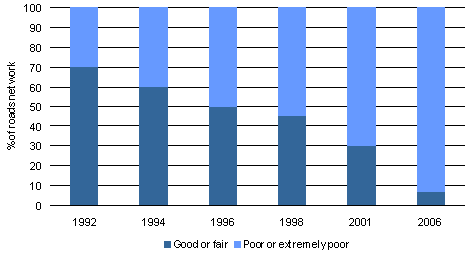
According to the third annual Travel & Tourism Competiveness Report, Moldova is ranked the 132nd place among 133 countries in terms of quality of traffic infrastructure. The report worked out by the World Economic Forum ranks Moldova among countries with worst traffic infrastructure like Chad, Bosnia and Herzegovina, Paraguay and Bolivia. As well, the quality of transport network in Moldova is also bad, with our country being ranked the 87th place. In addition, Moldova is considered an "expensive" country in terms of air tickets and airport taxes. Here Moldova is ranked the 108th place among 133 countries. The Constraints Analysis worked out in 2007 reveals a similar situation.
Table 1. Evolution of the roads network conditions in Moldova
Source: Analysis of the current condition of the Moldovan Transport Sector, World Bank, 2007.
On the other hand, Moldova has progressed in terms of hospitality, level of fuel prices, hotel services. It climbed five places in the Travel & Tourism Competiveness Report and ranked the 93rd place among 133 countries, compared with the 98th in 2008. Moldova is ranked between Kazakhstan and El Salvador. Romania is ranked the 66th place, Ukraine the 77th, Russia the 59th. The rating was carried out on the basis of some indicators such as tourism regulatory framework, infrastructure, natural resources and human capital. Switzerland, Austria and Germany are the most attractive countries for tourism development, ranking the first three places, while Burundi, Lesotho and Chad rank the last three places.
4. Social protection
Pensions in Moldova are among lowest in the region…
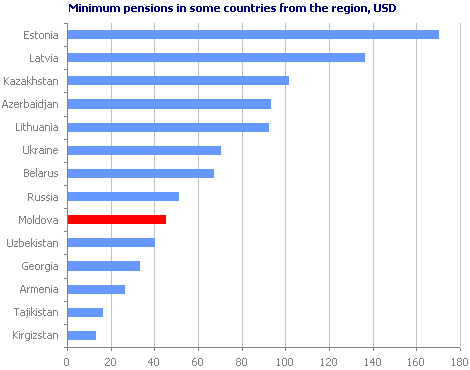
Moldova is ranked the 8th place in the Commonwealth of Independent States and Baltic Countries in terms of minimum pension. According to statistics, a Moldovan retiree was earning minimum 45 dollars in early February. The highest minimum pensions are paid by Estonia – 170 dollars, Latvia 136 dollars and Kazakhstan 101 dollars. Moldova was ranked after Azerbaijan, which pays a minimum pension of more than 93 dollars, Lithuania 92 dollars, Ukraine 70 dollars, Belarus 67 dollars, and Russia 51 dollars. The ranking ends with Uzbekistan – 40 dollars, Georgia 33 dollars, Armenia 26 dollars, Tajikistan 16 dollars, and Kirgizstan 13 dollars.
Table 2. Minimum pensions in CIS member states
Source: www.infotag.md
Building non-state or private pension funds is being discussed for quite a long time, as legislation seems to be well for this purpose, but no actions are taken in this respect. On the other hand, these funds are part of a developed financial market, while our financial or capital market is underdeveloped. For example, employees’ liabilities to private pension funds would be an investment in a more quite and stable retirement to match annual contributions and a lasting solution to a long-term crediting for economic agents. More by token that these institutions along with banks make the same financial market everywhere and Moldovan legislation allows building such funds.
A solution to beat the crisis would be for the Government to find all possible ways in order to oblige Moldovans working legally abroad to contribute to the pension system in their host countries and further transfer their rights. But this would be possible in case Moldova has (or will have) such agreements with countries concerned. Otherwise, Moldovan immigrants could contribute directly to the domestic pension system, as its security could be threatened when some emigrants will come back home.
In this respect, estimates by the United Nations Population Fund (UNFPA) reveal that the number of population will fall by 10 percent in 2010–2050 in 45 countries, including Belarus, Bulgaria, Georgia, Germany, Latvia, Lithuania, Moldova, Poland, Russia, Romania and Ukraine. Updated UNFPA forecasts say that Moldova will have only 2.9 million people in 2050, should the state of things be the same (low birth rate, negative natural rise, massive emigration of population), so that the economically active people will not exceed 1 million and maximum half of them will be salary earners, while the number of retirees will exceed one million (more than 640,000 people at present). Respectively, a salary earner will "carry" more than two retirees.
"2+1" consultations
Transnistrian leader Igor Smirnov has announced that a "meeting of presidents in a 2+1 format" was set for March 18, 2009 in Moscow. He instructed the department for foreign relations to prepare the meeting jointly with the Russian Embassy in Chisinau. Smirnov stressed that the "meeting of presidents" Medvedev and Smirnov will take place anyway, while a confirmation of the participation of Vladimir Voronin was expected. Chisinau authorities confirmed that the chief of state will participate in the March 18-scheduled meeting.
Ukraine accepts "2+1" consultations, not negotiations
The special representative of Ukraine at the "5+2" negotiations, Victor Krizhanovsky, has visited Tiraspol to discuss with Transnistrian foreign minister the situation relating to the Transnistrian settlement before the March 18-set meeting in Moscow. The Ukrainian diplomat noted that Ukraine will not change its positions concerning the Transnistrian settlement after the resignation of Ukrainian Foreign Minister Vladimir Ogrizko. Krizhanovsky stressed that Ukraine has nothing against "2+1" consultations, but it does not accept the signing of any political documents without its participation: "We do not warm separate negotiations. No agreement is possible without Ukraine, as this would mean eroding the negotiation process. We do not want to be common signatories; we want to keep participating actively in the negotiation process." In his turn, Transnistrian foreign minister Vladimir Yastrebciak stated: "This position of Ukraine is well-known, we have an understanding attitude, but the Moscow trilateral meeting does not mean undermining the "5+2" format. The vacuum in the negotiation process must be filled up and any mediation initiatives are welcome in this regard. These are not separate negotiations; all will be transparent for all participants in negotiation process."
Ukraine will open interdepartmental structure for Transnistria settlement
While visiting Tiraspol, the special representative of Ukraine at the "5+2" negotiations, Victor Kryzhanovsky, has stated that his country will promote a very clear and outlined policy on Transnistrian settlement. He noted that an interdepartmental group will be established and it will be headed by Stepan Gavrish, deputy secretary of the Security and Defence Council. Kryzhjanovsky will be the deputy of Gavris. The necessity of setting this group was dictated by the fact that Ukrainian ministries and departments do not coordinate their actions very well in relations with Transnistria. "Each ministry or department in charge with regulating Moldovan-Transnistrian relations has its interests. The Foreign Ministry has to harmonise these interests and this requires time. Equilibrium of these interests is needed."
Eventual Voronin-Smirnov meeting
The Transnistrian leader has stated that he could meet separately with Vladimir Voronin in Transnistria in the second half of March, in order to discuss issues related to commercial cooperation, exports by Transnistrian economic agents, other problems aimed to facilitate the life of people. He stressed that the Tiraspol administration does not warm the "package of documents" on conflict resolution which President Vladimir Voronin handed in to Igor Smirnov at the December 24, 2008 meeting, since Moldovan authorities did not give green light to the initiative to sign a friendship and cooperation treaty with Transnistria. Serious talks could focus only on an "agreement on harmonising relations" with the Republic of Moldova.
Foreign trade exceeded 2.5 billion dollars in 2008
Transnistria’s foreign trade was worth 2.571 billion dollars in 2008, according to the statistics department from the secessionist region. Exports were worth 928.9 million dollars and imports amounted to 1,642.6 million dollars. The trade balance was negative – 713.7 million dollars. In 2008 the Transnistrian region held commercial relations with 114 countries, including 12 CIS member states. The trade with CIS states covered 55 percent of the exports and 68.7 percent of the imports. The import-export proportion in relations with Ukraine is 3:1. Overall production in 2008 was by 2.1 percent smaller than in 2007. Inflation was 33 percent.
Social problems in Transnistrian region
The Transnistrian statistics department has reported wages in the eastern region of Moldova. In particular, the average salary in 2008 was 246 dollars. The average wage of budgetary organisations was 118 dollars. The highest average salaries on sectors were recorded in energy, banking and insurance, respectively 595, 435 and 365 dollars. The nominal average wage has increased by 28.2 percent in 2008 compared with 2009, but the real average salary covered just 96.1 percent of the one paid in 2007. Retirees count for 133,209 people before January 1, 2009, which is by 115 persons less than on January 1, 2008. The average pension in the region amounted to 54 dollars in 2008.
Transnistrian NGOs seek proportional electoral system
Twenty Transnistrian nongovernmental organisations backed requirements for introduction of a proportional electoral system in the region chosen by the Supreme Soviet. The proportional system is expected to represent widely different groups of people. The initiative seeking the adoption of a proportional electoral system is motivated by necessity to harmonise the Transnistrian legislation with Russian laws. However, developers consider that the electoral threshold in Transnistria should be 2–3 percent, not 7 percent like in Russia. As well, they seek open, not closed candidate lists, as voters should know those who will represent them for five years.
Sittings of Joint Control Commission are inefficient so far
Sittings of the Joint Control Commission (JCC) are inefficient so far. Just talks on agenda take two hours. Last sitting on March 12, 2009 focussed on two Moldovan prisons based in Bender municipality and training centre of the Transnistrian defence ministry dislocated to Cetatea Bender. Separatist authorities want the prisons to be shut up while Moldovan representatives invoke the necessity to close the training centre, as it violates the convention on principles of peaceful settlement of the armed conflict in the Transnistrian region of the Republic of Moldova, signed by Russian and Moldovan presidents on July 21, 1992.
European Integration
British Parliament releases motion to support Moldova
According to a communication by the Ministry of Foreign Relations and European Integration of Moldova, the House of Commons of the United Kingdom Parliament has released a parliamentary motion "Future of Moldova" to sustain Moldova’s efforts in fulfilling its European integration and country reintegration goals.
The parliamentary motion was worked out by a group of parliamentarians headed by Mr. Alun Michael, member to the British-Moldovan parliamentary friendship group, and was signed by 53 members to the House of Commons. The parliamentary motion supports Moldova’s European integration prospect, with the signing of a new Moldovan-community legal framework which would ensure Moldova’s way forward accession to EU. At the same time, the motion backs the sovereignty and territorial integrity of Moldova, calling for the resumption of the "5+2" Transnistrian settlement negotiation process. It highly appreciates the activity of the EU Border Assistance Mission and calls for the extension of its mandate after 2009. (According to MFAEI communication)
General Report on EU activities in 2008
The European Commission has published the General Report on the Activities of the European Union in 2008.
Bilateral cooperation
Republic of Moldova – Bulgaria
During March 12–13, 2009, Bulgarian President Gheorghi Pirvanov was on a formal visit to Chisinau, met Moldovan President Vladimir Voronin and visited the Taraclia-based State University. During bilateral talks, the sides approached issues relating to socio-economic cooperation between Bulgaria and Moldova, as well as topical international matters. In particular, it was mentioned an unused potential of bilateral commercial-economic relations and necessity to implement joint investment projects in future, including with a touristic destination. Speaking about Moldova’s European option, Gheorghi Pirvanov assured that Bulgaria will support the European integration efforts of Moldova. (According to a press release by Moldovan Presidency)
Note by ADEPT: Many political commentators said that the visit of the Bulgarian president in full electoral campaign was part of visits bringing electoral capital to PCRM and aiming less at getting Bulgaria’s support in the European integration process of Moldova, with Bulgaria having many faults within EU.
Multilateral cooperation
Republic of Moldova – Council of Europe
ECHR decisions
The European Court of Human Rights (ECHR) pronounced a decision on Eugenia and Doina Duca vs. Moldova on March 3, 2009. It established violation of the rights to property and fair trial. Non-pecuniary and pecuniary damages will be established under a separate decision.
On March 10, 2009, the Grand Chamber of the European Court of Human Rights pronounced a decision on Paladi vs. Moldova. The case was resent to the Grand Chamber at the request of Moldovan Government after the 4th Chamber awarded victory to Paladi vs. Moldova on July 10, 2007. The Grand Chamber confirmed the violation of the right to freedom and security and the right to appeal to the Court, as well as violation of Article 3 of the European Convention on Human Rights (ban of torture and degrading treatment). The Court granted 2,080 Euros to the applicant in pecuniary damages, 15,000 Euros in non-pecuniary damages and 7,000 Euros in costs and expenses. (Source: www.echr.coe.int and www.lhr.md)
Visit by Council of Europe Secretary-General Terry Davis
During March 5–6, 2009, Council of Europe Secretary-General Terry Davis was on a working visit to Chisinau, discussed with President Vladimir Voronin, Prime Minister Zinaida Grecianii, and participated in the inauguration of the first promotion of the National Institute of Justice. During discussions, Terry Davis appreciated progresses made by Moldova in some areas, including in terms of alignment to European standards and norms. At the same time, the secretary-general said that these successes are not a reason to relax and Moldovan authorities shall keep developing democratic reforms, strengthening the rule of law and ensuring respect for human rights and fundamental freedoms. Speaking about forthcoming parliamentary elections in Moldova, Mr. Davis said that the Council of Europe wants these elections to be fair. The CoE Parliamentary Assembly will monitor the electoral process and will work out a report.
Common lists of candidates
Igor Botan, 9 March 2009
1. Ban of electoral blocs gave birth to "political poles"
Amendments operated to the Election Code last year have incensed controversies. The Party of Communists of the Republic of Moldova (PCRM) and the Christian Democratic People’s Party (PPCD), promoters of a higher electoral threshold up to 6 percent, besides prohibition of electoral blocs have motivated their option by necessity to avoid an excessive fragmentation of the future Parliament. On the other hand, the "Moldova Noastra" (Our Moldova) Alliance (AMN), the No.1 opposition party, has criticised the amendments, but hinted that it is content anyway not to have to bear with pressures from eventual electoral fellows to be carried into "marsupium", the way it happened at the 2005 parliamentary elections. Other parties were more sincere while protesting against amendments, saying that they violate recommendations by international institutions OSCE, Venice Commission etc.
The attitude towards amendments concerned is explained by interest of parties credited with "great chances" to take advantages of the "lost ballots" redistribution by those with a rating closed to the electoral threshold etc. Of course, the latter will not enjoy the role of "electoral plankton" which nourishes "political whales". But an old quote says that "not for one expected, but for one who comes to pass." It means that raising the electoral threshold and banning electoral blocs could have unexpected effects on designers of amendments. In this regard, the clearest danger for PCRM is that it could be deprived of eventual coalition partners. Perhaps, this is the reason why the PCRM has started pouching parts of the "electoral plankton" on its list of candidates.
It was clear from the very beginning that the "common lists" of several parties that means compiled under the name of one of them is the only way to avoid the ban of electoral blocs. Unexpectedly, the party which prohibited blocs, the PCRM, has resorted to this escaping solution as well. But the curiosity is that right-wing parties and their supporters have pathetically discussed "the common list of national unity" for half a year and two parties – the National Liberal Party (PLN) and the National Romanian Party (PNR) – have finally gathered under auspices of the "Actiunea Europeana" (European Action) Movement (MAE). At the same time, the PCRM and the Centrist Union of Moldova (UCM) have set up two sets – "common lists" joined by eight parties – without publicly discussing the necessity of "strengthening forces".
The three "common lists" have raised a great interest of political observers in Moldova, as they revealed, by occurrence or not, the absolutely distinct polarising of options on Moldovan electoral ground. One may say that "common lists" in the ongoing electoral campaign have been built around three poles known well by electorate: pro-Romania, pro-Russia and pro-government/pro-Moldova.
2. Pro-government
The fact that the PCRM has accepted a "common list" with the Agrarian Party of Moldova (PAM) and the Party of Socialists of Moldova "Patria-Rodina" (PSMPR) proves that leaders of the ruling party are not sure any longer of their capacities to reach former successes. PCRM was expected to halt other parties from compiling into "common lists" by invoking Article 41(2) of the Election Code: "Political parties may nominate both members and politically unaffiliated persons as candidates." But PCRM accepted joint statements by leaders who ceased their political membership to participate in elections on a "common list". Even more, PCRM has become a key beneficiary of this artifice aimed to avoid the ban of electoral blocs. Plans regarding "common lists" were clear when leading bodies of PSMPR and PAM have publicly supported PCRM and leaders of these parties were included in the PCRM list, after ceasing their quality of heads and members of parties.
The only source of confusion is the "weight category" of PCRM’s partners. The joining to the "common list" by PSMPR is understandable, as this party has a constant rating of approximately 2 percent. But it is unclear why did PAM co-opt, since it could not participate in the 2005 parliamentary elections and collected approximately 300 votes at the 2007 local elections. However, the "common list" of PCRM does not lack profound meanings. Thus, PAM dominated the political life in Moldova for more than four years – from July 1992 to January 1997 (it was called then Democratic Agrarian Party of Moldova – PDAM). The party took over the rule in several rounds. After the People’s Front of Moldova (FPM) stepped in opposition on October 13, 1991, the former informal PDAM leader, Andrei Sangheli, became prime minister in more than half a year, on July 1, 1992. PDAM took over the entire rule definitively in January 1993, when FPM leaders tendered resignation from parliamentary leadership. Agrarians formally lost the rule in 1998, shortly after parliamentary elections, though PDAM was already ruined when former premier Sangheli had to resign on January 24, 1997, ten days after the investiture of Petru Lucinschi as chief of state.
Important developments for Moldova’s destiny happened during the PDAM governing: the PCRM was reinstated, immediately after PDAM won the 1994 parliamentary elections; the document on accession to CIS was ratified; the Constitution was adopted and the ample privatisation was commenced. To note in this context that another partner from the "common list" of PCRM – PSMPR – is a former member of the Bloc made of the Socialist Party and Unitatea-Edinstvo (Unity) Movement (BPSMUE). This bloc got 28 out of 104 mandates at the 1994 parliamentary elections, influencing political developments decisively by supporting PDAM to ratify the document on Moldova’s accession to CIS and adopting the Constitution. However, it is worth noting that ideological affinities between PAM and PCRM particularly run into "Moldovenism", which the two parties regard as rescuing for ethnical identity and statehood of the Republic of Moldova. Agrarians initiated and PCRM developed the "ideology of Moldovenism", cultivating the afferent historical-religious mythology and including its perceptions in country’s legislation.
PCRM has unanswerably demonstrated at the 1995 local elections and 1998 parliamentary elections that the 1994 success of socialists was temporary, a success of provisional substitutes which had to resign shortly after reinstatement of the Communist Party. It is worth noting that the heart of the communist team, informally led by Victor Stepaniuc, was strengthened within BPSMUE faction. PCRM proved at the 1998 parliamentary elections that agrarians were temporary substitutes, too. Further, PCRM proved that it did not forget its benefactors. It accepted at the 1999 local elections to make the bloc of communists, agrarians and socialists (BCAS), with the latter being ruined completely. Hereby, the "common list" of PCRM is both a reincarnation of BCAS and a gesture of "paying older policies".
It is worth pointing out the PCRM attitude towards PAM, as PCRM has rewarded PAM leader Anatol Papusoi by appointing him director-general of the state forestry agency Moldsilva. Anatol Popusoi was assigned to this office on June 28, 2001, four months after the absolute victory of PCRM at the 2001 parliamentary elections. He was reconfirmed to this office after the parliamentary victory of PCRM in 2005. One may say that PAM was co-opted on the "common list" of PCRM to enjoy "administrative resources" of the "chief forester" of the Republic of Moldova. It is unlikely, since PCRM enjoys all administrative and other resources. One may think that Moldova was ruled by a communist-agrarian coalition in the past eight years, which wants to be institutionalised and extended via the "common list". This is the formal true, but in fact PCRM has simply demonstrated a constant attachment to political-ideological affinities between the two parties. It is important to understand political developments in the independent Republic of Moldova. Following all PCRM experiments related to declaring "liberal revolution", building post-industrial society, "de-constructive tests and cleavages of willingness of post-modernist subject", etc., the "common list" with PAM and PSMPR brings back the ruling party to its origins when Moldova gained independence.
3. Pro-Russia pole
The "common list" compiled under auspices of the Centrist Union of Moldova (UCM) carries as profound significance as the one of PCRM does. However, there are great differences as well. Representing a very modest party, former UCM leaders succeeded at the beginning to co-opt former premier Vasile Tarlev as leader. He plays the role of "electoral engine". Further, other parties and movements – the Humanist Party of Moldova (PUM), Popular Republican Party (PPR), "Ravnopravie" (Equality) Movement (MR), Party of Law and Justice (PLD), Gagauzia Unita (United Gagauzia) Movement (MGU), decided to catch their "trucks" to the "Tarlev engine". The presence of MR and MGU on the "common list" is the gage that this set is regarded pro-Russia. This fact cannot be neglected since Russian-speaking citizens of Moldova make up an electoral segment of approximately 25–30 percent. Therefore, the fact that former premier Tarlev became head of the organisation Russia’s Friends in Moldova before becoming UCM leader is not an occurrence. So far, Tarlev is the informal leader of the two organisations, as the Ministry of Justice does not recognise his statute-based authority. The facts mentioned above do not leave room for doubts regarding political appeals by Vasile Tarlev to position himself categorically, and this could help him "separate waters" in relations with PCRM.
The UCM "common list" indicates unquestionably that the party is capable "to absorb like a vacuum cleaner" electoral portions placed more on the left side of PCRM (about 4 percent, according to results of the 2007 elections), more on the right side (about 4 percent), being able to "pick" the dedicated electorate of the ruling party as well. Headed by a well-known leader like former premier Tarlev, chances of UCM grow much. In this regard, PCRM was motivated to oppose and halt the "Tarlev project". The most amusing action was the attempt to deprive UCM of the right to use the name "Tarlev" for the electoral symbol printed on ballot papers. That means PCRM was claiming the right to deprive former premier Tarlev of possibility to dispose of his name because it was mediated for 7 years, when he ran the PCRM government.
Remarks above just draw the attention on allegations that the "Tarlev project" would be an intelligent emanation of PCRM aimed to assure a victory within a "two-column electoral march". There are lots of arguments against these allegations, as well as against suppositions that the "strategy of the two columns" would have functioned better if the "Tarlev project" was not obstructed. The idea of the two columns, which would converge in the Parliament, was launched last summer by historian Ivan Grec, former PCRM deputy and ideologist of this party. Grec argued that according to records, "Moldova’s citizens who call for consolidation of Moldovan statehood would act judiciously should they participate in the 2009 parliamentary elections in two columns: one headed by Voronin and one headed by former premier Tarlev." If this logic seems clear, then why implementing it would be a "drama"? But this is not a "drama"; the problem is that the PCRM leader does not simply want Tarlev as an equal and somehow independent partner. The danger is that the "waters will go apart" within the PCRM as well, should Vladimir Voronin stop being chief of state and PCRM fail an absolute majority in Parliament. In other terms, the "old guard" could migrate to Tarlev’s camp and "young runners" could join a social-democratic pole etc.
Therefore, the "exacerbation" of the pro-Russia message of former premier Tarlev aims to "separate waters". Tarlev’s recent statements on plans to meet the "president of the Transnistrian region", grant the status of official language to Russian, legalise the Russian military presence in eastern rayons of the Republic of Moldova etc., are not moment improvisations. These statements evoke previous unfulfilled promises by PCRM "to settle the conflict in several months," to "join the Russia-Belarus Union", etc. These facts were mentioned in an article "Multi vad chezasia succesului Moldovei in cooperarea echipelor consolidate in jurul lui Vladimir Voronin si Vasile Tarlev" (Many see guarantee of Moldova’s success in cooperation of teams consolidated around Vladimir Voronin and Vasile Tarlev) by Sergiu Nazaria. Nazaria is the executive director of the organisation Russia’s Friends in Moldova headed by Vasile Tarlev. To note that Sergiu Nazaria published his article on September 22, 2008, a day before the UCM congress that elected Tarlev chairman of the party. The article targets at two directions. On the one hand, it replies to Ivan Grec, saying that the "Tarlev project" clearly balances with the one implemented by Voronin and it cannot be regarded as a parallel. In this regard, Nazaria describes the "Voronin regime" which gives birth to corruption and degradation in the Republic of Moldova. On the other hand, Nazaria’s article claims to be a political manifest upon new UCM leader, who is advised to organise an "upward revolution":
It is true that the "manifest" was signed without any mentioning that the writer is the executive director of Russia’s Friends in Moldova. It is also true that Tarlev avoids trenchant positions like his fellow Sergiu Nazaria. However, affinities should not be ignored. Even more, the joining of "Ravnopravie" Movement to the "common list" of UCM is unthinkable without a programmatic cohesion on major problems. In this respect, clauses of the "Nazaria manifest" match with programmatic visions of "Ravnopravie" Movement, which say that "there is one way for Moldova to escape the historical impasse. It is Moldova’s rebirth as a flourishing state within the union with Russia, restoration of traditional Moldova-Russia unity." The public pro-UCM support of the "Patria-Moldova" organisation of gastarbeiters from Moscow is also unimaginable without some affinities. Hereby, "Patria-Moldova" leader Andrei Tarna is known for calling for the confederalisation of Moldova, supporting the independence referendum in Transnistria etc. Thus, this set will be effective to succeed the electoral threshold just one time, should the cohesion of components of the "common list" of UCM reach a certain level.
4. Pro-Romania pole
Co-opting on the "common list" of candidates representatives of the National Liberal Party (PNL) and National Romanian Party (PNR), MAE has built the "European pole" with an electoral offer focussed on "European integration". In fact, all important parties in Moldova call for the European integration, but the MAE offer is special anyway. It targets rather at building a pro-Romania pole. Hereby, MAE is the only electoral set which provides a clear European integration vision as a process developed in a pro-Romania runway. In this respect, MAE released the "Soroca Manifest" on February 22, 2009, inviting parties which introduce themselves as "reforming and national" to "express openly, frankly and firmly" their attitude towards ten crucial problems for our common future:
Names of parties which issued the "common list" of MAE and political biographies of their leaders justify the name of pro-Romania pole of this set. It is true that people do not know much about political biography of PNR and its leaders. PNR participated in the 1994 parliamentary elections and won less than 1 percent of the votes. At the 2001 parliamentary elections it was part of the bloc "Credinta si Dreptate" (Faith and Justice) along with the Party of Reform, garnering about 0.7 percent. In this respect, the participation of PNR in current elections on a "common list" is clearly explained by the name of the party. On the other hand, the other two leaders of the MAE are known well. MAE chairman Anatol Petrencu is a well-known historical scientist, a cogent promoter of the course of "Romanian History" in Moldovan schools, while the PNL leader, parliamentarian Vitalia Pavlicenco is a known philological scientist and coherent promoter of the "interstate union" between Republic of Moldova and Romania.
Advocacy for building a pro-Romania pole is relevant because the PNL leader has asked that the last survey conducted by a regional branch of GALLUP-group in Moldova on autumn 2008 include a question about attitude of people towards an eventual union with Romania. Since this question in Moldova is somehow "tabooed" in surveys, the related interest may be regarded just in the light of tries to strengthen the pro-Romania pole. Hereby, PNL leader Vitalia Pavlicenco says that 29 percent of respondents would support an possible union. Results of the four parliamentary elections held after Moldova declared independence revealed that pro-Romania parties did not win more than 25 percent of the votes.
5. Conclusions
The ban of electoral blocs by PCRM has an uncertain effect so far and the final impact could be assessed just after elections. It would be appreciated should an eventual political destabilisation be avoided and should parties which issued "common lists" merge, "refreshing" the political scene. The compilation of "common lists" would be regarded a banal artifice, irrelevant both for strengthening the party system and representing interests of people, should planned mergers fail;
Substitutes of electoral blocs – the "common lists" – have curiously evoked the division of political scene on trenchant ethnical and geopolitical criteria:
The results of the April 5 elections will allow estimating the approximate weight of the "ethnical vote";
The "common list" of PCRM evokes ideological and optional affinities of the three parties regarding governing agenda in different periods; European integration; privatisation of public property. In terms of electoral interest of PCRM, the "common list" carries a serious risk for this party. Parties inserted on the "common list" of PCRM rule the country directly for more than 12 years of the 18-year-old Republic of Moldova that means 2/3 of the independence period. Even more, given the fact that PCRM self-declares "bastion of independence" of the Republic of Moldova, for which it did not fight and was gained in fact by the People’s Front of Moldova, and its successor PPCD is now an informal political partner of PCRM, the latter cannot blame anybody for the failures suffered before the PDAM victory in July 1992.
In these circumstances, it seems that PCRM would be right to criticise just the 1998–2000 governing of the Alliance for Democracy and Reforms (ADR), having no relation with ADR members. However, the PCRM is credible nor in this case. The ADR governing had to deal with the emergent remediation of consequences of the August 1998 Russian financial collapse, which hit Moldova directly, destroying its economy. In that period, the No.1 political force of Moldova, PCRM, was displaying a political agenda almost equivalent to the one introduced by former premier Tarlev’s UCM nowadays, and PCRM contests it now;
PCRM criticism against democrats that they did not move a finger for European integration is inimical. The two governments ADR – Ciubuc-2 and Sturza were the first to work out governing programmes focussed on European integration. In that period, PCRM was collecting signatures to organise a referendum on banning private land ownership. Is anyone here to believe that PCRM claims it was a stronger promoter of European integration than ADR? Is the European integration achievable without ensuring the right to private land ownership? In this respect, it is clear that PCRM has delayed the European integration process. A confirmation in this regard was also the 2001 electoral agenda of the party. PCRM does not have any special merit relating to the signing of the Action Plan with EU. EU has simply introduced its neighbourhood policy in 2004, elaborating action plans with neighbours and proposing them to sign;
Privatisation of public property which PCRM calls "prihvatisation" (i.e. seize-ation) was really started and promoted by PDAM governing. The two key laws of the plans on privatisation of public estates for 1995–1996 and 1997–1998 were adopted under PDAM governing. The recent massive privatisation programme elaborated by PCRM does not leave room for doubts regarding authors of big "prihvatisation" in Moldova. Therefore, one could say that the PCRM "common list" indicates the main addressee that Moldovan people should ask all questions relating to political and economic developments in the independence period;
The future political project of former premier Tarlev has very vague outline, inclusively in the event the UCM crosses the electoral threshold. The simple reprinting of the political agenda of PCRM dating from eight years ago evokes plans to "enter the same river twice," and this action is not recommended much. But the "Tarlev project" will not be pro-Russia to the "necessary" extent. By calling for federalisation, legalisation of Russian military presence etc., Tarlev will be asked more and more. For example, what could Tarlev say if the "Gagauzia Unita" (United Gagauzia) Movement and "Ravnopravie" from the common list demand him to recognise the independence of Ossetia and Abkhazia? Acting Moldovan authorities have been asked to do so. In addition, no matter how experienced former premier Tarlev is, he does not have the experience of party leaders included in the "common list" of UCM. Finally, analytical groups which identified a weak-willed character in Tarlev will exert pressures with unexpected, confusion-making results;
Polarising political scene by "common lists" has a very interesting specific. On the one hand, the pro-government and pro-Russia poles are neighbours; other political parties do not occupy the space between them. On the other hand, there is a bloc of three liberal parties, a bloc of two social-democratic parties and Christian democrats between the pro-government and pro-Romania pole. These virtual placements may be suggestive for eventual coalitions to elect leading bodies of the country after parliamentary elections. In this respect, the joke that "the parliamentary elections were set for April 5 to exclude an eventual new April 4" suggests that the line "separating the waters" crosses the field of social-democrats. But things are very vague so far and it is not clear which parties will cross the electoral threshold.
The contributors to this issue are:
|
© 2001-2015 Association for Participatory Democracy "ADEPT" Reproduction of the materials is welcomed provided the source is indicated | e-mail: [email protected] |