ADEPT | Gagauzia 2016 | Presidential 2016 | Elections 2015 | Bashkan 2015 | Gagauzia 2012 | Political Parties
Whom do I vote?
 |
| |
|

Periodical Barometers of Public Opinion (BPO) commissioned by the Institute for Public Policy (IPP) provide the possibility to monitor trends of social-economic and political life. As a rule, BPO in “electoral years” is conducted about a month before elections. The 7th “pre-electoral” BPO conducted a month before the April 5, 2009 parliamentary elections provides one of few opportunities to estimate the probability of achieving a “change” or maintaining “stability”. However, BPO polls have never been conducted in such a tumultuous ambiance. A series of factors of influence with both immediate and “late effect” on electorate are persisting. This remark is necessary for stating that the BPO, for example, could measure the first effects of the world financial and economic crisis on the Republic of Moldova and its population, and of the presidential initiative concerning the sale of “electoral bread”. However, it did not cover the people’s concerns after the light panic on currency market, as well as concerns with reduction of budgetary incomes after a strong fall of exports and remittances. Nor the effect of the 20-percent rise of pensions promised by Government and wages for some categories of budgetary employees on the eve of elections, on April 1, 2009 is known. This time, the BPO findings should be interpreted with much caution.
Perception of social-economic situation
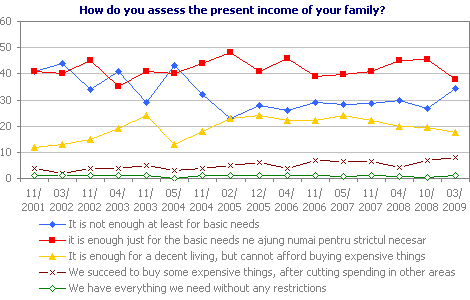
The recent BPO reveals that people have already experienced the impact of the international financial and economic crisis on the Republic of Moldova: 43 percent of the respondents consider that the impact of the crisis was serious and another 45 percent said that it was unimportant. Only 8 percent said that the crisis did not have any impact. Members of families of 62 percent of the respondents have directly experienced the effects of crisis and only 32 percent said that the crisis did not touch their families yet. These findings correlate with those on reduction of household incomes. In particular, the percent of families who are short of money to cover at least the essential has increased on account of those who faced difficulties to cover the strictly necessary spending.
The ratio of approximately 2:1 for families touched and untouched by crisis is also effective to assess the general direction Moldova is moving towards — less than 2/3 of the respondents fear that the country is moving towards a wrong direction and only 1/3 consider that the country is moving towards a right direction. In consequence, the poverty is back again to the top of problems which raise concerns, defeating the problem of prices, perhaps after the trend of falling fuel prices has strengthened.
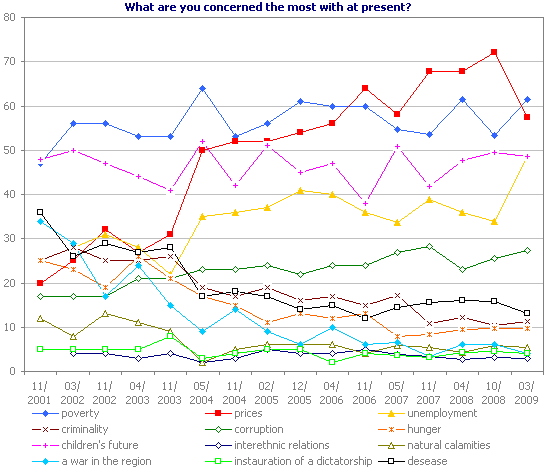
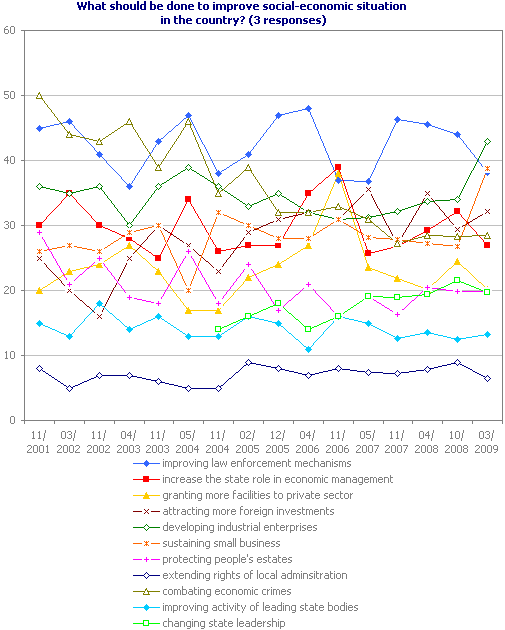
The concern with unemployment has suddenly increased (by about 15 percent), being equivalent to the concern of people over the children’s future. In this respect, responses relating to concerns correlate with data on solutions that people see to improve the situation in the country — industrial enterprises development policies and sustenance of small business. At the same time, the percent of those calling for increasing the role of the state in economic management has dropped much.
It is worth noting than 25 percent of the respondents have confirmed that someone in their households is working abroad. This percent is much lower than previous estimates, confirming the trend of Moldovan gasterbeiters to come back home. To note in this context that 3 percent of the respondents have made investments, 6.5 percent have money for investments, of them 1.5 percent do not know in which area they could invest and another 3 percent are afraid to invest their incomes. On the other hand, 10.6 percent said that they have savings for difficult times and 76 percent said that they do not have savings and means for investments.
Confidence towards personalities and parties
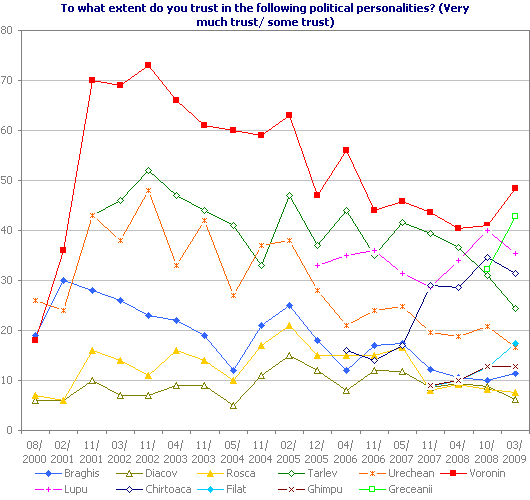
The conducting of electoral campaign since early February has updated ratings of main political leaders. According to free responses (to open question) regarding trust in political personalities, the rating of the leader of the Party of Communists of the Republic of Moldova (PCRM), Vladimir Voronin, has increased more in the present electoral campaign than in 2005, but on a generally descendent background. Ratings of leaders of the Liberal Party (PL) and Liberal Democratic Party of Moldova (PLDM), Dorin Chirtoaca and Vlad Filat respectively, have also grown. The rising grade of Filat’s rating is much stronger than of Chirtoaca. Perhaps, this is the effect of the much more dynamical campaign of PLDM.
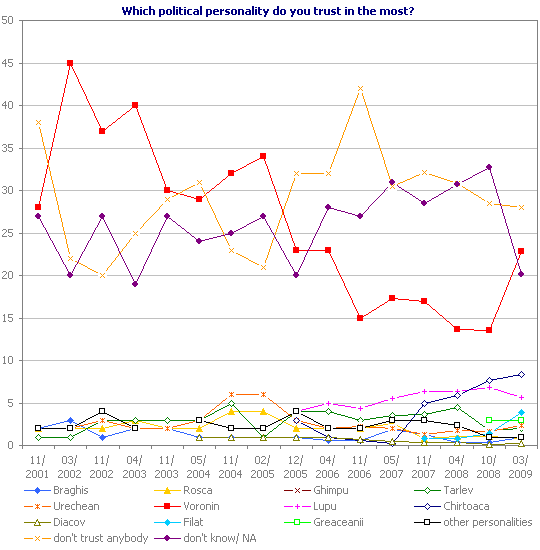
The closed question (presentation of the list of personalities) about trust in political personalities confirms a strong rise in the President Vladimir Voronin’s rating. The trust rating of Premier Zinaida Greceanii has grown much, defeating Speaker Marian Lupu, whose rating has fallen over limits of error margin. The PCRM extremely “technologised” media campaign, which includes the abundant use of administrative resources, dissemination of humanitarian assistance, make and sale of “electoral bread”, opening of social facilities in presence of PCRM leaders in full electoral campaign has fully manifested.
As well, the PLDM leader rapid ratings rise was confirmed on background of a stagnation or light fall of the Dorin Chirtoaca’s rating. However, the trust rating of Dorin Chirtoaca is the highest one among opposition leaders. Leaders of other parties earlier credited with great chances to cross the electoral threshold have serious reasons of concern.
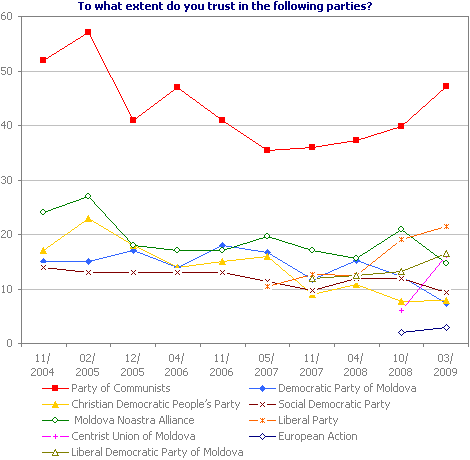
Results relating to confidence towards leaders correlate very well with data on trust in their parties. Hereby, the confidence rating of the PCRM has grown by about 15 percent compared with the one before the 2007 local elections. As well, in case of opposition parties the curves describing the evolution of trust in these parties repeat the curves describing the evolution of confidence towards leaders. There is just one exception in case of the Centrist Union of Moldova (UCM), as the trust in this party has increased much after former premier Vasile Tarlev was elected UCM leader. But Tarlev’s trust rating tends to fall as strongly as it has grown.
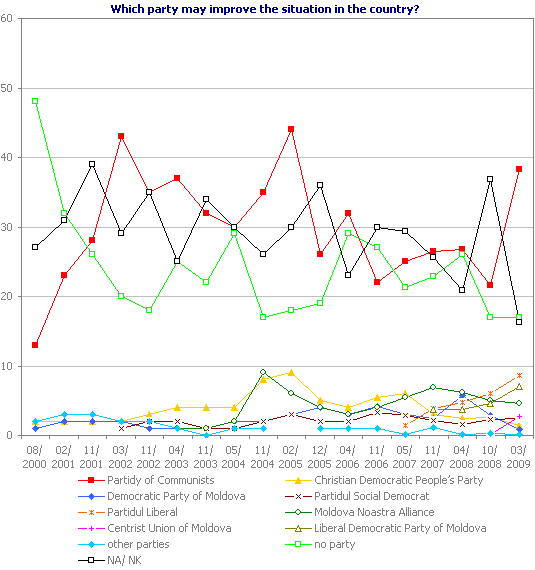
One more confirmation of these facts comes clearly from responses to the question about political force able to improve the situation in Moldova. In this respect, the percent for the PCRM has increased by 15 percent, compared with the last measuring in October 2008. The results for opposition parties repeat the trends revealed by responses regarding trust in leaders and their parties.
Plans to participate and vote
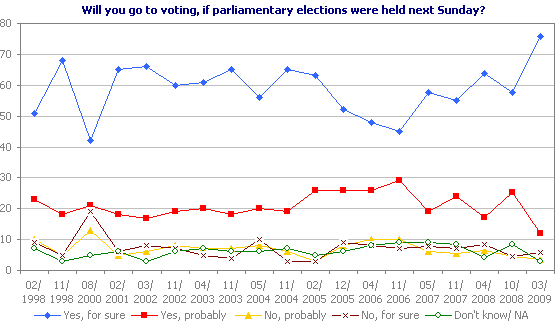
The recent BPO has revealed the highest intention to participate in elections. Long before the release of BPO findings, the Central Electoral Commission (CEC) was also confident that the turnout at the April 5 parliamentary elections will be much higher than the average rate for the last electoral cycles. It is hard to explain why the intention to participate in the April 5 elections is higher than usually. Howsoever, factors capable to influence the turnout are the following: the excessive straining of relations between the ruling party and opposition parties; the expected “change” promised by the opposition and its defeating by the “stability” promised by the ruling party; the comeback of many Moldovan gasterbeiters.
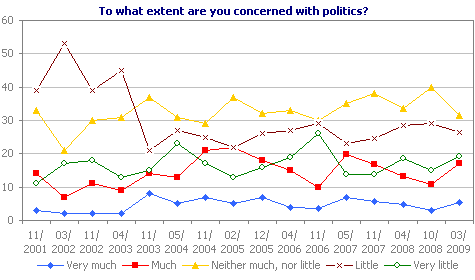
Although the poll was conducted during electoral campaign, the percent of those who are concerned little or very little about politics is pretty high — about 45 percent. This attitude of citizens towards politics provides the main explanation for the very high percent of people who cannot express an electoral option for political parties.
Although the number of undecided respondents has dropped down to 27 percent in the recent poll, compared with 45 percent in October 2008, it is much higher than the number of undecided electors before the 2005 parliamentary elections, when it was 20 percent. The pretty high number of the undecided hardens the estimation of final results of the April 5, 2009 elections.
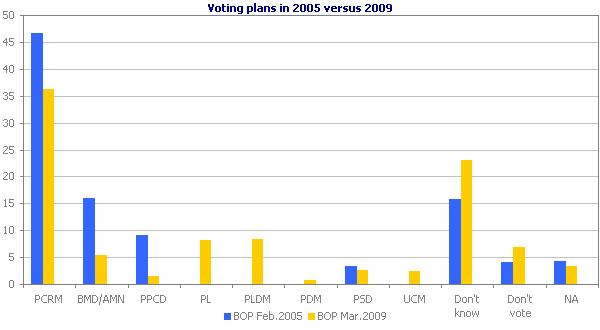
It is worth noting that the 2005 survey has “predicted” very precisely the results of the ruling party and votive opposition of those times — the PPCD — that means parties with a well-defined status PCRM — 47 percent, and respectively PPCD — 9 percent. The ascendant political force then — Democratic Moldova Bloc (BMD) — was measured only 15 percent of the voting plans, becoming the main absorbent of votes by the undecided and finally gathering 28 percent of the ballots. The difference between the percent of the PCRM and the aggregated percent of opposition parties which crossed the electoral threshold was approximately 23 percent in 2005. According to the present poll, this difference is just about 16 percent, given the certain chances of PL, PLDM and AMN to cross the electoral threshold. It seems that positions of opposition parties are better at present than in 2005, but things are not so sure. In the ongoing electoral campaign the ruling party is climbing more than the PL and PLDM, and the “main opposition force” AMN is losing this status, proving a very clear descending trend. Surveys last year conducted by various companies reveal that the AMN is becoming the “weak link” of the “liberal chain” AMN-PLDM-PL.
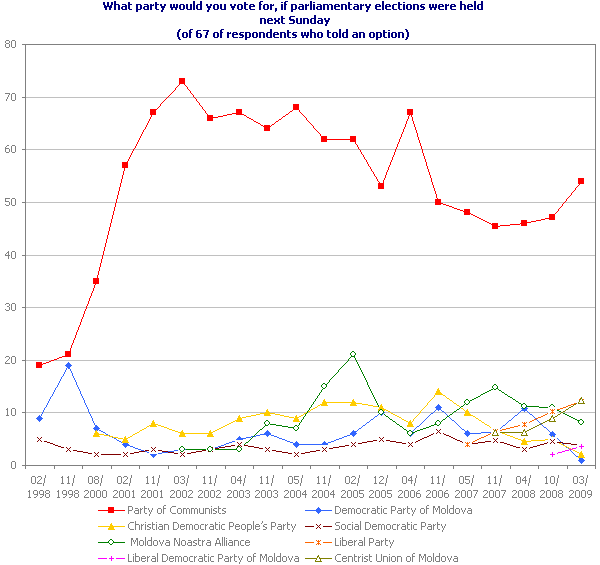
The factors mentioned above taken altogether reduce the certainty that the undecided will have at the April 5, 2009 elections a conduct similar to the one in 2005, voting preponderantly for opposition parties. A special research would be needed to make clear the voting behaviour of undecided voters.
There may be several more or less probable scenarios of the voting behaviour of undecided voters:
- The optimistic scenario for the ruling party. Due to the “technologized” campaign, the PCRM will keep attracting sympathies of a great number of undecided electors. This scenario is based on the reasoning that ascendency of the PCRM rating revealed in the diagram above did not stop and the rating of this party was on the fall before elections in 2005. In addition, it is hard to estimate the impact of the 20-percent rise of pensions for the 630,000 retirees on the eve of elections. At the same time, the rating of the “main opposition force” AMN is tending to fall unlike 2005, when this party was the pivot of BMD. Of course, the PL and PLDM will attract the absolute majority of undecided electors, but not the quasi-total majority the way the BMD did in 2005. The undecided will focus on the PCRM and aggregated liberal opposition at an equal extent, given the growth “grade” of their ratings, should this scenario come true. Therefore, the PCRM would garner 40–45 percent of the votes and the aggregated liberal opposition would win 30–35 percent. Of course, the percent of the aggregated opposition would grow due to the leaking of ballots of undecided electors mainly to the PL and PLDM and less to the AMN. This scenario would reproduce in fact the post-electoral situation from 2005;
- Optimistic scenario for the aggregated liberal opposition. This scenario is based on the supposition that the undecided electors have a relatively stable and repeatable conduct, the way it happened before the 2003, 2005 and 2007 elections. That means that the undecided electors go preponderantly to ascending opposition parties. Applying the “corrections” which proved to be effective for the elections concerned, both the PCRM and the aggregated opposition would win by approximately 40 percent. According to this scenario, the aggregated opposition could even win some percent more than the PCRM and here is the “optimism” of the situation, but it could also garner some percent less. The descending rating of the AMN reduces the chances of this scenario;
- Intermediary scenario. Given the error margin (±3 percent) and high number of the undecided electors, the findings of the poll leaves room for hope to the Social Democratic Party (PSD) and Centrist Union of Moldova (UCM) that they will cross the 6-percent threshold. There are no premises to suppose that an important percent of the undecided electors would not go to these parties. In the event the PSD and/or UCM cross the 6-percent threshold, these parties would become holders of “golden shares” someway. This situation would increase the probability of coalition partners for the PCRM on background of one of the two scenarios described above.
The results of the poll do not make positive forecasts for the Democratic Party of Moldova (PDM) and Christian Democratic People’s Party (PPCD). Leaders of these parties should ignore the findings of the poll, as they have some time to bring developers of the sociological research to the “infamy pillar”. Leaders of other electoral contestants may do the same. The only encouraging fact for them is that accordingly to findings of the poll, only 0.5 percent of the respondents regard it as an important information source.
Conclusions
- On background of a stronger manifestation of effects of economic and financial crisis, the poll reveals the competition of two major options — the “change” promoted by the PL and PLDM on one hand and the “stability” promoted by the PCRM on the other hand. Offers of other political parties seem to be common reverberations of the two major options. In this regard, it becomes clear that the “change” will be rather sectoral. The PL is becoming leader of the rightwing step by step and continues to “confiscate” the PPCD electorate. In its turn, the PLDM is becoming leader of the centre-right segment, enjoying a much wider field of manoeuvre and “confiscating” the PDM electorate, which the PLDM leader has quitted along with a number of branches in 2007. As ascending parties, the PL and PLDM seem to “confiscate” many AMN electors. This is the only visible explanation for the PL and PLDM ascension on background of the PPCD and PDM “fall” in the survey on the one hand and slower descending trend of the AMN on the other hand. The PCRM ascension as promoter of the “stability” endangers the chances of PSD and UCM to cross the electoral threshold. Hereby, the polarising degree of political scene on the “change” — “stability” line has become very clear, bringing the danger of collapse of “political centre”, as nuances of electoral offers are less important. The poll reveals that after the April 5, 2009 elections the distinct polarisation in parity conditions may undermine both the eventual “change” and “stability”.
- The PCRM has organised its campaign as it looked like the EU-Moldova Action Plan and related commitments did not ever exist. The conduct of the ruling party and its partners focussed on polarising the political spectre and antagonising the opposition. The extremely “technologized” campaign of the PCRM included wide media intoxication via “media holdings”; abundant use of administrative resources including humanitarian aid; electoral gifts such as cheaper “electoral bread”, a procedure also confirmed by bribery of citizens on budgetary funds or exchange of the “carpet of the chief of state” on people’s ballots, opening of social facilities in presence of PCRM leaders in full electoral campaign etc. This seems to be the main source to recover the rating which fell in 2007. Of course, the opposition has replied on the same level, committing 10 percent of violations, justifying this way the 90 percent of breaches committed by PCRM. “Alternative civic coalitions” base their operation on this fact, drawing the conclusion that “both the ruling party and the opposition have committed breaches, but everything was generally quite.” Nobody recalled the “code of electoral conduct”. In consequence, the post-electoral situation could be very strained.
- Immediately after elections opposition parties will face the problem of validating mandates for holders of “dual citizenship”, despite the ECHR decision on this issue. The PCRM has sent a very clear signal in this regard, withdrawing the persons who hold dual citizenship from its list of candidates. An eventual conflict in this regard could block negotiations on election of leading bodies of Parliament and chief of state. Consequences of such a blockage may be very serious for political stability, particularly when developments will take place on background of deepening effects of economic and financial crisis.