ADEPT | Gagauzia 2016 | Presidential 2016 | Elections 2015 | Bashkan 2015 | Gagauzia 2012 | Political Parties
Economic Policies on January 17–31, 2011
 |
 |
e-journal #161 |
Banking system
Despite the distortions on financial and banking international and regional markets, the banking system in Moldova in 2010 marked positive development trends. The capital of 1st degree, the financial indicator determining the solvency of banks and their consolidation level was about 6.76 billion lei at the end of the year, i.e. increasing by over 5% comparative to the end of 2009. This dynamics, in comparison with the decrease marked in 2009 by 2.8%, confirms the increase in the system and overcome of the crisis. The share of foreign investments in banks’ capital was 77%, i.e. by 0.6 percentage points lower compared with the end of 2009, following the capital increase at the expense of resident-shareholders’ investments. The average capital adequacy weighted on risk per system is still situated at a high level, constituting over 30% (when minimum level is 12%). Its reduction by 2 percentage points compared to the end of 2009 shows a progression of banks in making use of their potential for credit operations without jeopardizing their financial security. Total assets, an indicator showing extensive development of banking system, at the end of 2010 totalled by about 42.303 billion lei (U.S. $3.5 billion — Figure 1), i.e. having increased by about 6% compared with the end of 2009. During 2010 the quality of credit portfolio was also improved, so the unfavorable credits (doubtful and compromised) in the total of credits decreased by 3.1 p.p. since the end of 2009, constituting 13.3% at the end of the year. Return on assets (ROA) and return on equity (ROE) were 0.5% and 3% accordingly comparative to the negative values (-0.5%) and (-2.5%) marked in 2009.
Figure 1. Share of banking assets in GDP in%, 2010 estimative data
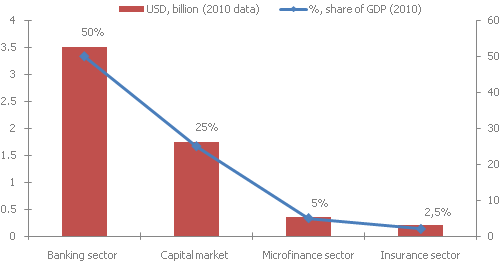
Source: NBM
Internal trade
Domestic sales are growing, as also confirmed by increased consumption…
NBS data show that in 2010 commercial establishments of all types of ownership sold consumption goods to population amounting to MDL 25.1 billion (nearly $ 2 billion), registering in real terms an increase by about 9% compared to 2009. This increase was largely due to increased sales of non-food goods (by over 11%) and food products (by about 4%). The growth of retail sales was registered in case of commercial units with mixed ownership, with foreign capital (about 10%), private (over 9%) and public (a little bit over than 5%). At the same time, the sales volumes were reduced (by about 12%) in case of commercial units with mixed ownership, i.e. with public and private property. This situation determined the change of sectorial share in the total of retail sales.
Figure 2. Structure of retail sales in commercial units with various forms of ownership in %, 2010
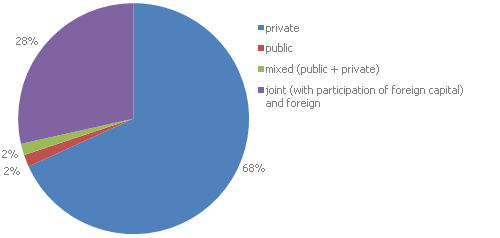
Source: NBS, www.statistica.md
Significant share in the total value of retail sales comes upon municipalities Chisinau — over 58% and Balti — about 8%, TAU Gagauzia — almost 3%, followed by the districts of Cahul, Orhei, Edinet, Drochia, Ungheni and Soroca. At the same time, in 2010 officially registered units have provided the population with paid services worth MDL 14.2 billion, marking under comparable price conditions an increase of over 5% compared to 2009. Businesses operators with mixed form of ownership (public + private), joint one (with participation of foreign capital) and private increased the volumes of paid services rendered to population by more than 23%, 9% and 4%. At the same time, the public sector economic operators have marked a decrease in the volume of services provided (-0.3%).
Agricultural sector
Increase in agricultural production on the background of an extensive and rudimentary sector…
According to preliminary assessments of NBS, the global agricultural production in the households of all categories and form of ownership in 2010 was in current prices MDL 19.72 billion, marking{0{/0} an increase of about 8% compared to 2009. The growth in agricultural sector was determined both by livestock production by about 14%, as well as crop production by more than 5%. In 2010 the share of crop production in total agricultural production was 66% (in 2009 — 68%), and the one of livestock production was 34% (in 2009 — 32%). The increase of crop production in 2010 compared to previous year was due to sown areas, as well as to increase of the average harvest of major crops. For example, the average harvest per hectare of sugar beet has increased by 84%, soy — by 70%, corn — by 22%, sunflower — by 20%, wheat — by 9%, vegetables — by 4%. The increase of annual average herd of cattle and pigs in households of all categories, as well as the growth of the number of birds have generated the increased production of main livestock products and animal products in total. Situation in the profile of household category indicates that 32% of gross agricultural production comes upon agricultural enterprises, 19% — peasants’ households (farms), 49% — population’s households. The high share of population’s households in agricultural production is determined especially by important share of animal production in these households (about 80% of total livestock production in the country).
Industry
Industry also grows…
In 2010, compared to 2009, the industrial sector has increased by 7%. So the industrial enterprises of all types of ownership manufactured products worth about 27.1 billion lei in current prices. Industrial output growth was driven by an increase in the volume of production in processing industry by 8%, in the quarrying — by about 6%, in the energy sector — by 1%. Substantial increases were marked in the following business sectors: sugar production — by 2.5 times (with a share of 3.3%), tobacco products — by over 30% (with a share of 2.6%), wine manufacturing — 6% (a share of 7.5%), manufacturing dairy products — by over 9%, manufacturing distilled spirits — by 11% etc. At the same time, there was a reduction of the production volume at enterprises with the following activities: manufacturing vegetable and animal oils and fats — by about 14%; manufacturing final metal products, except for machinery and equipment production — 19%; manufacturing of rubber and plastic-metal products — by about 7%; wood processing and wood products — by more than 21%, etc.
Archive
2011 2010 2009 2008 2007 2006 2005 2004 |
