ADEPT | Gagauzia 2016 | Presidential 2016 | Elections 2015 | Bashkan 2015 | Gagauzia 2012 | Political Parties
Economic Policies on March 1–15, 2008
 |
 |
e-journal #113 |
Inflation and prices
Inflation rate breaks new records…
The inflation rate in February was close to expectations of the market, reaching 1.5 percentRO, and this may have a negative impact on economy in general. In spite of official statements by NBMRO that “the January inflation is something separated and it cannot be regarded as a change of the trend or beginning of a new inflation rise trend,” the inflation has grown in continuation. So, our inflation forecasts made in precedent issues are becoming true.
According to recent data released by the National Bureau for Statistics (NBS), the Consumer Price Index (CPI) rose by 1.5 percent in February because of dearer gas, and the inflation rate for the last 12 months has grown up to about 15 percent, being a record in nearly two years. The February inflation was similar to the January rate and the cumulated rate for the two months was 3 percent. The inflation was fuelled most by a 2.4-percent price rise of food products (in particular of fruits, vegetables, meat, etc.), followed by a 1.8-percent growth of tariffs of public services (particularly water providing, sewerage, heating and electricity tariffs) and a 0.5-percent advance of prices of manufactured goods. The big share of food products in the CPI calculation (35 percent) maintains the inflation at high levels.
The inflation rate could be the same or even higher the next two months because of dearer energy agents, dwelling services and food products. The current dynamic maked recently the central bank increased the monetary policy interest by 1.0 percent, up to 17 percent. The March-April inflation could exceed the annual rate of 15 percent, and this could be a maximum level for this year, and it could calm down below 14 percent by the end of 2008. However, it will depend on the 2008 agricultural year and evolution of prices of energy agents imported from Moldova.
Banking sector
Commentaries on recent amendments to the law on financial institutions…
The Parliament has recently passed in the first reading a set of legal amendments which introduce a 100-million-leu (more than 9 million dollars) single quota for the overall normative capital of commercial banks. Thus, the National Bank of Moldova will allow financial institutions to work unless they hold a 100-milion-leu overall normative capital. These amendments aim to adjust the law on National Bank and the law on financial institutions to international banking standards, as well as to other effective legal acts. In fact, by increasing the normative capital of commercial banks, the central bank wants to make them respect European requirements and standards. In addition, this action aims to strengthen the domestic banking system.
But sometimes the central bank uses this tool in situations of potential crisis or instability of the system. Therefore, the monetary authority would do this for two reasons: either to boost the credibility of the system or to influence the capitalisation of some domestic banks which do not respect the NBM norms. However, such a situation was not observed on domestic banking market. The required minimum normative capital will not affect banks, as statistics released in late 2007 reveal that all 16 banks in Moldova have a normative capital of over 100 million lei.
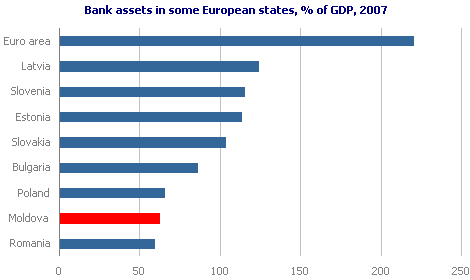
At present, overall assets of the Moldovan banking system are estimated at about 33 billion lei[1] (approximately 2.8 billion dollars) or nearly 62 percent of the GDP (2007). They are apparently enough, if compared with the number of country’s people, number of clients and given the complexity of the national economy. On the other hand, if comparing this indicator with those from other countries in the region, Moldova is ranked a last place (see Diagram 1). Even more, assets of Moldovan banking system count for 50 percent of all assets of Transilvania Bank of RomaniaRO, which is ranked the 4th place in the top of Romanian banks as regards overall assets. Therefore, the domestic banking system is not capitalised enough in spite of positive statements.
Diagram 1. Bank assets in some European states, % of GDP (2007)
Source: NBM, NBR, ECB, EBRD, RST 2007
Public funds
Progressive taxation system vs. single taxation quota…
A best fiscal level is rarely found in an economy; that means to satisfy the tax-payer on one hand and the state, which collects taxes, on the other hand. In other terms, what is the best fiscal system: that based on a progressive taxation, the one implemented in Moldova, or the single taxation quota applied in many European countries? The state budget share exceeds 30 percent of the GDP in Moldova. It exceeds 60 percent in the rest of Europe. The tax policy did not grow so far and this is called taxation basis. Although it was said two years ago that the Government was considering the perspective of introducing a single taxation quota for incomes of individuals, officials of the Ministry of Finance have recently called for the maintenance of the current progressive taxation system for revenues of individuals. Even more, the progressive taxation system will be maintained in 2009–2011, too.
The implementation of the single taxation quota proved in some countries such as Romania, Estonia, etc., that revenues covered most of expenses of the consolidated general budget. The necessity of implementing such a tax system in Moldova would result from variety of existing taxes, rather than from the high taxation level, which is medium compared with European Union, as various taxes harden their monitoring and collection to different budgets and maintain a quite large administrative apparatus. The single quota is attractive for being simple and comfortable due to its low costs. On the other hand, its implementation could increase the social polarisation, as people who are paid low salaries would suffer and those who are paid high salaries would be advantaged.
Foreign trade
Trade deficit — code red…
According to NBS statisticsRO, the trade deficit — inequality between value of exports and imports — increased on all categories of products from the list of trade balance in January 2008. At the same time, the surplus declined in continuation for few categories of products for which exports were larger than imports, going in fact to a deficit. The January 2008 trade deficit was roughly 173 million dollars, and it increased by about 40 percent, compared with January 2007 (123.5 million dollars).
Imports in Moldova were valued at more than 261 million dollars in January 2008, and they exceeded by about 33 percent the January 2007 indicators (197.2 million dollars). Imports from CIS have increased by nearly 19 percent, while imports from the European Union have advanced by more than 42 percent. In January, Moldova registered the highest trade deficit with Russia (-36.3 million dollars), Ukraine (-25.5 million dollars), Romania (-18.2 million dollars), China (-13.4 million dollars), Turkey (-13.2 million dollars), Germany (-11.3 million dollars).
Currency
Leu reaches new records versus dollar…
The appreciation of the leu versus E.U. dollar reached the level of 1999–2000. The strong appreciation of the leu could calm down the inflation in the near future, compensating eventual higher prices of food products or tariffs for some public services. However, the appreciation of the leu advantages the National Bank on a short term, because it helps temperate the inflation but fuels the foreign deficit. If the leu continues to appreciate this way, foreign deficits will grow more (because a strong leu encourages massive imports) and the durability of the economic growth registered until now will be uncertain. The present trend could revert, that means the leu could depreciate and this would hit borrowers of foreign currency.
Cheaper imports and credits…
Imports could grow should the leu appreciate versus main reference currencies. At the same time, Moldova “may play this card” for its interest, should equipment and technologies be imported to cheaply modernise the economy. But cheaper imports could also disadvantage the national economy: larger imports of cheaper and better goods than Moldovan products would estrange clients from domestic producers who already face problems. On background of the appreciation of leu and lower interest rates on credits in foreign currency than on loans in lei, population and economic agents would choose this kind of credits without ensuring themselves against currency risk. Should the domestic currency depreciate, they would see their rates growing by the same percent. But the leu is unjustifiably growing.
Labour market
So far, Moldova is the European country with cheapest labour force…
A study by Technology Forecasters Inc. reveals that Moldova has the cheapest labour force in Europe. According to the study, a qualified Moldovan worker earned about 3,600 dollars in 2006, compared with more than 34,000 dollars paid to a worker in Germany, country with the dearest labour force in the European area. At the same time, the medium cost per hour in the E.U. (15 members only) was about 25 euros in 2006 and the average cost in the other 10 new E.U. members was about 7 euros, compared with 0.6 euros per hour in Moldova. The cheap labour force should make Moldova more attractive for international companies, but not many foreign enterprises come to Moldova so far.
- ↑ Accounts for January 2008.
Archive
2011 2010 2009 2008 2007 2006 2005 2004 |
