ADEPT | Gagauzia 2016 | Presidential 2016 | Elections 2015 | Bashkan 2015 | Gagauzia 2012 | Political Parties
Economic Policies on November 1–15, 2008
 |
 |
e-journal #127 |
Prices and inflation
Inflation forced to fall…
According to NBS accounts, the inflation rate for October was 0.8 percent. It was influenced by higher prices for food products, which have increased by 1.5 percent, manufactured goods by 0.4 percent, and tariffs for public services by 0.5 percent.
The growth of prices of food products in October was linked to higher average prices in September; in particular, prices of agricultural products such as tomatoes have increased by 30 percent, aubergines by 7 percent, peppers and red peppers by more than 6 percent, dietetic eggs by 12.5 percent, and sausages by more than 3 percent. Tariffs for public services rose in October as follows: drinkable water supply and sewerage services by more than 7 percent, hotel and spa services by about 6 percent, and public alimentation services by about 2 percent. However, prices for this category could go up in November, as the heating tariff for population has been increased.
The cumulated inflation rate for 2008 (October 2008 compared with December 2007) is 7.5 percent (for information, the inflation rate was 10.7 percent in October 2007, compared with December 2006). Medium prices in the last 12 months (October 2008 compared with October 2007) have grown by 9.8 percent (14 percent in October 2007, compared with October 2006).
Banking sector
The banking system not affected by financial crisis, for the time being…
Deposits in Moldovan lei by individuals in domestic commercial banks have grown by 150 million lei in the first week of November 2008. According to data of the Ministry of Economy and Trade, deposits in foreign currency by individuals have decreased by 144.8 million lei in the same period due to the appreciation of the euro-leu exchange rate.
Despite consequences of the world financial crisis, the rise of deposits in lei reveals the confidence of people towards the domestic currency and banking system, which seems to be among most stable in the region, according to many references (IMF, WB). Data of the National Bank of Moldova show that deposits by individuals in commercial banks accounted for 24 billion lei, including 14.4 billion lei in Moldovan lei and 9.6 billion lei in foreign currencies. The supply of deposits in the banking system has grown by about 3.4 billion lei this year.
Foreign trade
Spirits exports up by 76 percent…
The spirits exports from Moldova have grown by 76 percent in nine months of this year, compared with the same period of 2007. According to accounts of the agro-industrial agency Moldova-Vin, exports have grown up to more than 146 million dollars, compared with 83 million dollars in 2007. The agency said that more than 86 percent of exports went to the CIS, and they were worth more than 126 million dollars (by 82 percent more than in 2007). Exports to the EU were worth more than 17 million dollars (by 42 percent more than in 2007), and Moldova exported spirits worth about 3 million dollars to other countries (by 38 percent more than in the same period of last year).
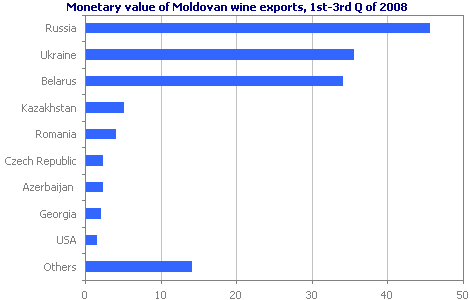
As a rule, the largest spirits supplies went to the Russian Federation — 47.6 million dollars, exports to Ukraine were worth over 35 million dollars, Belarus — more than 34 million dollars. According to Moldova-Vin, Moldovan wine exports to Kazakhstan were worth 5 million dollars, Romania — more than 4 million dollars, the Czech Republic 2 million dollars, Azerbaijan — over 2 million dollars, Georgia 1.4 million dollars, and the U.S. 1.2 million dollars.
Diagram 1. Value of Moldovan wine exports in the 1st-3d quarters of 2008, million dollars
Source: Agro-Industrial Agency Moldova-Vin, www.aamv.gov.md
Social sector
Moldova has most retirees…
The Parliament has recently passed in the first reading the draft state social insurance budget (SSIB). The budget was not modified in terms of structure. However, its revenues have been increased, but this is something normal when the number of state-assisted people increases every year, particularly due to rise in the number of retirees. Single birth indemnities and monthly allocations for growing up babies have being increased. Finally, the measure that employees will feel is the rise of their contribution to the state social insurance budget by 1 percent point up to 6 percent. This rise seems to have an explanation. Firstly, the number of employees decreases every year, and therefore, social insurance revenues are on the decline. Secondly, the number of retirees is on the rise every year and more resources will be needed to maintain them. For example, the elderly counts for 15 percent of the population and this is a very high share.
In addition, pensions will be indexed 20 percent, both accordingly to the inflation rate and rise of the monthly medium nominal wage. Therefore, the pension fund will be increased by about 909 million lei and will account for about 5.4 billion lei. This rise will be particularly due to the increase of the social contribution by employees. Indeed, the policy on this sector over the last years was focussed on social salaries rather than on social policy elements such as reformation of the pension system which is discussed much for a long time. Moldova, for example, has more than 620,000 retirees.
Reform of pension system…
Building non-state or private pension funds is being discussed for quite a long time. These funds are generally part of a developed financial market, but our financial market or capital market is growing up. For example, contributions by employees to private pension funds would be an investment for a calmer and more stable retirement accordingly to annual contributions, as well as a lasting solution to a long-term crediting of economic agents. These institutions along with banks form the financial market in the world and the Moldovan legislation does not ban such funds.
A solution to remedy an eventual crisis in the retirement system would be for the Government to find all possible ways in order to oblige Moldovans working legally abroad to contribute to the retirement system in the countries they work and to further transfer the rights. But this would be possible in the event Moldova has (or will have) such agreements with the countries concerned. Otherwise, Moldovan immigrants could contribute directly to the domestic retirement system from other countries, as the security of this system could run a risk when some immigrants will come back home.
Archive
2011 2010 2009 2008 2007 2006 2005 2004 |
