ADEPT | Gagauzia 2016 | Presidential 2016 | Elections 2015 | Bashkan 2015 | Gagauzia 2012 | Political Parties
Economic Policies on January 1–31, 2008
 |
 |
e-journal #110 |
Inflation and prices
Inflation is still a problem for Moldova on long term…
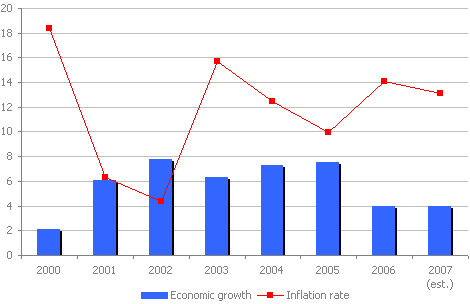
The inflation rate in Moldova was 13.1 percent in 2007 (compared with the 10-percent governmental forecast) and this is the main reason of concern for economy in 2008, too. The inflation target established by Government and National Bank of Moldova for 2008, 9 percent plus or minus one percent, could be failed because of internal and external factors, even if the central bank would increase the basic interest rate. At the same time, a rise of the reference interest of the central bank could affect the economic performances of companies by increasing the crediting costs. In addition, a higher interest and stricter conditions on monetary market would not make commercial banks careless, as they would not hesitate to increase the crediting costs in spite of competition. Therefore, effects on economy in general will not be the best.
Possible rises of volatile prices (food products, fuels, tariffs of public services) are expected to grow the next months, and this will strongly increase the annual inflation rate. However, the National Bank is not to blame for perpetuation of inflation, as current consumption prices for which the demand is inelastic are on one hand, and the evolution of the exchange rate is on the other hand. At the same time, the central bank may negotiate some solutions with the Government, as for example administrated prices, which could help the inflation on a short term. But as regards the long term, the inflation is a problem for Moldova so far, as inflationist pressures exceed the potential. Volens-nolens, the central bank will have to seriously consider stricter crediting conditions, as the recent expansion of high-risk credits could affect the inflation targeting policies in future.
Diagram 1. Evolution of economic growth and inflation rate, annual rates in percent
Source: NBM, Macroeconomic indicators
At the same time, the budgetary policy shall be prudent in continuation, in order to support efforts to reduce the inflation. However, it is unknown how real the 2008 budgetary deficit target of 0.5 percent of the GDP is, since the budget was constrained after the reduction of income taxes. Priorities regarding expenses shall be redirected from current expenses to productive investments. The role of the budgetary policy is limited, particularly because of small revenues from production and big development necessities of the country. Also, the ability of the monetary policy to compensate the impact of strong capital inflows and reduce the inflation is partly limited by weak delivery channels and undeveloped financial market.
Financial-banking system
Bank assets up to 2.83 billion dollars in 2007…
Overall assets of the banking system were worth about 32 billion lei (2.83 billion dollars) in 2007 and they increased by 68 percent, compared with 2006. The rise of assets of commercial banks was particularly due to the growth of the credit portfolio and supply of deposits by population, as well as to the continued advance of foreign investments in banks’ capital. The supply of deposits in banks rose by more than 63 percent in 2007. Interests on credits and deposits were stable in spite of inflationist trends and rise of basic rate and demand for loans, in particular by population. The average rate on credits increased from 18.7 percent in January up to 19.2 percent in December. At the same time, interests on credits in foreign currency decreased from 11.1 percent down to 10.8 percent.
The share of foreign investors in capital of domestic banks exceeded 65 percent. Although foreign investments have reached a record, the rise was lower compared with the precedent year, when it was 12 percent. The advance of foreign investments in capital of Moldovan banks in 2007 was particularly due to the rise of the share of the French group Societe Generale in the shareholder capital of Mobiasbanca up to 95 percent, investment of the ExImBank revenue in bank development and purchase of 25 percent of the FinComBank shares by the investment company Horizon Capital.
Financial sector is insufficiently developed so far…
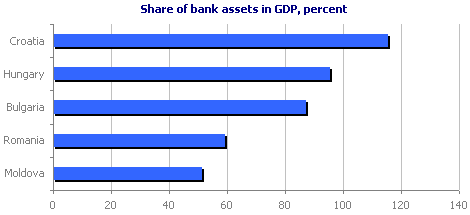
A joint mission of the International Monetary Fund and World Bank, the Financial Sector Assessment Program (FSAP) in 2007 revealed that the banking is very resistant to external shocks, but it is still behind similar systems in terms of economic management. All assets and credits for the private sector have doubled starting 2001, but the share of the financial sector in economy, which is 54 percent and 51 percent of the GDP, is low so far, compared with more developed countries in the region (Diagram 2). Only about 10 percent of households from rural areas have access to bank accounts. Elsewhere, the IMF noticed that structural reforms aimed to improve the financial infrastructure and budgetary framework, agreed earlier within the PRGF, have been implemented.
Diagram 2. Share of bank assets in GDP: regional comparisons
Source: Economist Intelligence Unit
External financial place of country
International reserves of NBM estimated at 33 percent of GDP…
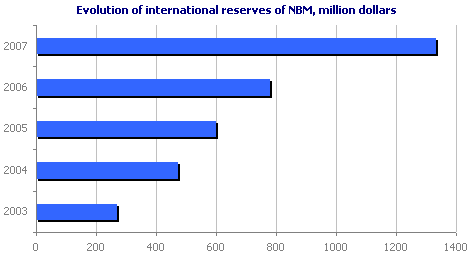
International reserves of the National Bank increased by 72 percent in 2007, up to 1.33 billion dollars, which is 33 percent of the GDP (2007). They reached an absolute record in terms of volume and rise pace. The great rise of reserves was due to interventions of the central bank by acquiring the excessive currency liquidity on domestic market occurred after large remittances from abroad. Accordingly to the August 2005 methodology, the mandatory reserves of the whole banking system and currency from the directorate of credit lines of the Ministry of Finance are calculated as part of the reserves. Of course, the value of reserves is relatively high, but it is unknown how enough is it, in order to help the Government control eventual financial or currency shocks, especially from outside. Even more, if comparing this indicator with those from other countries in the region, Moldova’s currency reserves are very low. In addition, they are incomparable with international reserves of most developed states compared with their share in the GDP. For example, Japan has an international reserve like the United States and Europe altogether.
However, some of the currency comes from modification of the minimal reserves in currency of commercial banks, which does not belong to the state. That’s why they are called reserves, as a bank must have currency to reimburse people if it goes bankrupt. International reserves have grown very much due to massive remittances. But the central bank is summoned to buy the currency excess in order to prevent a strong appreciation of the leu, as long as the economy cannot assimilate it, this being a dangerous trend in an economy which is vulnerable in front of external developments. At the same time, Moldova’s foreign debt exceeds 3 billion dollars. The state and state-guaranteed foreign debt exceeds 931 million dollars and the non-guaranteed private debt accounts for 2.1 billion dollars. The commitments by economic agents exceed 43 percent and of the governmental sector is 25 percent in the structure of the foreign debt. Short-term foreign commitments exceeded 1.1 billion dollars (37.5 percent of the debt).
Diagram 3. Evolution of international reserves of NBM, million dollars
Source: NBM data
Archive
2011 2010 2009 2008 2007 2006 2005 2004 |
