ADEPT | Gagauzia 2016 | Presidential 2016 | Elections 2015 | Bashkan 2015 | Gagauzia 2012 | Political Parties
Economic Policies on January 31 – February 13, 2005
 |
 |
e-journal #46 |
Prices
In January 2005 consumer price index rose over December 2004, i.e. 101.1%. According to Statistics and Sociology Department, the greatest price hike in January was registered on food, while price on non-food products registered a slight change. Consumer price index on food amounted 102.6%, non-food — 100,4 %, and services 99.3%.
Labor market
According to a report of the Department of Statistics and Sociology (DSS), the average monthly salary in the economy made up MDL 1,496 in December 2004, by MDL 287 more than in November. The average salary increased in December of last year, as compared to November, at the expense of the increases paid to employees at the end of the year.
In the budgetary sector, the average salary made up MDL 961 in December 2004, and in real economy sector, the average work remuneration index constituted MDL 1,774. The highest salaries were received by bank employees, on average MDL 4,620, by MDL 1,830 higher than in the previous month. In education, the average salary constituted MDL 855 in December 2004, and in health and social assistance sectors — MDL 1,011.
Nonetheless, DSS shows in its latest report, from the beginning of January, that, as at 1 December, salary arrears made up MDL 158 million, which is by MDL 10 million more than at the beginning of 2004.
Public funds
Government sources say that the plan of collections to the state budget for January 2005 was fulfilled in advance with an outrun of 11.3 percent, as compared to the forecasts. According to the data provided by the Ministry of Finance, the income collected in the state budget amounted to MDL 428 million, which is by MDL 43.4 million more than planned. The increase in budgetary income was by MDL 151.6 million or 54.9 percent higher than in the similar period of 2004.
The 2005 state budget law approved income of MDL 7.47 billion and expenses of MDL 7.72 billion. The income section of 2004 state budget law was executed at the rate of 101 percent, and the expense section — at the rate of 99.9 percent, with a budgetary surplus of MDL 125 million, which was directed towards external debt payment.
Banking and insurance
Eventual consequences of the reduction in bank interest rates
The National Bank of Moldova (NBM) recommended to the commercial banks, in a press release made public last week, to revise their liability (deposit) interest policy, which would allow for “a revision of the asset (loan) interest policy and a more efficient placement of excess reserves”.
The Central Bank requires, in fact, commercial banks to reduce their deposit interest rates in order to decrease the rate of interest on loans granted. At the same time, the release says that NBM is concerned about the high financial liquidity in the system (this being a factor that could stimulate inflation), which increased in the first month of the year by 2.2 times (from MDL 508.6 million at 31 December 2004 to MDL 1,095.2 million at 31 January 2005), and thinks that such liquidities must be placed in the economy at lower interest rates.
Many financial experts say that, if the National Bank’s recommendations are implemented, they will affect the depositors’ pockets, forcing them into withdrawing some of their savings from banks. On the other hand, too low interest rates on the loans granted to economic agents will stimulate internal demand, thus making it more complex to attain the inflation target.
For a central bank, which mainly aims at controlling inflation, and taking into account the effects of tax reduction (as well as of the increase in prices of public utilities), the fast fall of interest rates is an incongruity. And here comes the need for a low budget deficit to support the reduction in inflation. We think that overburdening the budget as an instrument of economic policy could cause major collateral damages.
In 2004, the average interest rate on loans granted in national currency was maintained at the level of 21 percent, and on loans granted in foreign currency — at the level of 11.3–11.6 percent, and interest rates on deposits increased on average from 14.8 percent at the beginning of the year to 15.5 percent in December 2004.
Foreign trade
According to the Department of Statistics and Sociology (DSS), the trade deficit of the Republic of Moldova constituted about USD 788 million in 2004 and exceeded by 28.5 percent the figure registered in 2003. In 2004, the amount of exports was estimated at USD 986.2 million, and imports — at MDL 1,774.2 million.
The Government had forecast for 2004 exports of USD 900 million and imports of USD 1,525 million, with a deficit of USD 625 million. The Republic of Moldova had a positive balance, amounting to USD 137.1 million, with Russia, and the highest foreign trade deficit with the main partner countries was registered with Ukraine, of USD 211.1 million. Moldova registered a high level of the trade balance deficit with France, Germany, Romania and Turkey.
The trade deficit has grown by circa 30 percent in the past two years. In the middle of January, the Government approved an action plan to lower the trade balance deficit, which specifically provides for the institution of a tougher control over the preferential import of goods, especially in free economic zones, as well as for the simplification of export procedures.
Moldova and the world
According to the data of the CIS Statistics Committee, the Republic of Moldova registered in 2004 one of the most modest economic growth among the Community’s countries, with an increase in the Gross Domestic Product of 7.3 percent, under the average economic growth of 8 percent, achieved in the post-Soviet space.
The trend of the Moldovan economic growth outran only those of Kyrgyzstan and Russia, which registered a growth of 7.1 percent. On the other hand, the Republic of Moldova was outrun by Ukraine, with a GDP increase of 12 percent, Belarus — 11 percent, Tajikistan — 10.6 percent, Azerbaijan — 10.2 percent, Armenia — 10.1 percent, Kazakhstan — 9.4 percent and Georgia — 8.4 percent.
In 2004, the Gross Domestic Product comprised, according to the preliminary estimations, MDL 31,992 billion in current prices. The registered progress is under the level forecast by the Ministry of Economy, which anticipated an economic growth of 8 percent.
Industry has registered an increase of 6.4 percent, while agricultural production increased by 20.4 percent. The increase in the industrial production was much lower than the 2003 level, which constituted 13.6 percent. The production from the industrial sector is mainly generated by processing industry enterprises, which accounted last year for 89 percent of the total amount of the industrial production.
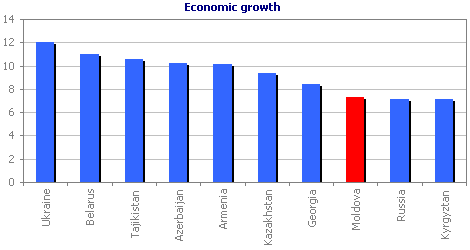
Sourse: Department of Statistics and Sociology
Archive
2011 2010 2009 2008 2007 2006 2005 2004 |
