ADEPT | Gagauzia 2016 | Presidential 2016 | Elections 2015 | Bashkan 2015 | Gagauzia 2012 | Political Parties
Economic Policies on February 1–15, 2008
 |
 |
e-journal #111 |
Inflation and prices
Price rise: eventual forecasts…
Prices of food products and fuels have strongly increased on foreign markets in 2007. Tools and levers used by the National Bank of Moldova to dam up the inflation have partly succeeded. However, the rise of petroleum and wheat prices on international markets is mostly exogenous shocks that no central bank can defeat. They fuelled the inflation besides the drought and the rise of local administrated prices. Influences of the inflation growth late last year will affect this year, too.
Prise rises and eventual salary claims of trade unions and employers could turn into an eventual social crisis. Although Moldova is now at the phase of a “yellow code” regarding the rise of prices of majority basic products, trade unions have resumed the pressures to obtain higher salaries. Ceding to them would mean higher earnings for certain categories of workers, but the price-salary spiral may push the economy to a recession. Latest inflationist pressures affected the evolution of the real salary (Diagram 1).
One more serious reason to fuel prices was added in late January, in particular, dearer natural gas and electricity supplied to private consumers. In addition, the public agenda was filled up by warnings from some producers, who say that the price rise will be unavoidable, fuelling this way the governmental forecasts. This is the effect: a necessity to increase salaries at least accordingly to prices has naturally appeared. It will mean an additional expense from the budget uncompensated by higher revenues, which unbalances more the economic indicators. This fact may make foreign experts and assessors give negative marks and thus the confidence of investors towards domestic economy may decline.
The annual inflation is expected to exceed 10 percent in the first half of this year and to temper in the second semester, reaching 10–11 percent in December, if the agricultural year will be “normal”. But there are also factors capable to halt the decline of inflation such as salary rises, an “easier” budgetary execution, besides the “fiscal revolution” tools introduced earlier this year and a further rise of petroleum price.
Diagram 1. Evolution of main economic indicators, annual rates in %
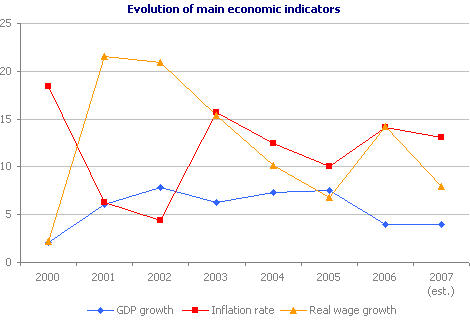
Source: NBM and NBS reports
Financial-banking sector
Measures that the NBM has directly or indirectly taken to attenuate the inflationist expectations last year could increase the interest rate on credits. Credits could become dearer soon, both because of direct methods applied by the central bank and on background of a shorter liquidity on market, aimed to limit the growth speed of credits. This trend was already observed in the crediting policy of many domestic banks. More than that, the NBM accelerated this year its interventions on monetary market, “swallowing” the liquidity excess and maintaining the bank interests at a level closed to the key interest (16 percent). On the other hand, many analysts notice that the rise of interest rates is unavoidable under current market conditions.
Now the average interest on a classic deposit for a 12-month term in a domestic bank is a little higher than 4 percent. But clients often signal that they do not gain anything after deducing the inflation rate and eventual fees. In other terms, the real output is negative; it means that the interest paid by a bank does not protect against inflation, in particular, when the inflation is pretty high. Interests on deposits should be higher than the basic interest of NBM — 16 percent. This would be a fair rate, given the demand-supply relation on market, inflation rate and requirements imposed by the central bank.
As deposits are not a special investment, state securities (HVS) may provide high interests. But the access of people to such securities is quite difficult. However, now small and medium banks shall affirm themselves. Some of them are already offering higher interests than the medium rate on market, winning room in front of other financial-bank institutions. Or, the competition would accelerate under such conditions, as no bank would accept to lose its clients and would have to increase the interests.
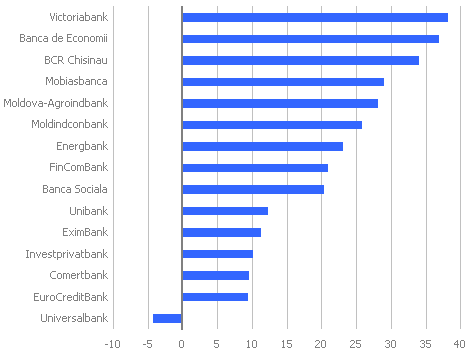
Diagram 2. Standing of banks regarding return on earning ROE in %
Foreign trade
Exports increased, but slower than imports…
Moldova’s commodity exports in 2007 were estimated at about 1.34 billion dollars and rose by 27 percent compared with 2006. Moldovan exports to the European Union increased by more than 26 percent last year, while deliveries to the CIS advanced by nearly 30 percent. The following were the main partner countries of Moldova in terms of exports in 2007: the Russian Federation, Romania, Ukraine, Italy, Germany, Belarus, Poland, Kazakhstan, the United Kingdom and North Ireland. Textiles and items, appliances and devices, power appliances, mineral products, vegetal products, footwear, other commodities count for more than 83 percent of the Moldovan exports.
At the same time, imports were worth nearly 3.69 billion dollars and rose by 37 percent compared with 2006. Imports from the European Union have grown by 38 percent, while those from the Commonwealth of Independent States increased by about 31 percent. Important rises were registered for transportation means and materials, food products, drinks and tobacco, plastic materials, medications, detergents, and others. The big difference between the evolution of exports and imports accumulated a trade deficit worth over 2.3 billion dollars in 2007, which is by 43 percent higher than in 2006.
Labour market
Medium salary up, but living standards did not improve…
The nominal medium salary on economy accounted for 2,063 lei (about 170 dollars) in 2007 (enterprises with at least 20 workers) and it increased by 22 percent compared with 2006. However, the 2007 inflationist pressures hit the evolution of the real salary, which increased by only 8 percent on average. The medium wage in budgetary sector amounted to 1,625 lei (130 dollars), while the average salary in the real sector of economy accounted for 2,292 lei (182 dollars). The medium salary of a worker in December 2007 was 2,630 lei, by 20 percent more than in December 2006. The medium salary in budgetary sector accounted for 1,832 lei, while the wage in real sector amounted to 3,054 lei.
Archive
2011 2010 2009 2008 2007 2006 2005 2004 |
