ADEPT | Gagauzia 2016 | Presidential 2016 | Elections 2015 | Bashkan 2015 | Gagauzia 2012 | Political Parties
Economic Policies on October 1–15, 2006
 |
 |
e-journal #82 |
Inflation and prices
Inflation rose by 1.1% in September compared with August…
The inflation rate rose by 1.1% in September compared with August. The growth affected all groups of commodities and services included in the Consumer Price Index such as food products, manufactured goods and services granted to population. The cumulated inflation rate for January-September 2006 was 9.1%.
Prices of some food products, especially vegetables (which is rather a paradox for autumn), fowl and dairy have grown in the period concerned. Prices of fuels, including coal, furniture, drugs and building materials have risen among manufactured goods. Tariffs for carriage of passengers by taxi, hotel services, house repair, travel services have also grown.
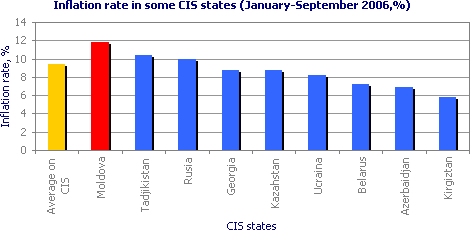
According to the CIS Committee for Statistics, the annual Moldovan inflation is the highest one in CIS — 11.9%. Following Moldova in this rating is Tajikistan, which reported 10.4% inflation, Russia 9.9%, Azerbaijan 6.9%, Belarus 7.2%, Georgia 8.7%, Kazakhstan 8.7%, Kyrgyzstan 5.8%, Ukraine 8.2%. Inflation on CIS was 9.4%.
Labour market
About 309,000 persons formally left for abroad…
According to formal statistics, about 309,000 persons capable to work were declared as working or seeking jobs abroad in the first half of this year. This number represents more than 20% of the total of active population. Two thirds of those declared departed are men. Each second of three men who left for abroad is from village. Other sources indicate a much higher number of Moldovans working or seeking jobs abroad. According to a study on migration and remittances conducted by the International Organisation for Migration in October-November 2004, about 571,000 Moldovans were working abroad or nearly 40 percent of the population capable to work.
Exodus of population leads to ageing of population, depopulation of country…
Bad economic conditions in Moldova have encouraged a massive departure of labour force to western countries. The failure to pay higher salaries to people in order to make them stay home led to a very massive exodus. Many people leave for West Europe because salaries there are very high compared with what they earn at home. In spite of many actions to stop the illegal exodus of labour force, it was not stopped and the number of those who come back home is very low. If current trends on labour market continue, how will Moldova’s population look like in 2050? We may be in a situation when an employee would “carry” 9 retirees, children and students. Pensions, allocations, health and education would be paid from his salary. IMF estimates show that net remittances of Moldovans working abroad will formally amount to 1.1 million dollars this year and to over 1.3 billion dollars in 2008, which represents more than 30% of GDP.
Foreign trade
Trade deficit is strongly growing…
Trade deficit registered a record of nearly one billion dollars (997.5 million dollars!) in January-September 2006, by about 36% more than in the similar period of 2005. According to our forecasts, the deficit of trade balance for January-September 2006 could be about 1.1 billion dollars. Imports in July were 3-fold worthier than exports, while the highest growth of over 40% was recorded for imports of mineral products (petroleum, gas, etc.). Although exports rose by about 22% in August, this rise was not enough to improve the situation in the field. The decline of exports per total in that period was conditioned by a 20.7% decline of deliveries to CIS, especially to the Russian Federation — by about 15%.
Balance of payments with Russia declined due to reduction of exports…
Moldova’s balance of payments with the Russian Federation has declined down to 88.5 million dollars. However, the balance of payments continues to favour Moldova, but it has dramatically declined, especially in the 2nd quarter of this year, notably from 105.5 million dollars in 2005 down to about 50 million dollars this year, after Russia has restricted the importation of Moldovan wines in March 2006. On the other hand, imports from Russia were over two-fold worthier, including after prices of Russian gas imported by Moldova have risen two-fold, up to 160 dollars per 1,000 cubic metres.
Public finances
State budget revenues rose by more than 17%…
About 7.6 billion lei (451.7 million dollars) was raised to the state budget in incomes in January-September 2006, which is by 17.6% more than in the similar period of 2005. Also, 7.001 billion lei was spent from the state budget in the period concerned, by 24.2% more than in January-September 2005. As much as 25.5 million dollars was spent for foreign loans credited by Moldova, of which 16.7 million dollars in principal payments and 13.5 million dollars in interest on foreign loans.
Budget was completed with more than 57 million lei after controls…
The state budget was completed with 57.77 million lei after taxes and sanctions applied by territorial tax inspectorates during controls held in January-August. According to official data, more than 22,000 fiscal violations were discovered after controls and additional taxes were calculated and sanctions were applied. At the same time, the tax service has transferred about 170 million lei to the budget, of which more than 30 million lei seized from pay offices of economic agents which had debts, 84.55 million lei withdrawn from their bank accounts and some 22 million lei from sale of sequestered goods.
Archive
2011 2010 2009 2008 2007 2006 2005 2004 |
