ADEPT | Gagauzia 2016 | Presidential 2016 | Elections 2015 | Bashkan 2015 | Gagauzia 2012 | Political Parties
Economic Policies on February 1–14, 2006
 |
 |
e-journal #67 |
Financial-bank sector
Six Moldovan banks hold about 77 percent of overall assets of banking system…
The total assets in banking system accounted for about 35.5 percent in 2005 or by 6 percent more than in 2004 (29.5 percent). The assets of the banking system amounted to more than 18 billion lei (about 1.4 billion dollars) on January 1, 2006. This trend suggests that the inflows of new deposits and revenues were the main factor that fuelled the rise of assets. This is a proof that the banking system continues to demonstrate that it is one of the most dynamic sectors of economy.
The six large banks (Moldova-Agroindbank, Savings Bank, Victoriabank, Moldindconbank, Mobiasbanca, Banca Sociala) own worth between 1 and 4 billion lei. As a rule, Moldova Agroindbank is leader regarding the size of assets, as it owns assets worth 3.7 billion lei, followed by Savings Bank — 3.4 billion lei, Victoriabank — 2.08 billion lei, etc. The rest of banks oscillate between 160 million lei and 900 million lei. Mobiasbanca posted the highest jump of assets in 2005, as they grew by 73 percent and this institution climbed from the 6th up to the 5th place in the standing of banks. The assets of Savings Bank (in which the state owns 56 percent of the majority package) also registered a spectacular rise in 2005, 49 percent, while the assets of Energbank grew by 46.8 percent (see the diagram).
The Austrian group Raiffeisen International opened a representation in Chisinau via the subsidiary Raiffeisen Bank Romania in late January 2006. Domestic banks are not very happy of the presence of the Austrian bank, since it could overturn their financial “calculations” through some lower interest rates than on the system. “Slanderous tongues” in Chisinau say that the National Bank of Moldova (BNM) has informally opposed the arrival of Raiffeisen Bank on market, perhaps because the lobbying of big banks which does not warm some interests. One thing is sure: the arrival of foreign banks to Moldova’s market would generate a true competition in the system and a strong rise of FDI (foreign direct investments).
Volume of bank deposits rose by 43 percent on average in 2005…
Also, one of basic indicators, the 1st-degree capital, rose by 437.1 million lei or 18 percent in 2005, up to 2,871.2 million lei. The evolution of this indicator contributed to consolidation of stability of banks in general. The share of foreign investments in the banking capital was 50.6 percent in 2005. It declined by 1.8 percent compared with 2004 and it was mostly due to higher investments of domestic businessmen than of foreign entrepreneurs.
Another two financial indicators, profitableness of assets (RA) and shareholder capital (RC), count for 3.2 percent and, respectively, 17.3 percent in 2005, and declined by 0.5 percentage points compared with late 2004. The decline was a result of higher rise paces of assets and shareholder capital compared to profit of banks. It should be mentioned that the latter, which is mostly raised from crediting activity, was influenced by reduction of afferent interests last year and this fact conditioned a firmer financing of economy.
The rise of deposits of individuals by about 42 percent up to 6.89 billion lei and of deposits of individuals by 45.4 percent up to 6.34 billion lei in the structure of assets, as of January 1, demonstrates an increasing stability of the banking system in Moldova.
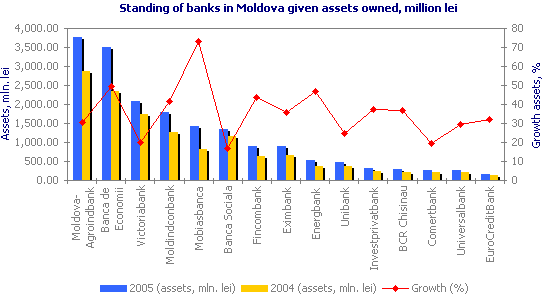
Source: BNM and our estimates
Foreign trade
Moldova has smaller exports than trade deficit…
Statistics show that the foreign trade of Moldova rose by 23.5 percent in 2005, up to about 3.4 billion dollars. At the same time, a huge trade deficit of 1.22 billion dollars (estimated at over 40 percent of GDP) was registered. Indeed, Moldova has exports (which turned over 1.09 billion dollars in 2005) lower than trade deficit. It is interesting that alcohol drinks, food products and tobacco represent 36.3 percent of Moldovan exports.
Despite the phyto-sanitary and veterinary barriers of Russia, as well as the uncertainties related to commercial relations, this country ranks the first place. Moldovan exports turned over 347.52 million dollars, while imports from Russia amounted to 273.64 million dollars. Moldova exported goods worth 324.27 million dollars to the European Union, but imports amounted to 752.35 million dollars.
Moldovan exports to the E.U. could grow after Moldova’s inclusion in the Generalised System of Preferences GSP+ on January 1, 2006. On the other hand, experts say that exports will develop slowly rather than will register a strong rise because they do not cover the products for which Moldova has competitive advantages, firstly the agri-food products. Moldovan officials are interested to obtain some Autonomous Trade Preferences stipulated by the Action Plan that Moldova signed with the E.U. in 2005.
Archive
2011 2010 2009 2008 2007 2006 2005 2004 |
