ADEPT | Gagauzia 2016 | Presidential 2016 | Elections 2015 | Bashkan 2015 | Gagauzia 2012 | Political Parties
Economic Policies on September 16–30, 2006
 |
 |
e-journal #81 |
Real sector
Industry is on the permanent decline…
Official statistics show that all industrial enterprises made production worth about 13 billion lei (approximately 770 million euros) in January-August 2006 or by 5.7% less than in the similar period of 2005. The reduction of wine production by 48% was the main cause of decline of industrial production in the period concerned.
At the same time, the production volume of food and drink enterprises has declined by 19%. The recession of industry has influenced the economic growth in Moldova and, therefore, the Government has reduced the macroeconomic indicators for 2006 and 2007.
Economic growth this year could be lower than average on CIS…
According to the latest report World Economic Outlook by the International Monetary Fund (IMF), the Moldovan economic growth will be this year below the average on CIS, more than 3%, compared with 6.8% in CIS. The IMF forecasts the highest economic growth for Azerbaijan — 25.6%, followed by Turkmenistan 9.0%, Kazakhstan 8.3%, Tajikistan 8.0%, Armenia and Georgia 7.5%. The Russian economy will grow by 6.5%, while the Ukrainian economy is expected to grow by 5%.
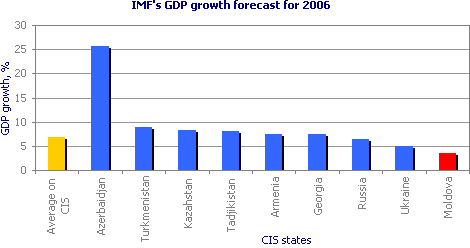
The real GDP growth in CIS will likely be about 7% in 2006 and a decline of down to 6.5% is forecasted for 2007. This region continues to benefit of high prices of goods and high incomes from export. Moldova registered a 5% economic growth in the first half of this year, as the industry has regressed and the agriculture has stagnated while consumption has permanently grown.
Prices and inflation
Inflation will grow slowly, but surely…
The inflation rate could register a maximum of 1.5% in September. Prices of vegetables remained at the level of August, while some of them became cheaper. Prices of fruits are generally acceptable, but prices of peaches and grapes have beaten all records, this being an unprecedented phenomenon in Moldova (1–2 dollars per kilogram of grapes). Tariffs of services provided to population will insignificantly grow and they will be influenced by delivery costs of energy agents for sure. As regards prices of fuels, we consider that they will not change. Although they are on the decline on international market, it is not advantageous for domestic importers to lower the prices, especially on the eve of winter.
Banking sector
Share of foreign investments in banking system has grown…
The share of foreign investments in capital of Moldovan banks rose by 4.2% in January-August 2006, up to 54.8% of the total of assets. In comparison with the similar period of 2005, the share of foreign capital in Moldovan banks has grown by 3.3%. The share of foreign capital has grown after the Italian bank Veneto Banca bough all shares in the commercial bank Eximbank last May and increased its capital by about 10 million euros.
At the same time, total assets of the banking system of Moldova amounted to 20.5 billion lei (1.54 billion dollars) in late September and they rose by 14.25% in eight months of this year and by 28.7% compared with the similar period of 2005. The shareholder capital of banks accounted for 3.4 billion lei (255.8 million dollars) and rose by 17.1 percent in January-August 2006. The highest share of foreign investments in the total of assets of Moldovan banks was registered in 2003, notably 61%.
Foreign trade
Export diversification rate is on the decline…
The Ministry of Economy and Commerce has unveiled data showing that Moldova exported goods within more than 700 tariff groups in 2005, compared with over 1,000 groups in 1998. The export diversification indicator is on the decline. Moldova becomes dependent on exportation of some categories of commodities only such as agri-food products, textiles. The export concentration degree is very high. As for example, food products, drinks and tobacco covered 36% of overall exports of Moldova in 2005. Thus, Moscow’s interdiction against Moldovan spirits reveals that exports have a very high geographic concentration degree. The low competitiveness of domestic products and services conditioned by high costs and inefficient management make the Moldovan production less solicited on foreign markets.
Also, Moldova has insufficiently used the trade preferences awarded by western countries because it failed to comply with international standardisation, certification and quality control systems. Although Moldova benefits of the Generalised System of Preferences GSP+ starting January 1, 2006, Moldovan exports to the European Union have advanced very slowly and they have even declined on some positions. Moldovan exporters did not recover so far after the “cold shower” applied by the Russian Federation on Moldovan wines and food products and they failed to meet most of quality standards in order to make the production competitive on the E.U. market. The Government should “ring the bells” in these directions. We think that the 2006–15 strategy on attracting investments and promoting exports which the Government has recently launched will mark the passage from elaboration of some strategies to their implementation and will not have the fate of the precedent documents forgotten on shelves of governmental structures.
Labour market
Medium salary on economy is on the rise…
The average salary on economy accounted for about 1,600 lei (94.5 euros) in January-August 2006 and it has grown by 29% compared with the similar period of 2005. The highest salaries were paid in financial sector in the period concerned, notably 3,759 lei, followed by transportation and communication — 2,459 lei, constructions — 2,233 lei, industry — 1,985 lei, public administration — 1,945 lei. At the same time, workers in agriculture and forestry sectors were paid the least — 732 lei, fish breeding sector — 1,073 lei, teachers earned 1,212 lei on average, doctors and social assistants earned 1,291 lei.
It should be mentioned that starting July 2006 the tariff salary for the first qualification category of workers in agriculture and forestry sectors, as well as for enterprises with maximum 9 employees was increased from 360 lei up to 500 lei. The tariff salary for the first qualification category of workers of other branches of national economy will be 700 lei, compared with 550 lei formerly.
Archive
2011 2010 2009 2008 2007 2006 2005 2004 |
