ADEPT | Gagauzia 2016 | Presidential 2016 | Elections 2015 | Bashkan 2015 | Gagauzia 2012 | Political Parties
Economic Policies on November 15–30, 2010
 |
 |
e-journal #157 |
Labour market
Key indicators are in disarray…
According to NBS data in Q3’2010 the economically active population (employed plus unemployed) in the Republic of Moldova constituted almost 1314 million persons, in decrease by about 13,000 in comparison with the same period of 2009. Significant disparities by sex and areas within active persons were not registered: the proportion of men (51.2%) exceeded non-essentially the percentage of women (48.8%), and the share of people active in rural area was significantly higher than the active population in urban area (53.7% and 46.3% accordingly).
The activity rate of population aged 15 and over[1] was slightly more than 44%, practically maintaining the value of previous quarter (44.8%). The employed population was over 1.228 million people or over 22 thousand less than in Q3’2009. As in case of active population, there were no differences by sex (50.9% men and 49.1% women), while on average there were significant differences (45.3% in urban and 54.7% in rural area).
Employment rate of population aged 15 and over[2] was 41.4%, decreasing by 1% from the same period of 2009. In case of men it was higher (44.5%) than for women — 38.6%. The distribution by residence the occupancy rate was 44.1% in urban and 39.4% in rural area. The employment rate of working age (16–56/61 years) was 48.6%, of the population aged 15–64 years — 46.2% and in the category of 15–29 age this indicator had a value over 28%.
About one third of the employed population works in agriculture…
The agricultural sector involved in this period over 384,000 people or over 31% of total employed persons. At the same time, every second person employed in agriculture continues to work in his/her own auxiliary household, which means over 15% of total employment. In non-agricultural activities the number of employed persons was about 844,000 people. The percentage of persons employed in industry was just over 12% and in construction over 7% accordingly. Every second person employed or more than 49% of total works in service sector.
At the same time, the NBS data show that informal sector involved in this period about 15% of total employed persons in the economy and every third person of the total employed people (about 34%) had an informal job. The number of unemployed persons[3] was over 85,000, up by 9200 comparative to Q3’2009. Unemployment has affected to a greater proportion the men — 55.7% of total number of unemployed, as well as people from urban area — 61.4%.
In the covered period unemployment rate registered 6.5%, being 5.7% higher than value registered in Q3’2009. Male and female unemployment rate was 7.1% and 5.9% accordingly. There were significant disparities between urban unemployment rate — 8.6%, compared to rural — 4.7%. Among youth (15–24 years) the unemployment rate was 18.8%. In the age category 15–29 years this indicator had a value of about 14%.
… and wages remained virtually unchanged
The same data of NBS show that in January-October 2010 the average monthly wage (nominal) in the economy was 2910 MDL and increased compared to the previous year by about 8%, but the real wages remained virtually on last year level. In the budgetary sphere the average wage was 2526 lei and increased compared to the same period of last year by about 8%, in real sector — 3130 lei, increased by 8% against the same period of last year.
Subjective reflections…
Although we have witnessed recovery of economic indicators such as GDP growth, growth in budgetary revenues, etc., by total the population does not feel it in its pocket, as it’s also noted by some expertsRO. In fact, that economic growth noted in statistics is more on account of some increases of taxes and duties and not as a result of higher productivity or wages higher than they should be. What also matters here is that a great part of the population has low and under-low incomes, the average wage in the economy being mentioned here.
We can say that the year 2009, but in particular 2010, is the year when the intensity of labour market decreased visibly. That, as previously reported, is also shown by statistical data, increased unemployment, lowered employment rate, etc. Moreover, this fact was associated with the increase of number of people / companies who have migrated from formal to informal sector. Thus, it is more than natural the concern or care for jobs and this concern is all over the region, in Europe and beyond. In undergoing through a major crisis, jobs are in fact the main obsession of people, which is increasingly highlighted by most opinion polls.
But there are risks that are not under the control of authorities. These are in fact consequences of some international circumstances, decreased exports, decreased production of enterprises (the crisis has strongly hit the private sector), which made the latter to analyse the working time for staff or even to resort to layoffs. The year 2010 was the year of job rush, and trends show that for 2011 the scenario will remain the same. Employers found to be more discerning and more demanding. In addition, lowered investments (also influenced by domestic social and political situation), which is by the way are job generators, put pressure on some labour market indicators.
However, the situation in Moldova is not yet dramatic as in some countries in the region, where reductions of wages, pensions and other social payments were made, and probably sooner or later the optimistic figures, which statistics gives us, will be also felt in people’s pockets.
Real sector
Industry looks to rebound…
The same statistics show that in January-October 2010 industrial enterprises of all types of ownership manufactured products worth 21.45 billion lei (1.8 billion USD) in current prices. Accordingly, the index of industrial production against January-October 2009 increased by 7.6% in comparable prices. The growth was driven by increased output in processing industry by over 8% and in the energy sector — by 4%, which motivated the total production increase by 7% and by 0.5% accordingly.
Substantial increases were registered in the following activities: clothing production — by 9.6%, tobacco products — by about 41%, wine production — over 9%, dairy products — by 9%, footwear production — by more than 21% (holding a 2% share it caused 0.4% growth), manufacture of machinery and equipment — over 31% (holding a 1.5% share it caused 0.4% growth), distilled alcoholic beverages — by about 12%, manufacturing medicines and pharmaceutical products — by 25%, etc. At the same time, the volume production at enterprises with the following activities was reduced: manufacturing of vegetable and animal oils and fats — by more than 12%, mill products — by about 16%, etc.
Transfers and remittances
Moldovans apparently send more money home…
According to the NBM data in the first 10 months of 2010 $1014.64 million came to Moldova through banks, transferred from abroad by resident and non-resident individuals. 870.73 million USD of these or about 85.82% came through Quick International Transfer Systems used in Moldova.
However, most of money accounted by banking system were registered in September, when the transfers made amounted to about 133 million USD, which means over 13% of total transfers for the first 10 months of this year. In October 52.7% of money transferred through Transfer Systems were in USD, 35.2% — in Euros and about 11% — in Russian rubbles. In the reference period, by about 6% more money entered the country though banks compared to the same period of 2009.
Figure 1. Dynamics of remittances, USD million
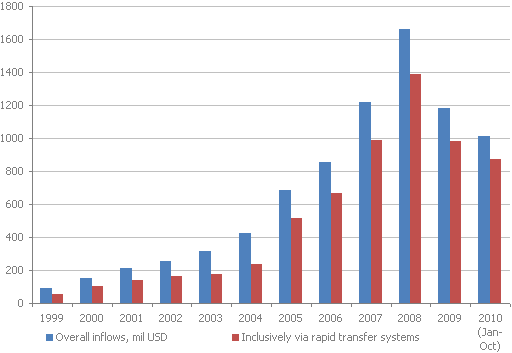
Source: NBM data
Archive
2011 2010 2009 2008 2007 2006 2005 2004 |
