ADEPT | Gagauzia 2016 | Presidential 2016 | Elections 2015 | Bashkan 2015 | Gagauzia 2012 | Political Parties
Economic Policies on January 1–31, 2007
 |
 |
e-journal #88 |
Inflation and prices
Government fails inflation target…
The inflation rate rose by 1.2 percent in December 2006. The general rise of consumer prices was especially influenced by higher prices of some food products (vegetables and fruits, flour, eggs, dairy, etc.). The cumulated inflation rate for 2006 was 14.1 percent and it was even higher than the Government’s updated forecast (12 percent) for last year.
The inflation in 2007 will be the target of targets, perhaps at a bigger extend than in the past years, while its decline will be more difficult. Other macroeconomic indicators will depend on evolution of inflation and they will have an impact on wide public. At the same time, the inflation remains the indicator with the strongest impact in economy.
However, it may be supposed for the time being that the annual inflation rate is “credited” with big chances to exceed the governmental forecasts (10 percent), given the higher prices of imported energy agents, uncertainty that still persists on foreign markets for Moldovan products and the prediction of an unfavourable agricultural year. The administrated prices could also grow, and this would rather happen after the general local elections. In addition, the internal growth will induce an additional pressure on inflation. All these factors could make the Government and the National Bank of Moldova face an inflation that does not continue the decreasing trend any longer.
Public finances
Budget revenues continue to grow in spite of recession in production sector…
Although the industrial production dropped visibly in 2006, the plan of incomes in the national public budget was executed 101.6 percent. This state of things demonstrates us one more time that the budgetary revenues depend more on economy of consumption than of production. The cumulated payments to the budget exceeded 17.8 billion lei (about 1.34 billion dollars). The final incomes of the national public budget exceeded by more than 22 percent the revenues of 2005 in 2006 and by over 23 percent the state budget incomes.
The fiscal returns were the main source of state budget collections, while the rise paces of internal tax collections exceeded those afferent to external economic activity. Thus, collections produced by value-added tax on goods made and services granted in the country have grown by more than 33 percent, while those produced by VAT on imported goods by approximately 29 percent. However, indirect taxes contribute with about 70 percent of all budget returns, and this state of things shows that the domestic production sector still does not progress. In addition, the higher rise of imports than expected allowed the compensation of losses with higher collections from VAT and excises on imports.
Banking sector
Year 2006, year of takeovers on Moldovan banking market…
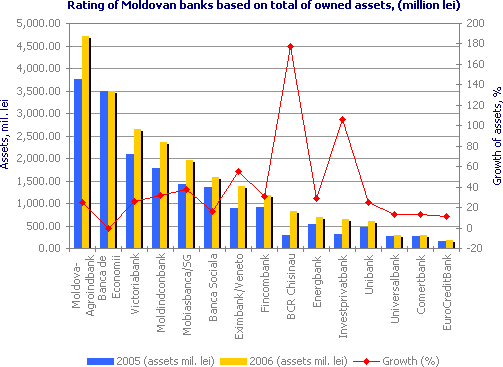
The banking system strongly developed in 2006. The clientele and portfolio of commercial banks have extended and, therefore, the volume and level of products offered by financial-banking institutions from country have grown. In addition, the legislation on banks generally fits the European requirements and this fact increased the confidence of clients and attracted strong international players in 2006. The arrival of some actors such as Raiffeisen Bank, Veneto Banca di Italia and the soon arrival of the French group Societe Generale on Moldovan banking market is an extraordinary beginning.
If other big groups will join the banking market soon, we consider that they will be rather the result of international concentrations, as for example the acquisition of the bank Mobiasbanca. Although banks from member countries of the European Union (E.U.) may join the domestic market after a simple notification submitted to the National Bank of Moldova, few banks will truly enter the market, but some offices or representatives may open to “observe the market”. Individuals and small and medium firms will be the main segments of clientele for banks because they will have high growth rates. Even more, the arrival of some international players could be associated with a development of exchanges, investment and pension funds, as well as of insurance, segments which are at a primary stage of activity in Moldova.
The average interest rate on deposits rose in 2006 from 10.8 percent in January up to 13.4 percent in December, in spite of a higher inflation rate. Therefore, interests on credits in lei have also grown, notably from 17.9 percent in January, up to 18.6 percent in December, while the average interest rate on loans in foreign currency remained at the level of 11 percent. The supply of forward deposits rose by more than 21 percent in 2006, while the supply of credits grew by about 31 percent. Assets of Moldovan banks rose by approximately 27 percent or 4.8 billion lei in 2006, up to roughly 22.8 billion lei (1.74 billion dollars) in early 2007. They represent 50 percent of GDP (2006). Bank assets in countries from the euro area exceed 100 percent of GDP.
Foreign trade
Exports declined constantly in 2006…
Moldova’s exports were valued at about 932 million dollars in January-November 2006, but this value was by 5.4 percent lower than in the same period of 2005 due to the interdiction against Moldovan products on Russian market. They could exceed one billion dollars in all 12 months of 2006. The CIS absorbed 41 percent of Moldova’s exports in the period concerned, compared to 51 percent in 2005. At the same time, the imports were valued at 2.36 billion dollars, by 16.5 percent more than in the same period of 2005. Therefore, this evolution of foreign trade accumulated a deficit of trade balance in the amount of over 1.43 billion dollars in January-November 2006, by 386 million dollars (or 36.8 percent) more than in 2005. We consider that the trade deficit for 2006 will reach 1.6 billion dollars after the data on foreign trade for the whole year will be processed.
On the other hand, if the trends registered in 2006 do not change, Moldova’s exports to the E.U. could exceed 40 percent of the total in 2007 (now the exports to the E.U. count for 34 percent of the total). In January-November 2006, 34.3 percent of exports went to the E.U., which is by 5.1 percentage points more than in the similar period of 2005. However, trade exchanges with the E.U. have modestly grown, being lower than the Government’s forecasts, though Moldova benefits of a preferential system (GSP Plus) of E.U. Moldova could raise larger profits from implementing the GSP Plus in 2007, if companies rely on quality of products and a more aggressive marketing. Moldova continues the dialogue with the E.U. in order to be included in the list of beneficiaries of the Autonomous Trade Preferences of the E.U., a freer preferential trade regime.
Production sector
Industry fell in 2006 down to the lowest levels recorded in the past years…
Industrial enterprises in Moldova made production worth over 22.2 billion lei (1.7 billion dollars) in 2006 or by about 7 percent less than in January-December 2005. The decline of industrial production in 2006 was due to a 2-fold fall of wine production, distilled alcohol drinks — by 37 percent, cigarettes by 23 percent, oils and fat by 9 percent, glass and glass items by 6 percent, etc. The production volume of food and drink enterprises has declined by 19 percent. Many economic experts explain the recession of industry as a consequence of Russia’s embargo on Moldova.
However, we should mention that the recession of some industrial branches was not directly correlated with Russia’s commercial barriers (oils and fat, engineering and equipment, rubber and plastic, glass manufacturing). Important rises in other branches (carpet, footwear, furniture manufacturing, cement and other building materials, electricity) failed to compensate the recession of wine industry.
On the other hand, the higher price of imported natural gas had also a negative but more moderate impact. It mainly conditioned the rise of production costs in glass moulding branch and reduction of its competitiveness.
Archive
2011 2010 2009 2008 2007 2006 2005 2004 |
