ADEPT | Gagauzia 2016 | Presidential 2016 | Elections 2015 | Bashkan 2015 | Gagauzia 2012 | Political Parties
Economic Policies on July 16 – August 1, 2008
 |
 |
e-journal #122 |
Inflation and prices
Vegetables and fruits of farmers likely to calm down inflation growth …
Medium consumer prices decreased by 1.1 percent (deflation) in June compared with May 2008, in particular, prices of food products have dropped by 3.5 percent, while prices of manufactured goods have grown by 0.2 percent and tariffs for public services by 0.4 percent. In particular, prices of fresh vegetables have decreased by 26.4 percent, early potatoes by 30 percent, fresh fruits by more than 7 percent, eggs by 8.5 percent and dairy by 1.2 percent. Prices of household appliances and footwear have decreased in the structure of manufactured products. However, there were some high price rises on foodstuffs in the period concerned; in particular, the price of rice has increased by more than 30 percent, sugar by over 2 percent, vegetal oil by 1.1 percent. The inflation rate this year was 6.1 percent (July 2008 compared with December 2007), while the annual rate exceeded 15 percent.
The Government, National Bank of Moldova and many independent analysts anticipate a slower price rise after the seasonal decline of prices of food products. Many food products are cheaper on summer and this stimulates the reduction of the inflation growth pace. Food products cover about 40 percent of people’s consumption and any change of prices influences the rest of economy. NBS and NBM follow statistics while calculating a growth of food prices close to zero for summer. The supply of farms which flood markets in cities with vegetables, fruits and other food products on summer overturns the inflation rate for several months. This year, authorities expect the same phenomenon, which would reduce inflationist pressures related to expensive fuels, foodstuffs, etc. From statistical point of view, prices of foodstuffs decrease much in July and August. A deflation may be also recorded for this period. But consequences of floods will be reflected in the inflation rate for the next period for sure.
On the other hand, price cut pressures come from other sides, too. The more the leu is strengthening, the cheaper imports are. Meat and sugar prices could fall. Prices of milk and dairy, which cover more than 10 percent of people’s consumption, could decrease much this summer. One will see whether problems in agriculture will allow a long-term price stability or prices of foodstuffs will grow again more than in other areas. One will live and see…
At the same time, the National Agency for Energy Regulation (NAER) has recently approved new tariffs for natural gas, electricity and heating, after acquisition prices of natural gas and imported electricity have grown, and this will fuel the inflation for sure. Under a NAER decision, natural gas tariffs have grown by 27 percent on average, up to 3,523 lei per 1,000 cubic metres, which is by 748 lei more than at present.
Thus, consumers of up to 30 cubic metres of natural gas a month will pay 3,414 lei per 1,000 cubic metres, while those consuming more than 30 cubic metres will pay 3,813 lei. Electricity tariffs have been raised by 17 percent on average. Thus, the tariff for RED Union Fenosa was increased from 0.71 lei up to 0.79 lei/kWh, while other consumers will pay 1.1 lei per kWh. RED Nord and RED Nord-Vest will introduce a single tariff of 1.2 lei/kWh for all consumers. Heating tariffs were raised by 36.4 percent, up to 454.7 lei per Gcal. Consumers supplied heating by CET 1 will pay 512.05 lei/Gcal, CET 2 — 410.4 lei/Gcal, and final consumers of CET Nord will pay 786 lei per Gcal.
Real sector
Industrial production up by 4.6 percent in 1st semester…
All industrial enterprises have made production worth over 14.1 million lei in current prices in January-June 2008, which is by 4.6 percent more than in the same period of 2007. The growth was particularly motivated by advance of production of food and drink industry by 12 percent and energy sector by 8 percent; these sectors controlled 36.4 percent and 13.1 percent and contributed to the growth of overall production with 4 percent and more than 1 percent. Following sectors have achieved important rises: wine making — about 1.6-fold (by controlling 8.3 percent, it contributed with 3.2 percent to the growth); distilled spirits 1.4-fold (by controlling 3.1 percent, it contributed with 1 percent to the growth), etc.
Foreign sector
Moldovans sent home more than 606 million dollars in first 5 months…
According to NBM accounts, remittances in Moldova have increased 1.6-fold in January-May 2008 compared with the same period of 2007, and exceeded 606 million dollars, with this amount being almost similar to all inflows for 2005. As much as 75.3 percent (456.5 million dollars) of transfers out of all remittances operated in the first five months of this year have been performed via rapid money transfer systems. In particular, remittances via commercial banks accounted for 89.72 million dollars in January 2008, 104.55 million dollars in February, 126.4 million dollars in March, 154.29 million dollars in April, and 129.75 million dollars in May. Remittances operated via commercial banks in Moldova in 2007 accounted for about 1.22 billion dollars, by almost 43 percent more than in 2006. Largest remittances came to Moldova from Russia and Italy.
Diagram 1. Evolution of remittances
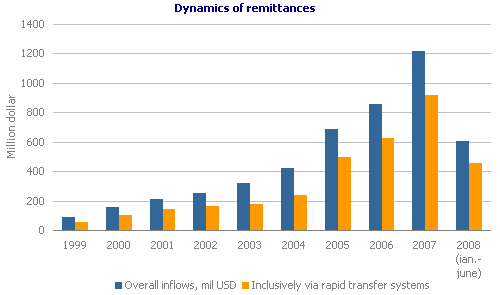
Source: NBM
Labour market
The medium monthly salary of an employee in national economy amounted to 2,429 lei (about 250 dollars) in January-May 2008 and it rose by 26 percent compared with the similar period of 2007. The real salary index for the same period has increased by 9 percent. The medium salary in budgetary sector amounted to 1,978 lei and the average wage in real sector accounted for 2,665 lei. The medium remuneration in June was 2,751 lei, which is by 8.4 percent more than in May. The medium monthly salary has grown by about 24 percent compared with June 2007. The medium pay in budgetary sector amounted to 2,642 lei and it rose by 21 percent compared with the similar period of the precedent year. The average monthly salary in real sector was 2,805 lei and it rose by 25 compared with the same period of last year.
Reflections: it is true that real salaries are on the rise, as noted by president at a conference held to sum up results for the first half of the year, but they rose faster than the productivity. Therefore, Moldova’s competitiveness has decreased. According to official accounts, salaries have annually increased by 10 percent in the past three years, and this rate was maintained in 2008, too. In reality, the rise was higher particularly in areas which strongly develop such as banking, building, services, etc. On the other hand, such a rise of salaries (and earnings) is the ground of consumption and economic growth implicitly, but a consumption-based growth cannot ensure a lasting convergence in terms of real indicators. But investments generating a high value-added, which is a crucial factor for a healthy economic growth, is needed to improve the output. A building-based growth like that in Moldova involves credit transactions, speculative investments and money is often originated from shadow economy and it cannot be invested to bring profit in productive sectors. This finally encourages an unreasonable boom of housing prices.
Archive
2011 2010 2009 2008 2007 2006 2005 2004 |
