ADEPT | Gagauzia 2016 | Presidential 2016 | Elections 2015 | Bashkan 2015 | Gagauzia 2012 | Political Parties
Economic Policies on April 12–28, 2006
 |
 |
e-journal #72 |
Real sector
Decline of industry’s pace turns into trend…
According to statistics, the Moldovan industry registered in the 1st trimester of 2006 the lowest rise pace in the past five years, notably 99.7%, compared with the similar period of 2005. The industrial production was valued at about 5 billion lei (380 million dollars). The rise in January-March 2005 was 3.2%, compared with 16.7% percent in the 1st trimester of 2004 and 12.8% in the similar period of 2003. The industrial production declined by 3.4% in March after it rose by 1.3% in the first two months of this year. The most pessimistic forecasts are being confirmed, the decline of industry is turning into a trend. This is a process capable to threaten the medium-term economic growth on background of other risks.
The processing industry is crossing a difficult period, including after the Russian Federation has restricted the importation of Moldovan wines. The wine industry declined by 7% in the 1st trimester compared with January-March 2005. The processing industry declined by 3% in the 1st trimester. The processing industry represented 61% of the total industry in the 1st trimester of this year. According to statistics, the decline of the processing industry has generated a reduction by 2.3 points of the general production index in industry, including wine making dropped by 1.3 points, tobacco by 1.0 points and beer by 0.2 points.
Public finances
Budget likely to fail revenues of about 600 million lei due wine crisis…
According to the finance minister, the budget could fail revenues in the amount of about 600 million lei (46 million dollars) if Russia does not withdraw the interdictions on Moldovan wine production the next 2–3 months. However, the impact could be more serious because the wine making sector is in deep connection with other branches such as glass plants, cardboard production, etc. According to data of the Agri-Industrial Agency MoldovaVin, wineries use 25 percent of their capacities needed to cover the exports to other markets than Russia. Russia absorbs more than 80% of Moldovan wine exports, while the annual deliveries are evaluated at about 300 million dollars. The wine exports dropped by 6% in January-February due to the uncertainty related to deliveries to Russia.
…while rise of gas price could lead to higher budgetary deficit and inflation…
At the same time, experts from the World Bank say that Moldova’s budgetary deficit could grow by another 0.5–1% of GDP (200–300 million lei), if the price of natural gas imported from the Russian Federation rises up to 160 dollars per 1,000 cubic metres in the second half of the year. The government forecasts a budgetary deficit of 0.8% of GDP for 2006. The Republic of Moldova is very vulnerable to higher gas prices while an increasing trend of these prices could become true the next years. The natural gas counts for 2/3 of the consumption of fuels in Moldova and electricity for 10 percent only. The high prices will also exert a new pressure on current account deficit and inflation.
Financial-banking sector
BNM enforced new automatic system of interbank payments…
The National Bank of Moldova (BNM) has enforced the automatic system of interbank payments (SAPI), which is a system used to perform payments in Moldovan lei in banking sector in Moldova. SAPI is created from a discount system on raw base in real time (DBTR) for processing of urgent and high value payments and from the system of compensation with discount on net base (CDN), a system for processing of low value payments.
The regulation on automatic system of interbank payments stipulates the tariffs that the National Bank will raise for payments processed in SAPI and programme of operational day of SAPI. Thus, a 2.5-leu fee will be in effect for a document processed in the DBTR system and 1.25 lei for a document processed in the CDN system, except for invoices afferent to budgetary transfers lower than 1,000 lei processed in the CDN system, for which a 0.25-lei fee will be paid.
The implementation of this system aims to ensure the readjustment of the interbank payment system of Moldova to international standards and practices and to speed up the cash-free payments in Moldova. The new automatic system of interbank payments was implemented in compliance with the Strategy of the Government and BNM regarding the development of Moldovan financial sector in 2005–2010.
EBRD will grant 13.4 million dollars for trade facilitation in Moldova…
The European Bank for Reconstruction and Development (EBRD) will give Moldova more than 13 million dollars for export promotion, an amount allocated via the EBRD-financed Trade Facilitation Programme (TFP). This programme promotes the foreign trade with Central Europe, Eastern Europe and CIS.
The EBRD guarantees the import and export deals through TFP. At the same time, the EBRD grants short-term credits to importers and exporters from Moldova via commercial banks. The EBRD has signed 5 TFP projects worth 13.4 million euros with commercial banks Moldova-Agroindbank, Moldindconbank, Victoriabank, Mobiasbanca and Banca Sociala.
Business environment
Investments in free economic zones (ZEL) are on the rise…
According to a report by the Ministry of Economy and Trade, investments in free economic zones (ZELs) of Moldova have grown about 4-fold in the past five years. Thus, 72.1 million dollars has been invested in ZELs from 1995 to January 1, 2006, of which 11.7 million dollars or 16% in 2005. At present, Moldova has six free economic zones. The first zone opened in Chisinau in 1996, while the last ZEL opened in Ungheni in 2003.
ZAL Expo-Business-Chisinau absorbed 30.4 million dollars out of the overall investments, ZAL Taraclia — 13.4 million dollar, ZAL Tvardita — 10 million dollars, ZAL Valkanes — 9.6 million dollars. Investments in ZEL Ungheni-Business amounted to 8.3 million dollars, while investments in ZAL Otaci-Business accounted for 4 million dollars. ZELs focus on industrial production. Thus, the net sales of industrial production totalled 1.02 billion lei last year, of which production worth about 630 million lei was exported.
Labour market
Minimum pay in the Republic of Moldova is about 29 euros a month…
Moldova is ranked the last but one place regarding the minimum pay, respectively 28.98 euros a month, in a top that covers 28 European countries, worked out by the Federation of European Employers (FedEE). Moldova is ranked before Russia, which is ranked the last place in the top with a minimum pay of 23.48 euros, and after Ukraine (55.58 euros), Bulgaria (81.80 euros), Serbia and Montenegro (91.24 euros) and Romania (97.07 euros). Employees in Luxembourg earn the highest minimum pay — 1,503 euros. Luxembourg leads this top for a couple of years. FedEE notes that the minimum salary offers a standard of living which is close or even lower than the subsistence level.
FedEE took into account the remuneration of full-time workers over 23 years old in order to elaborate the top. On the other hand, FedEE operates with data for early 2004 which have been modified meanwhile as regards some countries, including Moldova. Thus, the tariff salary for the 1st-degree qualification [the lowest] was increased by 25 percent on August 1, 2005 through an agreement between social partners — trade unions, employers, government, up to 550 lei (35 euros). However, Moldova was ranked after most of countries.
According to official statistics, the medium salary on economy amounted to 1,424 lei (some 110 dollars) in January.
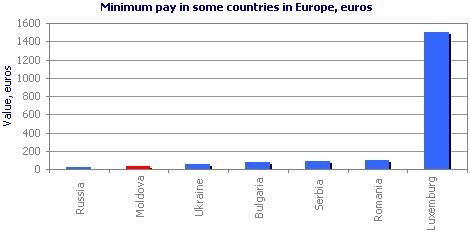
Source: FedEE
Every 5th youth has left for work abroad…
According to a study by the National Bureau for Statistics (BNS) themed “Youths on Labour Market”, every 5th youth in Moldova works or looks for work abroad. It reveals that about 70% of the surveyed young people would like to work abroad, if they are provided this chance. Further, 35.8% of the surveyed youths would accept a qualified job, 38% would agree to work without any qualification, but for a high pay, while 26.2% would accept any job abroad. More than 40% of all interviewed persons intend to change their jobs because of low salaries. Every 11th youth wants to leave the country in case of dismissal. According to 70.8% of respondents, the creation of new jobs would be the most important action to improve the situation of youths on labour market and 18.2% indicated the creation of opportunities to get employed abroad. BNS conducted the study in 2005. It has interviewed youths aged 15–29 years, including about 55% from rural localities.
Government will create single data collection network for researches of household budgets…
At the same time, the Government has decided to create a single network to collect data on household budgets and labour force in order to improve the database on living standards of population and labour force market, a network stipulated by the Moldova-European Union Action Plan. As many as 150 investigators and 51 inspectors assigned to 200 selected localities will work in this network.
The National Bureau for Statistics (BNS) will have to draft a regulation on organisation and conduct of statistical researches on households. Thematic surveys on youth, education and healthcare will be conducted in parallel with studies on household budgets and labour force and they will help the monitoring and evaluation of poverty and execution of actions stipulated by Economic Growth and Poverty Reduction Strategy Paper.
Archive
2011 2010 2009 2008 2007 2006 2005 2004 |
