ADEPT | Gagauzia 2016 | Presidential 2016 | Elections 2015 | Bashkan 2015 | Gagauzia 2012 | Political Parties
Economic Policies on October 1–31, 2008
 |
 |
e-journal #126 |
Prices and inflation
Inflation rate likely to fit governmental forecasts…
According to official statistics, consumer prices rose by 0.6 percentRO in September, compared with August 2008, as prices of food products have grown by 1.3 percent, of manufactured goods by 0.1 percent and tariffs for public services by 0.7 percent. Prices of food products rose in September, as vegetables, meat products, eggs, etc., were more expensive than in August 2008. As regards prices of manufactured goods, clothes for children, didactic supplies for school, and shoes for kids were more expensive than before, this being a clear phenomenon. Also, prices of furniture have grown by more than 1 percent.
Tariffs for services rose in September 2008 as follows: rent taxes for hostels and private apartments increased by 5.5 percent, fees for education services by 2.4 percent, housing handicraft services by 2.1 percent, and public alimentation services by 1.6 percent.
The inflation rate this year (September 2008 compared with December 2007) has grown by 6.7 percent (the inflation rate in September 2007 was 9 percent, compared with December 2006). Medium prices in the last 12 months (September 2008 compared with September 2007) have increased by 10.7 percent (by 14 percent in September 2007, compared with September 2006).
Macroeconomy
IMF estimates a 6.5-percent growth for Moldova for 2008–09…
The International Monetary Fund forecasts a 6.5-percent GDP growth for Moldova for 2008–09, which is below the average in the Commonwealth of Independent States. According to the IMF World Economic Outlook, the inflation rate in Moldova will reach about 14 percent this year and it is estimated at about 10 percent for 2009. The report says that the current account deficit will be about 20 percent in 2008 and more than 19 percent in 2009, with Moldova being “leader” among CIS member states regarding this indicator, which is 2–3-fold higher than the average on the region.
The World Economic Outlook estimates that the greatest economic growth in the CIS area will be recorded in Azerbaijan — 16.4 percent in 2008 and 16 percent in 2009, and Turkmenistan 10.8 percent and 10.3 percent, accordingly, as these countries are rich of hydrocarbons. Russia’s economic growth will decline from 7 percent down to 5.5 percent, while Georgia will face most serious falls — from 12.4 percent in 2007 down to 3.5 percent in 2008, and it will redress up to 4 percent in 2009. According to the IMF, this evolution is linked to the Russian military intervention in August-September 2008. Economic growth paces in Ukraine will also slow down: from 6.4 percent in 2008 down to 2.5 percent only in 2009. Also, the IMF forecasts a 3-percent global growth, assuring that there are no risks for a world recession.
Labour market
Average revenue per capita not covering the minimum consumer basket…
According to NBS accounts collected for the Household Budgets Research (HBR), available revenues of people in the 2nd quarter of 2008 covered 90.6 percent of the minimum consumer basket. The average revenue per capita in Moldova accounted for 1,215.2 lei (86.7 Euros) in the period concerned, while the NBS-calculated minimum consumer basket was 1,341.9 lei (95.8 Euros).
However, the minimum consumer basket rose by 2 percent in the 2nd quarter of 2008, compared with the 3rd trimester of 2008. The rise was conditioned by prices of food products included into the food basket and share of expenditures for the non-food basket (the cost of manufactured goods and services), which is established on the basis of the real structure of consumer expenditures of population, according to the Household Budgets Research.
The minimum consumer basket in urban areas was 1,437.7 lei, compared with 1,274.6 lei in rural areas, which is a difference of 163.1 lei (about 13 percent) due to the different structure of consumer expenditures and higher share of self-consumption in villages. The non-food basket in urban areas is 34 percent on average of the minimum consumer basket, compared with 21.3 percent in rural areas (this indicator is 28.4 percent on country).
The worthiest minimum consumer basket on categories of population was recorded for employable people, particularly men — about 1,510 lei. Looking for a child costs 1,228 lei on average per month, but this indicator depends on the age of the child, from 474 lei for a baby under 1 up to 1,360 lei for a child of ages 7–16. The minimum consumer basket for retirees was 85.7 percent of the average value per total and it amounted to about 1,150 lei.
External position of country
Moldova’s overall external debt equivalent to banking assets…
Updated statistics reveal that Moldova has an overall external debt worth over 3.7 billion dollars, which is 75 percent of the GDP. It is almost equivalent to overall assets of the Moldovan banking system. The external debt has particularly grown due to the fall of some indicators in the external sector of the country and rise of the trade balance deficit, current account deficit, following the fulminating expansion of the public and private consumption, appreciation of the domestic currency, factors which fuelled the imports and hit the indicators concerned.
How alarming is this evolution?
The indicators above confirm a trend of external deficits with the decisive “contribution” of the private sector. The unguaranteed private debt of economic agents counts for more than 2.6 billion dollars of the external debt, growing after the ascension of commercial and investment credits, which account for more than 72 percent of the overall debt. In addition, the trade deficit for eight months has reached a record of 2.2 billion dollars. However, this situation should not scare. Moldova’s debt is admissible compared with the region or some developing countries.
It was established that the external debt is rather at the private sector, or this one borrows more than the state. But there is a simple explanation here: the private sector is more rational than the public sector is (because it respects the market rules) and these deficits have natural explanations as well. Statistics prove this assessmentRO: imports of technological equipment, machines and appliances are on the rise; therefore, economic agents invest more in the modernisation of enterprises, expecting higher profits in future.
Currency market
Euro falling down…
Latest developments on the currency market, in particular the appreciation of the leu versus Euro has alerted the people. There are many factors to explain this trend. First, this is a result of the international evolution of euro-dollar rate. The dollar has appreciated much versus euro in the last 18 months, growing from 1.6 (in April) up to 1.25 (in late October), after massive interventions by the U.S. Federal Reserve. But the U.S. dollar has lost its credibility as foreign currency, especially as reserve currency.
Secondly, developed economies in Asia, Japan or China are trying to modify the structure of their foreign currency reserves, it means to get rid of dollars and acquire euros or other reserve currency. The National Bank of Moldova could also be tempted to do this. Thus, it would be very convenient to pay 13 lei for a euro than 15 lei 2–3 months ago. More than that, negative evolutions of many European economies prove that they are running the risk to stagnate or even recess and this would influence the financial market.
There is a massive capital inflow (particularly through remittances) at local level; the demand does not cover it, so that the NBM is trying to control the situation on market by purchasing currency, thus influencing the exchange rate indirectly. Even more, by seeing the trends of the currency market, people are trying to get rid of the euro, worrying about the temper of eventual consequences or effects of the financial crisis. But this could also be some market speculations which are pressing the exchange rate.
Who are losers of the market conjuncture?..
In general, there are three key groups of losers of the current market conjuncture. First of all, these are the exporters who will normally raise less currency from export operations, as well as firms and companies which have commercial relations with the EU. One should not forget that more than 50 percent of Moldovan exports go to the EU. Secondly, these are people whose earnings are about 1/3 in euro, in particular from those sending money home, they lose upon exchange. And construction companies are probably hit the most. Most of them have established sale prices in euro, but all works and payments are operated in lei. Many of them have already revised their prices per square metre for sale (by increasing them).
Banking sector
Bank credits becoming costly so far…
Loans in Moldovan lei and foreign currency continue to become costly, with the average interest rate on credits in lei reaching about 23 percent in October and the interest on loans in foreign currency going up to about 13 percent. Bank loans in lei have increased by more than 21 percent in nine months. According to data by the National Bank of Moldova, the interest on loans “met” the rising trend of the interest rate on deposits which have grown at the same level.
…but they are on the rise as well…
Despite this situation, credits in lei are on the rise for the third month in a row. Loans in lei released to legal entities and individuals have grown up to 1.53 billion lei, as of late September, which is by 8 percent more than in August. Certain experts say that so far there is room for a growth after a potential reduction of the basic rate and mandatory reserve norm by the National Bank. More than 23 percent of loans were released for up to one month; credits for 6–12 months (about 20 percent) and those for more than 12 months (more than 51 percent) had an important share as well. Credits for one month were granted with an average interest rate of about 28 percent, while those for more than 12 months had an average interest rate of 21.5 percent.
Central bank strengthens its presence on currency market…
Following massive capital inflows from outside, particularly of remittances which were estimated at more than 1.1 billion dollars in the first eight months, the National Bank of Moldova continued in September to massively purchase currency on interbank market, in order to moderate the pressure of the currency surplus. It has purchased about 57 million dollars. Purchases operated by the central bank on the interbank market count for about 40 percent.
International reserves reached a new record of 1.8 billion dollars in late September, which is by about 100 million dollars more than forecasted for this year, and experts anticipate a rise of reserves up to 2 billion dollars by the end of this year. Official reserve assets of the state were covering four months of critical import.
Banking institutions — dearest companies at stock exchange…
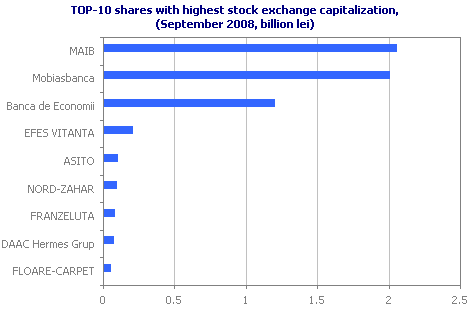
The stock exchange capitalisation evaluated accordingly to the methodology of the Rating and Estimation Agency Estimator-VM amounted to about 15.35 billion lei in late September, which is by about 560 million lei more than in August. As a rule, banking institutions rank the first three places at stock exchange that means they are the most expensive. Another seven classes of shares are issued by societies working in diverse sectors of national economy, including securities issued by S.A. Asito and S.A. DAAC-Hermes Grup. Moldova-Agroindbank is the dearest company so far.
Diagram 1. TOP 10 companies with highest stock exchange capitalisation (September, 2008)
Source: SEM, www.moldse.md
External trade
European Union ready to develop free trade with Republic of Moldova…
For this purpose, Moldova shall be ready to deal with effects of a complete liberalisation of the trade with the EU. Officials of the European Commission have stated that the future agreement will go beyond the effective Partnership and Cooperation Agreement and will cover the objective of a deep and comprehensive free economic zone.
The new status relating to the trade with the EU will probably allow the rise of Moldovan exports to the EU both in quantity and monetary value terms. However, it will depend most on Moldova’s efforts (economic agents) to meet EC requirements and conditions. Further, it will depend on domestic companies to be capable to use the granted preferences and manufacture goods accordingly to quality and preferences of European consumers.
But the still low quality of some groups of Moldovan products does not allow the reorientation of exports to the western markets. Moldovan enterprises would face serious problems, should they fail to improve the quality and productivity (a direct task of business managers rather than of state structures). In fact, the quality and productivity shall be a strategic priority of Moldova in 2009 and afterwards. Chisinau officials will have to provide concrete examples of progress when they will negotiate a more advantageous system than the current one with the West and even before negotiating an association agreement.
The European Union is the main sale market for Moldovan products, absorbing 52 percent after eight months. Starting March 1, 2008 Moldova benefits by the autonomous trade preferences regime. Moldovan exports to the EU have grown by about 34 percent in eight months, up to 546 million dollars. This is the highest growth compared with other markets.
Archive
2011 2010 2009 2008 2007 2006 2005 2004 |
