ADEPT | Gagauzia 2016 | Presidential 2016 | Elections 2015 | Bashkan 2015 | Gagauzia 2012 | Political Parties
Economic Policies on March 29 – April 11, 2006
 |
 |
e-journal #71 |
Prices and inflation
Inflation rate was 4.8 percent in the 1st trimester of 2006…
The inflation rate rose by 1.5 percent in March while the cumulated rate in the 1st trimester of 2006 was 4.8 percent. The Consumer Price Index (CPI) for food products rose by 1 percent in March, manufactured goods by 0.8%, while tariffs of services for population grew by 3.2%. Significant rises of prices were registered for services provided to population, especially for gas tariffs. If the inflation rise paces continue the next period, the 10-percent governmental target for inflation could be exceeded.
At the same time, the International Monetary Fund (IMF) has warned in a report that high prices of fuels intensify discrepancies and risks of a world crisis. “Perhaps the world economic discrepancies will remain high as long as the fuel is expensive, increasing the risks of a sudden and disorderly adjustment”, reads the IMF report.
Foreign trade
Moldovan exports rose by 2.3% only in January-February 2006…
Moldova’s exports rose by 2.3% in January-February 2006. They totalled 158.1 million dollars. Food products, drinks and tobacco count for about 90 percent of the export, followed by textiles, vegetal products, electric machines and appliances, equipment, footwear, transportation units and materials, raw leather and leather, furs, etc.
How close is the danger of a crisis?
At the same time, imports rose by over 30 percent in the same period, compared with January-February 2005. Trade balance in the first two months registered a deficit of 171 million dollars and it was 1.7-fold higher than in the similar period of 2005. In particular, the high deficit was due to the rise of tariffs for Russian natural gas. Consequences of commercial relations (exports of Moldovan products to the Russian market) in the Russian section of Moldova could distort the country’s economy more.
How close is the danger of a crisis? The uncontrolled long-term rise of trade deficit (and of current account deficit), of discrepancy between capacity of exportation and need of imported goods and services induces a risk. IMF representatives have indicated this risk more than once to the Chisinau authorities. The fear of IMF is of a medium and long term because Moldova’s economy is open and dependent on exterior and everything is happening in regional and world economies influence us, too.
CEFTA — a proposal to join E.U…
Moldova’s entry in CEFTA could improve the situation for exportation of Moldovan products and diversification of trade partners. Bucharest hosted a meeting of prime ministers of CEFTA member and candidate states, including the Republic of Moldova, on April 6. Indeed, this year Romania runs the chairmanship of CEFTA, which also includes members Croatia, Bulgaria and Macedonia, as well as candidates Albania, Serbia-Montenegro, the Republic of Moldova and Bosnia-Herzegovina. CEFTA (Central European Foreign Trade Agreement) was created by the Czech Republic, Hungary, Poland and Slovakia in 1992, while Slovenia, Romania, Bulgaria and Croatia joined the agreement the next years. The agreement was intended to replace CAER and to be an exercise, a form of preparation of states in Central and Eastern Europe for integration in E.U.
Financial-banking sector
Remittances via commercial banks exceeded 680 million dollars in 2005…
According to data of the National Bank of Moldova (BNM) remittances of Moldovans working abroad via commercial banks rose by 260.8 million dollars in 2005 compared with 2004, up to 683.24 million dollars. About 498 million dollars or 72 percent of remittances came via rapid money transfer systems. In addition, we should take into account the fact that money is introduced in Moldova via other means than those used by banks such as “transfers via bus”, so that some analysts estimate the overall remittances at over one billion dollars. Independent and IMF and World Bank experts estimate that the volume of remittances could drop the next years due to reunification of families of those working abroad.
In 2005, the largest remittances via banking system came from Moldovans working in Russia and Italy — 277.4 million dollars and, respectively, 135.3 million dollars. Russia was the destination with largest remittances in 2005, as about 41% of remittances via banking system came from individuals working in this country. Remittances via banking system have permanently grown in the past years. Thus, they count for 89.62 million dollars in 1999, 152.94 million dollars in 2000, 211.99 million dollars in 2001, 254.12 million dollars in 2002, 317.29 million dollars in 2003, 422.41 million dollars in 2004, and 683.24 million dollars in 2005. This is a proof that the number of emigrants has grown in the part years.
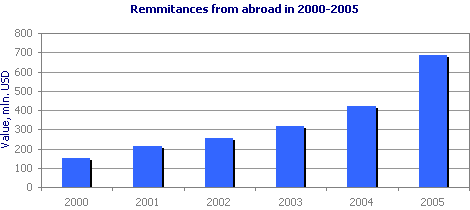
Source: BNM and our estimates
Public finances
State budget revenues rose by over 15% in the 1st trimester of 2006…
The state budget revenues accounted for 2.089 million lei (160.5 million dollars) in the 1st trimester of 2006. They rose by 15.3% compared with the 1st trimester of 2005. The basic revenues are estimated at about 1.87 billion lei and they rose by 17% compared with the similar period of 2005. Expenses estimated at over 1.88 billion lei went from the state budget in the period concerned or by about 18% more than in January-March 2005.
The basic expenses accounted for about 1.65 billion lei and they rose by 21.2%. Most of them went to salaries of workers of budgetary institutions, pensions, lifelong indemnities and monthly state allocations for war invalids and participants in the World War II, scholarships, financing of capital investments, etc.
Business environment
EIU forecasts for Moldova are not very optimistic…
Analysts of EIU (Economist Intelligence Unit) for Central and Eastern Europe say that the main “follow-up” problems could delay unwillingly much the improvement of living standards in Moldova compared with the rest of Europe. The weak points are: inconsistent and fragile economic reforms, weak investment climate, poverty, legislation which is not adjusted to the E.U. norms, etc.
According to EIU, Moldova’s progress cannot be faster than estimates mentioned below because the institutional development is modest, though it is trying to improve it, while the legislative system is faulty (despite tries to adjust it) and the demographic rise is completely unfavourable (forecasted population ageing rates are negative, while exodus of youths is strongly increasing) and there is an unhappy relation between growth pace of population and ageing. Thus, how Moldova’s chances are seen from London?
According to EIU estimates, Moldova’s economy will have a slower rise pace in 2006–2007 than in 2004–2005, while GDP could grow by 5.5% this year and by 5% in 2007. Finally, the internal demand could grow in 2006, too, while exports could remain at the level of 2005 or even decline a little bit. Exports will influence the general evolution of GDP in a small measure due to the rise of local consumption.
…while Fitch Ratings agency confirmed the rating for Moldova
At the same time, the international agency of financial evaluation Fitch Ratings has reconfirmed the Long Term Issuer Default Rating “B-” and the Local Currency Long Term Issuer Default Rating “B” for Moldova, while the Local Currency Long Term Rating was described as “stable”. At the same time, Fitch Ratings has confirmed the Short Term Issuer Default Rating “B” and the Country Ceiling “B-”. Thus, Fitch reconfirmed the rating for Moldova and the “stable” forecast for the second time.
Labour market
The number of job seekers dropped by 11% in 2005 compared with 2004…
The labour market registered some positive trends last year, as for example, the reduction of the official number of job seekers, while unemployment rate was 7.3%, compared with 8.1% in 2004. According to data of the National Labour Bureau, Moldova had 104,000 job seekers in 2005, by 11% less then in 2004. The unemployment affected men the most — about 58% of the total number of registered jobless people, and persons with residence in urban areas — 70% of the total.
…but official statistics do not offer a completely right state of things
At the same time, 85% of job seekers were experienced people. In addition, it should be taken into consideration that the unemployment rate in rural environment could exceed the official rate. At the same time, not all jobless people (or people without permanent jobs) are registered as job seekers, a situation that favours a lower unemployment rate. Many persons consider that if many workers did not emigrate, the unemployment rate would be higher. In 2005, job seekers benefited of allocations worth 489 lei on average. The unemployment allocation accounted for 482 lei in the first two months of this year. The employed population count for 1.318 million people in 2005 and remained at the level of 2004.
Archive
2011 2010 2009 2008 2007 2006 2005 2004 |
