ADEPT | Gagauzia 2016 | Presidential 2016 | Elections 2015 | Bashkan 2015 | Gagauzia 2012 | Political Parties
Economic Policies on February 14 – March 6, 2005
 |
 |
e-journal #47 |
Prices
Inflation rate: registered 2% in February. The cumulative inflation for the first two months of the year (January — February) registered 3.2%. According to Statistics and Sociology Department consumer price index on food surged by 2.8%, non-food products by 0.6%, while tariffs on services by 2.4%.
Price hike on fuel. Many businessmen do not exclude a 5 to 10% price hike on oil (diesel oil, petrol) in the next couple of weeks. The eventual move comes as a result of a price hike on the world market. On the international markets oil is traded at 55 USD a barrel. Analysts say prices shot up because of bad weather over Europe that spurred the demand, but also because of speculations.
Representatives of “Importcompetrol” of Moldova say great many oil importers had drained their stocks of cheap diesel oil and petrol and started buying it for higher prices. Currently 1 l of diesel oil is traded at 6.85 Lei/litre (0.54 USD), albeit the cost of goods reached 7.1 Lei per litre (0.56 USD). Losses incurred in trading diesel are partly compensated by the higher revenues in selling petrol. According to the same source, currently the diesel is imported at 510–550 USD/tone, while petrol A 95 at 475 USD.
Lukoil Moldova officials say it is too early for a price hike, while in the near future it is inevitable. If prices on the international market continue to swell they would also swell on the domestic market, once the cheaper stocks are drained.
If so, price hike would definitely fuel inflation. This is quite risky as fuel is included in the price of many goods. For the state budget, price hike on fuel is not necessarily a bad thing as it would levy additional excises.
Last year the price hike on crude oil boosted by 30% the prices on oil products in RM. Currently diesel is traded at 6.75 — 6.85 Lei/litre (0.54 USD), petrol A 98 — 7.75 Lei (0.62 USD), A 95 — 7.55 Lei (0.6 USD), A 92 — 7.25 Lei (0.58 USD), A 76 — 6.9 lei (0.55 USD) at petrol stations.
Labor market
According to the Department for Statistics and Sociology (DSS), the salary on economy was 1,146.3 lei (91 dollars) on average last January, and rose by 20 percent compared with the similar period of 2004, but the real growth was seven percent due to a high inflation rate. DSS announced that salary in budgetary institutions was 870.4 lei and 1,306.7 lei in non-budgetary sector.
Employees of financial institutions were paid the most, 3,140 lei, followed by workers of companies working in energy and heating industry, gas, water — 1,911 lei, transportation and communication — 1,807 lei.
The lowest salary was paid to farmers — 487 lei or 42.5 percent of the average salary on economy, teachers earned 790 lei on average, while doctors and social assistants earned 903 lei. According to the Department for Statistics and Sociology, over 505,000 persons or 38.6 percent of the total of employees worked in agriculture sector in the 4th quarter of 2004, and another 19.5 percent in public administration, education, healthcare, and social assistance sectors.
Banking and insurance
Development of the bank system in Moldova was marked by positive tendencies last year the 1st-degree capital rose by 20.3 percent compared with 19.7 percent in 2003, up to 2,442,000,000 lei in late 2004.
In the context of consolidation of bank system, a new requirement of BNM was enforced on June 30 regarding the minimum limit of the 1st-degree capital. Thus, this requirement calls for a 40-million-leu level for banks holding Licence A, 80 million lei for Licence B, and 120 million lei for financial-bank institutions holding Licence C.
The total assets accounted for 13,313,200,000 lei on December 31, by 29.5 percent more than in early 2004. The tendency of growth of assets registered until now indicates the development of bank system and means their continued growth on account of inflows of deposits and new incomes.
All assets rose in their structure: cash grew by 34 percent up to 733.9 million lei, money owed by banks and BNM by 45.6 percent up to 3,206,100,000 lei, securities by 34.5 percent up to 969.2 million lei, total net credit portfolio by 25.3 percent up to 7,241,200,000 lei. The share of unfavourable credits in the total of credits was 6.8 percent on 2004 December 31 and rose by 0.4 percent compared with the similar period of 2003.
BNM officials note that incomes in bank system are stable and this fact reflects the efficiency of its general activity. The net revenue in 2004 amounted to 430.7 million and rose by 7.8 percent compared with 2003. Profitableness of assets and share capital for 2004 accounted for 3.8 percent and, respectively, 18.1 percent. Compared with late 2003, these indicators dropped by 0.6 percent and, respectively, by 1.6 percent, especially because of a faster growth of assets and share capital compared with rise of income.
Liquidity remains at a high level, reflecting the capacity of banks to honour both current, and long-term obligations. Evolution of deposits demonstrates in continuation the credibility of the bank system. Deposits of individuals rose by 44.4 percent in 2004 up to 4,857,300,000 lei, while deposits of businesses grew by 30.1 percent up to 462.4 million lei.
Foreign trade
According to data of the Department for Statistics and Sociology (DSS), Lohn production made up some 40 percent of Moldovan exports to the European Union in 2004.
The Moldovan textile exports turned over 115.4 million dollars, which is 38.8 percent of all supplies to the E.U. markets — mainly clothes. In general, Moldova exported cloth articles and accessories on basis of Lohn production contracts signed between Moldovan enterprises and partners from Western Europe.
The Lohn production has considerably extended in the past years and therefore the imports and exports rose. An increasing number of Moldovan light industries are manufacturing goods for Italy, Germany and other countries, from the raw materials delivered by clients. The largest Moldovan companies working on Lohn conditions are Ionel, Artima, Zorile, and Leather Factory.
The export of raw and processed leather and fur, and goods made from these to the E.U. turned over 63.7 million dollars, which represents 21.4 percent of all Moldovan exports. Other exports in 2004 featured vegetal products [29.9 million dollars], food and drinks including alcohol, and tobacco [25.5 million dollars], common metals and iron articles [11.7 million].
The Moldovan exports to the E.U. markets last year rose by 40.8 percent till 297.1 million dollars, while the imports accounted for 582.7 million dollars [+15.3%]. From E.U. markets, Moldova absorbed mainly hardware and equipment [131.6 million dollars], textiles and textile articles [84.7 million], chemical goods [60.0 million], vehicles and cars [40.3 million].
Moldova and the world
According to data of the CIS committee for Statistics, Moldova was on the last but one place in the Commonwealth of Independent States (CIS) in terms of investments in real estate last year. It was just Kyrgyzstan with a 3 percent growth to outweigh Moldova, which posted an 8 percent rise.
The growth of investment in real estate was highest in Azerbaijan, 36%; Ukraine, 35 percent for 11 months; Georgia 22% for 11 months; Belarus 20%; Armenia 17%; Kazakhstan and Russia 11%. The CIS Statistics Committee said that the average growth in all the CIS countries was 14 percent in 2004.
Investments in fixed capital in Moldova accounted for about 1,470 lei (118 dollars) per capita in 2004, including 20 percent from foreign sources. Also, investments in fixed capital accounted for 5,270 million lei in 2004. The Economics Ministry forecasts an 11-percent growth of investments in fixed capital for 2005 and a nine-percent rise for 2006.
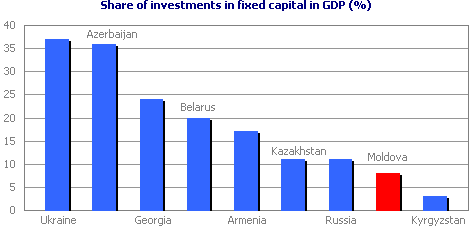
*IFC — investments in fixed capital
Sourse: Department of Statistics and Sociology
Archive
2011 2010 2009 2008 2007 2006 2005 2004 |
