ADEPT | Gagauzia 2016 | Presidential 2016 | Elections 2015 | Bashkan 2015 | Gagauzia 2012 | Political Parties
Economic Policies on May 23 – June 5, 2005
 |
 |
e-journal #52 |
Banks and insurance
The governor of the National Bank of Moldova (BNM), Leonid Talmaci, has reported on activity of BNM in 2004 to the parliament at a recent sitting. Although the bank sector did not post a wonderful evolution, the financial stability was one of its successes in 2004.
The evolutions on the currency market and dynamic of inflation in 2004 threw doubts on the BNM’s efforts to respect the monetary targets from the Monetary-Currency Policy for 2004. The supply of currency on domestic market rose under the influence of remittances from abroad (a 70-percent estimated growth) and collections from exports (25 percent). To oppose the excessive appreciation of the Leu, the BNM intensively purchased currency in the second quarter, so that its reserves rose by 55 percent in December up to over 470 million dollars. The annual inflation rate in December 2004 was 12.5 percent, compared with the 8–10 percent inflation forecasted by BNM.
Under such a situation, the BNM had to introduce important changes of key monetary policy tools, and namely it increased the targets for monetary base and unit M2. Raising currency reserves through acquisition of currency from banks was the main monetary growth channel in 2004. However, this tendency seems to be dangerous since it generates new inflationary spirals. The sterilization operations undertaken by BNM were inefficient, while the used tools had low financial maturity terms.
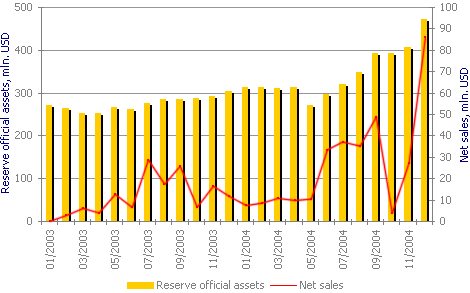
BNM purchased 277.1 million dollars on the domestic market in 2004, as a significant supply of currency was available on currency market, particularly generated by remittances of Moldovan nationals who work abroad, while the international reserves rose by 55 percent.
The remittances are on a significant rise this year as well. According to BNM, Moldovans transferred 153 million dollars in the first quarter via bank channels alone, by 53 percent more than in the similar period of 2004.
On the other hand, the remittances in currency represent a massive pressure on the domestic currency market since only ten percent of the money earned abroad represents direct investments, another 60–80 million dollars of annual remittances is deposited in banks, while the rest goes to consumption.
If the remittances grow in continuation the same way, they could amount to more than 600 million dollars this year, and for over one billion dollars, if taking into account the extra-bank inflows, too. We think that the BNM is trying to rebuild a normal stock of currency reserves, so that to enhance Moldova’s credibility (and to recover its image) on international capital markets and in front of foreign financiers.
Labor market
The medium salary in Moldova amounted to 1,278 lei in April, or 75 lei more than in March. In the publicly-supported sector the salary was 971.6 lei, by 27 lei more than in March, and in the non-budgetary sector the salary was 1.437.7 lei, and rose by 97 lei.
As usually, the largest salary was paid to bank employees, 4,305 lei, by 204 lei more than in March; in the energy industry, gas, and water supplying business, 2,258 lei; in the transportation and communication, 2,161 lei.
The lowest salary was paid in the agriculture, 607 lei a month on average, by nine lei less than in March; in the education area, 872 lei; and in the healthcare and social assistance, 971 lei.
The employed population of Moldova accounted for 1,249,000 persons in the 1st quarter of this year, by 67,000 persons less than in late 2004, according to data of the National Bureau for Statistics (BNS). Salary-earners count for about 67 percent of the employed people, workers on own account represented one third, and employers count for 0.9 percent.
Statistics show that workers in the agriculture sector represented 37.1 percent of the total of employed people at the end of the 1st quarter, by 4.6 percent more that in the similar period of 2004. Workers in the industry sector count for 12.5 percent, services 37.2 percent, medicine and education 14.3 percent.
The parliament has passed amendments to the law on employment and social protection of job seekers. They call for the enlargement of categories of unemployment assistance beneficiaries and lower joblessness indemnities.
The monthly average unemployment indemnity counts for 507 lei (40.5 dollars) at present, and it will amount for 497 lei (39.7 dollars) after enforcement of the new amendments. The category of beneficiaries of unemployment assistance comprises the
people sacked after the closure or reorganization of enterprises, who will benefit from a joblessness indemnity of 50 percent of the medium salary for the precedent year.
Many lawmakers representing the parliamentary opposition demanded that the unemployment indemnity remain unchanged, saying that the voted version is unacceptable because it has positive and negative sides. Job seekers will receive lower sums from the state, though the number of beneficiaries will grow, they added.
The salary arrears accounted for 137 million lei overall on May 1, 2005, by 14 million lei less than on April 1. The agriculture still holds the largest debts — 51.2 percent or 70 million lei, followed by industry 35.2 million lei or 25.7 percent, including the processing industry 28.4 million lei or 80.7 percent, transportation 10.6 million lei or 7.7 percent, and constructions 8.3 million lei or 6.1 percent.
The state-owned enterprises (public property) hold 21.2 million lei or 15.5 percent out of overall arrears, the private sector 88.3 million lei or 64.6 percent, mixed property (public and private) 22.6 million lei or 16.5 percent, and foreign property 4.6 million lei or 3.4 percent.
Foreign trade
Moldova’s wine exports rose by ten percent in January-April 2005 up to 7.4 million deciliters or for over 100 million dollars. The exports of sparkling and frothy wines registered the highest rise — 37 percent.
Russia is the main sale market for Moldovan wines, as it absorbs more than 80 percent of the total of wine production, followed by Ukraine, Belarus, Poland, and Germany. Moldova exports wines to 27 states of the world.
MoldovaVin forecasts a 10-percent growth of wine exports for this year up to about 300 million dollars. Moldova exported alcohol production worth 278 million dollars last year.
According to a study undertaken by the Chamber of Commerce and Industry (CCI) on basis of data of the International Trade Centre (ITC), Moldova was ranked the 11th place in the world top of the biggest wine exporters in 2003, and it held 1.2 percent of the world wine export. Following Moldova in the world top are Argentina and New Zealand, which held less than one percent of the world wine export.
According to the study, France was the world leader of wine exports in 2003, its supplies were valued at 6.6 billion dollars, or 37 percent of the world export. Italy exported wines worth 3 billion dollars in 2003, Spain 1.67 billion dollars, and Australia 1.54 billion dollars. Italy held 17 percent, Spain 9 percent, and Australia 8 percent of the world wine export.
On the other hand, the study shows that the United Kingdom and the United States were the biggest importers of wines, and they held 20 percent and, respectively, 19 percent of the world wine import in 2003. Germany held 11 percent. The world Top-10 biggest wine importers comprises Japan — 5 percent, Belgium 5 percent, Canada 4 percent, Switzerland 4 percent, the Netherlands 4 percent, France 3 percent, and Denmark 2 percent.
Data of the Ministry of Agriculture and Food Industry show that imports of agri-food products rose by 13.2 percent in January-April 2005, up to about 121.2 million dollars, while exports grew by 1.2 percent up to 215.68 million dollars, compared with the similar period of 2004. Analysts explain this phenomenon through a growth of the volume of oleaginous seeds and fruits that Moldova does not produce, which accounted for more than half of the overall imports in January-April 2005.
Also, exports of wines and strong alcohol drinks represented about 50 percent of the overall supplies in January-April, or 995.6 million dollars. Supplies of fruits and grapes declined from 460,000 dollars in January-April 2004 down to 239,000 dollars in the first four months of 2005. Exports of perfumery and cosmetics rose by over 20 percent up to 961,000 dollars.
Russia’s restrictions for imports of fruits, vegetables, meat and sausages from Moldova did not seriously hit the domestic businesses for the time being, but the losses will be visible the next months, if Moldova fails to resume the exports. Earlier, the Agriculture Ministry had forecasted that the exports of agricultural-food products will grow by about eight percent this year, while imports will remain at the level of 2004–2003.
Moldova and the world
The European Bank for Reconstruction and Development (EBRD) forecasts a 5.5-percent economic growth for Moldova in 2005
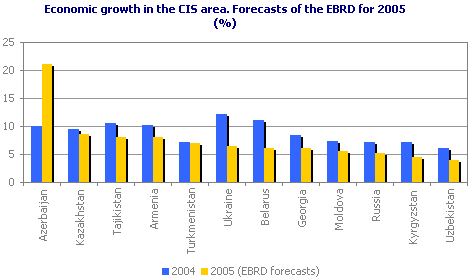
EBRD experts estimated that Moldova will register a 5.5-percent economic growth in 2005, compared with 7 percent in 2004.
The world economy will provide a less favorable environment for the transition economies in 2005, compared with 2004. The performances of the U.S. economy in 2004, as well as the positive estimates for 2005, suggest that the better results of the developed countries will reduce the capital inflows in the transition regions.
According to EBRD analysts, the economies in East Europe and former Soviet states will post a 5.2-percent average development pace in 2005, compared with 6.5 percent in 2004. The slower growth pace is particularly due to the worsening of economic climate at the world level; the high interest rates in the United States; possible declines of the capital inflows in this region.
The EBRD forecasts slower growth rates in all the CIS members, except for Azerbaijan. Thus, Russia’s economy will grow by 5.2 percent in 2005, compared with 7.1 percent in 2004; Ukraine 6.5 percent, compared with 12.1 percent in 2004; Armenia 8 percent, compared with 10.1 percent in 2004; Georgia and Belarus 6 percent, compared with 8.4 percent and, respectively, 11 percent in 2004; Kazakhstan 8.5 percent (9.4 percent in 2004); Tajikistan 8 percent (10.6 percent); Turkmenistan 7 percent (7.2 percent); Kyrgyzstan 4.5 percent (7.1 percent); Uzbekistan 4 percent (6 percent); and Azerbaijan 21 percent, compared with 10 percent in 2004.
In turn, the International Monetary Fund (IMF) indicates a slower economic growth in the CIS in its latest global economy development report. According to the IMF estimates, Moldova will register a 5-percent economic growth in 2005. The Economist Intelligence Unit launched a similar forecast. On the other hand, the Moldovan government expects a six-percent economic growth in 2005.
Elsewhere, Kurt Geiger, director of the Business Group, the department for financial institutions of the EBRD, told Moldovan President Vladimir Voronin last week that the EBRD will continue to assist Moldova to strengthen and develop the progressive bank sector. EBRD experts appreciate the situation of Moldova’s bank sector as positive and stable.
Earlier, the EBRD had expressed readiness to start 10 new projects valued at 21 million euros in Moldova this year, including three worth about 10 million euros in the bank sector.
Under the EBRD Strategy for Moldova approved in July 2003, the Bank will assist the “development of the private bank sector and will provide efficient and adequate financing for private enterprises through local banks, especially for small- and medium-sized businesses and micro-enterprises.”
Although the EBRD has opened cheap enough special credit lines in several local commercial banks, such as Victoriabank, Moldindconbank and Mobiasbanca, they increase the interest rate 2–3-fold and make inaccessible the long-term credits, which are absolutely necessary to finance the investment and production spending. Problems such as increased unemployment rate, vulnerability of national producers to foreign stocks, low quality of investment environment, and inefficient promotion of exports are directly connected to accessibility of these credits.
Archive
2011 2010 2009 2008 2007 2006 2005 2004 |
