ADEPT | Gagauzia 2016 | Presidential 2016 | Elections 2015 | Bashkan 2015 | Gagauzia 2012 | Political Parties
Economic Policies on January 16–31, 2006
 |
 |
e-journal #66 |
Financial-bank system
Interests on credits in lei dropped by about 4 percent in 2005…
Local commercial banks reduced the interest rates on credits in lei by 3.81 percent on average in 2005, down to 17.3 percent a year, compared with 21.11 percent in late 2004. Also, the interest rates on credits in foreign currency declined by 0.71 percent, down to a medium level of 10.64 percent in early 2006. According to statistics of the National Bank of Moldova (BNM), banks released credits worth 13.45 billion lei in 2005, of which 9.27 billion in lei and the rest in foreign currency.
Indeed, the Government has “suggested” commercial banks more than once to reduce the interest rate on credits in lei down to the level of 15 percent a year, “in order to enhance the accessibility to credits, especially of businesses.” Many banks have already introduced an interest rate of about 15 percent, but it is effective only for mortgage credits, which are contracted for maximum ten years in the maximal amount of 60,000 dollars.
The evolution of interest rate on forward deposits in Moldovan lei in 2005 was interesting. It dropped by 4.93 percentage points, from 15.48 percent in late 2004 down to 10.55 percent on average in late 2005. Specialists consider that this reduction was also conditioned by “ultimate” indications of the Government to reduce the interest rates on the entire banking system. However, the maintenance of this level of interest rate could reduce the attractiveness of deposits in lei.
…while the cheap credit gladdened consumers
The growth of consumption in the past years has probably worried the BNM and Government officials, who lent a “helping hand” by obliging bankers to reduce the interests on credits in lei. Most of them have complied and we were witnesses of reduction of interests on deposits in lei by about 4 percentage points. This is a good sign for consumers, but a negative signal for banks, which maintained high rates on deposits for a long time. Remaining loyal to the idea that banks never lose, representatives of banks will find a way to reduce losses by reducing interests for lei. They may also replace the profit raised from interests with the profit from some high commissions. Thus, clients will pay the same amounts in some cases.
Real sector
Economic growth was registered in all sectors of economy…
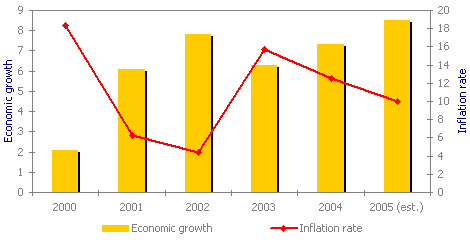
Industrial enterprises in Moldova proposed goods worth about 21.13 billion lei (1.3 billion euros) in 2005 and registered a 6.3 percent growth compared with 2004, contributing this way to the rise of GDP, which is estimated at 8.5 percent, according to preliminary statistics. Basic sectors also rose in 2005. The rise of the food industry was almost at the level of 2004, while the agricultural sector grew two-fold compared with 2004.
However, the retail and wholesale trade, hotel services and restaurants had the main contribution, as they rose by 15 percent overall. Imports rose by about 16 percent, as the internal supply could not get through the rise of internal demand. More than 23 percent of the revenue in economy went to gross formation of fixed capital, a sure, favourable trend for perpetuation of economic growth.
Evolution of GDP and inflation rate
Archive
2011 2010 2009 2008 2007 2006 2005 2004 |
