ADEPT | Gagauzia 2016 | Presidential 2016 | Elections 2015 | Bashkan 2015 | Gagauzia 2012 | Political Parties
Economic Policies on April 16–30, 2008
 |
 |
e-journal #116 |
Macroeconomics
IMF is very optimistic over evolution of macroeconomic indicators in 2008…
According to the World Economic Outlook 2008 by the International Monetary Fund (IMF), the IMF is very optimistic over evolution of macroeconomic situation in Moldova, forecasting a 7-percent economic growth and 11-percent inflation for 2008. At the same time, the IMF report says that the current account deficit compared with the GDP will be 10.3 percent. The Government and the National Bank have forecasted a 10-percent inflation rate for 2008 (but this rate was recently revised and now they forecast 11.8 percent), with this rate being also included in the Policy Memorandum signed with the IMF. The higher inflation than expected before is linked to developments on international and regional markets, as well as to the U.S. crisis.
From fiscal-budgetary prospect, IMF experts consider that prudent policies will be further promoted and the condition of maintaining a budgetary deficit of 0.5 percent of GDP will be respected. Fiscal-budgetary incomes are expected to tend to a positive evolution in continuation, while fiscal-budgetary expenses shall correspond to the Programme with the IMF, including with regard to introduction of a new nominal social assistance system next autumn.
IMF is recommending Moldova to keep austere monetary policies in order to reduce the inflation and get through pressures linked to the rise of capital inflows, in particular, of remittances from other countries. In this regard, preliminary data by NBM reveal that Moldovans working abroad have sent home more than 270 million dollars in the 1st quarter via banks from Moldova.
Labour market
Minimum wage rate in Moldova is 30-fold lower than in Luxembourg…
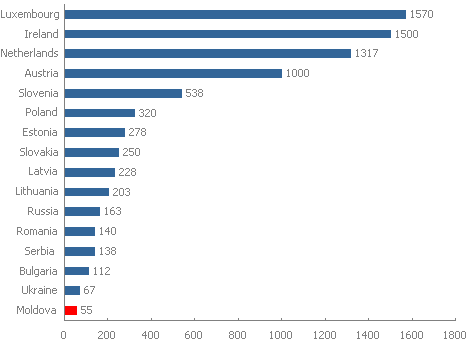
According to a rating by the Federation of European Employers (FedEE), in spite of double rises in the past years, the minimum wage in Moldova is the lowest in Europe. Starting June 2007, after collective negotiations between social partners, the minimum wage rate is 900 lei (55 euros or 6.8 euros/hour)[1]. This rate ranks Moldova in the bottom of the standing, as it is about 30-fold lower than the maximum rate in the European Union (Diagram 1).
Therefore, there is much room for a rise from statistical point of view. Even more, compared with the purchase power, salary earners in Moldova seem to be justified to seek more. On the other hand, the things are changing while comparing the salary-productivity relation. Unfortunately, this correlation is not a priority for unionists, with the economic conjuncture favouring demands of higher wages at a certain extent only.
The labour market in Moldova has entered a phase when the supply is higher than the demand. Thus, seeking higher salaries is positive. Hence, if trade unions demand, employers have to give green light at this juncture. But there is one basic condition: the productivity should grow accordingly to wages.
Major developments related to the relation between social dialogue and decent salaries include the June 7, 2007 merger of the two unionist confederations (Confederation of Free Trade Unions Solidaritatea and Confederation of Trade Unions of Moldova) into the National Confederation of Trade Unions of Moldova (NCTUM), with a total number of 720,000 members. The segregation of trade unions in December 2000 has weakened the unionist movement in 2001–2006, with the image of organisations being compromised meanwhile by unsettled property conflicts.
The merger of the two confederations could essentially improve the dialogue with the Government and employers and the protection of rights and interests of employees. One of goals assumed by NCTUM at the merger and constitution congress was to obtain “a lowest wage rate at the minimum subsistence level (which is about 1,100 lei at present).” At the same time, this goal will be accomplished should the new organisation be really independent from governance.
With regard to the FedEE rating, Moldova is ranked much behind some countries from the region. In particular, the minimum wage rate in Albania is 131 euros, in Serbia 138 euros, in Romania 140 euros. The minimum wage rate in Moldova is 10-fold lower than in Slovenia, which pays at least about 540 euros per month. On the other hand, Slovenia is known as ranking a leading place regarding the dependence of the cost of living.
Luxembourg pays a minimum wage of 1,570 euros to unqualified workers; that means the minimum wage rate on economy is much higher. Ireland pays a gross minimum wage of 1,500 euros a month, while employees in the Netherlands earn roughly 1,320 euros a month. Montenegro pays a gross minimum wage like Moldova, as workers in this country earn at least 55 euros a month (but this seems to be irrelevant).
Diagram 1. Gross minimum wage in some European countries, euros
Source: FedEE
Banking system
Overall assets of local banks estimated at about 34 billion lei…
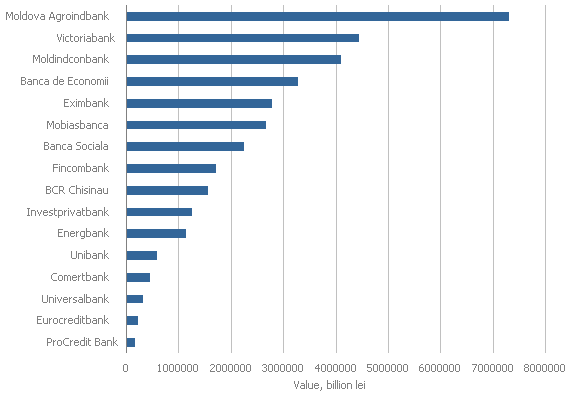
According to NBM accounts and media reportsRU, overall assets of the domestic banking system were worth about 34 billion lei (over 3.2 billion dollars), as of March 31, 2008, or the equivalent to 76 percent of the 2007 GDP (4.23 billion dollars). The rise of deposits by population in commercial banks fuelled by massive remittances (they exceeded 1.2 billion dollars in eight months of 2007), as well as the general growth of people’s incomes increased the assets (Diagram 2).
Diagram 2. Top of Moldovan banks regarding overall assets, as for 31.03.2008, billion lei
Source: Infomarket.md
Interesting: According to NBM, there were approximately 692,000 valid credit cards in Moldova on April 1, 2008, which is by over 12 percent more than in the similar period of 2007 (617,000 credit cards). For comparison, there are about 10 million valid credit cards in Romania. That means each second Romanian holds a credit card, compared with each fifth Moldovan.
- ↑ It is worth to note that FedEE data for other countries date from 01.01.2007; therefore, one may suppose that the minimum wage rates have been increased and they could be higher now, but the available data were not updated.
Archive
2011 2010 2009 2008 2007 2006 2005 2004 |
