ADEPT | Gagauzia 2016 | Presidential 2016 | Elections 2015 | Bashkan 2015 | Gagauzia 2012 | Political Parties
Economic Policies on June 1–15, 2008
 |
 |
e-journal #119 |
Prices and inflation
Inflation “defeats” forecasts…
According to statistics, the Consumer Price Index (CPI) rose by 1.5 percent in MayRO compared with April. The inflation rate was 7.4 percent in early 2008, compared with December 2007, and the annual rate was about 17 percent. For example, the inflation rate was 3.9 percent in May 2007, compared with December 2006. Prices of food products have grown by about 3 percent and of manufactured goods by 1.2 percent in the period concerned.
Tariffs of pay-for services were at the level of April 2008 in May. Higher prices were recorded for food products in the period concerned; in particular, prices of rice have increased by more than 64 percent, potatoes by 10 percent, vegetal oil by more than 4 percent, meat, canned meat by about 4 percent. Prices of fuels have grown by about 5 percent (including oils by more than 8 percent and bottled gas by over 7 percent), and drugs by more than 3 percent.
Inflationist expectations are very big in Moldova and the National Bank could continue to mark up the crediting, and the monetary policy interest could reach 20 percent. Given statistics on evolution of GDP in the 3rd trimester and the inflation rate, the central bank could increase again the monetary policy interest. The growth of inflation by the end of the year will make the real interest too restrictive.
International: prices of foodstuffs will grow by 80 percent over next 10 years…
According to a recent report by the Organisation for Economic Cooperation and Development (OECD) and U.N. Food and Agriculture Organisation, prices of foodstuffs will grow by about 80 percent over the next ten years due to the growth of grains crop used to make biofuel and demand for agricultural commodities. Prices of food products will grow by 20–80 percent over the next ten years, compared with 1998–2007.
This trend is also related to a fast rise of the demand for agricultural commodities and meat, as well as to the world growth of population. People will consume by 85 percent more meat in half a century and it will be by about 1/5 more expensive, and by up to 50 percent more grains which will be by approximately 60 percent dearer than in 1998–2007. Sugar is not an exception and its price will grow by about 40 percent over the next ten years, while butter, coarse grains and oilseeds will grow by 60–80 percent.
The report comes on background of a revolt linked to the lack of food products in African, Asian and Caribbean countries, as well as to dearer fuels, and it anticipated the June 3 Rome summit which discussed further actions to prevent an acute crisis in poor countries. Dearer food products will famish millions of people from economically disadvantaged areas and will fuel inflation.
The rich of the world will win…
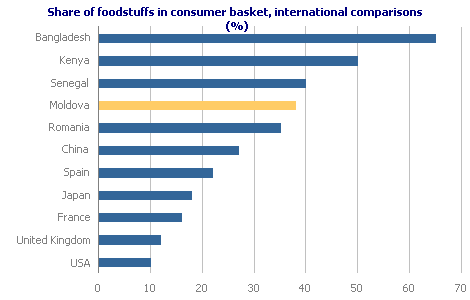
The accelerated rise of food prices will advantage developed countries and developing states which are big exporters of grains and will seriously hit developing countries, especially poor urban areas which import food products. While American, British and Japanese people spend less than 20 percent of their earnings on food, residents of poor countries spend about 60 percent (foodstuffs cover between 35 and 40 percent of the consumer basket in Moldova Diagram 1).
Diagram 1. Moldovans spend one third of their earnings on foodstuffs (in percent)
Sources: NBS, Eurostat, Reuters
Banking
Market expects new interest rises…
Many bankers and analysts anticipate a new rise of the monetary policy interest after the central bank raised the basic interest rate from 17 up to 18.5 percent in May. Such a decision would mark up again the loans, which now are contracted for an average rate of about 20 percent in lei and over 11 percent in foreign currency. Credits will become dearer and dearer for people. The National Bank will not hesitate to raise the reference interest should the economic situation impose this; in particular, should inflationist expectations be higher than forecasts.
The rise of key interest will mean a dearer crediting but more attractive bank deposits. Besides, savings (deposits) proposed by many banks have an annual interest rate of 23 percent, which is similar to 1997–98. The signal given by NBM by raising the monetary policy interest will be experienced on market in half a year. Hence, the rise of the basic interest rate in May will be felt in the crediting cost in October-November 2008. Banks generally prefer to raise the interest rates by a percent similar to the rise of the key interest of the central bank. The Moldovan inflation continued to grow in May and analysts anticipate that NBM could modify the monetary policy interest in the next period.
Public finances
Interventions into budget…
The Government modified the 2008 budget law at a recent sitting by elaborating a draft law. It increased the basic incomes of the 2008 state budget by 340.6 million lei and expenses by 124 million lei. Following these rectifications, the budgetary deficit is expected to reduce by 124 million lei, down to about 100 million lei. Authorities said that this draft law is a consequence of the evolution of economy and monetary market which influence the execution of the state budget. The draft hardens the fiscal-budgetary policy to reduce inflationist effects. Expected estimates of the 2008 national public budget impose a more austere fiscal position by reducing the budgetary deficit from 0.5 percent of GDP to a balanced budget.
External sector
Trade deficit exceeds 1 billion dollars…
Data of the National Bureau for Statistics reveal that Moldova’s trade deficit for January-April 2008 exceeded 1.12 billion dollarsRO. The import/export coverage rate was 32.3 percent, compared with 36.7 percent in January-April 2007 and imports exceeded over three-fold the value of exports. In particular, exports were worth over 482 million dollars and imports turned over 149 billion dollars and increased by 46 percent.
Exports to CIS have grown by over 45 percent, up to 194.5 million dollars. Moldovan supplies to the European Union have grown by about 27 percent up to 246 million dollars. Imports from the CIS have grown by more than 40 percent, up to 534 million dollars and imports from the EU by over 43 percent, up to about 664 million dollars. The trade deficit balance with the EU has increased by more than 55 percent up to 417 million dollars and with the CIS by about 38 percent up to 340 million dollars. Moldova registered the highest trade balance deficit in January-April 2008 with Ukraine (about 180 million dollars), Russia (about 133 million dollars), Romania (more than 97 million dollars), Germany (more than 88 million dollars), China (about 85 million dollars), Turkey (about 62 million dollars), Italy (about 38 million dollars), and Belarus (over 31 million dollars). The trade deficit could reach 3 billion dollars or even more by the end of this year, which would be equivalent to over 56 percent of the 2008 GDP.
Archive
2011 2010 2009 2008 2007 2006 2005 2004 |
