ADEPT | Gagauzia 2016 | Presidential 2016 | Elections 2015 | Bashkan 2015 | Gagauzia 2012 | Political Parties
Economic Policies on February 2–14, 2009
 |
 |
e-journal #132 |
Macroeconomics
GDP “keeps well”…
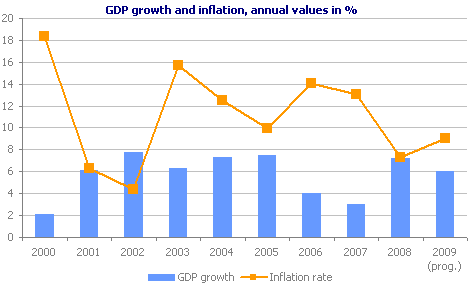
Official statistics reveal that the GDP was worth 62.84 billion lei (about 6 billion dollars) in 2008, with current market prices exceeding by 7.2 percent the achievements of the last year in real terms (Diagram 1). The gross value added in commodity sector has increased by 14.7 percent compared with 2007 and contributed with 3.6 percent to the real GDP growth. The growth was conditioned by a significant rise of the gross value added in agriculture, more than 35 percent, compared with the last year. In industry, the gross value added has grown by 0.3 percent only in 2008, compared with 2007.
The gross value added in service sector has increased by 3.8 percent, contributing with 2.3 percent to the real GDP growth. Taxes on product and import have advanced by 9.2 percent, compared with the last year, contributing with 18.8 percent to the GDP formation and with 1.7 percent to its real growth. The GDP growth on expense elements was primarily conditioned by the 4.6 percent rise of the final consumption, compared with the last year, contributing with 5.2 percent to the real GDP growth. The gross fixed capital formation has increased by 1.8 percent compared with 2007, contributing with more than 34 percent to the GDP formation and with 0.6 percent to its real growth.
Diagram 1. Dynamic of key economic indicators, annual values in %
Source: NBS, NBM, IMF, governmental forecasts
Inflation and prices
Prices in Moldova are on the decline, compared with regional realities…
According to NBS, a 0.1-percent deflation was recorded in January. The fall of average consumer prices was linked to the prices reduction for manufactured goods by 0.6 percent, while prices of food products and tariffs for public services have increased by 0.2 percent each.
As regards food prices, average consumer prices rose as follows in January: fresh vegetables by about 6 percent, potatoes by 2.3 percent, fresh fruits by 1.1 percent (apples by 4.6 percent), milk and dairy by 0.6 percent. On the other hand, prices of rice have decreased by 7.5 percent, vegetal oil by approximately 7 percent, citric by 5 percent, sugar by 4.8 percent, bakery by 1.2 percent (grits by 3.6 percent).
Prices of the following manufactured goods have decreased in the period concerned: fuels by 3.6 percent (oil by 6.3 percent, bottled natural gas by more than 7 percent), building materials by 0.5 percent, ready-made clothes, footwear, TV sets, telephony, audiovisual and household appliances by 0.2 percent each.
Tariffs of public services increased as follows in January 2009: education services and tariffs for nursery and kindergarten services by 3.4 percent, pay-for services by healthcare institutions by 2.4 percent and sanatorium services by 3.7 percent.
Banking system
Popularity of credit card transactions is on the rise…
Transactions by credit cards issued in Moldova have increased by about 44 percent in 2008, compared with 2007. On the other hand, transactions by local credit cards have decreased by about 8 percent, from 25.3 million lei down to 23.3 million lei, while transactions by international cards have increased by about 44 percent, from 8 billion lei up to 11.5 billion lei. Transactions by foreign bank cards operated in Moldova have increased by more than 13 percent, from 1.1 billion lei down to 1.3 billion lei.
Moldovans sent home the equivalent to a budget in 2008…
According to statistics on international bank operations, Moldovan nationals working abroad have sent home 1.65 billion dollars in 2008, by about 36 percent more than in 2007. They sent more than 1.32 billion dollars via rapid money transfer systems, which is by about 44 percent more than in 2007. The largest amount was transferred in the 3rd quarter of 2008 — nearly 504 million dollars.
Remittances have constantly grown from the beginning of the year till August, when a decline was recorded. In particular, 166.33 million dollars was sent in August 2008, 156.8 million dollars in September, 139.1 million dollars in October, and more than 111 million dollars in November. Remittances increased by 44 percent in December 2008, compared with November, up to 141.5 million dollars. Remittances in Euros accounted for 48.7 percent in 2008, in dollars for 45.4 percent, Russian roubles 5.5 percent, other currencies 0.4 percent; the currency structure in 2007 was the following: 40.5 percent in Euros, 57.9 percent in US dollars, 1.6 percent in Russian roubles, and 0.2 percent in other currencies.
Diagram 1. Dynamic of remittances, annual values, million dollars

Source: NBM, IMF
External trade
Moldova’s tries to align to European standards…
The Republic of Moldova chaired the Central European Free Trade Agreement (CEFTA) in 2008. Majority of CEFTA member states have already aligned to community legislation, as they are candidates or potential candidates to EU. In particular, they aligned to standardisation and metrology, customs system, etc. Moldova has to adjust its legislation to the acquis communautaire, in order to remove non-tariff barriers.
As regards industrial products, Moldova has made all necessary legal decisions and adjusted the legislation to EU standards, so that it just has to implement them and make these mechanisms operational. As for food products, especially sanitary and phytosanitary measures, the situation is unfavourable. On the one hand, there are lots of laws and the priority to execute them is unclear to Moldovan authorities themselves. Moldova lacks a distinct strategy on sanitary and phytosanitary measures. As regards the customs sector, almost all legal and institutional frameworks were readjusted to EU regulations and now their functioning is considered.
Montenegro will take over the CEFTA Chairmanship in 2009. CEFTA surnamed as EU ante-chamber stipulates the cancellation by 2010 of all import and export duties, quantity restrictions and other equivalent taxes on trading industrial products, majority of agro-industrial products. Current CEFTA members are: Albania, Bosnia and Herzegovina, Macedonia, Moldova, Montenegro, Croatia, Serbia, and Kosovo. Moldova’s trade exchanges with CEFTA member states accounted for 25 million dollars in 2008, which is 0.4 percent of the overall external trade of Moldova.
Archive
2011 2010 2009 2008 2007 2006 2005 2004 |
