ADEPT | Gagauzia 2016 | Presidential 2016 | Elections 2015 | Bashkan 2015 | Gagauzia 2012 | Political Parties
Economic Policies on March 2–16, 2009
 |
 |
e-journal #134 |
Inflation and prices
Prices “moving backward”
BNS data show that the Consumer Price Index (CPI) in February 2009 was 99 percent compared with January 2009 and 103.1 percent compared with February 2008 (for information, CPI was 101.5 percent in February 2008 compared with January 2008 and 114.8 percent compared with February 2007). Therefore, Moldova records a negative inflation rate (deflation) for the first two months (minus 1.1 percent). Consumer prices decreased by 1 percent, as prices of food products have declined by 1.8 percent, manufactured goods by 1 percent, while tariffs for public services rose by 0.2 percent.
In comparison with January 2009, prices of rice dropped by 7 percent, vegetal oil by 5.5 percent, grits by about 5 percent, bread by nearly 4 percent, grapes by about 4 percent, sugar by 3.5 percent, fresh fruits by 3.4 percent (apples by about 5 percent), fresh vegetables, fowl and wheat flour by more than 3.1 percent. As for manufactured goods, prices of fuels have decreased by 5.5 percent (bottled natural gas by 15.4 percent, coal by 3.1 percent, motor fuels by 0.8 percent) in the period concerned, building materials by 1.7 percent, footwear by 0.7 percent, and ready-made clothes by 0.5 percent.
Tariffs for public alimentation and telecommunication services rose by more than 1 percent in February 2009. At the same time, tariffs for interurban public motor transportation services were reduced by about 5 percent in February, interstate railway transport by 0.4 percent and hotel services by 0.5 percent.
Macroeconomics
International forecasts “push” Moldova to recession…
The British Economist Intelligence Unit anticipates that Moldova’s economy will contract by 1 percent this year. On the other hand, Moldovan Government expects a 6-percent economic growth. British experts say that Moldova’s GDP will fall this year and the economic growth will be recovered in 2010 only, when it will be approximately 3 percent. The budgetary deficit could reach 1.5 billion lei, the country will be short of funds to develop announced programmes and, in consequence, the Government will have to update the expenses, should these forecasts become true.
At the same time, the International Monetary Fund anticipates that Moldova’s reserve currency will fall by more than 600 million dollars this year. As well, IMF experts simulated a heavier model for Moldova — the reserve currency of the country could decline by more than 1.3 billion dollars, from 1.365 billion dollars at present, should remittances, exports and foreign investments fall suddenly. For example, remittances accounted for 64.8 billion dollars in January 2009, falling by about 28 percent compared with the same period of 2008, when this indicator exceeded 71 million dollars. Remittances have actually substituted Moldova’s economy and this is not a good solution for a long term. The fall of remittances will reduce the purchase power of people.
According to this scenario, Moldova’s economy will enter into recession and a 4.5-percent fall could be recorded in 2009. This is a mathematical exercise, but these estimates should be taken into account as last version. IMF has recently updated its forecasts for the poorest countries. Hereby, IMF forecasts a 3.5-percent GDP growth for Moldova in 2009. On the other hand, EBRD economists say that Moldova’s economy could grow by 4.1 percent in 2009.
Infrastructure
All our roads… will they ever repair?
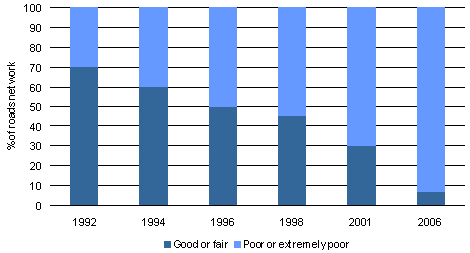
According to the third annual Travel & Tourism Competiveness Report, Moldova is ranked the 132nd place among 133 countries in terms of quality of traffic infrastructure. The report worked out by the World Economic Forum ranks Moldova among countries with worst traffic infrastructure like Chad, Bosnia and Herzegovina, Paraguay and Bolivia. As well, the quality of transport network in Moldova is also bad, with our country being ranked the 87th place. In addition, Moldova is considered an “expensive” country in terms of air tickets and airport taxes. Here Moldova is ranked the 108th place among 133 countries. The Constraints AnalysisRO worked out in 2007 reveals a similar situation.
Figure 1. Evolution of the roads network conditions in Moldova
Source: Analysis of the current condition of the Moldovan Transport Sector, World Bank, 2007.
On the other hand, Moldova has progressed in terms of hospitality, level of fuel prices, hotel services. It climbed five places in the Travel & Tourism Competiveness Report and ranked the 93rd place among 133 countries, compared with the 98th in 2008. Moldova is ranked between Kazakhstan and El Salvador. Romania is ranked the 66th place, Ukraine the 77th, Russia the 59th. The rating was carried out on the basis of some indicators such as tourism regulatory framework, infrastructure, natural resources and human capital. Switzerland, Austria and Germany are the most attractive countries for tourism development, ranking the first three places, while Burundi, Lesotho and Chad rank the last three places.
Social protection
Pensions in Moldova are among lowest in the region…
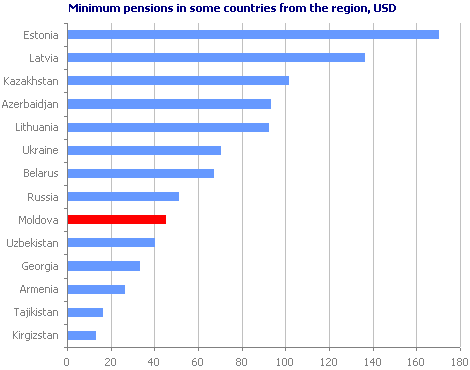
Moldova is ranked the 8th place in the Commonwealth of Independent States and Baltic Countries in terms of minimum pension. According to statistics, a Moldovan retiree was earning minimum 45 dollars in early February. The highest minimum pensions are paid by Estonia — 170 dollars, Latvia 136 dollars and Kazakhstan 101 dollars. Moldova was ranked after Azerbaijan, which pays a minimum pension of more than 93 dollars, Lithuania 92 dollars, Ukraine 70 dollars, Belarus 67 dollars, and Russia 51 dollars. The ranking ends with Uzbekistan — 40 dollars, Georgia 33 dollars, Armenia 26 dollars, Tajikistan 16 dollars, and Kirgizstan 13 dollars.
Table 2. Minimum pensions in CIS member states
Source: www.infotag.md
Building non-state or private pension funds is being discussed for quite a long time, as legislation seems to be well for this purpose, but no actions are taken in this respect. On the other hand, these funds are part of a developed financial market, while our financial or capital market is underdeveloped. For example, employees’ liabilities to private pension funds would be an investment in a more quite and stable retirement to match annual contributions and a lasting solution to a long-term crediting for economic agents. More by token that these institutions along with banks make the same financial market everywhere and Moldovan legislation allows building such funds.
A solution to beat the crisis would be for the Government to find all possible ways in order to oblige Moldovans working legally abroad to contribute to the pension system in their host countries and further transfer their rights. But this would be possible in case Moldova has (or will have) such agreements with countries concerned. Otherwise, Moldovan immigrants could contribute directly to the domestic pension system, as its security could be threatened when some emigrants will come back home.
In this respect, estimates by the United Nations Population Fund (UNFPA) reveal that the number of population will fall by 10 percent in 2010–2050 in 45 countries, including Belarus, Bulgaria, Georgia, Germany, Latvia, Lithuania, Moldova, Poland, Russia, Romania and Ukraine. Updated UNFPA forecasts say that Moldova will have only 2.9 million people in 2050, should the state of things be the same (low birth rate, negative natural rise, massive emigration of population), so that the economically active people will not exceed 1 million and maximum half of them will be salary earners, while the number of retirees will exceed one million (more than 640,000 people at present). Respectively, a salary earner will “carry” more than two retirees.
Archive
2011 2010 2009 2008 2007 2006 2005 2004 |
