ADEPT | Gagauzia 2016 | Presidential 2016 | Elections 2015 | Bashkan 2015 | Gagauzia 2012 | Political Parties
Economic Policies on March 1–14, 2006
 |
 |
e-journal #69 |
Real sector
Moldovan economy rose by 7.1 percent in 2005…
The Moldovan economy rose by 7.1 percent in 2005, while GDP amounted to 34.2 billion lei (2.7 billion dollars) in comparable prices. At the same time, the rise pace was slower than in 2004, when a 7.3 percent growth was registered.
In particular, the rise of GDP was due both to positive evolutions in commodity and service sectors and to considerable collection of taxes on products and imports. Also, more than 60 percent of GDP collections came from services and trade, while the share of industry and agriculture still remains low enough. As for example, the agriculture registered a one-percent rise compared with 2004 and it contributed with about 25 percent to GDP in 2005.
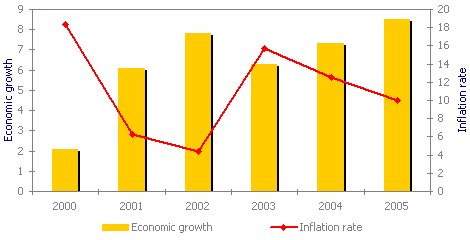
…but rise paces slowed down like in other states in CIS area
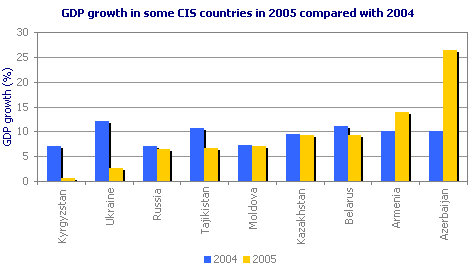
On the other hand, according to data of the CIS Committee for Statistics, Azerbaijan has reported the highest economic growth — 26.4 percent, followed by Armenia — 13.9 percent, Belarus and Kazakhstan — 9.2 percent of GDP. If a GDP growth standing is worked out, Moldova would rank the 4th place in CIS. Indeed, according to a recent report of the United Nations., the transition countries (including in the CIS) registered the highest economic growths in 2000–2005, 6 percent on average, while CIS recorded a 7-percent average. On the other hand, in Armenia and Azerbaijan only the economic growths in 2005 were higher than in 2004, an evolution reflected in the table below.
On the other hand, the Economist Intelligence Unit forecasts a 4.1 percent average rise pace for Central Europe (the Czech Republic, Hungary, Poland, Slovakia and Slovenia), 4.4 percent for the Balkan states (Bulgaria, Croatia, Macedonia, Romania and Serbia-Montenegro), 6.6 percent for the Baltic countries (Estonia, Lithuania, Latvia) and 5.9 percent for the CIS (Azerbaijan, Kazakhstan, Moldova, Russia, Ukraine, Uzbekistan).
Prices and inflation
Inflation grows slowly but surely…
The inflation rate in January 2006 was by 1.9 percent higher than in December 2005, while the consumer price indicator in February was 1.4 percent. The cumulated inflation rate for the first two months of this year was 3.3 percent. In our opinion, this level will be maintained in March as well or it will even grow moderately. The tariffs of services provided to population rose the most — by 3.3 percent (mainly generated by higher prices of natural gas), prices of food products grew by 3.1 percent, while prices of manufactured goods rose by 2.6 percent.
According to BH data (budgets of households), food products will hold 44.5 percent in the CPI (consumer price index) calculation in 2006, compared with 45.77 percent last year, manufactured goods — 30.19 percent, compared with 29.77 percent last year, while services for population will hold 25.36 percent, compared with 24.47 percent in 2005.
…with Moldova ranking the 3rd place in CIS regarding price rise
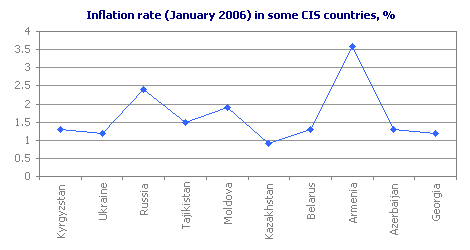
The Republic of Moldova is ranked the 3rd place in CIS regarding the CPI rise, after Armenia and Russia, which registered 3.6 percent and, respectively, 2.4 percent. Following Moldova is Tajikistan, which reported a 1.5-percent inflation, Azerbaijan, Belarus and Kyrgyzstan, by 1.3 percent each. Ukraine and Georgia have reported the lowest price rises, by 1.2 percent each, while Kazakhstan posted the lowest inflation rate in CIS — 0.9 percent.
The Government and the National Bank have forecasted a 10-percent maximal inflation rate for this year, but we fear that it will be hard to maintain this level because the economy could be affected by higher prices of fuels. We note that the natural gas tariffs rose by about 37 percent in February, and these tariffs will be in effect till April 1, 2006 and they will generate, in turn, a rise of electricity tariffs.
Bank sector
Total assets of the Moldovan banking system rose in January 2006…
The total assets of the Moldovan banking system rose by 147 million lei (11.4 million dollars) in January, fuelling estimates that the rise trends registered in the past two years will be maintained in continuation. The assets were valued at about 18.2 billion lei (some 1.401 billion dollars or 1.175 billion euros) in early February. For comparison, the assets of the Romanian banking system are estimated at over 36 billion euros and these assets are 30-fold higher than of the Moldovan banking system.
…but the volume of forward deposits in Moldovan lei dropped…
At the same time, the volume of forward deposits in Moldovan lei has dropped, mainly due to the decline of deposits of businesses. On the other hand, the share of forward deposits of individuals rose by 11.7 % compared with December 2005, up to 69.8% of the overall volume of deposits in domestic currency attracted in January 2006.
…on background of a higher interest rate
The average interest rate of forward deposits in Moldovan lei rose by 0.28 percentage points in January, up to 10.83 percent (7.91 percent for businesses and 12.10 percent for individuals, compared with 7.98 percent and 12.41 percent in December 2005). At the same time, the average interest rate on deposits in foreign currency dropped by 0.18 percentage points, down to 5% (4% for businesses and 5.19% for individuals).
According to data of BNM, the supply of deposits in the banking system turned over 11.245 billion lei in early February, declining by 10.8 million lei (0.1%) compared with December 2005. The decline was due to reduction of deposits in domestic currency by 211.4 million lei (3.2%).
Population could look for other investments due to low interests on deposits…
Forecast for 2006: The value and number of credits will grow, but not the same will happen with deposits, as people could look to place their savings in other, more profitable investments because of low interest rates.
Central banks in the world modify their currency reserves…
According to a survey published the London-based publication Central Banking in the mid-February, a trend of national currency reserves to migrate from dollar to euro was outlined last year. The Central Banking survey covered 56 central banks in the world.
Euro
10 banks have reduced the ratio of reserves in euros.
23 banks have increased the ratio of international reserves in euros.
Most of those which reoriented to euro were European central banks from outside of the euro area.
Dollar
15 banks have reduced their ratio of reserves in dollars.12 banks have increased the ratio of international reserves in dollars.
Most of those which have consolidated on dollar were central banks in Asia, Latin America and other petrol producing countries.
The reserves of banks participating in the survey represent about 42 percent of the total of 4.4 trillion dollars administrated by central banks in the world in late June 2005. The National Bank of Moldova holds international reserves worth about 600 million dollars, while 30% of them are denominated in euros.
Public finances
State budget revenues could decline in the next period…
Basic revenues in the amount of about 1.1 billion lei (71.2 million euros) were raised to the state budget in January-February 2006 and they rose by 22.2% compared with the first two months of 2005. However, this strong rise could be tempered after the reduction of the corporate tax down to 15%, reduction of incomes of economic agents due to higher prices of fuels, governmental regulations and, not the last, the commercial obstacles like those introduces by Russia.
Foreign trade
Trade deficit grows with “perspectives”…
Moldova’s trade deficit turned over 76.5 million dollars in January and rose almost 1.9-fold compared with January 2005, with “perspectives” of a strong rise in the next months. Statistics show that the foreign trade volume was 220 million dollars in the first month of this year, by over 17 percent more than in January 2005. Although CIS countries remain the main partners of Moldova in export-import relations, with an overall share of 46.7 percent, the Moldovan exports to the European Union rose from 29.7 percent in December 2005 up to 34.7 percent in January 2006, and this growth was mainly due to reorientation of food and vegetal production to the E.U.
The value and volume of Moldovan exports could grow after Romania and Ukraine resume the importation of Moldovan sugar (the Kiev Government is to examine a draft in this regard soon). The Government has forecasted a 13-percent growth of exports and an 11-percent rise of imports for 2006.
Archive
2011 2010 2009 2008 2007 2006 2005 2004 |
