ADEPT | Gagauzia 2016 | Presidential 2016 | Elections 2015 | Bashkan 2015 | Gagauzia 2012 | Political Parties
Economic Policies on March 15–28, 2006
 |
 |
e-journal #70 |
Prices and inflation
Gas price and agricultural crop will mainly influence inflation this year…
Inflation in March did not exceed 1% in the past 4–5 years. However, March 2006 threatens to be a sad exception in this regard. The rise of gas tariffs will develop into higher prices for almost all goods. Therefore, expenses of households will also grow, especially because of higher gas tariffs. In addition, it is easy to forecast higher prices for most of agricultural products after unfavourable climatic conditions last spring for many crops.
Many cereals were compromised, generating higher prices…
The government could intervene again with administrative measures on the cereal market after the cereal crop in 2003 exceeded 100,000 tons and it had to use different methods in order to ensure the internal needs, necessities which did not always satisfy economic agents and consumers. The cause is simple — the frosts last winter compromised most of autumn cereals. Data of the Ministry of Agriculture and Food Industry show that more than 90 percent of cereal fields and up to 45 percent of wheat fields have been compromised. Domestic farmers need 14,600 tons of barley seeds and 1,036 tons of wheat seeds in order to reseed the fields.
According to the Commodity Exchange of Moldova, prices of cereals rose by over 10 percent on average on March 1–24. The price of soy grew the most in the period concerned — by 25 dollars, up to 225.5 dollars a ton; price of fodder wheat rose by 14 dollars (110 dollars), fodder barley by 9 dollars (113 dollars), while price of corn rose by 8 dollars, up to 91 dollars a ton. Prices of sunflower seeds only have declined by 7 dollars a ton, down to 215 dollars in the period concerned.
Labour market
Average salary on economy rose by about 26% in January-February 2006…
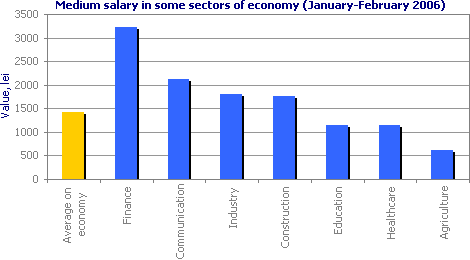
The medium salary in national economy rose by 26% in January-February 2006, compared with the same period of 2005, up to 1,417 lei (109 dollars). Employees of finance sector earned the most in continuation — 3,220 lei, while workers in transportation and communication earned 2,118 lei on average a month, industry — 1,812 lei and construction — 1,751 lei.
At the same time, agriculture and forestry sectors paid the least — 608 lei, followed by healthcare and social assistance — 1,137 lei, and education — 1,156 lei. A new quantum of tariff salary for the first qualification category in the real sector of economy will be negotiated and established in 2006, and this wage accounts for 550 lei at present.
Source: NBS and our estimates
Real sector
Industrial sector rose by 1.3% in the first two months of this year…
According to data of the National Bureau for Statistics (NBS) industrial enterprises in Moldova made production worth about 3.16 billion lei (more than 200 million euros), with industry growing by 1.3% compared with the first two months of 2005. The growth was mainly due to food and drink industry, which registered a larger production volume for processing and canning of fruits and vegetables, processing and canning of meat and meat products, bread and pastry products, dairy.
…while Moldovan strategists draft projects aimed to enhance the importance of this sector
Scientists of the Academy of Sciences of Moldova (ASM) jointly with functionaries of the Ministry of Industry and Infrastructure and Ministry of Economy and Trade have drafted a project on Industrial Policy of Moldova for 2006–2016. The project was published on the website of ASM and it will be discussed soon at a national seminar. This is a strategic planning document and it includes basic principles, objectives and priorities of state policy on industry. The strategic goal of the Industrial Policy of the state stipulated by project is to create a technologically developed, efficient and competitive industrial sector of economy readjusted to European standards.
At the same time, the annual growth of agricultural production is estimated at 5–7% the next 10 years…
At the same time, the agri-food development strategy for 2006–2015 stipulates an annual rise of agricultural production by 5–7%, a growth of processed agricultural production up to 20% and of ecological production up to 10%. According to the strategy, these rises shall correlate with the growth of real revenues of farmers up to 85%, compared with the average on economy, by 2015. The strategy proposes some primary branches such as sugar beet growing, livestock sector, etc., which will benefit of state subsidies. The decapitalisation of agri-food sector has a negative influence on developments in this branch in the latest period. Assets of owners of agricultural fields rose 5-fold, but they represent only 4.9% of overall investments in fixed capital which contributed to the formation of GDP for 2006.
On the other hand, profitableness of agricultural enterprises is only 2.7%…
Profitableness of agriculture has significantly declined: only 8–9 out of 15 groups of commodities analysed within the statistics system are profitable, while only 50% out of 11,800 enterprises of agricultural exploitations working in Moldova are profitable. The medium profitableness of agricultural units is only 2.7%. This situation is motivated including through unreasonable use of fields.
IMF forecasts a record world economic growth for this year…
Experts of the International Monetary Fund (IMF) forecast a 4.8% overall economic growth for 2006. It will exceed the level of 4.3% that IMF has earlier forecasted due to a better economic situation in Europe and Japan. According to IMF experts, the economic conjuncture in the world is very profitable, so that the negative impact of oil price on production growth and its influence on inflation will be counterbalanced by low interest rates and positive effect of globalisation. The Chisinau government estimates a 6.5% economic growth for this year, compared with 7.1% in 2005 and 7.3% in 2004. On the other hand, independent experts forecast a 6% percent economic growth, while international institutions predict 5.0–5.5%. The internal demand could grow in 2006, too, while exports will influence the GDP in general in a smaller measure due to the rise of national consumption.
Financial-banking sector
Rise of banking sector slowed down…
According to data of the National Bank of Moldova (NBM), evolution of banking sector was slower in January-February 2006 than in the same period of 2005. Total assets of banks rose slower in the first two months of this year than in the similar period of 2005, while deposits and credits grew insignificantly. They rose by 1.42% in January-February up to 18.2 billion lei (over 1.4 billion dollars). Both the share of granted credits and of deposits has declined. The reduction of deposits is probably generated by decline of interest rates on deposits of population.
One of basic indicators, the 1st-degree capital, which aims to cover eventual financial losses, rose much faster than assets, respectively by 4.6%, up to over 3 billion lei (230.7 million dollars). The rise of this indicator serves indeed to strengthen the stability of banks in general and protection of depositors’ interests. The share of assets in foreign currency in the total of assets is 43.3% and it dropped by 0.35% in January-February.
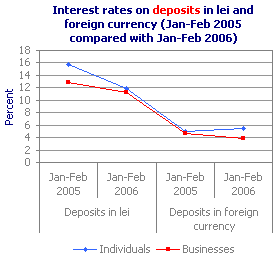
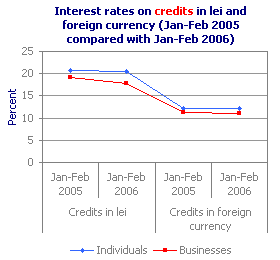
The difference between interest rate applied by commercial banks on deposits and interest rate on credits is still high both in lei and in foreign currency: about 8 percentage points for individuals and approximately 6.5 percentage points for businesses. Situation developed favourable enough for businesses in February, as interest rates rose much enough, by 3.28 percentage points for deposits in lei and 0.68 percentage points for deposits in foreign currency. At the same time, the interest on credits rose insignificantly. The interest rate for individuals declined both for credits in lei and for deposits in lei by 0.36 percentage points and, respectively, 0.26 percentage points. The interest rate on credits in foreign currency rose by 0.03 percentage points, while on deposits in foreign currency dropped by 0.16 percentage points.
Source: NBM and our estimates
Moldovan leu depreciated by about 1% verso dollar and euro in the 1st trimester of 2006…
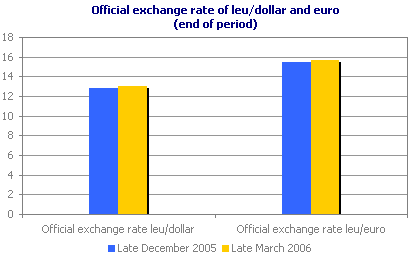
The official exchange rate of Moldovan leu depreciated by about 1% verso American dollar in the first trimester of this year, from 12.8320 lei per dollar in late December 2005, down to 13.0015 lei per dollar in late March 2006. At the same time, the average official exchange rate of leu/euro has depreciated by about 1%, from 15.4251 lei per euro in late December 2005 down to 15.6468 lei per euro in late March 2006.
According to NBM data, the turnover of transactions in lei on domestic currency market was valued at about 450 million dollars in February, by 0.3% more than in January 2006. Purchases of foreign currency on domestic currency market accounted for 222 million dollars in February; whole sales amounted to 230 million dollars. Operations in dollars accounted for 70% out of the total of transactions, deals in euros — 25.5%, in Russian roubles — 4%, and in Ukrainian hryvna and Romanian lei — by 0.3% each.
Source: NBM and our estimates
Business climate
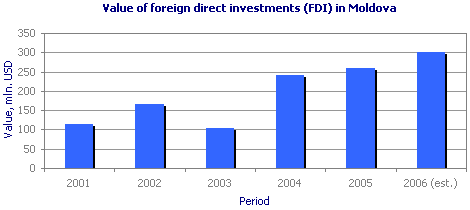
Foreign direct investments represented about 9% of GDP in 2005…
Moldova attracted foreign direct investments (FDI) worth 260.3 million dollars last year or about 9% of GDP, these being the largest FDI in the past 15 years. In comparison with 2004, FDI have grown by 7.7%. FDI amounted to about 240 million dollars in 2004, to 102 million dollars in 2003, to 166 million dollars in 2002, and to 114 million dollars in 2001. According to statistics, 721 foreign capital enterprises were registered in Moldova in 2005, by 65% more than in 2004, while the total number of foreign capital firms count for 4,324 businesses early this year.
…while FDI in Baltic Countries hold about 30% of GDP
On the other hand, the average share of FDI in the Baltic Countries is about 30% of GDP. Russia is the main investor in Moldova, as it has invested about 147 million dollars in 1994–2005, followed by Spain — 81 million dollars and the United States — 61 million dollars. The Top-15 investors also includes the Netherlands (59 million dollars), Germany (31 million dollars), France (30 million dollars), Romania (27 million dollars), Switzerland (17 million dollars), the United Kingdom (15 million dollars), Ireland (15 million dollars), Greece (14 million dollars), Liechtenstein (13 million dollars), Malta (12 million dollars), Turkey (12 million dollars), and Cyprus (11 million dollars).
Archive
2011 2010 2009 2008 2007 2006 2005 2004 |
