ADEPT | Gagauzia 2016 | Presidential 2016 | Elections 2015 | Bashkan 2015 | Gagauzia 2012 | Political Parties
Economic Policies on December 2–15, 2006
 |
 |
e-journal #86 |
Inflation and prices
Prices and inflation grow constantly…
The Consumer Price Indicator rose by 1.7% in November compared with October, while the cumulated inflation rate for 11 months was 12.7%. In spite of governmental efforts, prices have grown slowly but strongly, especially of food products. Prices of most vegetables have gone up once the weather grew cold. But it is still curious how the two-fold rise of the price of imported gas was not followed by higher electricity, heating, water tariffs. Prices of fuels including for coal deliveries have grown among manufactured goods.
The higher inflation could be a result of the “lower” unemployment rate. The economic theory says that if the Government of a country is trying to reduce the unemployment rate to maximum, it runs the risk to face an increasing inflation because the money allocated to new salary earners will press the prices. The inflation could reach 14% by the end of this year (our forecast of 13.5–14% made earlier this year could become true), and this value would exceed the Government’s expectations regarding the inflation rate updated in September up to 12%. We consider that nor the rise of the base interest rate from 14% up to 14.5% by the National Bank of Moldova (aimed to stop the growth of inflation) would help the Government obtain the updated inflation rate. The central bank decided in early December for the second time this year to increase the base interest rate in order to attenuate the pressures of the internal demand supported by rise of credit on foreign deficit and inflation.
In addition, remittances of those working abroad and higher salaries (both in public and private sectors) also endanger the inflation. The rise pace of prices may also fix the inflation when authorities would try to correct the trade deficit or when an uncertainty of the calendar of administrated prices would exist. The evolution of prices of food products and manufactured goods is also part of the risks of targeting inflation. We do not know how the price of crude oil will develop, while administrated prices may appear at any moment through a political decision. At the same time, the CIS Committee for Statistics has said that Moldova registered the highest inflation in the commonwealth in January-October 2006, notably 12.4%.
Labour market
Unemployment “does not seem to be a problem”…
According to data of the National Bureau for Statistics, the economically active population in Moldova count for 1.48 million people in the 3rd quarter of this year, of them approximately 1.4 million persons were employed. At the same time, the unemployment rate was 5.4%(!). The highest unemployment rate (70%) was registered among persons aged between 50 and 54 years. According to the structure of population on fields of activity, about 40% out of the employed people work in agriculture. The share of people hired in industry was 10.6%, trade and hotels — approximately 15%, healthcare and education — 13.1% of the total.
It is interesting that the unemployment rate is placed at a comparable level with the one of more developed countries. Either the reduction of taxes disclosed jobs or the working abroad has maintained this low rate, but the unemployment does not “seem” to be a problem. However, the reality demonstrates another situation.
Firstly, to be jobless is not a simple economic mark for a person, but a social condition, even a state of class. It is a label that has a deep psychological influence on a job seeker. The unemployment is becoming a factor of risk capable to make people follow another way than the legal one, become an alcohol addict or behave violently in family. We often observe such negative influences in Moldova. Secondly, the unemployment is a grave form of wasting resources needed to achieve economic growth and raise larger incomes. In its turn, the growth must produce new jobs, improve the living standards for large masses of people and reduce the inequalities in distributing incomes. If not so, relatively few people benefit of the created revenues. We face such a situation in Moldova, when 40% of population is employed in or subsidised from agricultural activities that produce very low incomes.
At the same time, salary arrears rose by more than 21 million lei…
In spite of some salary rises (both in public sector and in private sector), salary arrears on economy amounted to about 135 million lei in late November, by over 21 million lei more than on July 1. The highest salary arrears were recorded for workers in agriculture and processing industry, notably 60 million lei and 24 million lei. Salary arrears in industry accounted for about 30 million lei in the period concerned. The building sector was owing 4.7 million lei for salaries, while the transportation sector 4.8 million lei. Although the Government has promised more than once to combat salary arrears, they are registered in continuation (and even more, they are growing). Of course, many enterprises face big financial problems but the Government should sanction managers of businesses which admit illegalities for payment of salaries, the way financial organisations demand reports from Government on any occasion.
Financial-banking sector
In spite of unfavourable trends in economy, banks register permanent progress…
The total assets of the banking system in Moldova rose by about 17% in the 1st-3rd quarters of this year compared with 2005, and totalled approximately 21 billion lei (1.6 billion dollars) in early October. In comparison with the similar period of 2005, the banking assets have grown by about 29%. The credit portfolio of banks has grown by 22% up to 12.3 billion lei, while the supply of deposits has increased by 15.2% up to 15.9 billion lei. The 1st-degree capital of commercial banks accounted for 3.37 billion lei and rose by about 20 percent compared with 2005. Commercial banks raised an undistributed net profit of about 2 billion lei (150 million dollars) in nine months of 2006. This trend reveals that new deposit inflows and incomes are the main factor that increased the assets. This is a proof that the banking system continues to be one of the most dynamic sectors in economy.
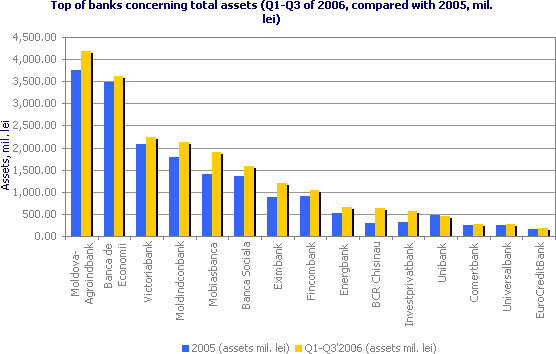
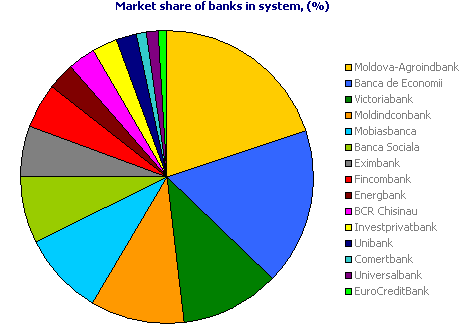
Sources: NBM, magazines Profit and Экономическое Oбозрение
Real sector
Industry is on the decline…
The industrial production declined by 7% in January-October 2006, compared with the same period of 2005, down to about 17.5 billion lei. The fall of production was particularly linked to the wine crisis, though other branches such as tobacco growing or oil making have also declined. According to official statistics, the wine industry has declined 2-fold (holding about 10% of the sector, the reduction of wine production has decreased the production per total industry by 9.2%), while the making of distilled spirits has dropped by 33% (reducing the industry per total by 1.4%).
The cigarette industry has declined by 20%, oils and fat — by 7%, paper and cardboard by 11%, glass and glass articles by 7% (the last two being in a direct correlation with wine industry). The machine and equipment manufacturing has declined by 6%. Finally, the production made by food and drink enterprises has declined by 19%. The Government has reduced the 2006 growth forecast for industry from 6.5% down to 1% after Russia had restricted the Moldovan wines, hitting seriously wine enterprises and companies working in related branches. However, certain experts doubt over this forecast, fearing that the industry will finish this year with a regress.
Situation in agriculture is also bad…
Nor the agriculture enjoys a better situation. According to the relevant ministry, the agriculture will stagnate in 2006 after an insignificant rise (1%) in the past two years. The agro-industrial production is expected to be worth approximately 14.5 billion lei (1.16 billion dollars), a value comparable with the one registered in 2005. According to forecasts, farmers will obtain an agricultural production worth about 9 billion lei, while the food industry will made goods worth 5.5 billion lei. The stagnation is seemingly linked to reduction of grape, wheat and fruit production, as well as of cattle livestock and milk production. A 3.6% rise was anticipated earlier this year. The forecasts were updated after the agro-industrial sector declined by 4% in the 1st-3rd quarters of 2006. The agro-food industry covers 28% of the GDP and deliveries of this production covers 75% of the overall Moldovan exports.
Foreign trade
Trade deficit grew due to stronger expansion of imports…
Moldovan exports to the European Union rose by 6.5% in the 1st-3rd quarters of 2006, up to about 240 million dollars. Thus, the volume of domestic goods exported to the United Kingdom rose nearly 3-fold in January-September 2006, deliveries to France grew 1.7-fold, Slovakia by 35.2%, Poland by 18%, etc. At the same time, Moldovan imports from the E.U. totalled about 560 million dollars and rose by 6% compared with the similar period of 2005.
However, Moldovan exports have declined by about 7%, down to nearly 816 million dollars, in spite of the growth registered in January-October 2006. Moldova’s foreign trade was close to 3 billion dollars, by 12.3% more than in the similar period of 2005, but the trade deficit (about 1.3 billion dollars) has grown by about 38%.
Archive
2011 2010 2009 2008 2007 2006 2005 2004 |
