ADEPT | Gagauzia 2016 | Presidential 2016 | Elections 2015 | Bashkan 2015 | Gagauzia 2012 | Political Parties
Economic Policies on December 1–16, 2007
 |
 |
e-journal #108 |
Prices and inflation
2007 inflation likely to reach 13.5–14 percent…
The Consumer Price Index or the monthly inflation rate in November was 1.3 percent. The cumulated inflation rate for 11 months was 12.1 percent. Prices of food products rose the most in November, in particular, by 1.5 percent, prices of manufactured goods increased by 1.4 percent and tariffs for public services grew by 0.8 percent. Prices of eggs have increased by more than 15 percent, of butter by approximately 5 percent, of fresh fruits by 4–5 percent and prices of grapes have advanced by 38 percent. Prices of fuels “beat” the record, as they increased by nearly 5 percent. Also, heating tariffs rose by about 6.5 percent and tariffs of drinkable water providing services increased by more than 6 percent in November.
Higher prices of certain goods, particularly of fuels, food products and public utilities were essential factors which increased the inflation in the past months. The 2007 inflation rate could be 13.5–14 percent, if prices grow in continuation in December. In addition, eventual dearer utilities will increase the inflation up to over 14 percent. The boom of the oil price on world market, dearer energy and effects of the drought will strengthen the inflation-related tensions. It will not be a drama, but it depends on evolution of prices on domestic market in 2008.
Inflation also reflects the structure of consumer basket…
A family is poor if it spends more than one third of earnings on food. Expenses for food products are very high when the consumer basket is calculated for Moldovan population. Moldovans spend about 38 percent of all earnings on food stuffs, and only 17 percent of their monthly salaries on services. The structure of these expenditures is revealed by a consumer basket calculated after a 2006 survey on households, and the inflation rate is calculated on its basis. Therefore, the structure of the consumer basket reveals that Moldovans are a poor nation.
Inflation is also present in regional context…
According to Erste Bank (Austria) analysts, the inflation suddenly grows after the disinflation process has successfully developed in Central and East Europe. This not a regional problem only, the inflation is growing at world level. The higher inflation rests with dearer food stuffs and oil, and their contribution to inflation in Central and East Europe is bigger than in West Europe. All these findings are part of an Erste Bank (Austria) research on growth of inflation in Central and East Europe.
Banking sector
Higher interests on deposits…
The net outputs on deposits in banks have grown concomitantly with the inflation. Deposits in lei for 6–12 months had higher outputs in October and November. The interests on deposits in lei have grown by more than 0.5 percent on average, compared with August 2007. The interests have grown while the inflation rate was higher than expected. Consumer prices rose by 6.7 percent in August-November. The inflation rate in late November was 12.1 percent. In fact, the deposits in lei could bring higher outputs to depositors due to the difference between interest on domestic market and in Eurozone, as well as due to appreciation of the domestic currency.
Savings in lei are recommended on long term…
Most analysts consider that the Moldovan leu continues to be the best currency for savings on long term due to the appreciation trend which could be maintained on one hand and due to higher interest rates on deposits in lei one the other hand. Therefore, specialists forecast an increasing leu on long term. But those who have savings in foreign currency or have to reimburse credits in foreign currency must keep some savings in foreign currency, in order to avoid risks or short and medium-term variations on currency market.
At the same time, credit-related costs advance…
But banks’ interest rates have increased both on deposits and on credits. Many domestic banks increased the effective costs of new loans in lei in October-November for the first time this year. Consumer credits are largest loans of banks and they count for more than 50 percent of all contracted credits. However, consumer credits are estimated as risky for population because Moldovans borrow much money to buy consumer goods on long term.
The trend of population to borrow from banks in order to buy consumer goods on long term could affect the property of population because the assets purchased this way (for example, household appliances or cars) depreciate faster than borrowers reimburse the debts. In addition, people borrow more currency from banks than save in banks.
The quality of the structure of credits contracted by population is lower than in the EU. The sensibility of population towards risky factors is pretty low, while high interests on credits increase the insolvency risk of people to reimburse the loans (the overall costs of crediting are the highest in Europe). High interests are also the result of a restrictive policy promoted by the National Bank. Moldova has the highest monetary policy interest in Europe and the largest minimum reserves imposed to banks, and this maintains high crediting costs.
Bank efficiency rating…
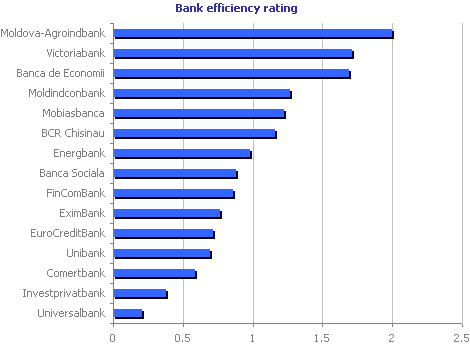
Moldova-Agroindbank (MAIB) continues to top the bank efficiency rating for nine months of this year, being rated 1.989 points (Diagram 1). Victoriabank ranks the 2nd place, being rated 1.707 points, and it defeated Banca de Economii, which has descended to the 3rd place, holding 1.680 points. The rating was worked out by the rating and estimation agency Estimator-VM on basis of five efficiency indicators (overall revenue, net income, ROE and ROS, and asset rotation). According to Estimator-VM, Moldova-Agroindbank has reported the best overall revenue and net income in the banking system, in particular, 648.7 million lei and 183.89 million lei. At the same time, Victoriabank reported the highest ROE (return on earning), which reached about 30 percent, while BCR Chisinau reported the highest ROS (return on sales) — 46.5 percent.
Diagram 1. Bank efficiency rating
Source: Rating and Estimation Agency Estimator-VM
Financial market
Domestic insurance market is underdeveloped in spite of lots of companies…
Fourteen out of 33 insurance companies which hold insurance licences have already met the new insurance law and hold a registered capital of minimum 4 million lei. Another 19 insurance companies have a registered capital below 4 million lei, of which one company has reported a registered capital of 350,000 lei. Under the new insurance law enforced in April 2007, insurance companies have to gradually increase their registered capital. Overall assets of insurance companies are estimated at about 700 million or approximately 2.5 percent of all assets of the banking sector (about 31 billion lei). In fact, their assets are lower than all assets of microfinance institutions.
At the same time, the share of insurance services in Moldova reached 1.43 percent of the GDP in 2006 and rose compared with 2005, and this indicator is estimated at approximately 2 percent for 2007. However, this indicator is lower than in underdeveloped countries, not speaking about developed countries. In particular, the share of insurance in the GDP in transition countries is around 3 percent, and this share in majority of developed states is about 6 percent of the GDP. The enforcement of the new insurance law and law on financial market will strengthen the insurance market. According to estimates including formal, approximately 22–25 out of 33 insurance companies could survive.
Public funds
Budgetary revenues are on the rise, but not welfare of population…
The state budget revenues turned over about 12.31 billion lei in 11 months of this year. Collections exceeded by 2.2 percent the planned indicators and by 25.5 percent the revenues collected in the period concerned. The basic revenues of the state budget accounted for 10.85 billion lei and rose by 28.4 percent compared with the similar period of last year. Revenues worth 163.7 million lei went to special funds, while public institutions funded from the state budget gathered about 1.04 billion lei in special funds.
Expenses worth 11.98 billion lei went from the state budget in January-November 2007, which is about 93 percent of the plan. In comparison with the same period of last year, they rose by 35.2 percent. The basic expenses of the state budget amounted to 10.24 billion lei, being used 97 percent only. In order to honour foreign loans contracted by Moldova, 53 million dollars (642.4 million lei) was operated in foreign payments accordingly to the schedule. About 380 million lei was spent for the internal state debt service.
Foreign trade
Wine exports to EU down approximately 2-fold…
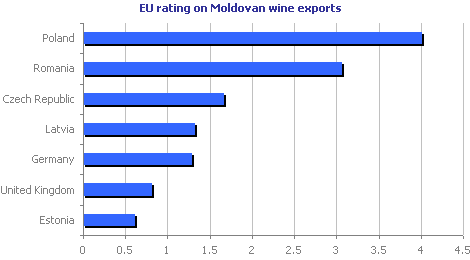
The Moldovan wine exports to the EU declined nearly two-fold in January-October 2007, down to about 14 million dollars, compared with over 27 million dollars in the same period of 2006. Moldova has exported wines to 19 EU member states in the period concerned. Poland was the main importer of Moldovan wines, and it imported wines over 4 million dollars, which is by 52 percent more than in January-October 2006. Romania and the Czech Republic ranked the 2nd and the 3rd place regarding spirits imports, in particular, 3.05 million dollars and 1.66 million dollars (Diagram 2).
However, the wine exports to Romania have decreased 5.5-fold, while wine deliveries to the Czech Republic have grown by 58 percent. Other important wine exports went to Latvia (1.32 million dollars), Germany (1.28 million dollars), the United Kingdom (0.8 billion dollars), Estonia (0.6 million dollars). All spirits exports were valued at over 99 million dollars in ten months of this year, and they decreased by over 33 percent, compared with the same period of last year (148.7 million dollars).
Diagram 2. EU rating on Moldovan wine exports
Source: State Agency Moldova-Vin
Archive
2011 2010 2009 2008 2007 2006 2005 2004 |
