ADEPT | Gagauzia 2016 | Presidential 2016 | Elections 2015 | Bashkan 2015 | Gagauzia 2012 | Political Parties
Economic Policies on February 16–29, 2008
 |
 |
e-journal #112 |
Inflation and prices
Price rise maintains high annual inflation rate…
According to official statisticsRO, the inflation rate in January 2008 was 1.5 percent. Medium consumer prices of food products have increased by 2.8 percent, of public services by 2.5 percent, while prices of manufactured goods have decreased by 0.1 percent. Prices of food products, in particular, of fruits, vegetables, and meat, and partly of dairy have grown the most. Tariffs for communal services, particularly for natural gas, electricity, as well as other public services have advanced much. However, the consumer price index does not include all rises of electricity and natural gas prices, as they were operated on January 18. Thus, the real inflation rate for January could be higher. A similar rate is estimated for February, so that the inflation rate for the first two months would be around 3 percent.
The annual inflation rate has been under the influence of autumn price rises. The long drought, dearer energy agents, leeway macroeconomic climate[1] and turbulences on international financial markets have directly influenced the inflation in the last 5 months of 2007. Prices of food products have increased by more than 6 percent in the period concerned (August-December 2007), while tariffs for services provided to population have advanced by about 10 percent. In fact, all these rises of prices and tariffs are part of the annual inflation rate afferent to January 2008.
Interesting: The annual inflation rate in Zimbabwe (Africa) reached a world record of 66212 percent (!) in 2007, hitting again the efforts of President Robert Mugabe to remedy the deep crisis faced by economy. Zimbabwe faces an extreme poverty, an 80-percent unemployment rate and a chronic reduction of food and fuel. For example, the monetary policy interest rate of the central bank of Zimbabwe is up to 1200% (it is 16 percent in Moldova).
Labour market
Salary aspects…
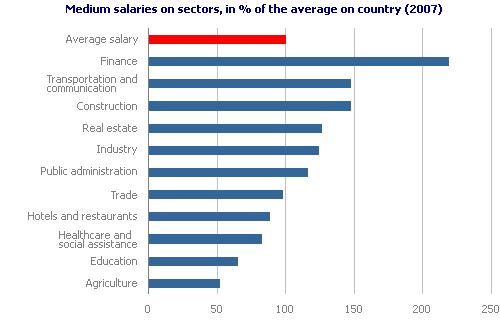
The medium salary on economy accounted for 2,266 lei in January, which is by 464 lei less than in December 2007 and by 263 lei more than the average wage for 2007. The medium salary in the budgetary sector decreased by 101 lei in January 2008, compared with December 2007, down to 1,731 lei, while the medium salary in the real sector was 2,570 lei. The highest average salary last January amounted to 5,280 lei and it was traditionally paid to employees of financial institutions, while the lowest wage was paid in agriculture — 1,035 lei, education — 1,495 lei, and the average pay in the healthcare and social assistance sectors was 1,927 lei. The average monthly salary on economy in 2007 accounted for 2,063 lei. This indicator was 1,625 lei in the budgetary sector and 2,292 lei in the real sector. The highest salary was paid in continuation in the financial sector (4,517 lei), and the lowest wage of 1,074 lei was paid in agriculture, which covers about 35 percent of the employed population. However, inflationist pressures in 2007 have affected the evolution of the real sector, which has grown by only 8 percent on average.
Diagram 1. Average salaries on sectors, % (2007)
Source: NBS
Some comments…
The internal macroeconomic instability, growth of inflation and prices, fluctuant exchange rate will have a negative impact on employees on labour market. The labour market will be more mobile and demands of workers will increase, in particular those seeking higher salaries, on background of the uncertain international economic climate which hits Moldova as well.
The relatively high turn-over faced by domestic employers, as well as the labour force migration to other countries are consequences of a “rocky” economy. In spite of a recently operated important salary rise, which will continue this year, this rise is artificial in fact. The rise of monthly earnings is uncertain because of the inflation growth, fluctuant exchange rate.
The shortage of qualified workers will be a problem in 2008, too, and building, textile sectors, hotels and restaurants, and financial-banking sector will have vacancies in continuation. At the same time, employees will face pressures in continuation, as the existing workers will be exploited at maximum because of the lack of qualified personnel and they will be more stressed and will hardly handle the professional tasks. Although the economic growth in the past years has apparently opened new jobs, the rate of persons employed after 2003 was negative; that means that the number of salary earners who withdraw from the labour market was higher than of those who joined it.
Currency
Remittances count for 1/3 of GDP in 2007…
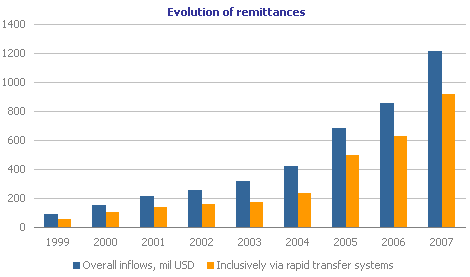
According to data of the National Bank of Moldova, remittances accounted for about 1.22 billion dollars in 2007 and increased by more than 42 percent compared with 2006. As much as 918.75 million dollars or 75.5 percent of all remittances were transferred via rapid money transfer systems.
The ceaseless rise of remittances may be a consequence of the bigger number of citizens working abroad, their legalisation and rise of remuneration. According to experts, the volume of remittances is overrated and a new methodology should be used to calculate them. The NBM calculates the remittances on basis of the volume of private money transfers via banks and international money transfer systems (Western Union, MoneyGram, etc.). But not all bank transfers are remittancesRO.
Transfers by emigrant workers in 2007 were equivalent to 1/3 of the GDP. According to recent reports, Moldova was ranked the 1st-2nd place in the world regarding the share of remittances by nationals working abroad in the GDP. Researches reveal that more than 80 percent of Moldovan emigrants send money to their families, and about 70 percent of them transfer more than half of their earnings. Remittances have fundamental implications on economic growth, balance of payments and labour market at macroeconomic level. They partly finance the trade deficit and encourage the rapid rise of salaries in certain sectors of national economy which already face a deficit of labour force.
Diagram 2. Evolution of remittances, annual rates in million dollars
Source: NBM
- ↑ The GDP increased by 3 percent only in 2007.
Archive
2011 2010 2009 2008 2007 2006 2005 2004 |
