ADEPT | Gagauzia 2016 | Presidential 2016 | Elections 2015 | Bashkan 2015 | Gagauzia 2012 | Political Parties
Economic Policies on September 16–30, 2008
 |
 |
e-journal #125 |
Inflation and prices
Inflation on the decline…
According to NBS accounts, the Consumer Price Index (CPI) rose by 0.7 percent in August 2008 compared with July 2008. The cumulated inflation rate this year is 6 percent, which is among lowest rates in the region. As a result, the annual inflation rate has decreased from the highest rate of 16.9 percent in May 2008 down to 11.7 percent in late August.
An analysis of factors which influenced consumer prices last year and their possible evolution together with other factors for the next period forecasts a further decline in annual inflation rate and gradual adjustment to the planned level. In these conditions, the National Bank of Moldova considers that there is no background now to continue tightening the monetary policy and reduced the basic interest rate from 18.5 percent down to 17 percent and the mandatory reserve rate from 22 percent down to 20.5 percent. This is a positive signal for the market, while lowering the interest rate on loans by one percentage point and encouraging the crediting would be a first effect.
Real sector
Industry up by about 3 percent in January-August…
According to NBS accounts, all industrial enterprises in Moldova made production worth more than 19.1 billion lei in current prices in January-August 2008, which is a 2.8-percent rise. The general rise of production was particularly linked to the growth of production made by food and drink industry (up by 7.5 percent) and energy industry (up by 6.7 percent), which hold 37.6 percent and 11.0 percent respectively.
At the same time, production made by the following sectors has decreased: clothes manufacturing by 11.1 percent; fruit and vegetable canning by 17.2 percent; beer making by 17.9 percent; oil and fat making by 10.2 percent; paper and cardboard manufacturing by 19.9 percent; glass manufacturing by 12.3 percent; cigarette making by 16.6 percent; concrete, gypsum and cement manufacturing by 13.2 percent.
Public funds
Government approves the 2009 budget law…
According to a governmental decision, revenues of the 2009 budget will count for about 17.735 billion lei, which is by 21 percent more than planned for this year. Expenses for next year will account for about 18.309 billion lei, by 23 percent more than this year. The state budget deficit will amount to about 574 million lei and it will be covered by revenues raised from privatisation and external credits. The draft law was built on a planned 6-percent GDP growth and a 9.5-percent inflation rate. The 2009 budget law was submitted to the Parliament for examination.
Banking sector
Banking assets will reach 65 percent of GDP…
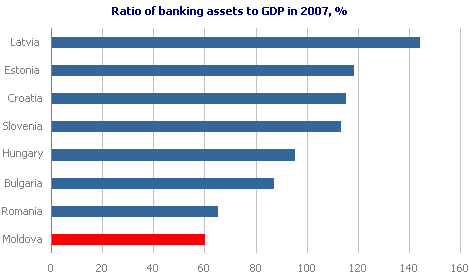
The Republic of Moldova has much to recover in order to reach the banking penetration rate (share of overall banking assets in GDP) of East European countries. Although the growth rate of banking assets is much higher than the economic development, they reached about 60 percent of GDP in 2007, compared with the average of over 70 percent on region. Leading countries in the rating had the following rates in 2007: Latvia 144.2 percent, Estonia 117.5 percent, Croatia 114.4 percent and Slovenia 113.3 percent (Diagram 1). The domestic banking is sensibly developing, as overall assets on the banking rose by about 18 percent in eight months of 2008, compared with late 2007, and by more than 28 percent compared wit August 2007.
Diagram 1 Ratio of overall banking assets in some European states, 2007
Source: Fitch IBCA
Banking assets estimated at about 3.7 billion dollars…
Assets rose by about 38 billion lei (about 3.7 billion dollars) in eight months of this year due to the growth of deposits by population and credits and financial leasing. Interest-carry savings of individuals rose by about 22 percent in six months and by nearly 45 percent compared with late August 2007. Interest-carry deposits have grown by more than 18 percent per total. Credits and (net) financial leasing went up to about 23 billion lei after a 15-percent rise in January-August 2008 and an advance of about 35 percent compared with August 2007.
The first-degree capital has grown up to 6.31 billion lei or by 20.75 percent more than earlier this year, proving in continuation the consolidation of the system and a good capacity to cover eventual financial losses. The share of foreign investments in banks’ capital rose by 1.1 percent up to about 73 percent. The average sufficiency of the risky capital on system has increased by 2.4 percent up to 31.4 percent (the minimum necessary level is 12 percent), compared with late 2007, and this proves in continuation a risk-free investment potential of banks equivalent to security of depositors.
External position of country
Fitch IBCA lowers Moldova’s rating…
The international ratings agency Fitch has descended Moldova’s rating from “positive” to “stable”, which is associated with long-term perspectives in foreign and national currencies, following the deteriorated external financing to the country and inflationist pressures. The agency also confirmed the rating “B-” for long-term credits in foreign currency and “B” for long-term credits in domestic currency. The lower ratings for long-term credits in foreign and domestic currencies prove the decline of external finances provided to Moldova and continuation of inflationist pressures.
Moldova has faced serious external shocks which hit its long-term prospect. The price of Russian natural gas exported to Moldova continued to grow this year, while Moldovan wine exports to Russia are not as large as before the 2006 and 2007 embargo. Moldova’s economy has experienced a significant impact of these shocks. The current account deficit of Moldova has grown up to nearly 18 percent of GDP. Moldova could face negative political and economic shocks due to the high trade deficit, increasing external debt, low liquidity and exposure to the trade with Russia, Fitch experts explained.
Moldova faces a serious structural deficit of the balance of payments hitting 50 percent of GDP. This deficit is partly compensated by remittances, which Fitch estimates at 20 percent of GDP in 2007. The external debt of the private sector is growing fast and rose up to 32 percent of GDP in 2007. The revenue per capita of about 1,300 dollars is low for the East European countries, though it is a little higher than the average of 1,240 dollars for countries with a rating “B”.
At the same time, several factors explain Moldova’s ratings. In particular, the country’s state debt is on ongoing decline and stood for 29 percent of GDP in 2007, which is less than the average of 33 percent for countries with a rating “B”. In 2007, Moldova did not face a serious deficit (about 1 percent), and the Government promises to ensure a balanced budget on medium term. At the same time, Fitch fears that the 2009 parliamentary elections could pressure the budget. In 2007, Moldova has become a net external creditor in terms of state debt (official reserves exceeded 1.5 billion dollars) and ensured a coverage of imports for more than three months in June 2008). The ratio between debt and revenues per capita is 68 percent and this is the lowest rate for countries with a rating “B”.
Archive
2011 2010 2009 2008 2007 2006 2005 2004 |
